
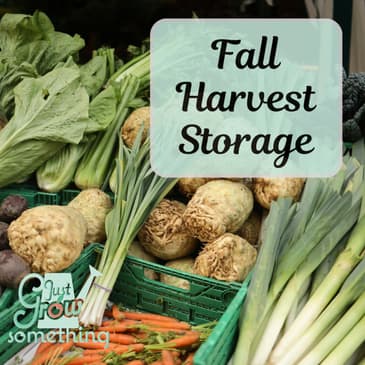
The frost has settled, most of the garden has gone to sleep, and now we’re turning our attention to what’s left — the fruits (and roots) of our labor.
I’m talking about how to store and preserve that late-season harvest, so all your hard work continues to pay off well into winter.
Today on Just Grow Something We’ll look at how long certain crops can remain in the garden, essentially in storage mode before you truly have to bring them inside, best practices for storing roots and late fall greens, and preservation options that retain nutrition and flavor.
Let’s dig in!
Resources:
Preparing to Preserve: Basic Canning Supplies for Beginners - Ep. 211: https://justgrowsomethingpodcast.com/episode/preparing-to-preserve-basic-canning-supplies-for-beginners-ep-211
Ep. 109 - Preserving, Part One: Freezing: https://justgrowsomethingpodcast.com/episode/ep-109-preserving-part-one-freezing
Ep. 110 - Preserving Basics, Part Two: Water-Bath Canning: https://justgrowsomethingpodcast.com/episode/ep-110-preserving-basics-part-two-water-bath-canning
Ep. 111 - Preserving Basics, Part Three: Pressure Canning: https://justgrowsomethingpodcast.com/episode/ep-111-preserving-basics-part-three-pressure-canning
Ep. 113 – Dehydrating, Cold Storage, and Fermenting: More Ways to Store Your Harvest: https://justgrowsomethingpodcast.com/episode/ep-113-dehydrating-cold-storage-and-fermenting-more-ways-to-store-your-harvest
Getting Started in Fermenting - Ep. 160: https://justgrowsomethingpodcast.com/episode/getting-started-in-fermenting-ep-160
National Center for Home Food Preservation: https://nchfp.uga.edu/
Get my weekly newsletter: https://justgrowsomethingpodcast.com/news
Hosted by Simplecast, an AdsWizz company. See pcm.adswizz.com for information about our collection and use of personal data for advertising.
00:00:00
So we are just about to the midpoint of November.
00:00:03
For most of us, the frost has started to settle in regularly
00:00:07
in the garden. Most of the garden has gone to
00:00:09
sleep and now we are turning our attention to what's left, which
00:00:13
is the fruits and the roots of our labor.
00:00:16
I'm talking about how to store and preserve that late season
00:00:20
harvest so that all of our hard work continues to pay off for us
00:00:24
well into winter. Today I'm just grow something.
00:00:27
We're going to look at how long certain crops can remain in the
00:00:31
garden essentially in storage mode before you truly have to
00:00:36
bring them inside. Best practices for storing your
00:00:39
roots and your late fall greens, and then some preservation
00:00:42
options that are going to retain the nutrition and the flavor.
00:00:46
If you really don't have enough room in the fridge or in a
00:00:50
basement to store a lot of these things, let's dig in.
00:00:53
Hey, I'm Karen and what started as a small backyard garden 20
00:00:57
years ago turned into a lifelong passion for growing food.
00:01:00
Now as a market farmer and horticulturist, I want to help
00:01:03
you do the same. On this podcast I am your friend
00:01:06
in the garden, teaching evidence based techniques to help you
00:01:09
grow your favourites and build confidence in your own garden
00:01:12
space. So grab your.
00:01:13
Garden journal and a cup of coffee and get ready to just
00:01:16
grow something. So honestly, it's kind of sad to
00:01:23
say, but food waste is actually sort of a hidden garden problem.
00:01:28
Like after all of that hard work, nothing hurts more than
00:01:34
going into, you know, your storage and pulling out a mushy
00:01:39
carrot or a moldy onion. So we really want to make sure
00:01:42
that we are preparing ourselves appropriately for the proper
00:01:45
storage because that's going to extend the shelf life.
00:01:48
It's going to reduce that waste. And it gives us access to our
00:01:53
own homegrown produce even when there's like a foot of snow
00:01:56
outside in the middle of the winter time, right?
00:01:59
The cool thing about a lot of our late fall stuff is that
00:02:04
things can actually be stored out in the garden.
00:02:08
And I'm using the term stored loosely, but the reason I say
00:02:10
stored is because a lot of these things aren't going to be
00:02:14
actively growing while they're sitting out there.
00:02:17
After a certain time in the season, as a day length begins
00:02:21
to decrease, that means the growth of our plants also starts
00:02:25
to decrease. And at some point, they
00:02:27
basically just kind of sit into a sort of stasis, right?
00:02:31
And so especially once we get down below what we call that
00:02:33
Persephone period was, which is where the day length is shorter
00:02:37
than 10 hours per day, nothing's really growing or it's growing
00:02:41
at a very minuscule rate. So one of the benefits is we can
00:02:45
get a lot of these crops to their mature size and leave them
00:02:50
in the garden to be able to harvest off of them for an
00:02:54
extended period of time. Now, depending on where you
00:02:56
live, there are certain things that do really well with this.
00:03:00
If you're in really, really cold zones, zones, oftentimes you're
00:03:04
very limited on the things that you can do this with and you
00:03:06
really have to do a lot of row covers and, and plastics.
00:03:10
And so it's not really worth it to you at that point.
00:03:12
It's better just to bring it in. But if you're in a more moderate
00:03:15
climate, there are a lot of things that you can keep out
00:03:17
there. Hardy greens specifically.
00:03:20
So kale and spinach and collards, they don't mind being
00:03:24
out there after a frost or multiple frosts.
00:03:28
I have overwintered kale and spinach very successfully out in
00:03:33
the gardens with very minimal row cover.
00:03:36
One simple frost cloth is really all it took, and I was able to
00:03:40
go out there and harvest off of those plants all winter long.
00:03:45
And then in the spring, those plants immediately bounced back
00:03:48
with their growth and I had an early spring harvest of those
00:03:51
grains. So that was fantastic.
00:03:54
But there are other leafy greens that maybe could use a little
00:03:57
bit extra protection and they still will continue to survive
00:04:00
for a little while. So lettuce or arugula and Shard
00:04:04
can absolutely continue going, especially if you're in an area
00:04:09
where the frosts are very infrequent early in the season.
00:04:12
That's kind of where we are in West Central Missouri.
00:04:17
As we've gotten a little bit warmer over the seasons, our
00:04:20
frosts have showed up a little bit later.
00:04:24
Our normal first frost date in the fall used to be right around
00:04:27
the 15th or 20th of October, and now this year I didn't
00:04:31
experience the first frost in my garden until Halloween.
00:04:35
It was overnight October 31st into November 1st.
00:04:39
Then before I saw my first frost, which is absolutely
00:04:42
unheard of, and then immediately later that that same week, it
00:04:47
bumped up to 70° during the week and it was fully sunny.
00:04:51
And so we're not seeing a bunch of frosts right now.
00:04:53
So it's super easy for those plants to be able to be out in
00:04:58
that environment with just very light cover and then be
00:05:01
uncovered for a while. And then just me keep an eye out
00:05:04
for when the next frost might hit.
00:05:06
If you're in an area that's even warmer than I am, then often
00:05:09
times you don't even have to worry about covers at all with
00:05:12
some of these things until you really start to get into, you
00:05:15
know, the, the, the heaviest or the coldest part of winter other
00:05:19
than greens. We also have root crops that can
00:05:24
be stored in the ground until that ground begins to freeze
00:05:29
solid. So again, if you are in one of
00:05:32
the colder zones further north in the northern hemisphere, then
00:05:36
you might be pulling these crops earlier than what I would be.
00:05:40
But it still means that these are the last things that you
00:05:43
necessarily need to harvest. And you can extend that a little
00:05:47
bit by adding those layers, years of heavy mulch.
00:05:51
So straw mulch is great for things like beets and carrots
00:05:55
and turnips and parsnips to keep that soil just warm enough where
00:06:01
you still have the ability to be able to dig in there and harvest
00:06:04
those things as needed. And then once you get down to an
00:06:09
area like mine, you know, our ground doesn't really start to
00:06:12
freeze solid until like sometime in December, maybe late
00:06:18
December. And so I can honestly keep those
00:06:20
crops out there in the garden as long as the garden soil is
00:06:24
fairly loose. Like, you know, if you have
00:06:27
very, very tight soil, this isn't going to work as well.
00:06:30
But because we have, you know, amended our soil really well,
00:06:32
and also because I'm growing it a lot in the raised beds, the
00:06:36
soil is loose enough to be able to do this.
00:06:39
The one thing that you do have to worry about is if you are in
00:06:42
raised beds, knowing that the volume of soil that's in those
00:06:45
beds is obviously less than what it is in the ground.
00:06:48
Duh. But it's, it means it's going to
00:06:50
freeze earlier than what the soil in your in ground gardens
00:06:56
is going to. So that is something that you
00:06:57
have to pay attention to, OK, how early is that soil freezing?
00:07:01
But in most instances, again, as long as you've got some
00:07:03
insulation, these things can be held in the ground until it
00:07:07
begins to freeze solid. And you can extend that by using
00:07:11
heavy straw mulch. Essentially, you have a garden
00:07:14
refrigerator. OK, So then once we get to the
00:07:17
stage where these things absolutely need to be harvested
00:07:22
or if they're things that you have harvested earlier in the
00:07:24
season, what types of conditions do we need in order to be able
00:07:28
to keep these going without that, you know, feeling of
00:07:32
disappointment of going into your root cellar or your
00:07:35
basement or whatever and grabbing a potato that has gone
00:07:37
to mush, right? Most root crops like conditions
00:07:43
that are going to mimic a root cellar.
00:07:44
So we want something that's around 32 to 40°F, OK, and
00:07:49
higher humidity. So this is for things like
00:07:52
carrots and beets and turnips, like they like like a 95%
00:07:58
humidity level. Potatoes also like this
00:08:01
temperature and this this humidity as well.
00:08:05
If we're looking at onions and garlic and like our winter
00:08:08
squashes, we want warmer temperatures, but we want lower
00:08:13
humidity. So the temperatures could go,
00:08:15
you know, as much as 60°F, but that humidity should be around
00:08:19
65%. OK.
00:08:21
So we kind of have these two different categories of how we
00:08:26
need to store things. So, you know, carrots and beets
00:08:29
and parsnips and turnips, they all do well in like damp sand or
00:08:36
in sawdust in a box or in a bucket.
00:08:39
Your potatoes, again, they're also going to like that, you
00:08:43
know, that temperature around 40° or so and that high humidity
00:08:46
like the root vegetables. But they prefer to be in
00:08:48
something like a paper bag or a burlap bag or even a, a paper
00:08:52
box in a, in a cool, you know, dark place that is for regular
00:08:57
potatoes. Sweet potatoes, however, do not
00:08:59
like that same temperature. As a matter of fact, you get
00:09:02
much below 60°F and you're going to start to see some damage on
00:09:05
your sweet potatoes. They're also not going to store
00:09:07
as long for you. So sweet potatoes are more like
00:09:10
the 55 to 60°F range with about 60 to 75% humidity.
00:09:16
This is also the same temperatures and humidity range
00:09:18
that you're looking for, for like your winter squashes and
00:09:22
even your, your onions and your garlic.
00:09:25
So again, two sort of separate categories for how to store
00:09:29
these things. You know, onions, ideally they
00:09:33
like that cool environment between 40 and 60 Fahrenheit.
00:09:37
So cool but not cold, OK. This temperature range is going
00:09:41
to keep them fresher and longer. It also prevents the sprouting
00:09:43
and the rotting that that humidity is crucial for onion
00:09:48
storage. It's going to prevent them from
00:09:50
drying out, but it's also not so high that it's going to cause
00:09:55
them to mold and and get rotten. Proper air flow is also pretty
00:10:01
important here, especially for onions.
00:10:02
You kind of want them to be in mesh bags or baskets or open
00:10:06
crates because you want to allow that air circulation.
00:10:08
That's going to keep them dry and it's going to keep them
00:10:10
fresh. This is not something that we
00:10:12
want to put in a plastic bag because that's going to trap the
00:10:14
moisture. Your carrots and your beets and
00:10:17
those things would actually appreciate a plastic bag if you
00:10:21
don't have them in sand in order to help trap that humidity.
00:10:24
OK Onions also should be kept in a very dark place.
00:10:28
We don't want them to sprout. Exposure to light can trigger
00:10:31
that sprouting process. And of course, that reduces
00:10:34
their shelf life. So we want to eat these, not
00:10:36
grow these. If you don't have a cellar, you
00:10:40
can use a basement, you can use a garage.
00:10:42
You can even use a cooler like if you have extra coolers as you
00:10:45
can throw, you know, into a corner somewhere, you know, in a
00:10:50
basement or in a garage or whatever that's going to keep
00:10:52
things colder then great, use those.
00:10:55
But we do want to keep in mind, again, we kind of have these two
00:10:58
categories. We don't want to store onions
00:11:02
and potatoes together. OK, This is going to lead to
00:11:06
faster spoilage for both of them.
00:11:09
And there is some science behind this.
00:11:12
Onions naturally emit ethylene gas, and ethylene is that plant
00:11:19
hormone that promotes ripening in a lot of our fruits and our
00:11:22
vegetables. So when we have our potatoes
00:11:25
near our onions, that gas is going to cause the potatoes to
00:11:30
sprout and it's also going to cause them to soften more
00:11:33
quickly. And that is going to lead to
00:11:35
spoilage. On the flip side of this,
00:11:37
potatoes have a really high moisture content and they
00:11:41
release moisture as they sit. And we just said that we want to
00:11:45
keep our onions dry because this moisture could actually cause
00:11:48
those onions to become moldy or mushy and that reduces their
00:11:52
shelf life. So the combination of the
00:11:54
ethylene gas from the onions and the moisture from the potatoes
00:11:57
just creates an environment that is not good for anybody in that
00:12:00
situation. So all the more reason for us to
00:12:03
basically have two separate sort of storage, I don't know,
00:12:09
approaches and two separate storage areas for the things
00:12:13
that like the cool, dark, but very humid conditions versus the
00:12:19
ones that like it a little bit warmer.
00:12:22
So I would say, let's over here we've got cold, not even cool
00:12:25
cool. I would consider 35°, you know,
00:12:27
Fahrenheit to be cold. So 35 to 40 or even down to 32
00:12:31
is cold, right? So cold and dark and high
00:12:34
humidity versus cool and dark with a more humidity.
00:12:39
And no matter what, we definitely want that airflow for
00:12:41
everybody involved. OK, So what about for those
00:12:45
greens that we were talking about, you know, the kale, the
00:12:48
collards, the spinach, the things that, you know, maybe can
00:12:51
stay outside for an extended period of time, but at some
00:12:54
point, depending on your climate, do need to come in to
00:12:57
be stored. I really do like to harvest
00:13:00
these things after they have been hit by a frost because they
00:13:03
taste better. You know, it's something about
00:13:06
the frost that induces a much stronger, almost sweeter flavor
00:13:11
in these greens. And so I like to wait at least
00:13:14
until after we've had a good couple of frost before I harvest
00:13:17
them, clip off the rest of whatever it is that you need to
00:13:20
bring in. You want to store them unwashed
00:13:25
in a perforated bag in your refrigerator.
00:13:28
They're going to hold for a longer period of time if you can
00:13:31
put them unwashed because you're not introducing additional
00:13:34
moisture that they don't need, which is also going to introduce
00:13:37
the possibility of them just getting yucky and funky.
00:13:40
So if you can make sure they're nice and dry before you put them
00:13:43
in the perforated bag in the fridge and then take them out
00:13:46
and wash them as needed until you have used them all up or
00:13:51
until you start to hit like that two week period because then
00:13:54
they don't send to to store as well.
00:13:58
So we're extending the life of these greens by basically
00:14:02
letting them stay out in the garden as long as they possibly
00:14:05
can until we have no choice but to bring them in.
00:14:08
Then we're going to bring them in and we're going to store them
00:14:10
unwashed for up to two weeks. If you see that you have more
00:14:15
than what you could possibly use in two weeks, then we have some
00:14:20
other options. Blanching and freezing is
00:14:23
probably one of the best ways that you can do this for these
00:14:27
particular greens because they hold up.
00:14:30
Now, I am not a huge fan of frozen greens.
00:14:34
It's just not my thing. Some people have no problem with
00:14:37
it. Some people really like frozen
00:14:38
greens. That's fine.
00:14:40
If you like frozen spinach, then by all means blanch it and
00:14:43
freeze it. It's one of the easiest ways
00:14:45
that you can preserve things. One of my more favorite methods
00:14:50
here recently is to do some fermenting.
00:14:53
So we're making sauerkraut, we're making kimchi, we're
00:14:56
pickling some of these things, right?
00:14:58
It's adding probiotics. It has a better flavor to it and
00:15:02
to me, the texture is better. So when it comes to, you know,
00:15:08
just our greens, that's another way that you can do it.
00:15:10
Obviously you can do some canning.
00:15:12
We're not going to go into canning in this episode, but you
00:15:14
can also can up some of these these greens if you like that
00:15:17
texture. Once again, I do not.
00:15:20
So this is not something that I do.
00:15:22
But if I find that I have a ton of these greens and I've already
00:15:27
saved what I could in terms of, you know, fermenting, the other
00:15:31
thing that I have been known to do is to dehydrate these greens
00:15:35
and crush them down into a powder.
00:15:38
So again, it kind of goes with that whole garden waste thing,
00:15:42
food waste thing of things coming out of the garden.
00:15:44
I spent all this time growing these things.
00:15:46
I don't want it to go to waste. I still want to give those
00:15:50
nutrients the opportunity to be able to do something for us
00:15:53
throughout the winter time. Especially in the winter time,
00:15:55
we don't have as much access to the really fresh things.
00:15:59
And So what I found is if I can dehydrate these things at a
00:16:02
lower temperature where it is preserving the nutrient content
00:16:07
and I'm just grinding them up into a powder, I can add that
00:16:11
powder to my smoothies. I can toss it into soups or into
00:16:15
stews or into sauces. It's adding flavor for sure.
00:16:19
You are getting the flavor coming through, but then it's
00:16:22
also adding those nutrients too. So some of my favorite
00:16:25
combinations have been spinach and kale and beet greens.
00:16:29
If you like the flavor of beets, the beet greens carry that same
00:16:33
earthiness. I know if you're not a fan of
00:16:35
beets, you're going to say it tastes like dirt, and I get
00:16:38
that. OK, then you don't have to
00:16:39
include the beet greens. But you know, if you can grind
00:16:43
these things up into a powder and just keep them stored in a
00:16:46
Mason jar and you can add it to your stuff, I'm telling you it's
00:16:49
a great way to get the nutrition and also feel like you didn't
00:16:52
waste the stuff that was coming out of your garden.
00:16:54
And if we're talking about things other than the greens,
00:16:59
you know, there are other things you can also ferment.
00:17:01
You know, you can ferment the the Pickles that are, are the
00:17:04
Pickles. You can ferment the radishes.
00:17:06
You can pickle those in a ferment as they're coming out of
00:17:09
the garden. You can do this with turnips and
00:17:12
you know, other root vegetables, again, really, really great for
00:17:16
your gut. These can all also be dehydrated
00:17:19
too. Whether you choose to dehydrate
00:17:22
them and then use them sort of like in soups and stews or you
00:17:26
want to rehydrate them and use them in other ways, then that's
00:17:29
great too. I would just always say, you
00:17:31
know, if you're new to any of these types of preserving
00:17:34
methods, and I will go back and I will go ahead and link in the
00:17:37
show notes all of the different episodes that we have done on
00:17:41
preservation of your food. And always use tested recipes
00:17:45
and guidelines from either the USDA or the Bald Blue Book of
00:17:49
canning, any of your University Extension Service resources.
00:17:55
These have all been tested for safety.
00:17:56
So don't go Willy nilly and start, you know, doing some
00:17:59
crazy things with the fermenting or with the, you know,
00:18:02
dehydrating and stuff until you have an idea of what it is that
00:18:05
you're doing and you are using a trusted source to teach you how
00:18:09
to do these things. And then a final note about
00:18:15
storage is just to make sure that you are checking your
00:18:18
stored crops pretty frequently. I mean, I would almost recommend
00:18:22
doing it weekly because when things do start to go South,
00:18:26
they can go South really fast. And unfortunately, when you have
00:18:30
one that starts to go bad, it can sort of spread that to the
00:18:34
other ones that are in that same container or box.
00:18:36
And it can really wreak havoc through everything that you've
00:18:40
stored at that point. So make sure that you're
00:18:43
removing any anything that is soft or that's sprouting or
00:18:46
that's got any mole or anything to it.
00:18:48
Once again, ventilation is key here.
00:18:52
So we get that airflow going. We make sure that you know, if
00:18:56
there is anything that is, you know, giving off that ethylene
00:18:59
gas that is kind of clearing it out too.
00:19:02
So it's not promoting over ripening of the other things.
00:19:05
So I just say, you know, a well stored harvest really is a
00:19:11
reminder that gardening isn't just about the actual growing of
00:19:16
the thing. Yes, that's what we put all of
00:19:17
our energy to into. But like the end result is the
00:19:21
stuff that we're eating, right? And so as we're pulling stuff
00:19:25
from like our pantry or from our freezer or out of our jars and
00:19:29
stuff, we get to take a minute to kind of celebrate what it is
00:19:32
that we grew. And sometimes that's a bit
00:19:35
overwhelming. In the summertime.
00:19:36
We have so much stuff coming in and, you know, we're going from
00:19:40
one activity to another and we're trying to preserve things.
00:19:43
It's in the preservation and the using of those preserved things
00:19:47
that I feel like we really get a chance to kind of savor and
00:19:50
appreciate the work that we put into things throughout the rest
00:19:54
of the gardening season. And I don't know, that's a
00:19:56
little bit of motivation for me to make sure that I do it again
00:19:59
come springtime. Until next time, my gardening
00:20:02
friends, keep on cultivating that dream garden, and we'll
00:20:04
talk again soon.