
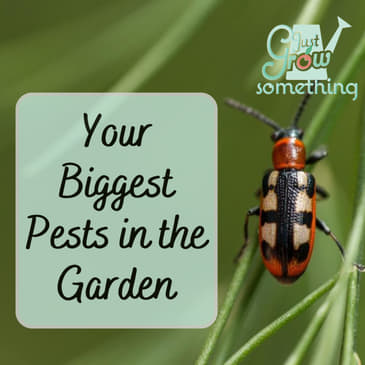
I had such a fantastic response to the March Question of the Month and we had such great conversations on Facebook and Instagram that I made this week’s entire episode all about! You came in clutch with problems and solutions and there was plenty of community discussion, which is what I love. Gardeners helping gardeners.
We all have a lot of pests and some very clever ways to deal with them. And not all of them are insects. So, today on Just Grow Something we are talking all about your biggest pests in the garden. Let’s dig in!
April Question of the Month: What have you struggled with the most in terms of garden maintenance and did you find a solution?
References and Resources:
Just Grow Something Merch Shop
Just Grow Something Gardening Friends Facebook Group
Check out how you can become a patron on Patreon
--- Send in a voice message: https://podcasters.spotify.com/pod/show/justgrowsomething/message

[00:00:00] I had such a fantastic response to the March question of the month and we had such great conversations on Facebook and Instagram that I made this week's entire episode all about it.
[00:00:12] You came in clutch with problems and solutions and there was plenty of community discussion which is what I absolutely love, gardeners helping gardeners.
[00:00:21] We all have a lot of pests and some very clever ways to deal with them and not all of them are insects.
[00:00:28] So today on Just Grow Something we are talking all about your biggest pests in the garden.
[00:00:33] Let's dig in.
[00:00:35] Hey, I'm Karin.
[00:00:36] I started gardening in a small corner of my suburban backyard and now 18 years later I've got a degree in horticulture and operate a 40 acre market farm.
[00:00:43] I believe there is power in food and that everyone should know how to grow at least a little bit of their own.
[00:00:49] On this podcast I share evidence based techniques to help you plant, grow, harvest and store all your family's favorites.
[00:00:56] Consider me your friend in the garden.
[00:00:58] So grab your garden journal and a cup of coffee and get ready to just grow something.
[00:01:03] This episode is brought to you by Paramount Plus.
[00:01:16] You and McGregor stars as Count Alexander Rustoff in a gentleman in Moscow, the new limited series based on the best selling novel.
[00:01:24] Let's stream it with a Paramount Plus with Showtime plan.
[00:01:27] Visit ParamountPlus.com to try it free.
[00:01:33] So the March question of the month was, what is your biggest pest in the garden and how do you manage it if at all?
[00:01:41] I got a ton of answers from the Facebook group directly from the Spotify app through email and from Instagram.
[00:01:48] In no particular order, let's dig into those responses.
[00:01:53] Ashley Coates responded on Spotify with, I struggle with cucumber beetles and the bacterial wilt they bring to my curcubits.
[00:02:02] H19 Little Leaf and County Fair both seemed to deal with the disease better than the other varieties I've grown.
[00:02:11] I love that Ashley has found a solution in just changing up the varieties.
[00:02:17] This is an important point to make. Sometimes just changing the variety, looking for a hybrid that has been grown specifically to be resilient to your particular pest or the disease that it causes really is sometimes the only way to effectively deal with them especially if you're trying to avoid insecticides.
[00:02:37] At Amy Sandwell replied on Instagram, cucumber beetle and not well with regards to how she dealt with them. Amy I feel you, I have tried a lot of different ways over the years to battle these and I still end up with bacterial wilt at some point in the season.
[00:02:54] I have resorted to making sure that I'm doing succession plantings in addition to using insect netting and trap crops.
[00:03:03] So maybe the varieties Ashley mentioned may be some help for you here and you are not alone in this at our WISCO homestead also replied on Instagram, cucumber beetles.
[00:03:15] Trapp crops and sprays because those things are the worst trap crops. Yes, what Meg is referring to here is growing something the cucumber beetles like better than your cucumbers.
[00:03:29] So trap crops are essentially just decoy plants. They're sacrificial plants that you plant a few feet away from the plant that you want to harvest.
[00:03:38] The idea is that you planted a little bit earlier than your intended crop and you leave it uncovered so the insects are attracted to it.
[00:03:48] In the meantime, you plant your cash crop inside the garden and you cover it up.
[00:03:53] The insects are so busy with the one that you planted along the outer edge because it's more mature and it's easier to get to.
[00:04:01] You can use whatever spray or removal method that you choose to get rid of them before your main crop matures.
[00:04:08] This works really well with all kinds of insects and all kinds of crops.
[00:04:13] Blue Hubbard squash and red curry squash for example are two that I have used for both cucumber beetles and squash bugs.
[00:04:21] Amaranth is another one that cucumber beetles are attracted to. Heck, even just an earlier maturing variety of the cucumbers or whatever it is that you're growing that you're trying to protect can be used to trap and remove the unwanted pests.
[00:04:36] It's all about timing and making that trap crop be the more attractive one.
[00:04:44] Amy Fagan responded via email with my biggest garden pests are the striped cucumber beetle and the squash bugs.
[00:04:52] How ideal? I don't expect a lot when I plant. I haven't been successful at beating them yet.
[00:04:59] So maybe Amy you can try the cucumber varieties that Ashley mentioned and see if that works better for you.
[00:05:06] I can say I have used first Saturday lime as a deterrent in the early part of the season by spreading it across the entire plant.
[00:05:15] The cucumber beetles don't seem to like the texture of the lime so I just watch them land and then they sort of bounce back up again very quickly.
[00:05:24] The problem is that later on there are just too many vines and too many surfaces to cover so the cucumber beetles end up getting in and doing their thing anyway.
[00:05:33] Amy by the way is from the grounded in Maine podcast. It's a show all about the world of sustainability so a little shout out for her show there.
[00:05:41] And as far as squash bugs are concerned, Amy you are not alone in that problem.
[00:05:46] Nazarine Azari said in the Facebook group squash bugs. I sprinkled diatomaceous earth around my plants and went out with duct tape every day I could to pick the eggs off my leaves.
[00:05:59] They were so bad for about two weeks but with consistent focus, I was able to get them under control and did not lose too many plants. However it was a huge effort.
[00:06:10] I also had some kind of pest that was all over my pole beans and something that greatly shortened my cucumber plants life.
[00:06:18] But I didn't figure out what these were or have time to do anything about them.
[00:06:23] Last year was my first with a pretty big garden, 2000-ish square feet. And I was trying so many new things it was hard to keep up.
[00:06:31] But I did have some amazing successes and so much produce even plenty of squashes and melons despite the squash bugs.
[00:06:40] First of all, congratulations. That's a huge garden.
[00:06:43] This approach to squash bugs is probably the most common that I've seen and yes it is very labor intensive.
[00:06:51] Diatomaceous earth or DE for short is made up of the fossilized remains of these tiny aquatic organisms called diatoms.
[00:07:01] Their skeletons are made up of silica, which has sharp irregular edges when you look at them at a microscopic level.
[00:07:08] So DE works on insects with exoskeletons because those little sharp edges cut at those hard shell insect exteriors subsequently drying the insect out and causing its demise.
[00:07:22] Squash bugs over winter as adults and they have that exoskeleton. They immediately start breeding in the spring and start laying eggs which hatch very quickly.
[00:07:34] So from the very first in-star of those nymphs that hatch, they have a hard coating.
[00:07:40] So this is likely how the DE is doing its job on the juveniles and the adults.
[00:07:46] The hand picking and the egg removal is so key to this approach but also so is keeping the DE intact.
[00:07:56] The problem with diatomaceous earth is that it is water soluble which means when you water or it rains, you're going to have to reapply it.
[00:08:05] And as it's disturbed by the insects, you're going to have to reapply it.
[00:08:09] You have to stay on top of both the application and the egg picking on a daily basis in order to really make a difference early on.
[00:08:18] And it is absolutely labor intensive but obviously it is well worth it.
[00:08:23] Nazrin, it sounds like you did exactly what you needed to and this approach may help other gardeners here who face squash bugs including me.
[00:08:31] In terms of the size of your garden, it's no wonder you didn't figure out the pest in your beans and your cucumbers. You had a lot going on.
[00:08:37] I would definitely start a garden journal and document what happened with your squash bugs last year so then you can focus on what's in your beans and your cucumbers this year.
[00:08:47] My sneaky suspicion is it likely is cucumber beetles because they thrive in the same areas squash bugs do and you may have had grasshoppers in the beans which is what I experienced last year too.
[00:09:00] Speaking of grasshoppers, Billy Bucking also replied in the Facebook group to say my biggest pest two years in a row we have had terrible amounts of grasshoppers.
[00:09:11] I mean they eat everything including the trees cannot walk through the yard without a wave of grasshoppers.
[00:09:18] Partway through the year, I let some ducks free range. They got the grasshopper population under control.
[00:09:25] Then when they started eating the garden, they got locked up in their run.
[00:09:30] I love ducks for insect control and weed control. I have no ducks at the moment and I am missing them but my chickens will be ranging in one of my garden areas for this exact reason.
[00:09:43] Ducks are less destructive on the garden until they run out of all the fun things to eat like the grasshoppers and the grubs and the weeds, but then it's a free for all.
[00:09:52] Chickens will do the job too but they aren't as discriminating between insects and produce so ducks are definitely the preferred way to go and you could also do this with geese.
[00:10:03] Grasshoppers can be very destructive especially in the numbers that you're talking about.
[00:10:10] In the garden areas where I don't have chickens to help control the insect population, I tend to cover everything with insect netting right from the start to exclude them right away.
[00:10:21] This works for squash bugs and cucumber beetles too and also the deer that like to eat everything in the early spring.
[00:10:28] Of course, if it's something that requires pollination, I eventually have to remove that cover which exposes the plants to predation at that point but for most of the pests we're talking about today,
[00:10:40] we absolutely need to use a multi-pronged approach and ducks can certainly be one of those.
[00:10:48] At EGF Brahmamama replied on Instagram to say squash vine boars and grasshoppers.
[00:10:56] Yes, just like at least I have also had to deal with the squash vine borer.
[00:11:01] You would hope that maybe some of the techniques that we use for the squash bug would apply here too.
[00:11:07] Unfortunately, diatamaceous earth or DE is not effective for killing the squash vine borer larvae.
[00:11:15] They are soft-bodied unlike the squash bugs that have that exoskeleton so the reaction to DE just isn't the same.
[00:11:23] However, it may deter the adult vine borer mobs from laying their eggs.
[00:11:31] The recommendation here is to sprinkle diatamaceous earth around and on the stalks when the squash vines are small and the threat of the squash vine borers is high.
[00:11:42] This is usually in the early to mid-summer.
[00:11:45] I have done this with first Saturday lime with some success and that means reapplying it less often than DE because that lime is water insoluble and so I don't have to reapply it after a rain.
[00:11:59] If you are okay with using some organic sprays, spraying the lower parts of the plant's stem and the base of the plant with some pyrethrends when those adults are outflying and actively laying is an option.
[00:12:15] So sometime around mid to late May.
[00:12:18] The pyrethrends are a class of organic compounds that are normally derived from chrysanthemums and so they act as insecticide by targeting the nervous system of the insects but they are non-discriminatory.
[00:12:32] So that means that you're affecting any insect that comes in contact with it, so be aware of that.
[00:12:39] And you'll also need to do this a second time around two weeks later.
[00:12:43] I've also seen people injecting BT, bacillus theriangences which is a naturally occurring soil bacteria or injecting a specific beneficial nematode into the wound in the plant stem to kill the borer larvae.
[00:12:57] Obviously they've already done some damage at that point.
[00:13:00] The success rate on this is kind of hit or miss depending on your technique and how well you do with it.
[00:13:06] You can also try trap crops for the squash vine borer too.
[00:13:11] Last year I kept all of my squash plants covered for as long as I possibly could to just her all love the squash pests.
[00:13:20] But again needed to uncover them for pollination so I always plan on planting a second or even third round of plants to get what I need to out of my garden in terms of squash.
[00:13:33] One other technique for this also specifically for the vine borers is to delay your planting until later on in the season.
[00:13:41] So if in your area you have tracked or you have found university resource that tells you that the squash vine borer in your area is done flying around by the end of June or the beginning of July,
[00:13:54] then you can wait to plant your zucchinis or your squashes until after the vine borer is no longer laying eggs.
[00:14:02] And so at least you've sort of cut that component out and then you just have to worry about the squash bugs.
[00:14:08] Me Elise replied in the Facebook group, hands down cabbage moths.
[00:14:14] They were so bad my dog was chasing and eating them.
[00:14:20] I laugh because I've been there. I mean maybe not the extra protein for the dog but definitely hordes of cabbage moths.
[00:14:28] My solution has been and will remain twofold.
[00:14:33] Interplanting onions among my brassicas and sweet elism at the bases of those plants both to help confuse the chemical signals that the brassicas give off
[00:14:44] and to immediately cover those brassicas with insect netting when I plant them.
[00:14:49] Since they don't require pollination cabbage broccoli cauliflower kale and all the other brassicas can stay covered the entire growing cycle until it's time to harvest.
[00:15:00] The key is to make sure that the netting is tightened securely to the ground because you can stand there and watch those cabbage butterflies bounce all along the netting,
[00:15:12] looking for a spot to get in so be sure that it's tight.
[00:15:15] I use landscape fabric staples to fasten the netting like down into the soil and then I push the soil up over the edges of the netting to bury it in sort of lock it in place.
[00:15:26] And I said butterflies because cabbage moths and cabbage butterflies are actually two different insects that can both damage our brassica plants.
[00:15:38] Cabbage moths are actually nocturnal so they're small brown moths that produce cabbage loopers which are green caterpillars.
[00:15:47] Cabbage butterflies are the white butterflies with the black dots on their wings that we see out during the day.
[00:15:54] Those produce cabbage worms which are also green caterpillars.
[00:15:58] Either way, they're both anusense and they can both be repelled with some interplanting and some insect netting.
[00:16:05] At HA Goesh said on Instagram, cabbage moth caterpillars and they were controlled with basic diligence and hand picking.
[00:16:15] The chickens adore me for it.
[00:16:17] Heather has the right idea here. Hand picking caterpillars and worms and feeding them to the chickens is a great treat for them and it helps protect your plants.
[00:16:25] If you're not fortunate enough to have critters that you can feed the worms too then just drown them in a container of soapy water as you pick them off
[00:16:33] and then just dispose of them accordingly.
[00:16:35] Merr Brown replied in the Facebook group, last year was my first gardening experience and it was overall awesome.
[00:16:43] However, my two biggest concerns were squash bugs and hornworms.
[00:16:48] I had a very small garden so my son and I went out every morning and picked them off by hand.
[00:16:55] However, this season I'm going from about 20 square foot to well over 90 square foot and I'm not sure what else I can do to be preventative or helpful.
[00:17:05] Hornworms are another one ripe for hand picking. They're actually easier to see after dark if you have a flashlight with a black light in it because they glow.
[00:17:16] Which makes them much easier to see than when they're camouflaged green on green during the day.
[00:17:23] Hornworms, this is another place where trap crops can help.
[00:17:27] Loved is a good one to plant in between your tomato plants the hornworms tend to be drawn to that herb rather than the tomato plants and so you can get them picked before they do damage to the tomatoes.
[00:17:39] Dill is another one that's good for this and the bonus with Dill is it attracts beneficial insects too.
[00:17:46] I have also noticed that eggplant is very attractive to tomato hornworms so if you're not growing eggplant to eat, you might plant that as a trap crop a few feet away from where your tomatoes are and hope that they're attracted to them instead.
[00:18:00] And be aware that any weeds that are in the Solanaceae family like black night shade is going to draw those hornworms in since they are an alternative host for them.
[00:18:12] So be sure to pull those weeds as you see them out of the garden.
[00:18:16] Congratulations Mara on extending your garden. I am excited to see what you do and hopefully some of these tips today will help cut down on the insect pests that you have to deal with.
[00:18:27] Brittany McCormick in the Facebook group replied, the biggest pest I had last year was Japanese beetles after I bought those Japanese beetle bags from the local tractor supply.
[00:18:38] My problem was quickly solved and I was glad to hear this because one of my concerns about those beetle bags is that they use pheromones to draw the beetles in.
[00:18:49] So the key to this is to be sure that you position the bags in the far corners of your yard so they're drawn away from the garden.
[00:18:57] Don't put them in the garden hoping to trap them as they come in because they are going to draw them to the bag.
[00:19:02] The problem I've seen with this in suburban neighborhoods is one neighbor a couple or a couple neighbors will put up bags and they're like right on the fence line.
[00:19:14] The neighbor next door doesn't have the traps up and so the beetles that are drawn to that yard by the pheromones but aren't trapped in the bag spill over into the neighbor's yard destroying their garden.
[00:19:27] If you're planning on using these be sure to be strategic in your own yard and then maybe let your neighbors know your plan.
[00:19:35] Now that I know that they're effective, I am absolutely going to stock up on some.
[00:19:39] I may be a vegetable gardener but I'm all about adding some color to the garden and it's never too early to dream about spring roses.
[00:19:49] With heirloom roses you can build your wish list all year long order anytime and choose the perfect delivery date for your gardening zone.
[00:19:57] With roses for zones three through eleven there is literally a rose for every garden.
[00:20:02] You can reserve your new favorite roses at heirloomrozes.com and enjoy risk free planting with their one year guarantee which I super appreciate because I don't have the best track record with roses.
[00:20:14] I am currently obsessed with their Julio Eglaceous Rose with its stunningly striped petals and strong citrus and verbina fragrance.
[00:20:22] I'm adding this one to my garden this year for cut flowers.
[00:20:26] heirloom roses know that the best roses start with the best roots which is why they only hand propagate own root roses not grafted investing in the foundations of your garden so you can root through awards of tons of healthy blooms this spring.
[00:20:41] heirloom roses has offered all of my listeners 20% off your next order with code just grow now through October 31st 2024.
[00:20:51] Select from a collection of roses suited for your growing zone and shipped at the proper time and use code just grow for 20% off at heirloomrozes.com.
[00:21:01] So rounding out our March question of the month we've got a final few answers rich Flint said in the Facebook group my biggest pests are rabbits and deer.
[00:21:11] I've fenced off the traditional garden bed but the food forest and fruit trees are a much bigger issue.
[00:21:17] I've planted a lot of mint oregano and basil as a deterrent which seems to help some maybe and emrags 15 on Spotify also replied deer and rabbits.
[00:21:28] I'm an organic gardener so I don't use any chemical deterrence but I love using strong smelling herbs and flowers on the outside of my garden works about 90% of the time.
[00:21:40] I love both of these answers fencing and row covers and physical berries of some sort are going to go a long way toward deterring the wildlife but it can only go so far and things like fruit trees aren't nearly as easy.
[00:21:54] You may remember me mentioning my plums last year and how I bagged every single fruit to prevent the deer and raccoons and they still managed to get all of them before I could.
[00:22:05] The trick with planting herbs and flowers to deter wildlife is to pick the ones that are really strong smelling or otherwise unattractive to them in some way.
[00:22:16] The number of gardeners that I have seen plant marigolds around the edge of the garden to prevent rabbits only to have those marigolds be eaten by the rabbits is both comical and frustrating at the same time.
[00:22:31] That to me is an indicator of buying the wrong type of marigolds you really need some strong smelling stuff.
[00:22:37] Garlic seems to work for rabbits but I did have the deer pulling mine out of the ground early this season as the greens popped up they didn't actually want to eat them they were just testing because it was something green and they immediately dropped them to the ground but it didn't peeped them from pulling them out of the ground.
[00:22:54] Lavender and scented geraniums are also good candidates for rabbits those also work with deer as do the mint and the basil rich mentioned sage and rosemary are good ones here too along with lemon balm and fever few unfortunately I haven't found anything to deter the darn raccoons.
[00:23:12] At moonrise dot ridge on instagram replied blister beetle help that was it that's the entire statement I could just feel the desperation coming from Lindsay with this comment last year seemed to be a particularly bad year for blister beetles in some areas and ours was included in that.
[00:23:31] It was the first year that I had multiple people ask me about dealing with those blister beetles are actually a family of beetles with something like 7500 different species worldwide their call blister beetles because they give off a defensive secretion of a blister causing chemical compound it's called can't there it in.
[00:23:53] They multiply faster than squash bugs an adult female blister beetle can lay as many as 9000 eggs every one or two weeks and they can do this five or six times across the season it's crazy how they multiply.
[00:24:09] The larvae are actually insectivorous they actually target like bees and other insects and sometimes grasshopper eggs this wouldn't be too bad for us as gardeners if those larvae didn't turn into adults that feed on the flowers and the leaves of many of the plants that we have our gardens particularly beans and night shades so tomatoes and peppers.
[00:24:33] They're not actively aggressive toward humans per se but in the process of trying to remove them it is very likely to crush them against your skin or them even just defensively releasing that can't there it in and because it senses danger or whatever and it's not a pleasant experience because it does cause painful blisters or welts on your skin in addition to them eating up your plants.
[00:24:58] The first method for dealing with these is exclusion so that insect netting I've been talking about a trap crop of beans or amaranth or anything in the asterisia family would be good to draw them away from the garden using diatomaceous earth around this susceptible plants in the garden is another barrier.
[00:25:18] If you know how to identify them you can put on some gloves and hand pick them off while the population is still low early on to prevent them from getting out of control and those pyrethrin can be used as a last resort also keep them at bay but please use those responsibly if at all it honestly sounds like I'm going to have to have a lot of DE on hand this year to keep all this stuff away.
[00:25:41] If you're sensing a theme here with all of these it is yes multiple methods being used at the same time are going to be what's most effective so if you can use a trap crop and also use a physical barrier of some sort and also use diatomaceous earth or whatever it is that you can use.
[00:26:01] The more likely you are to keep that pest at bay and keep it under control you are never ever going to eradicate these insect pests from your garden and we actually don't want them to be eradicated because just like there are natural predators to everything else there are natural predators to these insects too.
[00:26:20] What we really want to be doing is trying to draw in those natural predators but in lieu of that all of the other things that we've talked about today are things that we can do to help keep them from damaging our plants to the point where we don't get anything at all.
[00:26:35] And finally if you aren't in the just grow something gardening friends Facebook group yet here is one answer that may convince you Cody Ruth posted in the group and said my worst pest in the garden is a toss up between squash bugs and my cat.
[00:26:50] The squash bugs I can at least kill on site my kitty baby doesn't have a clear solution and he doesn't stick to one crop or another either no fence will keep him in her out and no I will not be restricting him to the house so I guess since I love him I'll just deal with it.
[00:27:07] And as happens in that Facebook group folks immediately started to reply with their solutions our friends Sarah Kern told her to put straw over your garden soil often they don't like the feeling of digging in it also orange peels cats don't like them.
[00:27:24] Well Cody has about eight inches of deep straw mulch over her garden and that hasn't seemed to be a deterrent although in my gardens that has worked and now I will be keeping that orange peel trick in my back pocket because the new raised beds behind my greenhouse are in an area frequented by two feral cats that come around
[00:27:44] and I don't need anybody making any messes in my beds so I've already got orange peels dried in a mason jar and I'm adding to it just in case.
[00:27:55] That was so much wonderful information from all of you I hope everyone learned a trick or two for the particular pests that you're dealing with I know I did and I was actually reminded of some that I had forgot.
[00:28:10] So fingers crossed we've all got some that will work for us.
[00:28:15] The question of the month for April is what have you struggled with most in terms of garden maintenance and did you find a solution this could be anything whether it's knowing how to amend the soil properly keeping up on pruning and trellising successful weed control anything you've struggled with in the past and found a solution to or something you still struggle with and that you'd like some help from the community on.
[00:28:43] You know how to get the answers to me and you have until April 30th to do so. Until next time my gardening friends keep on cultivating that dream garden and we'll talk again soon.
[00:28:53] Thanks for listening to another episode of Just Grow Something Podcast. For more information about today's topic and to find all the ways you can get in touch with me or support the show go to just grow something podcast dot com. Until next time my gardening friends keep learning and keep growing.
[00:29:13] you