
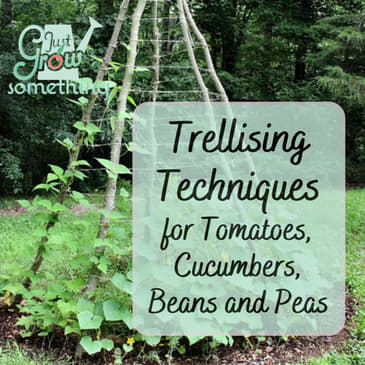
One of the most labor-intensive parts of growing some of our garden crops, like tomatoes, can be trellising them. Other plants naturally just climb whatever we place next to them without much intervention from us, but they do sometimes need some initial guidance. Cucumbers and peas are two good examples of this. Often times this depends on the type of trellis we’re using.
The type of trellis we use boils down to personal preference, the amount of space we have, the materials available to us, and whether we’re gardening in an in-ground space or utilizing raised planters.
Today on Just Grow Something, we’re going to cover the multiple trellising options for tomatoes, cucumbers, peas and beans. Many of these trellising options can be utilized for other crops, too, and some of them are multi-purpose for any of these crops. By the end you will have a multitude of techniques to choose from so you can make the best choice for your gardening situation. Let’s dig in!
Question of the month: Ask me anything! Reach out and ask me whatever you want to know, gardening or non-gardening, and I'll answer your question next week for our 200th episode!
References and Resources:
Just Grow Something Gardening Friends Facebook Group
Check out how you can become a patron on Patreon
Merchandise | Just Grow Something
--- Send in a voice message: https://podcasters.spotify.com/pod/show/justgrowsomething/message

[00:00:00] Sometimes one of the most labor-intensive parts of growing some of our garden crops like tomatoes can be trellising them. Other plants naturally just climb whatever we place next to them without much intervention from us, but they do sometimes need some initial guidance. Cucumbers and peas
[00:00:16] are two good examples of this. And oftentimes, this depends on the type of trellis we're using. All the type of trellis we use boils down to personal preference, the amount of space we have, the materials available to us, and whether we're gardening in an in-ground space or utilizing
[00:00:32] raised planters. Today on Just Grow Something, we're going to cover the multiple trellising options for tomatoes, cucumbers, peas and beans. Many of these trellising options can also be utilized for other crops, and some of them are multi-purpose for any of these crops.
[00:00:48] By the end, you will have a multitude of techniques to choose from so you can make the best choice for your gardening situation. Let's dig in! Hey, I'm Karin. I started gardening in a small corner of my suburban backyard, and now 18 years
[00:01:02] later I've got a degree in horticulture and operate a 40-acre market farm. I believe there is power in food and that everyone should know how to grow at least a little bit of their own. On this podcast, I share evidence-based techniques to help you plant, grow, harvest
[00:01:16] and store all your family's favorites. Consider me your friend in the garden. So, grab your garden journal and a cup of coffee and get ready to Just Grow Something. Welcome back to the podcast. I am your host and friend in the garden, Karin Vales. Whether you
[00:01:38] are new here or an OG, I thank you for being here. Remember, this week is your last week to submit the May question of the month, which is actually you asking me the question. And
[00:01:51] it's any question you want. Ask me anything. Do you need clarification on something that I've already talked about in a previous episode? I got a lot of questions about that. It can be gardening related, non-gardening related, coffee related, whatever. Talk to me in the
[00:02:08] Facebook group, send me an email, DM me on Instagram or on Facebook, answer directly in Spotify, wherever you can get ahold of me. You have until this Friday, May 31st, to send me your question. And I will feature it next week in celebration of our 200th episode.
[00:02:28] And if you are gardening somewhere where there have been severe storms or flooding, I hope that you and yours are all okay and that your gardens are all in one piece. We did have storms here over the weekend. We had a bunch of power outages.
[00:02:43] We have had flash flood warnings because we have had so much rain here, which I am not complaining about. I would rather have too much than not enough. Our daughter in Arkansas had tornadoes there
[00:02:55] last night. Our son out in Ohio has experienced the same thing a few weeks back. So if you are in a very volatile area right now in terms of weathered, please stay safe, heed those storm warnings, be prepared for emergencies and fingers crossed all of our
[00:03:10] gardens all make it through the remaining spring storms. Okay, let's talk trellising. I get a lot of questions about how we trellis our tomatoes and our other plants here on the farm. Oftentimes, it depends on where we are growing that crop. We use a bunch of different methods
[00:03:32] and sometimes it's different whether it's in one of our large in-ground beds out in one of the fields or if we've got them in one of the raised planters that's in the kitchen garden.
[00:03:43] I change up how I trellis things each year. I mean it isn't always the exact same with the exception of some of the trellises that I have put into place that are actually permanent.
[00:03:54] And we'll talk about that here in a little bit. What you choose to use oftentimes is going to depend on how much time you have to dedicate to working on trellises and trellising the
[00:04:06] plants, how much money you have to spend on materials or what type of materials that you have available to you and the type of plant that you are growing. So let's start with
[00:04:18] the big one and that is tomatoes. First up is the stake and tie method. This is very straightforward and very space efficient. You really just need a six to eight foot wooden or metal stake and
[00:04:34] either those soft garden ties or just some regular twine or whatever it is that you're going to use to tie your tomato plant up to that stake. You just want to drive the stake into the ground
[00:04:45] about two to three inches from each one of the plants and just make sure that that stake is down deep enough into the soil to provide strong support. And then as the plant grows, you tie
[00:04:58] the main stem of the tomato plant to that stake about every six to 12 inches going up using those soft ties or that twine or clips or whatever it is that you're using. The key with the ties is to
[00:05:12] make sure that they are loose enough to allow for that stem to grow but also tight enough that it's not going to flop over on you. Now the advantages to this method is it is very simple
[00:05:25] and it is very cost effective. It is also very easy to install and maintain. It's also easy to pull out at the end of the season and to put away and store. The disadvantage though is that you do need to go
[00:05:38] out there and adjust the plant and where it is tied along the stake. You have to go out there and tie it up continuously as that plant grows and it may not support really heavy fruit loads
[00:05:54] without adding in some additional reinforcement. So if you're growing those really big heavy beef steak slicing varieties of tomatoes, it may cause that stake to completely fall over or it may not be strong enough to be able to hold onto that fruit without it falling off or breaking.
[00:06:12] So you may end up adding like a second steak to sort of sandwich and sort of use it that way. This method also works best with some judicious pruning because if you think about the way a
[00:06:25] tomato plant naturally grows, it kind of bushes out and you get all of these different vines going all these different directions. And so if you're only tying that one main stem to the pole or to the stake then all those other vines or all those different shoots
[00:06:46] that are coming off are kind of going wild and there's nothing to hold them up which means there's nothing to kind of support that fruit. So if you're going to use just one stake and
[00:06:58] tie it, a lot of the time you are going to be pruning a lot of those suckers off. That's fine, that's okay. That's what I mean by a lot of these techniques are going to depend on
[00:07:06] how much time you want to spend working on doing the trellising. So you can do it without doing any type of pruning and it's going to be sort of wild and crazy and that's okay.
[00:07:17] I mean we've had tomatoes before that never even got trellised because I just ran out of time and they grew across the ground. Not my best crop but I still got tomatoes out of them.
[00:07:26] Next up is tomato cages. Cages are a very popular choice because they are sort of easy, right? You just pick up a commercial tomato cage whether they're metal or they're plastic, they come in all kinds of different shapes and different sizes. Some of them collapse,
[00:07:40] some of them are just round, some of them are square. Plenty of options out there. They're very easy to use. You just place the cage over each tomato plant but you want to do this
[00:07:49] immediately after you plant it because number one, you don't want that plant to get too big and it's roots to spread out before you jam that tomato cage down into the soil because you might damage the roots at that point and it's not easy to try to
[00:08:05] jouge a half grown tomato plant into this cage as you place it over the top. So you want to do this when the plant is still very small and then as the plant grows, just guide the stems and the branches to sort of stay within the cage.
[00:08:21] These things will provide really good support depending on the size based on the size of your plant. It also helps to contain the plant. It will absolutely support heavy fruits. I love these four determinant varieties. They're very, very easy because the sort of downside to
[00:08:43] them is that they may not be tall enough or big enough for really vigorous indeterminate varieties of tomatoes. So what I have seen is the indeterminates will tend to kind of grow up and over the
[00:08:56] top of these cages and then they'll come back down again the other side, which is fine. They can grow that way. That's not a big deal but it is going to require pruning on that sort of inside part of
[00:09:08] the plant in order to have good airflow and to prevent diseases. They can also be kind of cumbersome to store during the off season if they're not something that collapses. So definitely advantages
[00:09:21] and disadvantages for sure. Next up is the Florida weave or a basket weave. Now this works really well if you are growing your tomatoes in a row or in several rows. This is something that is commonly
[00:09:34] used by market gardeners. It's also used by commercial growers as well. We have used this method off and on over the years. You still need stakes and in this instance you're going to need
[00:09:47] stakes for about every two to three plants that you plan on growing. Plus you're going to need some heavy-duty twine or string. So if you've got this row of tomato plants, you drive a stake
[00:10:01] at both ends of the row to start with and then put an additional stake in between every two to three plants. Then you're going to take your twine and you're going to attach it to one
[00:10:15] of the end stakes. Then about eight to ten inches above the ground, you're going to start walking along with that twine and you are going to weave it around the stakes, looping it around each plant
[00:10:28] as you go or weaving it in between the plants as you go, which is the way that we do it. We weave it in between the plants so we're not looping it around. I just feel like that looping action
[00:10:39] oftentimes will damage the plant a little bit. I don't know if it's just because I haven't done it properly but I tend to weave. So if you imagine a stake at the end, you've got it tied off
[00:10:52] and you weave it to the right of the first plant and then to the left of the next plant. So it's going in between those plants and then you weave it back to the right again and now you've come
[00:11:02] to another stake so you loop it around the stake and then again move to the left and then back to the right and then loop it around the stake. Then when you get to the other end
[00:11:12] you turn around and you come back and you do that the exact same way but you do it on the opposite side. So this way the plants are sandwiched between the twine and this is what's going to keep them
[00:11:25] upright. So if you do it to where you're looping it around each plant, you need to make sure that you're looping it fairly tight around that stem as you continue on because you've only got
[00:11:38] that sort of one loop that's holding it up unless you come back and you loop it around again that seems like overkill to me. So I really just prefer the actual weave itself and then you just keep
[00:11:48] doing this about every 8 to 10 inches as the plant continues to grow up. So this is going to provide really good support if you are growing a lot of plants. It's a very efficient use of your
[00:12:04] stakes and your space and just your materials in general. You do need to pay attention though and make sure that you are adding those additional layers of twine as the plants grow and do it on
[00:12:21] time because ask me how I know this can get away from you very quickly and if you're not out there at an appropriate timeframe to be able to get these things trellised as they're growing they
[00:12:33] very quickly can get out of control and then you're going back and you're trying to hold plants up while you're trying to weave that twine in between because they have kind of overgrown the space and they're flopping over and they're only being held up by what you
[00:12:47] had originally put in there. So it can be sort of labor intensive to get set up initially and you need to make sure that your timing gets right but it really is a good way to provide
[00:12:58] really excellent support for rows of tomatoes or multiple rows of tomatoes and it doesn't involve nearly as much investment as some of the other methods that we use. Now one method that is gaining popularity in home gardens is something that has commonly been used in greenhouses
[00:13:20] and this is the trellis and string method. So essentially you need some sort of overhead horizontal support to use this method and then just some garden twine or some string. So think about a short row of tomatoes and then having a stake on either end, a tall
[00:13:43] stake or pipe or something on either end and then one going across the top. That horizontal support should be directly above wherever your tomatoes are growing and then you
[00:13:56] tie a piece of twine to the base of each one of your plants and then you run that twine up and you secure it to that overhead support. So then as the plant grows, you just twist
[00:14:10] the main stem around the twine or use clips or ties to attach the stem to the twine. So rather than using a stake for this, you're just using the twine. So this sort of maximizes your vertical space,
[00:14:26] it helps with the air circulation, it makes it pretty easy to get in there and prune and harvest, you're not having to worry about driving stakes into the ground. It does require a very sturdy
[00:14:37] overhead support structure because you've got multiple plants that are relying on that beam at the top for holding up all of their weight once they get nice and heavy with their fruit. You do need
[00:14:48] to regularly be out there to train those plants up the string or once again, just like the previous method, they'll sort of flop over and then they'll start to grow in that direction and you try
[00:14:58] to straighten them back up and you very well may break them. So you need to be out there fairly frequently checking to make sure that they need to be strung up again or clipped onto
[00:15:06] the string and then it also requires regular pruning to keep these plants to just one or two main vines. So if we think about this in terms of how the plant is growing, we call this a single
[00:15:21] leader or a dual leader system. So you're either training one main vine to go up or you're doing two main central sort of vines coming off of the plant. If you try to do more than that,
[00:15:34] they are going to sort of intermingle with the ones next to each other and they're going to sort of hold hands in not a good way and kind of go crazy. And as it continues to grind up the top, again,
[00:15:45] there may not be enough support for those that aren't being trellised to hold on to those fruits. So it does require a bit more in the way of pruning. But this is the way that we, you
[00:15:56] know, has been done in professional greenhouses for years and years and years. It's very, very effective, but it does require some attention. Now one of my favorite methods is by using a panel trellis. So you're using a cattle panel or a hog panel or something similar in
[00:16:14] terms of a mesh panel that is sturdy enough to support heavy fruit loads. And then you just need whatever the panel is and teaposts or really strong wooden posts. You put those posts in
[00:16:26] the ground, you secure the panel vertically between the posts at either end. If it's a longer one that's like 16 feet, you likely want to put one in the center too. So like three posts per panel. And
[00:16:37] then you just plant the tomatoes along the base of the panel. Then as the plants grow, you just sort of guide and tie the stems to the panel. These panels are extremely sturdy. They are
[00:16:49] very durable. You're only going to have to buy them once and they are excellent support for those really heavy tomatoes. It is a little bit more of an investment, a larger initial investment.
[00:17:02] And those panels can be heavy so it might take a little bit to get them installed. And also it's not something that you probably are going to want to move every single year. You
[00:17:11] can. We use teaposts to secure them in place. And so you can take the panels off and pull the teaposts and put them away to store them. When we put them in place, we leave them in place.
[00:17:22] And so I will utilize those panels for different crops across the different seasons. So one year it might be tomatoes, but then the next year it might be my early sugar snap peas and then my
[00:17:33] later pole beans. And then the following year it might be my cucumbers. Right? So I said some of these things can be used for multiple plants. And so that's how we do it. Again,
[00:17:44] it's a little bit higher of an initial investment, but it is a really full proof way to have something super sturdy for different crops. Multiple different types of crops can use this. And it does not require me to be pruning nearly as much as some of the other
[00:18:03] methods because as I get in there with these tomatoes, if I'm trellising them and I'm tying up that main sort of leader, that one vine and I've got all these other shoots that are coming
[00:18:14] off, I can choose if I want to remove those or I can choose to also just attach those trellis those tie them to that panel because there's plenty of space to work with. So what I tend to do is
[00:18:28] I give myself more space between the tomato plants that are being grown on the panels and that way I don't have to be pruning nearly as much. I'm actually getting more fruit
[00:18:40] out of those plants. They're just not as large. So, you know, if you think of it in terms of the amount of energy that's being used by the plant to produce the fruit, if you're removing the suckers
[00:18:54] and you're very heavily pruning, when what you're doing is you're having it concentrate all of its energy into a smaller amount of fruits or a concentrated area of fruiting versus it fruiting all over the place and it's got to sort of divide its energy up to do that,
[00:19:15] which means those fruits are eventually going to be a little bit smaller. And that's okay. I'm perfectly fine with it. So, to me, it just works better with my system and works better with
[00:19:25] my energy level to not have to focus on doing a ton of pruning. I will prune the lower 12 inches to make sure that there's plenty of airflow and after that, I'm really just kind of tying it to these
[00:19:36] panels. Now, I don't have panels for all of my tomatoes. I do still use the stake and tie method and I do still use the Florida weave and I do use cages depending on which tomato plants I'm
[00:19:49] growing, where I'm growing them and what I have available to me. So that should be the deciding factor for you as well. What type of an initial investment can you make? What do you have access
[00:20:00] to? What types of tomatoes are you growing and where are you growing them? No garden is complete without roses. This queen of the flowers creates a foundation for the garden and offers beautiful
[00:20:15] blooms to enjoy both inside and outside. But roses often get a bad rap for being fussy, hard to grow and disease prone. While this may be true of grafted roses, own root roses are easy to grow, have a higher disease resistance and last for years to come.
[00:20:31] Airloom roses wants to help you succeed with roses with their collection of over 900 varieties of healthy own root roses. When choosing roses that are grown naturally on their own roots, gardeners can avoid the headache of weak grafting points, winter damage that often kills the
[00:20:46] plant and spending precious time fighting root stock suckers. Instead, choose airloom roses. Airloom roses' hand propagates only the highest quality own root roses that are known to be fuller, more disease resistant and will push out healthy blooms in their first growing season.
[00:21:03] At Airloom Roses, each mother plant is tested for over 10 different varieties of rose viruses to ensure that you receive healthy top quality plants. No gall, no rose rosette, no mosaic virus. Just clean, strong plants ready to add beauty to your garden.
[00:21:19] As a special offer, Airloom Roses is offering you 20% off all roses with code just grow. Use this code at checkout now through October 31st 2024 and since they ship year round, you can choose the perfect ship date for your garden. It's time to experience growing healthy
[00:21:37] roses the way nature intended on their own roots. Find your next rose today and take 20% off with code justgrowatairloomroses.com. Okay, we talked about tomatoes. Now let's talk about trellising cucumbers. One of the ways we can do this is with an A frame trellis. This is a really
[00:21:59] sturdy structure that can support really heavy cucumber vines and fruit. So you'll need wooden or metal poles, hardware for hinges if you're using the wood and a garden netting or twine. So essentially, you're just going to create two A shaped frames either using poles that are tied
[00:22:20] together at the top or wooden stakes or wooden beams and hinge them from the top to form an A shape. Having a support beam across the top to connect the two A frames is a good idea sometimes
[00:22:36] too depending on what you're using but it all depends on how many cucumber plants you're planning on growing. So if you picture these two A shapes, one's on the left side,
[00:22:48] one's on the right side, the A's are facing each other, right? And then you either can connect them from at the top so that you have a top support or you don't have to necessarily do that. You
[00:23:00] can string the netting, the garden netting that you're going to use as your trellis in between the legs of the A frame on both sides. So and then you secure the legs, the feet of that
[00:23:13] A frame into the soil or into the ground so they don't fall over. You can also do this with string. You can just kind of take twine that goes back and forth between the legs and then you just
[00:23:23] plant the cucumbers at the base of the trellis on both sides and then as the cucumbers grow, you just kind of train them to climb up the netting or the string. Usually you only have
[00:23:34] to do this at the very beginning just to kind of judge them to go in the right direction. At that point, they generally take off and do it themselves. Now a small space alternative to this is to adjust
[00:23:45] the trellis so that one side leans at about a 45 degree angle and the other one is almost straight up. So I guess think of it like it's got a back on it maybe it is straight up and down.
[00:23:59] So instead of it being an A where both sides are sort of at a 45 degree angle, you've shortened the one side and so it is straight up and the other side is at 45. And what you can do is you can
[00:24:11] grow your cucumbers on the one side that's at a 45 and then on the back side you can grow, you know, green beans or sugar snap peas or something on that straight up side. If you have the appropriate amount of light, obviously if you face this a certain direction
[00:24:28] then you know if you face it towards the south then that back side isn't going to get enough sun if you're here in the northern hemisphere. So you want to make sure that your angle like the
[00:24:36] appropriate way. But this is another way where if you've got a very small space you can sort of do dual purpose in this. This can also be done, this A frame can also be
[00:24:45] done by creating just a square frame and attaching the net trellising or the twine or the wire mesh or whatever in side that square frame and then just leaning that entire thing against
[00:24:59] a fence or creating hinged legs that hold that frame at like a 45 degree angle. You can also just bend cattle panel into an A shape or even a hoop and you will accomplish the same thing.
[00:25:12] All of these versions are very sturdy and can support really heavy vines so especially if you are growing full-sized cucumbers that tend to be very productive those vines can get very heavy very quickly. This also allows access for harvesting from both sides. You'll also will see
[00:25:29] that a lot of those fruits will sometimes hang down in the A frame, sort of underneath so you can go through and pick that way. It does require some construction effort so you know if you're
[00:25:40] not super handy at this um at that this might not be the proper trellis for you. It can also be bulky you know to move around or store when it's not being used so unless
[00:25:50] you're using something that can stay outside all the time that might be a consideration as well. Next up is a vertical net trellis so essentially it's it's very similar to the A frame only instead of putting it in a frame it's just going to be held up by
[00:26:09] T-post or by wooden stakes so they have these net trellises they are soft trellis material it looks like a fence that's made out of nylon almost so it comes on a roll and you can use that
[00:26:23] for in between your A frame or you can do it this way with just T-post or wooden stakes and just drive the stakes or the T-post into the ground at intervals along where you plan to
[00:26:37] grow your cucumbers and then attach the net trellis to the posts and this creates a vertical climbing surface and then you just plant the cucumbers at the base of the trellis train
[00:26:46] the vines to climb the trellis as they grow. The saves ground space it also provides really good air circulation and sunlight exposure especially if you're only planting on one side of this trellis
[00:26:57] you still get the airflow you do need to make sure you're using fairly sturdy posts though because in my experience this nylon will tend to sag a little bit with the weight of
[00:27:10] the vines and the fruit and so make sure you're using enough posts and make sure those posts are sturdy but it's a very inexpensive way to be able to create a trellis. One other disadvantage of this
[00:27:24] though is it's a little bit more difficult to reuse this type of thing it requires you sort of waiting until all of the vines have died off at the end of the year and then cleaning
[00:27:34] that off and it's not always super easy to do with the nylon. I've also seen this in sort of like a I don't know a hard flexible plastic too which is not my my favorite but you know it can be reused
[00:27:49] it just takes a little bit of cleaning up at the end of the year. Now something we've already talked about cattle panel trellis just the same way that we do this with our tomatoes
[00:27:58] we can use for cucumbers as well I already mentioned that that is something that I do I leave those permanently in place I use them for tomatoes one year I'll use them the next year for
[00:28:08] some legumes and then the following year I will use them for you know cucumbers or something again you know it's it's very durable it's very long-lasting but it just depends on whether or not
[00:28:17] you want to put that initial cost into it and you know the panels are heavy you probably aren't going to be taking them down and and putting them away at the end of every year
[00:28:26] unless you've only got like one and then it's super easy but any more than that then it takes a little bit of effort we can also use that string trellis that we use with the tomatoes
[00:28:38] we can do that with cucumbers too so once again we have that overhead support structure some sort of frame some sort of pergola something and that garden twine or string the difference with this
[00:28:50] is that you know with tomatoes we're waiting until the tomatoes are planted and we're attaching that garden twine to the base of that plant and then we're running it up to that overhead support
[00:29:00] structure in this instance you're going to set up that overhead support and then tie the strings from the overhead support down to the ground and then I usually will stake them into the ground
[00:29:13] just to make sure that it sort of stays tight but you don't necessarily have to do that it can just kind of be free hanging you plant your cucumbers at the base of the string and
[00:29:22] then you just guide the vines to climb up those strings you know it's it's fairly inexpensive and easy to set up you may have to replace those strings periodically and it's going to require you to go
[00:29:35] out and sort of train those vines to go where they need to go but it's a it's actually kind of a good introduction to this sort of method versus trying it out with the tomatoes first if
[00:29:47] you're going to try this method I would absolutely recommend trying it with cucumbers first and then see if you like how that works and then trying it with your tomatoes the next season
[00:29:56] we can also make TP trellises so these are really cute actually you just take bamboo poles or long sticks whatever you can find around that's fairly straight and grab some garden twine and then
[00:30:10] just gather you know several of the poles together three four five however many you know plants you plan on growing and tie them together at the top and then spread the bases out to form a TP shape
[00:30:22] and then plant your cucumbers around the base of the TP and as the plants grow you train the vines to climb those poles it's super cute it can you can kind of make it a focal point in the middle
[00:30:33] of your garden it's really easy to make it may not be as sturdy depending on what it is that you're using compared to other methods so you can either use it for like the smaller cucumbers
[00:30:49] like the small pickling cucumbers that maybe don't get as heavy or just make sure you're picking a very heavy you know steak or whatever it is or pole to create the TP it also does though kind of limit
[00:31:02] the support surface compared to some of the larger trellises like the cattle panel so you know if you're only growing you know four or five plants well then it's perfect you just have four
[00:31:11] or five sticks and you put four or five plants at the base and you call it a day but if you want to grow more than that you either need to do multiple TP's or choose a different trellis type
[00:31:25] and then finally let's talk about trellising our peas and our beans now I'm talking about beans I'm talking about pole beans and climbing peas so there are pea varieties that are bush varieties
[00:31:38] and there are pole or there are beans that are bush varieties also we're talking about the climbing ones obviously and once again we can do the TP trellis in fact I have a garden consult client who
[00:31:48] is doing this in her garden this year it's a good way to sort of save some space in the garden be able to put these you know little poles together and tie them together at the top and then create
[00:32:00] this this TP shape then you just plant the beans or the peas around the base of each of the poles if you are planning on growing a lot of beans or a lot of peas this is probably not the most
[00:32:13] effective way to do this but if you're just growing a handful especially those pole beans that are going to continue to produce all season long for you then this is a really good way to go
[00:32:23] the second one is those A-frame trellises that we talked about with the cucumbers you can do the exact same thing for your peas or your beans and in this instance they don't have to be
[00:32:35] nearly as sturdy because obviously the peas or the beans are not going to weigh as much as a fully loaded cucumber vine so you can play around with the materials in this instance to be able to create
[00:32:46] your A-frames the same thing goes for the string trellis so just like with the tomatoes and the cucumbers you have that overhead support and then you are using garden twine or string as
[00:32:59] the trellis with peas and beans you likely are just going to use a lot more of the strings so you're tying those strings from the overhead support and you're running them down to the ground
[00:33:11] but you're going to space them a lot more closely together than you would if they were tomatoes or if they were cucumbers so you're just going to plant the pea or the bean at
[00:33:20] the base of each string and allow it to grow up again this is very inexpensive it's fairly easy to set up and so you can play around with this and if you put something permanent in place
[00:33:30] and you just change out the spacing of the strings every year you can do the same thing like what I do with the cattle panels you can you know start out by doing the peas the first year or the
[00:33:40] beans the first year and then switch to cucumbers the next year and then do tomatoes the third year and just do your rotation that way speaking of cattle panels that of course can
[00:33:49] also be used for the peas and the beans I mentioned that earlier it is absolutely part of my rotation it might seem a little overkill when it comes to peas or beans but let me tell you when I do this I
[00:34:02] space my peas fairly closely together and I will do them on both sides of that cattle panel and they can be very very heavy once they are loaded with all of those peas the same thing
[00:34:15] with the beans too so although with the beans I tend to only do it on one side because since they're growing all season long they eventually go up and over the panel and so I'm picking from one side
[00:34:27] and then they're kind of going all over over to the other side and traveling down or just kind of going up into the air all haywire the sugar snap peas on the other hand have
[00:34:35] just a short season that I will plant them on both sides and that cattle panel will hold all of that weight because it can get very heavy so again this you can use the cattle panel
[00:34:47] for multiple crops across multiple seasons you can also just grow these on a fence if you have a chain link fence and that's existing then that's perfectly fine too as a matter of fact
[00:35:02] we did that with cucumbers when we were still at our five acre homestead and it was just outside of where our chicken yard was and so of course you know that was very fertile right there
[00:35:12] and we just had a chain link fence and I planted our cucumbers there and they grew up the fence and then they also grew out from the fence too which was fine because we had plenty of room for
[00:35:21] them to sprawl along the ground so you can just use a chain link fence for your cucumbers and your peas and your beans and your tomatoes make use of whatever existing structure you have
[00:35:33] so long as it's going to provide ample support and it's going to give you easy access for harvesting it doesn't have to be something specific for all of your your crops so that's it for trellising
[00:35:47] some tips for successfully trellising all of these things number one make sure you're choosing the right varieties for your unique situation or for the trellis that you're actually using make sure that you are spacing them appropriately so like I mentioned with
[00:36:01] the cattle panel I tend to plant my tomatoes a little further apart with that because I don't intend on pruning them but then with the sugar snap peas I actually plant them more closely together
[00:36:15] that's because of the structure of the cattle panel but I'm not going to do that same thing if I'm using a string trellis or if I'm using poles so just keep that in mind as you are
[00:36:24] spacing out your trellises and your plants you probably need to keep some regular maintenance going to train those vines to climb the trellis just gently tie them or just zhuzh them where they
[00:36:35] need to go while you're doing this you do also want to make sure you're removing any diseased or damaged leaves because this is going to help with the plant health and it's also going to help with
[00:36:44] that air circulation then of course you always want to be monitoring for pests and diseases while you're doing that and trellising actually makes it easier to spot this and to manage those pests and diseases because it's not on the ground these plants are not sort of sprawling
[00:36:58] they're up they're up at eye level they're where you can see them and of course it also makes it easier to harvest because they are up and out of the way so hopefully you can select the right
[00:37:09] trellising method and maintain your plants properly after listening to this episode and you can enjoy a productive and healthy pea bean cucumber or tomato harvest this year until next time my gardening friends keep on cultivating that dream garden and we'll talk again soon thanks for
[00:37:25] listening to another episode of just grow something podcast for more information about today's topic and to find all the ways you can get in touch with me or support the show go to just grow
[00:37:35] something podcast dot com until next time my gardening friends keep learning and keep growing