
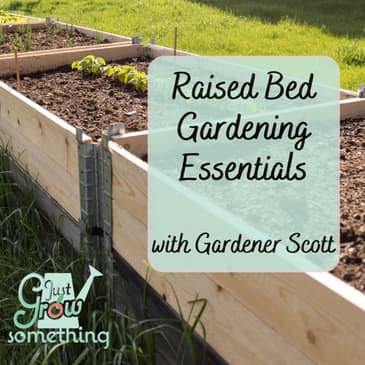
All this month we've been talking about creating new raised beds, what materials to use, and how to fill them. So, I thought it would be fitting to have on an expert on the subject.
Scott Wilson, otherwise known as Gardener Scott on YouTube, has been building and growing in raised beds for two decades and has taught others to do the same as both a Master Gardener and a garden educator. His new book, Gardener Scott's Guide to Raised Bed Gardening, is a step-by-step guide to planning, building and maintaining raised beds.
So, today on Just Grow Something, Scott shares his extensive knowledge with us including creating your own soil mix, compost, cost-effective and creative ways to create new raised beds and more. Let's dig in!
Get your new raised garden bed from PlanterBoxDirect.com using code JUSTGROW20 and save 20% and get free shipping, now through October 15th!
Get Scott's Book here: https://amzn.to/3Kgxw4T
Follow Scott on YouTube: Gardener Scott
Get the full show notes and transcript at https://justgrowsomethingpodcast.com/episode/raised-bed-gardening-with-gardener-scott-ep-268
Hosted by Simplecast, an AdsWizz company. See pcm.adswizz.com for information about our collection and use of personal data for advertising.
00:00:00
I mean, I was a raised bed gardener for about 20 years
00:00:02
before I built my first stone bed, and now that's all I wanna
00:00:07
do. All I wanna do is just design
00:00:09
new stone beds with new stones and new heights and new shapes.
00:00:14
That is Scott Wilson. You may know him.
00:00:17
From his YouTube channel Gardner.
00:00:18
Scott which has over 460 subscribers.
00:00:22
He is a master gardener and educator and the author of the
00:00:25
new book Gardner Scott's Guide to Raised Bed Gardening.
00:00:29
I read the book and it is a comprehensive step by step guide
00:00:33
to planning, building and maintaining raised beds with a
00:00:37
focus on soil health, sustainable practices, and
00:00:40
maximizing yields in various spaces.
00:00:43
And since Scott's approach aligns with my mission to
00:00:45
provide evidence based gardening techniques to you, I thought
00:00:49
that he would make the perfect guest for this month's.
00:00:51
Special. Series on raised bed gardens So
00:00:54
today on Just Grow Something, Scott shares his extensive
00:00:57
knowledge on raised bed gardening, including the
00:01:00
importance of creating your own soil mix and the benefits of
00:01:04
using raised beds. We talked about the significance
00:01:07
of compost, cost effective ways to build raised beds, and the
00:01:10
process of becoming a master gardener.
00:01:13
We also touch on planning and planting strategies as well as
00:01:17
the potential for growing a variety of plants beyond
00:01:19
vegetables. Let's dig in, Aaron.
00:01:22
And what started as a small backyard garden 20 years ago
00:01:25
turned into a lifelong passion for growing food.
00:01:28
Now, as a market farmer and horticulturist, I want to help
00:01:31
you do the same. On this podcast, I am your
00:01:34
friend in the garden teaching evidence based techniques to
00:01:36
help you grow your favorites and build confidence in your own
00:01:39
garden space. So grab your garden journal and
00:01:42
a cup of coffee and get ready to just grow something.
00:01:48
You garden in Colorado, it's zone 5B, right?
00:01:54
And your soil there is interesting.
00:01:58
Let's. Let's terrible you can.
00:02:00
You can say it's just flat out terrible.
00:02:04
So is that what led you to decide that, you know, raised
00:02:06
beds might be the way to go? Yeah, that was that was a big
00:02:10
defining factor. I had dabbled in gardening for a
00:02:13
while, and a little over 20 years ago I became a master
00:02:16
gardener and really didn't know much about raised beds until
00:02:20
then and realized that all the struggles I had in the terrible
00:02:25
Colorado soil could be solved by just putting in raised beds and
00:02:29
creating a good soil mix. And it definitely changed the
00:02:34
way I garden. What kind of struggles are we
00:02:36
talking about in terms of the in ground?
00:02:39
Oh, and so I I recommend to to anyone that asks to do a soil
00:02:45
test when you're first starting a garden just to establish a
00:02:48
baseline. And my native soil has less than
00:02:53
1% organic matter. Almost immeasurable.
00:02:58
Soil testing. Sound familiar?
00:03:00
Testing the amount of organic matter in the soil is done
00:03:04
through a university extension soil test.
00:03:07
This isn't something that you're off the shelf kit can measure.
00:03:10
That is focusing mostly on nitrogen, phosphorus, and
00:03:14
potassium along with the soil pH.
00:03:17
This is something that you need to send away to have tested now.
00:03:20
The ideal level of organic matter for soil is 5%, so less
00:03:26
than 1% meant Scott was gardening and essentially just
00:03:29
dirt, or in his case, sand. And it is primarily sand and it
00:03:37
is actually a compacted sand. So for me to grow in it in any
00:03:43
expected success rate requires a lot of amending over a lot of
00:03:48
years, and even then it's marginal.
00:03:51
And so the gardeners I know in my area who grow in the ground
00:03:55
are always struggling because they just don't add enough
00:03:59
organic matter. And in a raised bed started
00:04:03
right off with a good percentage of organic matter.
00:04:06
And since then I've learned about designing my own soils and
00:04:10
creating my own soils and using different soils for different
00:04:13
types of plants. And I can do all of that in my
00:04:16
raised pads. So in terms of somebody who is
00:04:19
wanting to create their own soil in their raised bed, you said
00:04:25
you've experimented and you've learned a lot over the years
00:04:27
about what the component should be and how you can modify that
00:04:31
based on what it is that you're growing.
00:04:33
Let's start with. What would be considered like a
00:04:37
just a basic way for somebody to be able to fill a brand new
00:04:42
raised bed? What would you recommend in
00:04:44
terms of the composition of that and what materials they should
00:04:47
use? So the basic soil should
00:04:51
actually be soil. And Mel Bartholomew in his book
00:04:56
about square foot gardening and Mel's mix is it's really a soil
00:05:00
less mix. There doesn't have the the
00:05:03
natural native mineral based soil.
00:05:06
And so a lot of gardeners think that a potting mix is all you
00:05:10
need or you put together perlite and peat Moss and that's all you
00:05:14
need. That mineral component really is
00:05:17
important. And I don't like to spend a lot
00:05:19
of money and I don't encourage people to spend a lot of money
00:05:23
so they can use their native soil, which has minerals, which
00:05:27
has some modicum of, of nutrients in it and then add
00:05:34
organic matter to that. A good soil that you've probably
00:05:39
probably seen the the wheel that tells that a soil is 25% air and
00:05:46
25% water and 45% of that mineral soil.
00:05:51
And you only need 5% of it being organic matter.
00:05:56
Now that that's by mass, that's not by volume.
00:05:58
So it really ends up being generally about 20 to 30% by
00:06:04
volume of organic matter. And compost is what everybody
00:06:10
recommends. And I agree with that because
00:06:12
compost already has nutrients that are available for the
00:06:16
plants. A good compost will actually
00:06:19
continue to decompose a little bit and release even more
00:06:22
nutrients for plants. And so it's as simple as that,
00:06:25
just taking your own native soil and mix in a lot of compost and
00:06:32
you can get started. Now I in my book, I talk about
00:06:36
that if you don't have compost, if you don't want to buy
00:06:39
compost, you're not familiar with the source of your compost,
00:06:43
then any organic matter will actually work.
00:06:46
So I use dried grass clippings, I use crushed leaves, I use
00:06:51
whatever organic matter I have. Remember what we talked about
00:06:55
last week about how to fill a raised garden bed?
00:06:58
Here we have another gardening expert outside of the university
00:07:02
system talking about using leaves and all kinds of other
00:07:06
types of organic matter to fill our beds.
00:07:09
We really do not need to be relying strictly on compost for
00:07:12
this. And so when I said, you know, I,
00:07:15
I have learned to build my own soils and I experiment a little
00:07:19
bit with that, it's because if I'm filling a bed in fall, it's
00:07:24
probably going to have a higher percentage of dried leaves,
00:07:28
crushed leaves. If I'm filling a bed in late
00:07:32
spring or summer, it's probably going to have a higher
00:07:35
percentage of dried grass clippings or even fresh grass
00:07:38
clippings that are mixed into it.
00:07:40
And so I have dozens of beds, and every bed has a different
00:07:45
soil composition based on what materials were available when I
00:07:49
filled it. And I don't think we can
00:07:51
overlook the fact that your native soil is going to have a
00:07:56
lot of the microbes that are native to your area that are
00:08:01
going to be able to help inoculate that compost,
00:08:03
especially if it's sort of brand new finished compost in that
00:08:07
bed. When it comes to the building of
00:08:11
a raised bed. And I, you know, we've done it
00:08:14
six ways this Sunday. It's been leftover materials,
00:08:17
it's been cinder block, it's been, you know, here recently.
00:08:20
I've got a company that I work with whose beds that I love and
00:08:23
it's like shipping to me. And it's US Steel that I can all
00:08:25
put together, which is fantastic.
00:08:28
But one of the things that gardeners over the years have
00:08:31
been told not to do is to use treated lumber.
00:08:37
And as an OSU alumni, I will. I love the fact that Oregon
00:08:42
State University came out with a study that said not really.
00:08:47
Can you talk about that study a little bit and kind of ease
00:08:50
everybody's minds? Absolutely.
00:08:52
In fact, I was actually part of that study.
00:08:54
So I, I worked with the Oregon State University team and like
00:08:59
like you said, I've got concrete block beds, I've got metal beds,
00:09:02
I've got wood beds. And, and some of the team had
00:09:06
actually watched some of my videos on YouTube and saw that
00:09:09
some of my beds were made with pressure treated wood.
00:09:12
Some of my beds were untreated wood, Some of my beds had the
00:09:17
lower half untreated and the upper half treated.
00:09:19
I was trying all kinds of different combinations so that
00:09:22
I, I could, at least within my garden, point out to everybody
00:09:27
that the plants will do just fine regardless of how you're
00:09:30
using it. And I actually took soil samples
00:09:32
of all of my beds and sent them to Oregon State University as
00:09:37
part of that study. And what they found out was you
00:09:41
can use pressure treated wood all day long and not worry about
00:09:46
it. There is a minimal amount of
00:09:49
copper leaching because the the pressure treatments in the woods
00:09:53
that are available to us now are all copper based, but so minimal
00:09:58
that it had no impact on the plants.
00:10:00
And it's it's nothing to worry about anymore. 30 years ago when
00:10:06
the pressure treated woods were using an arsenic compound, then
00:10:11
yes, that was something to be concerned with.
00:10:14
And not so much because of the plants, but because if you are
00:10:18
working with wood that has arsenic in it and you're not
00:10:21
wearing gloves, it could be a problem.
00:10:24
But even with the the copper azole and all the other copper
00:10:28
based chemicals that they're using now, you can do it with
00:10:32
your bare hands. I, I use gloves just because I
00:10:35
don't want splinters when I'm doing the the bed.
00:10:38
But pressure treated wood is perfectly fine in the home
00:10:43
garden. So, you know, when people have
00:10:46
come and they have a concern about, OK, how much is it going
00:10:49
to cost me to do this? What is the least expensive way
00:10:51
for me to do this? Do you have recommendations for
00:10:53
them? Well, the least expensive way is
00:10:55
exactly what you said. I've got beds that I constructed
00:10:59
with reclaimed wood that cost nothing, literally nothing
00:11:03
because the wood was free, had a bunch of nails just lying around
00:11:07
and I nailed the boards together and built a bed.
00:11:09
So that by far is the most cost effective way to make a bed.
00:11:14
You can also make a bed and it doesn't have to be wood.
00:11:17
You can stack stones, you can use whatever materials you have.
00:11:22
A raised bed is simply just an elevated area that we are
00:11:26
growing plants in and so the cheapest by far and very little
00:11:32
work is not even a half edging around it.
00:11:35
If you do like a Hugo culture mound, that's a raised bed and
00:11:39
you can actually grow in a mound of amended soil.
00:11:43
So that's that's one end of the spectrum where you can have
00:11:47
raised beds without spending any money whatsoever.
00:11:51
If you want to go into the mode of building the rectangular box,
00:11:56
which one of the huge advantages to that is when you plan your
00:12:00
garden, you can in the cold of winter, set your little grid
00:12:05
paper and figure out where you're going to put your plans
00:12:08
and how many are going to fit in the bed.
00:12:10
And that works perfectly with a rectangular box that's four feet
00:12:14
wide and eight feet long. And that's what you go to Home
00:12:18
Depot and Lowe's and buy 8 foot long boards.
00:12:20
You can make a bed like that. So Next up on that spectrum is
00:12:25
buying untreated wood that will cost you the least amount of
00:12:29
money. But as you pointed out,
00:12:31
depending on your climate, you might have to replace it in five
00:12:35
or six years. I'm at the six year point for my
00:12:38
untreated beds, but it's very dry here in Colorado.
00:12:43
And so I, I've got at least three more, maybe four more
00:12:46
years in those beds without any problem whatsoever.
00:12:50
Probably about 25 to 30% more in cost is pressure treated wood.
00:12:56
And you can expect that to probably last twice as long.
00:13:00
And then as you continue moving up the spectrum, you can get
00:13:04
into concrete blocks or bricks or I've, I've made some beds
00:13:09
this last year that I just absolutely love with flagstone.
00:13:13
Now Flagstone is not cheap when you buy it in the quantity that
00:13:16
you need to build a raised bed, but it's going to last forever
00:13:21
and I will never need to replace any of those components.
00:13:25
So there's there's for the most part, a pretty direct
00:13:29
correlation to the cost and how long the bed is going to last.
00:13:34
One of the things that I found in your book, there was a
00:13:36
picture of a spiral. Herb.
00:13:40
Garden that was just these stones that spiral and now I am
00:13:44
fat. I am determined to build one of
00:13:47
those here. I thought that was just the
00:13:50
coolest design. And it just goes to show, you
00:13:53
know, it doesn't have to be linear thinking.
00:13:57
It doesn't have to be. We're going to make it 4 by 8
00:14:00
and every single one is going to be 4 by 8.
00:14:02
And there's going to be exactly 18 inches in between each path
00:14:05
or 36 inches or whatever it is. You can be as linear and as
00:14:11
organized and you know, point to point as you want to be, or you
00:14:15
can be as whimsical as you want to be in your garden with raised
00:14:20
beds. They don't have to be 1
00:14:22
particular type. OK, coming up, Scott and I talk
00:14:25
about working with new compost, soil management, and the process
00:14:30
of becoming a master gardener, which was something I was
00:14:32
completely unfamiliar with, but I get asked about a lot.
00:14:38
Everything that Gardner Scott is talking about in this episode is
00:14:41
true of raised beds and my favorite raised planters come
00:14:45
from Planter Box Direct. You get your choice of colors,
00:14:48
sizes, dimensions, even tiered planters and planters on legs to
00:14:52
fit every garden space. They're simple to put together,
00:14:56
but they're designed to last a lifetime and they are my go to
00:14:59
when designing any new space around my gardens.
00:15:02
Through October 15th, you can save 20% and get free shipping
00:15:06
on these USA made steel beds at Planter Box direct.com.
00:15:11
Use code Just Grow 20 in honor of this special raised bed
00:15:15
series. And you'll have your own new
00:15:17
planter beds in time to build them and fill them this fall so
00:15:22
they'll be ready to plant in the spring.
00:15:24
Planter Box direct.com with code Just grow 20.
00:15:27
The link is in the show notes. When when you talk about
00:15:31
compost, using compost for raised beds, one of the things
00:15:35
that I have encountered with folks who have no way to really
00:15:39
create their own compost, or at least not in the volume.
00:15:42
That they prefer in. Terms of having to purchase
00:15:45
compost to bring it in, one of the things that I have
00:15:48
encountered is when people are building new raised beds and
00:15:52
they get this idea of, oh, it's spring.
00:15:55
It's time for me to build my beds and I'm going to bring in
00:15:58
this truckload of compost. And then they're going to fill
00:16:00
the bed in its entirety with this brand new compost.
00:16:05
And then they find out that their stuff is not growing.
00:16:08
And you know, I, I see the frustration because they don't
00:16:14
understand why that is. Can you speak to that a little
00:16:18
bit? Yeah.
00:16:19
So, so compost is organic matter that is in various stages of
00:16:25
decomposition. And depending on where you get
00:16:29
your compost from, it might actually be sterile.
00:16:33
And a lot of the major manufacturers will sterilize the
00:16:38
mix so that it stops decomposing.
00:16:41
Well, it's the life in our soil and it's the life in our compost
00:16:46
that makes the nutrients available to the plants.
00:16:51
And so plants don't grow in a sterile environment.
00:16:53
It can be the most amazing compost in the world.
00:16:57
But if you don't have that microbial activity and that
00:17:01
fungal activity within the soil, the plant is going to starve.
00:17:05
It can't, it literally can't access all those nutrients.
00:17:09
And so, yeah, by all means get the the compost by the
00:17:14
truckload, but what I recommend is you do that in fall because
00:17:18
you put the compost in your beds in fall.
00:17:21
Now you have all of the autumn months and the winter months and
00:17:26
the early spring months for that soil life to populate that bed
00:17:32
and make all those nutrients available to your plants.
00:17:36
I love it when somebody else preaches this besides me.
00:17:38
That way they can hear it from somebody else.
00:17:42
So, you know, talk to me about becoming a Master Gardener
00:17:48
because I have a lot of people ask me about this and I am not a
00:17:50
Master Gardener. I, I have a degree in
00:17:52
horticulture from Oregon State, but I've never gone through, and
00:17:56
I've had Master Garden. I've gone to Master Gardener
00:17:58
meetings and I've done presentations and had them out
00:18:00
here, but I've never actually gone through the sort of course
00:18:03
curriculum that goes along with this.
00:18:05
Talk to me a little bit about that process because I've had
00:18:06
people ask me about what it takes.
00:18:09
Sure, And I I became a Colorado Master Gardener a little more
00:18:12
than 20 years ago, and the process has changed mildly.
00:18:16
And each state might have its own minor modifications, but the
00:18:21
basic process is that there is a university in every state that
00:18:27
overseas the Extension Service. And the extension office is the
00:18:32
one that overseas the Master Gardener program.
00:18:36
And so when you become a Master Gardener, you are actually doing
00:18:40
it under the auspices of some State University.
00:18:44
So here in Colorado, it's Colorado State University that
00:18:48
overseas the program. So when I went through, and
00:18:51
these were in the days long before the computer and the
00:18:53
Internet and YouTube even, it was actually instructors from
00:18:58
Colorado State University in the horticultural department that
00:19:02
were doing most of the teaching. And the exposure to gardening is
00:19:09
quite broad. And so it's the way I typically
00:19:13
explain it to people is it's it's a weeks long program and
00:19:19
it's an all day class. So it might be Tuesdays or
00:19:23
Thursdays. I think we went on Thursdays.
00:19:25
And so in the morning for three hours you get non-stop education
00:19:31
on vegetable gardening. And then in the afternoon you
00:19:35
get 3 hours of non-stop instruction on fruit gardening.
00:19:39
And then the next week, you come back and you might get 3 hours
00:19:43
in the morning on soil composition and then in the
00:19:47
afternoon after lunch, you get 3 hours on compost and mulch.
00:19:52
And so that's the way the program tends to be laid out is
00:19:57
a very broad education without particular focus on anyone area.
00:20:04
And then after a couple months of classes, and so depending on
00:20:07
where you're going, it might be 8 or 12 weeks of these little
00:20:11
snippets. I think biology might have been.
00:20:15
One where like the morning was biology and the, the afternoon
00:20:19
was botany. So that was the closest we came
00:20:22
to a full day of the the same topic.
00:20:26
But you're, you're not an expert on anything and you finish and
00:20:29
you have to take tests of course along the way.
00:20:32
And when you are done, you're still not a master gardener.
00:20:36
So that class is offered usually to the the green industry.
00:20:43
And so you have a lot of landscaping companies, for
00:20:47
instance, that might send their people to those classes.
00:20:52
To become a Master Gardener, you need to go to the next level,
00:20:57
which is volunteering in the Master Gardener program for a
00:21:01
period of months. And that's where you really
00:21:05
begin that that expertise phase. Here in in Colorado Springs,
00:21:11
where I'm from and in most areas, there's a help desk or
00:21:15
there's some operation where the Master Gardeners answer
00:21:18
questions. Well, the Master Gardeners that
00:21:20
are answering those questions are the Master Gardeners that
00:21:23
just finished the training for the most part.
00:21:26
So when they're asked a question, they might not know
00:21:29
the answer, and often they don't know the answer.
00:21:31
But what they've been taught as part of the Master Gardener
00:21:34
program is how to find the answer and to look in the fact
00:21:39
sheets that the Extension Service provides so that they
00:21:44
can answer about insects or flowers or soil or compost.
00:21:49
And that's really how you become a Master Gardener.
00:21:52
You have to complete that volunteer phase before you get
00:21:57
the certification of Master Gardener, and then you have to
00:22:00
carry that on. If you want to maintain that
00:22:03
certification, you have to continue taking some classes and
00:22:07
you have to continue volunteering over a period of
00:22:10
time. That is fascinating.
00:22:12
I had no idea that Cass County Master Gardeners when they have
00:22:16
their, you know, their call in hour every week that those are
00:22:19
the brand new people who are answering those questions and
00:22:22
they're looking it up. That's that's fascinating.
00:22:24
But it's a long process. I mean, that's, it's some work.
00:22:26
It's not something that you can just, OK, you know, I'm just
00:22:29
going to decide to do this. You really need to have a
00:22:31
commitment, especially to maintain that certification.
00:22:34
So you continue to have to do continuing education every year
00:22:38
in order to sort of meet those qualifications to maintain in
00:22:41
your certificate. Yeah, basically it depends on,
00:22:45
it depends on the the respective Master Gardener programs.
00:22:48
So there there's variety, you know, throughout the country and
00:22:53
Canada as well also has similar programs.
00:22:56
And so there's a key difference too, because when you become a
00:22:59
certified Master Gardener, if you choose to continue to, to be
00:23:03
certified, you don't have to know everything.
00:23:07
Master Gardeners tend to focus. And so most of the Master
00:23:11
Gardeners I know might be an expert on irises, or they might
00:23:15
be an expert on roses, or they might be an expert on compost.
00:23:19
There are very few like me who just love learning and love
00:23:23
gardening and try to learn everything possible about
00:23:27
gardening. And then you might reach a point
00:23:30
like I did, where I, I kind of outgrew the Master Gardener
00:23:34
program and the things that I was being taught were not new.
00:23:39
I, I knew much more than that. So while I'm a Master Gardener,
00:23:43
I'm no longer a certified Master Gardener because I stopped doing
00:23:47
the volunteer hours and the the continuing education.
00:23:52
I think you're doing enough, enough education on your own, I
00:23:54
don't think. You have to worry about.
00:23:57
The hours being tracked. And that's interesting.
00:24:00
I think, you know, sometimes, especially as somebody who is
00:24:03
predominantly a, a vegetable gardener, I'm just like dipping
00:24:07
my toe into messing with flowers because this is, I mean, this is
00:24:10
18 years of, of growing vegetables for the public.
00:24:15
And so my concern has always been production level and forget
00:24:19
if it looked pretty, forget if there was flowers out there, you
00:24:21
know, unless it was a native pollinator garden, that was
00:24:23
fine. I'm just now sort of dipping my
00:24:25
toe into roses and, you know, some other things.
00:24:29
But I think I always tend when somebody says gardener, I
00:24:32
automatically go to vegetables. So it's interesting that you're
00:24:35
like, oh, no, there's, you know, there's the Master Gardeners, a
00:24:37
lot of them. It's just about the flowers.
00:24:39
And I guess I have to remember that when people want to come do
00:24:42
a tour, when the Master Gardeners want to come do a tour
00:24:44
and they want to see what we're doing out here, They're they've
00:24:46
done the flowers, they haven't done the.
00:24:48
Vegetables Coming up, Scott and I talk about crop planning in
00:24:52
raised beds. Versus in ground?
00:24:54
Beds preventing fungal diseases. How watering requirements.
00:24:58
This may change a little when you control the composition of
00:25:00
the soil, and more that's next. You had mentioned you know the
00:25:06
ease of planning in raised beds. I am a planner through and
00:25:11
through. The 1st course I released was a
00:25:13
planning course. It wasn't the course that
00:25:15
anybody wanted, it was the course that I wanted to give
00:25:17
them because I am a planner and I agree with you.
00:25:22
Raised beds make it so easy to just sit down with a grid and be
00:25:27
able to space everything out beautifully.
00:25:30
Plan your inter plantings, plan your inter croppings.
00:25:33
What I have found is that sometimes, you know, I am I am
00:25:38
very much about hey, make take advantage of all the space you
00:25:41
possibly can and make sure that you are pairing these these
00:25:44
plants together. You know, I have a high, low,
00:25:46
fast, slow, kind of, you know, method where that's how you pair
00:25:49
everything together. So they complement each.
00:25:51
Other but I. Think in raised beds sometimes,
00:25:54
now maybe not where you are because the humidity level is
00:25:57
always so very low. In most instances, I have found
00:26:01
that because that soil level is just below the edge of the bed
00:26:05
itself that sometimes we worry a little bit more about some
00:26:08
fungal diseases getting in there because there's less airflow
00:26:11
because it sort of gets trapped in there.
00:26:14
Do you have recommendations for people about properly spacing
00:26:19
your plants within the raised beds as they're planning versus
00:26:25
maybe how they would do it in an in ground bed?
00:26:27
Oh sure. And I luckily don't have many
00:26:30
issues because I am like you said, very low humidity and very
00:26:34
highwind. So most of my plants I have the
00:26:37
opposite problem. I have to worry about my beds
00:26:39
drying out too quickly. But but that's that's a very
00:26:42
important thing to be aware of. And and it does depend on the
00:26:46
plant because there are some plants that like higher
00:26:49
humidity. But if you live in an area with,
00:26:52
with high humidity and fungal diseases as part of normal
00:26:57
gardening, there's, there's two big things that I usually
00:27:01
recommend. The first being, of course,
00:27:02
pruning and taking off usually lower leaves in tomatoes.
00:27:08
That's the example that that is is so prevalent.
00:27:11
So you can get the air flow across the ground.
00:27:14
So it does dry out a little bit more and you don't have the the
00:27:19
likelihood of those fungal spores bouncing up onto the
00:27:22
leaves of your tomato plants. So selective pruning can make a
00:27:27
big difference. You can also get into trellising
00:27:29
where you you get the plants away from the ground.
00:27:33
Now you can also do this in in ground beds, but it's just so
00:27:37
easy in raised beds where you can build a trellis that fits
00:27:41
the bed perfectly. And then you grow up basically
00:27:45
away from that high humid environment that's all wet next
00:27:51
to that mulch on top of a wet soil and you let your plants
00:27:55
breathe, you let you let let the airflow go through the plants.
00:27:58
So those two things I think are very important and are often
00:28:02
overlooked by gardeners who have those kind of fungal issues.
00:28:06
And then of course, with the up and with the pruning, you throw
00:28:11
in what you're talking about, which is ample spacing between
00:28:15
the plants. And the problem I see most often
00:28:18
is, is gardeners don't think about how big the plant is going
00:28:23
to be right about the time that they're wanting to harvest that
00:28:27
plant. And plants can get quite wide
00:28:30
and they can spread quite a bit. So you look at the seed packet
00:28:33
and it says space 12 inches apart.
00:28:36
Well, yeah, that's fine for probably most of the life of
00:28:39
that plant. But when that plant ends up
00:28:41
being 24 inches wide and you got two of them together, you've got
00:28:47
no airflow and you are creating the perfect environment for
00:28:51
fungal diseases and for pests that like to hide amongst the
00:28:56
branches as well. So the spacing does need to
00:28:59
account for what the plant is going to look like later.
00:29:02
And, and it's tough, I know you know this as well.
00:29:05
When the plants are young and they're so far apart, you, you
00:29:08
feel like you just got to stick something in there.
00:29:11
But but you could be asking for problem a few months down the
00:29:14
road. Yeah, My favorite trick is to
00:29:16
put something in there that is going to be harvested well
00:29:19
before that other plant gets to maturity.
00:29:21
So I mean, I'm infamous for, you know, planting my tomato plants,
00:29:24
but also having lettuce or spinach or something underneath
00:29:28
it. That's.
00:29:28
Going to be. Totally done and out of the bed
00:29:31
by the time the tomatoes need that airflow.
00:29:33
I think. Too, what would you say about
00:29:36
the watering requirements for raised beds because I mean again
00:29:39
in your area it's super dry in most instances it's very windy.
00:29:44
Do you find that your raised raised beds dry out faster than
00:29:48
what you would see in like an in ground bed and you have to
00:29:52
adjust your watering for that? So in my area, my in ground
00:29:56
Rembra was talking about how terrible the soil was and how
00:29:58
sandy it is and the water drains right through it.
00:30:01
And so my raised beds, because there is more organic matter in
00:30:06
the beds, I actually do water less, not by much, but a little
00:30:10
bit less because the soil is retaining more water because of
00:30:15
that organic matter that's in it.
00:30:17
And then one of the things I didn't mention that when we were
00:30:20
talking about filling a raised bed.
00:30:22
But for my tall raised beds, the lower half is logs and branches
00:30:28
and wood chips and leaves to to fill U space.
00:30:34
And I don't have to pay for them, I just fill U that space.
00:30:37
But as those logs and branches and all that woody material
00:30:41
begins to decay, it just sucks up the moisture.
00:30:46
It's like putting in a little reservoir of water at the bottom
00:30:50
of my beds. And so that also helps moderate
00:30:53
the overall moisture level of the soil within my my beds.
00:30:58
OK. I want you to think about what
00:31:00
Scott just said. If you got distracted there for
00:31:03
a minute, go back and rewind and listen again.
00:31:05
We talked last week about the layers in a raised bed when
00:31:09
we're filling them and about using those woody organic
00:31:13
materials, materials as one of the lower components, especially
00:31:16
when you are filling a very deep bed.
00:31:19
The concern sometimes is the breakdown of that material.
00:31:23
Is it going to steal nitrogen from our plants during that
00:31:27
breakdown process And that might be true.
00:31:29
If we are creating beds like this in the spring and using a
00:31:34
really large amount of carbon based materials and then
00:31:37
planting into the bed immediately, then yes, the
00:31:40
nitrogen that the plants need to grow.
00:31:42
Might. Be taken preferentially by the
00:31:45
microbes in the soil that need to use it to break down those
00:31:47
carbon materials. But if we are building these
00:31:50
beds in the fall and allowing the materials to settle in and
00:31:54
break down over the winter, then using those woody materials in
00:31:59
the bottom layers of the bed is not going to be a concern.
00:32:02
And as you heard, Scott, just say, this woody mass is actually
00:32:07
going to help the beds retain water as it decomposes.
00:32:11
So we're getting organic matter, we're getting nutrients and
00:32:15
we're getting water retention, all positives.
00:32:17
So I always test my soil on a regular basis.
00:32:23
I should do it daily, but I don't always do it daily because
00:32:26
other things get in the way. But just simply sticking your
00:32:29
finger in the soil to seeing how moist, how moist it is.
00:32:32
And almost always here in Colorado, that top inch or two
00:32:36
inches is dry because of the low humidity and because of the wind
00:32:40
and because of the sun. But if you dig down 3 inches or
00:32:43
4 inches close to the root level, the soil might be
00:32:47
perfectly moist. And so that's how I water is
00:32:51
based on if the plant is getting enough moisture where the roots
00:32:56
are and not so much if the top is dry or if the top is wet.
00:33:02
Raised beds do tend to dry out faster than an in ground bed,
00:33:07
all other things being equal, but you can moderate that by
00:33:12
making sure you have that extra organic matter.
00:33:15
Oh, I think that that's a huge, you know, plus to just one of
00:33:19
them to raise bed Gardening is again, that control over the
00:33:23
soil composition and being able to make sure that you have that
00:33:25
right amount of organic matter. And glad somebody else is
00:33:29
preaching the less frequent, more thorough waterings get down
00:33:32
there and that 4 inch mark to see whether or not they leave,
00:33:35
you know, they need that that moisture.
00:33:36
So I appreciate that viewpoint because again, if you're
00:33:39
controlling the soil, then you're you're controlling how
00:33:41
much moisture retention there, there is.
00:33:43
As I mentioned in the intro, Scott has literally written the
00:33:47
a book on raised bed gardening. His recent release, Gardner
00:33:50
Scott's Guide to Raised Bed Gardening, is exactly what it
00:33:54
sounds like, a down and dirty look at how to build raised
00:33:57
beds, build good soil, and how to plan for growing in those
00:34:01
beds. I was super excited.
00:34:04
I'm going to put that on the camera there to read this.
00:34:08
Talk to me about why you decided that your book was going to be
00:34:13
the guide to raised bed Gardening.
00:34:16
You mentioned that you and when you got started, nobody was
00:34:18
doing raised beds. There wasn't anything about it.
00:34:20
Was that part of the reason behind writing this?
00:34:22
Well, so that that was part of the reasoning.
00:34:25
Yes, absolutely. And I do talk a little bit about
00:34:27
that book. But when I was contacted by
00:34:30
Firefly Publishing and asked if I wanted to write a book, they
00:34:34
actually proposed a few subjects and and I said I'd prefer to
00:34:41
write something that I really think I'm an expert on and that
00:34:45
others think I'm an expert on as well.
00:34:48
Those other books, maybe you'll come at another time.
00:34:51
But it really was what what do I do the most of?
00:34:55
What do I know the most about? And when I looked at my videos
00:34:59
on YouTube, I have more videos about raised beds than any other
00:35:05
video. My most popular video with with
00:35:10
over 4 million views, I think right now is about filling a
00:35:13
raised bed. So when I started looking at
00:35:16
what people are watching on YouTube, it it basically wrote
00:35:21
itself from that point on that yes, this book needs to be about
00:35:25
raised beds. I get more questions about
00:35:28
raised beds than anything else. And there's a lot of of, of
00:35:35
misconceptions, lack of awareness, and I think even for
00:35:40
people who garden in raised beds, And that's one, one thing
00:35:43
I wanted to put into the book is even if you're a raised bed
00:35:46
gardener, there's so much more you can do with raised beds that
00:35:51
you might not even be aware of. Like you mentioned the herb
00:35:53
spiral, There's a lot out there that even experienced gardeners
00:35:57
can still learn and raise. Bed gardening.
00:36:03
Yeah. So what else?
00:36:03
What else do you think that people who have already been in
00:36:06
raised beds are already, you know, think they know everything
00:36:09
about what it is to do and raise beds?
00:36:11
What are the other things that you think would take them by
00:36:13
surprise in terms of what they can do with their garden?
00:36:16
Well, you touched on it a little bit earlier when you said that
00:36:19
get away from the linear thinking and start start looking
00:36:23
beyond what everybody else is doing.
00:36:26
You look at all the videos on YouTube and everybody's growing
00:36:28
in a four foot by 8 foot box. There are more and more people
00:36:32
that are starting to use the metal raised bed kits that you
00:36:36
alluded to. And beyond that, there isn't a
00:36:40
lot out there. I've I've got a bed on how to
00:36:43
how to make that cinder block raised bed.
00:36:46
And it's one of the few on YouTube that shows how to do it
00:36:50
because not many people are using cinder blocks.
00:36:52
And last year when I did my stone raised beds, I'm not
00:36:57
seeing a lot of other videos out there with people making stone
00:37:00
raised beds. So that's that's it took me
00:37:03
years. I mean, I was a raised bed
00:37:05
gardener for about 20 years before I built my first stone
00:37:09
bed. And now that's all I want to do.
00:37:11
All I want to do is just design new stone beds with new stones
00:37:17
and new heights and new shapes. And my stone bed is, I have two
00:37:21
of them, actually. I use them as kind of anchor
00:37:24
points for an entry into my pollinator garden.
00:37:27
They are circular. You know, it's, it's basically
00:37:32
flagstone that has straight edges.
00:37:35
But I built the beds big enough and high enough that there's a
00:37:39
curve to them that just flows so nicely and it looks so nice.
00:37:46
And I'm using them for annuals and perennials.
00:37:50
They the the idea that vegetable gardening is how you garden when
00:37:54
you have a raised bed, that's another thing that not enough
00:37:58
gardeners are thinking about. You can grow some amazing plants
00:38:03
in raised beds that are outside of the the vegetable arena.
00:38:08
And so just expanding your mind to encompass the beauty,
00:38:13
potential beauty of a raised bed and the potential for new types
00:38:17
of plants in raised beds. That's that's what I'm really
00:38:21
hoping to encourage more gardeners to do.
00:38:24
Coming up, Scott digs deeper into the lessons he conveys for
00:38:28
gardeners in his book and the question that every beginning
00:38:31
gardener should be asking themselves before they begin.
00:38:35
Is there anything else that you that you wanted to point out
00:38:38
about you know your, your book, your YouTube channel, anything
00:38:41
else that you think people ought to know?
00:38:43
Well, I, I wrote the book to be a, a primer for any gardener of
00:38:49
any level. And particularly if you are a
00:38:52
new gardener and you really aren't sure what to do.
00:38:57
Well, my book talks about asking the most important questions
00:39:00
about gardening. You know why.
00:39:03
And I think you have to answer the why question before you
00:39:07
figure out where you're going to put your bed or what you're
00:39:10
going to grow in your raised bed.
00:39:12
So I, I ask a lot of those questions in the book or, or
00:39:15
encourage gardeners to ask themselves those kind of
00:39:19
questions. But then I talk a lot about
00:39:21
planning. I talk a lot about soil
00:39:23
development. I talk about plant selection.
00:39:27
I talk about the the climate and how you match plants.
00:39:32
I talk about watering, I talk about trellises, I talk about
00:39:35
harvesting, I talk about the different seasons and what
00:39:39
activities are best in what time of the year.
00:39:42
And so it's really intended to be a gardening book, it just
00:39:47
happens to have a focus on Ray's bets.
00:39:51
I think you absolutely accomplished what you set out to
00:39:54
do. Anybody who has listened to this
00:39:56
podcast just listened to you say all of that and went, huh, all
00:40:00
of that sounds really familiar. So now they understand why I
00:40:02
liked this book so much. So I appreciate you coming on.
00:40:07
Anybody who wants to find the book, I'm going to absolutely
00:40:09
link to that in the show notes. It's Gardner Scott on YouTube
00:40:14
and we will link to this. And I really appreciate you
00:40:16
being here today. Well, I'd loved being here with
00:40:20
you. I can talk gardening all day
00:40:22
long with anyone who wants to. And so I'm, I'm glad that today
00:40:25
it was you. I thoroughly enjoyed this
00:40:32
conversation with Scott about raised bed gardening and just
00:40:35
gardening in general. Like he said, at any time
00:40:38
gardeners get together we can talk for hours and hours about
00:40:41
anything gardening related. I will link to Scott's YouTube
00:40:45
channel and to the book in the show notes so you can check out
00:40:48
all of his stuff yourself. I truly believe raised bed
00:40:51
gardening is a fantastic way to grow, especially if you are
00:40:55
dealing with soil that is maybe less than ideal, which let's be
00:40:59
honest, that's probably about 7 75% of us.
00:41:02
Until next time, my gardening friends keep on cultivating
00:41:04
that. Dream Garden and we'll talk.
00:41:06
Again soon. But there was a lot that didn't
00:41:11
make it into the book. I had a lot more of the, you
00:41:16
know, this was me, this was my journey.
00:41:18
These are the things I like. And they said, no, this, you
00:41:22
can't have that in this book. This is we got to stick with the
00:41:25
information that is appropriate. And and so, you know, that's
00:41:30
that's All authors say the same thing.
00:41:32
You know, some of their best words are are cut out, but
00:41:36
that's all part of the process. It's.
00:41:38
Like, it's so difficult to be the writer and the editor.
00:41:41
It's like that. There's a reason you're not
00:41:42
supposed to be your own editor, because you believe everything
00:41:45
is. Exactly.