
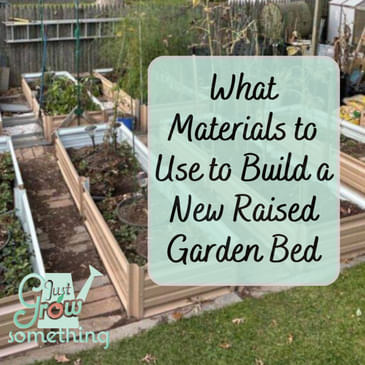
Thinking about building raised garden beds but not sure what materials to use? Today on Just Grow Something we dig into all the options for raised bed construction, from wood, stone, and galvanized steel to creative choices like reclaimed materials, fabric grow bags, and more. We’ll talk about the pros and cons of each, including cost, durability, aesthetics, and safety concerns like chemical leaching or microplastics. You’ll also learn when (and if) you need a bottom layer to block weeds, stop burrowing critters, or protect your soil. Whether you’re a new gardener or looking to upgrade your existing setup, this episode gives you the science-backed insights you need to choose the right raised bed materials for your garden. Let’s dig in!
Perfect for: raised bed gardening, beginner gardeners,vegetable gardening, sustainable gardening, DIY garden beds, pressure-treated wood safety, and backyard food growing.
Save 20% and get Free Shipping on your new planter from PlanterBoxDirect.com! Use code JUSTGROW20 now through October 15th, 2025!
References:
https://extension.umn.edu/planting-and-growing-guides/raised-bed-gardens
Full show notes can be found at https://justgrowsomethingpodcast.com/episode/materials-to-use-for-building-a-new-raised-garden-bed-ep-266
Karin Velez [00:00:00]:
Last week we talked about how to decide on the correct size of raised bed construction for your specific needs in your garden. Continuing the series this week, we're talking about the materials we can use for that construction. Whether it's reused materials, prefab purchases, or just leftovers from another project, you really can build a raised garden bed out of almost anything. So today on Just Grow Something, we're looking at what to build your raised beds with and whether or not you need anything at the bottom to contain the soil or keep out pests. Gardeners sometimes worry about chemical leaching from wood, the longevity of the materials they use, and how to keep weeds and critters at bay. So today we tackle it all. Let's dig in. Hey, I'm Karen and what started as a small backyard garden 20 years ago turned into a lifelong passion for growing food.
Karin Velez [00:00:57]:
Now, as a market farmer and hors horticulturist, I want to help you do the same. On this podcast, I am your friend in the garden teaching evidence based techniques to help you grow your favorites and build confidence in your own garden space. So grab your garden journal and a cup of coffee and get ready to just grow something.
Karin Velez [00:02:17]:
So we definitely have all the fall feels going on here right now. It has been unusually cool in the overnights. It has also been much, much cooler during the daytime. And it just has me like pulling out the hoodies and pulling out the flannels and I know we're gonna warm up again, you know, this week or whatever, but it's been kind of nice to feel the fall coming in and so it got me thinking about putting some hoodies back into the shop. So I've still got all the tank tops and T shirts and the mouse pads and all kinds of other stuff in there. But I'm gonna probably go ahead and start dropping in some of the cooler weather stuff, so like the long sleeved stuff and the hoodies. So justgr something.com go to shop and you will find all the options in there. I put some fun stuff in there earlier in like the late sp spring, early summer.
Karin Velez [00:03:04]:
I kind of dig the Alexa weed, the garden design and some other ones. So have some fun checking that out. I'm definitely going to throw some hoodies in there too. I have used so many different types of materials to create raised beds over the years that I've actually lost track. I haven't even come close to exhausting all of the options. So scrap wood, obviously, prefabricated beds, old metal wash tubs and wash bins, old leaky stock tanks, giant fabric growing beds. All of the things I have tried, a ton of them. You can use old bricks and stack them into a bed, concrete blocks, pavers.
Karin Velez [00:03:48]:
You can even use straw bales or like old logs as a way to create the perimeter of the bed. And also sometimes you can use those as the planter themselves, although that last option acts more like a pot than a large planter. But it's a pretty cool way to work with just found materials. The decision for what type of material you want to use comes down to a couple of things. How long you want the material to last, what your budget is, and your aesthetic. Now, obviously, if you want the bed to be built once and last for decades, then you're not going to choose straw bales or old logs that are going to break down after a really short period of time. You might choose reclaimed wood because it's free and you can just give it a coat of paint to extend its longevity, which is what I did for many, many years. But eventually those will break down too.
Karin Velez [00:04:42]:
Those beds are being replaced with new planter box direct beds as they sort of fall apart. And I also scored some very inexpensive fabric beds with like pockets that divide them into square foot, you know, gardening spaces. And I'm using those as temporary beds this year in some spots where I just needed some extra plants. Now, I don't think those fabric beds can stay in place over the winter if I want them to last very long. So the soil will likely be removed and I'll put it into my compost pile and then I'll store those beds away. But that may be a good option to see if a particular layout works for you. Or if, like me, you just needed some temporary extra space. But I wouldn't leave fabric beds in place for too long or they will start to break down.
Karin Velez [00:05:28]:
If you're pulling up like old pavers from a landscape project, you can use those to create a bed, depending on how many you have, or if you score some cheap concrete blocks someone's giving away and just use that. But if you have a specific design that you're going for, or you want something that will match the design or colors of your house, you might need to spend a little bit of money to get what you want. And often that means the beds are going to last longer too. Even, you know, combinations of materials may work in this respect. So material choices let's start with wood. Wood is the classic choice because it's relatively inexpensive and and it's easy to work with. So soft woods like pine and fir are affordable, but they definitely rot faster. Hardwoods like cedar and redwood are definitely more durable, but they are costlier.
Karin Velez [00:06:26]:
And some gardeners use pressure treated wood to extend that bed life. And this is where we're going to talk some sc. There has been a long standing adage among gardeners that you should not use pressure treated wood to build your raised beds because you risk the chemicals used in that wood, specifically arsenic, leaching into the garden beds. But let me assure you, for newly purchased pressure treated lumber, this is no longer a concern. Modern pressure treatment uses a preservative called micronized copper azole or mca, and it contains copper but no arsenic. Research from my alma mater, Oregon State University, found that this type of lumber increases soil copper concentration only within about an inch of the wood and only by about 20 parts per million. And that no excess copper was found in the vegetables that were grown in those beds. This means the risk of copper uptake is extremely low.
Karin Velez [00:07:33]:
The primary concern might be to direct contact between the gardener and the pressure treated wood or through accidentally inhaling or ingesting large amounts of the soil that might contain some copper. If this is a concern for you, wear gloves when you're handling the lumber and try not to inhale disturbed soil or just wear a mask. Older treated woods are a different story. Those contain chromated copper arsenate or creosote or pentachlorophenol, and those should never be used to create a raised garden bed. This means you need to know the source of your pressure treated wood. So if there is any question, be sure you are buying new wood and always buy lumber that is rated for ground contact and Labeled for residential use. Now the good news is CCA treated wood is no longer available for residential use as of 2004. So if the pressure treated lumber that you're thinking of using is less than 20 years old, yeah, you are likely safe.
Karin Velez [00:08:41]:
This also means though that you should avoid using reclaimed railroad ties or old utility poles. Those were treated with creosote and pentachlorophenol and absolutely can release harmful compounds into your garden soil. So if you're still feeling uneasy about using pressure treated woods for creating a new raised bed, then just choose those water and rot resistant species. So untreated hemlock, redwood, black cherry, black locust, Osage orange or cedar. These all are going to last for a lot of years without being treated and they're going to eliminate that need for any chemical preservatives. You can also paint those boards with exterior latex paint or use a semi transparent oil based stain and that will also slow down the decay. Now, they will eventually break down, but oftentimes you can replace a board here or there and keep the entire bed intact. In fact, a lot of my remaining wooden beds, the bottom board has absolutely rotted out to where I can see the soil and but the soil has been sort of jammed into that position for so long, it's sort of stuck there and it doesn't fall out unless I'm really digging deep into those beds.
Karin Velez [00:10:01]:
And those beds have been there for about 10 years, so I really could probably get away with pulling off a board and have very little soil loss and then just pop a new one on there and call it good. But I'm just kind of in the mode of replacing them as they fall apart. All right, so next up we're talking all of the non wood options, prefab metal beds, stone, brick, concrete, grow bags, and more. Now that I have made the decision to turn my in ground barn bed area into a raised bed garden, I am taking my time picking out the colors that I want to use. PlanterBox Direct has 23 different colors to choose from Plan plus three new textured colors. And since this bed is a whole separate area, I don't feel the need to continue the same color scheme as my other garden beds. I've typically gone with barn red and light stone, but the sunset blue is really getting my attention right now. All those colors offered by planterboxdirect are created using a silicone modified polyester coating.
Karin Velez [00:11:07]:
This is the same coating that's used on metal roofs. This coating is designed to stand up to years of heat and UV rays without degrading. So I am super confident that I will not need to be replacing these beds anytime soon. To go along with our special series this month on creating new raised garden beds, Planterboxdirect is giving you 20% off your order and free shipping on their 100% USA made steel beds. Just use code JUSTGROW20 at checkout now through October 15th to get this special deal and choose your own beautiful durable raised planters. Planterboxdirect.com with code JUSTGROW20. The link is in the show Notes so what are our non wood options for creating new raised beds? One option is galvanized steel which can last a really long time and is generally safe in neutral or alkaline soils. Just be aware that really acidic soils so anything that's got a PH of like less than 5 may cause zinc to leach from galvanized steel.
Karin Velez [00:12:19]:
Now since we're really controlling the soil that's inside our raised beds, this shouldn't be a problem for too many of us, but it's something to be aware of if you plan to use galvanized stock tanks or washtubs as a raised veggie bed. The other thing is, even though these are galvanized to be rust resistant, if you're drilling holes in the bottom of these tanks for drainage, which you should be, then that's opening those beds up to rust from the bottom up. Again, a very slow process, but it is something to be aware of. The next option is the prefabricated metal beds that we see everywhere now. Now obviously I have my favorite brand, but there are tons of options out there in a wide range of prices and and very different coatings. These beds are generally corrugated galvanized steel that is then coated in a UV resistant coating of some sort. Most of them use an aluminum zinc combo. One of the name brands is Alu Zinc.
Karin Velez [00:13:20]:
Planterboxdirect uses a siliconized polyester coating. Some of them don't tell you what they're using. So the more well known brands so Planterbox, Direct, Birdies, Vigorous, they list the attributes of the coating, but random brands on Amazon or TikTok Shop or wherever do not. And that is a red flag for you. Some of these prefabricated metal beds have been found to contain lead and of course lead can leach and it can cause all kinds of problems for us if we're in contact with it. So do your due diligence when deciding on a manufacturer. Don't just go by the looks of or by the cost. If there is no information about the construction of that bed or where it's manufactured, I would look someplace else.
Karin Velez [00:14:07]:
Now, of course, there are plenty of other options too that just require maybe a little bit more creativity and assembly on the part of the gardener. So stone, brick, concrete, these are all very durable and can be very convenient to use these if they've been pulled from like an existing project in your home or maybe somebody else on Facebook Marketplace has dug them up out of their yard and they need to get rid of them for cheap. Right. You can get really creative with the designs using these materials. Round or oval beds may be easier to create with these materials than if you were using wood or metal. You have a little bit more flexibility in just how tall you want to make these, and you can very easily just tuck smaller, little round or uniquely shaped beds using these materials into little corners or spaces in between all your other larger beds. Now, if you're buying these materials new, they are definitely more expensive than our other options, but they're going to last just as long as the metal beds will, if not longer. I will say.
Karin Velez [00:15:14]:
Though some cinder blocks may contain fly ash, this is a coal byproduct and it can actually contain heavy metals. So cement block, cinder block, concrete block, whatever you want to call them, are all made with cement and fine aggregates like sand or small stones. Now, unfortunately, depending on the quality of the manufacturing, fly ash is also often included and the labels do not give specific information on exactly what aggregate is used in the manufacturing of these blocks. And honestly, if you're reusing blocks, then you're not going to have any idea. There is also very little research on this topic and how it may affect garden soils when it comes in contact with them. So if you opt for concrete blocks, it is recommended to seal them with like a polymer paint or something to limit the gardener's like repeated direct contact with it and the contact with the soil. Now, finally, let's talk about fabric grow bags. You might automatically think of those little three or five gallon bags that come in like packs of five or ten and they are super light and they are super inexpensive.
Karin Velez [00:16:31]:
Those are more akin to like container gardening than actual raised planters. But the same material used to make those are also used to make full sized garden beds. I have three right now that are, I want to say, four foot by six foot, and they're divided into these either 12 or 18 inch pockets for planting. They're actually kind of cool. We've also experimented with really large round, 50 gallon all the way up to 500 hundred gallon fabric containers. All of these have done pretty well for us in different circumstances. And you might be surprised at how long those larger ones actually can last when they are exposed to the elements. The smaller ones are super easy to like, empty and store away, but something that's 100 gallons or more is not.
Karin Velez [00:17:25]:
And we ended up actually leaving them in place in the fields where we put them in. And after about five years or so, they did degrade, but the cost on them was so low, we definitely got our money's worth. The downside to these planters is that you have to research closely what they're made from. The fabric, and I'm using hair bunnies here is often made of one of several things. The first is polypropylene. Right. This is probably the most common material used for fabric grow bags. It's breathable, it's very sturdy.
Karin Velez [00:17:58]:
It can definitely withstand the rigors of gardening. It allows for really good air circulation and drainage, which helps to prevent over watering. It actually promotes healthy root growth. The second is polyethylene. This is another synthetic. It is also known for its durability and it's moisture resistance. It's a little bit less breathable than polypropylene, but it's still used in some grow bags because it's very tough and it is able to resist tears and punctures. And then there are non woven fabrics.
Karin Velez [00:18:29]:
These are popular because of their breathability, but also their moisture retention. They allow really good airflow to the roots. So this helps to prevent like root circling and promotes that healthier plant growth. Sometimes these, like non woven fabrics are made from plastic landscape fabrics. Sometimes they are other mixed materials. The problem with all of these is that the research on microplastic leaching from them is very, very limited. So I choose to treat these as temporary containers rather than long term raised bed solutions. Now, there are some grow bags that are made from biodegradable materials like jute or cotton or hemp.
Karin Velez [00:19:18]:
Even bamboo, I think is another option. These are obviously more environmentally friendly. They do provide good aeration and drainage. That does make them suitable for a lot of different plants. And they obviously are particularly beneficial for gardeners who are looking for more sustainable alternatives than the sort of plastic based alternatives that we talked about. They are a little bit more pricey than the other versions, but they are still affordable for what you're getting. And they can be a great option for raised beds. Okay, coming up.
Karin Velez [00:19:50]:
Bottoms up. Do you need something at the bottom of your raised bed to Keep the soil in or the critters out. That's next.
Karin Velez [00:21:01]:
In most cases, if you are placing your raised garden bed on a soil surface like out in the yard, you do not need a barrier on the bottom. A layer between the bed and the soil can actually restrict root growth. Depending on what it is that you're growing. It's also going to restrict the beneficial microbes that you already have existing in your yard from making their way into the soil that you add to the raised bed. And so instead kill the grass or the weeds or whatever where the bed is going to sit just by layering down some cardboard over the top and that's just going to smother them. Or you can sort of aerate and turn the soil over underneath and just place the bed on top. Now, if the concern is weeds, just remember that you are more likely to get weed seeds blowing in on the wind than you are to have weeds growing up through a very deep layer of soil.
Karin Velez [00:21:59]:
I mean, the one exception to this might be field bind weed. I swear I have seen that stuff tunnel up through 18 inches of soil. Everything else seems to get choked out. I just, I don't recommend any kind of like weed barrier cloth at the bottom, especially like those landscape fabrics. They tend to degrade and oftentimes they are made from plastic. So now you just have a bunch of shorts shredded like microplastics in the bottom of your bed. Burlap does work nicely if you don't want to use the cardboard, and it will definitely smother things out. But again, it is also going to degrade over time, and that is okay because it's a natural material.
Karin Velez [00:22:37]:
So I don't mind that one so much. So if you need something at the bottom, you really think that you need to choke out, you know, any of the, the, you know, grasses that are already existing there or any weeds that are existing there, then I always recommend cardboard or like burlap or something. Now, if burrowing animals like voles or moles are the problem, then it is a good idea to place something at the bottom. And I generally recommend hardware cloth. So put that at the bottom of the bed before you start adding in your soil. This is still going to allow, like, the worms and such to come up through the soil in between the hardware, but it's going to prevent those burrowers and from coming up to the root zone and destroying your plants. Now, if you're planting on a very rocky surface or on top of, like, landscaping rocks, then you might want to use the cardboard or the burlap to help keep the soil from washing out from the bottom of the bed while it's getting settled in. Because, you know, if you're putting these beds down on top of a very uneven surface where there's going to be gaps, then the soil can actually fall out of those gaps as you're filling it in.
Karin Velez [00:23:49]:
Once it's sort of in and it's packed in and it's settled, then this is less of a problem. And it will be okay for that cardboard or that burlap to sort of break down and, and go away, incorporate into the soil. But in the meantime, having something like the cardboard or that burlap at the bottom is going to help to kind of keep that soil from washing out while it's getting settled in. And there may be instances where you actually do need a physical bottom on the bed. So if you're planting over top of very chunky rocks, or you're placing a raised bed on like a concrete slab or on a deck, you might want to add a bottom onto your bed. So using the same material that you are constructing the bed from, whether that's wood or brick or metal, would be a really good idea. Or you can go with some, some other material. I just don't recommend plastics because again, we're not sure what the leaching from that plastics is doing to the soil.
Karin Velez [00:24:48]:
And how much of that is affecting us and our plants. Just always be sure if you do have a bottom that you have to place on the bed that you create drainage holes and a way for any excess water to run off and away from the those beds so that you don't end up waterlogged. And that's something that we're going to talk about next week too, when we talk about filling our raised beds. Okay, we've covered a lot today about what you can use to build your raised beds, the pros and cons of the different materials, and whether or not you need a bottom layer to keep weeds or critters out. At the end of the day, the best choice is for you comes down to budget longevity and just how you want your garden space to look and function. The good news is there's no right way to do it. You can get creative and still grow a thriving garden, so don't be afraid to experiment with different materials and shapes and layouts until you find what works best for you. Like me, you might find that you like combinations of a lot of different options, and that is perfectly okay.
Karin Velez [00:26:01]:
If you found this episode helpful, I would love for you to share it with a gardening friend who might be planning their own raised beds this fall. Sharing the show is one of the best ways to help more people just grow something. Until next time, my gardening friends. Keep on cultivating that dream garden and we'll talk again soon.