
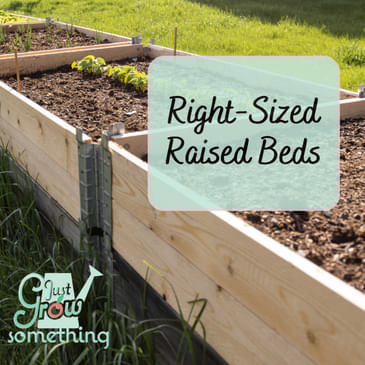
If you are considering adding your first raised bed or yourfiftieth to your garden for next season, now is the time to be doing it. A new raised planter is going to have to be filled and that material is going to have to break down a bit before it can be planted in order to make the nutrients available to your plants. This is NOT something we want to put together at the last minute in the spring just before we start planting.
For the entire month of September, I am taking you step-by-step through starting a new raised bed, from deciding the dimensions and layout, what materials to use to build it, what to fill it with and how, all the way to successfully planting those beds with your first crop in the spring.So, today on Just Grow Something, we’re starting with the basics: how to decide what size and depth your raised bed should be and how it can fit into the overall layout and design of your garden. You just might find they are so versatile, you will eliminate your in-ground beds in favor of an entire yard of raised beds, whimsical planters, and neat little walkways. Let’s dig in!
NEW! For a limited time, save 20% AND get FREE shipping on my favorite planters from PlanterBoxDirect.com. Just use code JUSTGROW20 before October 15th, 2025!
For full show notes, visit https://justgrowsomethingpodcast.com/episode/how-big-should-a-raised-bed-be-ep-265
Karin Velez [00:00:00]:
All right, my gardening friends, if you are considering adding your first raised bed or your 50th to your garden for next season, now is the time to be doing it. A new raised planter is going to have to be filled with something. And generally speaking, that something is going to have to break down a little bit before it can be planted into. And that something often contains commercial compost, which means it's going to need time to be inoculated with the particular microbes that are present in your garden in order to make the nutrients available to your plants. This is not something that we want to put together and then plant into right away. It will not go well for you or your plants. So for the entire month of September, I am taking you through step by step, starting a new raised bed from deciding the dimensions and the layout of what materials to use to build it, what to fill it with, and how, all the way to successfully planting those beds with your first crop in the spring. So today on JustGrow Something, we're starting with the basics.
Karin Velez [00:01:05]:
How to decide what size and depth your raised bed should be and how it can fit into the overall layout and design of your garden. You might just find that raised beds are so versatile, you'll actually eliminate your in ground beds in favor of an entire yard of raised beds and whimsical planters and neat little walkways. Let's dig in. Hey, I'm Karen, and what started as a small backyard garden 20 years ago turned into a lifelong passion for growing food. Now, as a market farmer and horticulturist, I want to help you do the same. On this podcast, I am your friend in the garden, teaching evidence based techniques to help you grow your favorites and build confidence in your own garden space. So grab your garden journal and a cup of coffee and get ready to just grow. See something.
Karin Velez [00:02:43]:
I apologize for the sound of my voice today. If anyone else is dealing with seasonal allergies right now, you are not. Al My head hurts, my eyes are watering, my sinuses are pounding, and my throat feels like I spent the night in, like, a smoky bar screaming at the top of my lungs. My particular weakness is ragweed, and we have three different varieties of them, pretty much uncontrolled on the farm right now, and they're blooming and they're just spitting their grossness all over. It actually truly makes me ready for the first frost to kick in and just eliminate the problem for me. But I'm not ready for the garden to go yet, so I'll just be over here, here, sipping my tea and blowing my nose until it all passes. And speaking of audio, let me start by thanking each and every one of you for sticking it out with me over the past few episodes of trying to nail down the audio for this podcast. A little behind the scenes here.
Karin Velez [00:03:42]:
I have been looking at ways to improve my editing process for this show ever since we added video to Spotify and YouTube, and that eventually involved me buying a new laptop for recording and editing. It was an investment, and I really thought it would free up a lot of my time in terms of the editing, and it did. But the new laptop obviously was built for video and not audio because the sound card, for whatever reason, is really lousy, and my favorite microphone just sounded like I was talking through a cotton ball. So I've been swapping out mics and trying new software and doing all the things to try to make this all work. And in the meantime, the sound quality of the show has suffered. So for all of the episodes where I was too quiet, too loud, too screechy, only recording on one channel, whatever. I really appreciate you hanging around, and hopefully I think we've got it figured out, but your feedback does matter to me. So if we don't have it nailed yet, and I'm using the royal we here because it is just me, myself, and I, please let me know so I can continue to improve.
Karin Velez [00:04:54]:
It makes no sense for me to try and impart all of this gardening wisdom on you if it's a struggle to listen to. So thank you very much for continuing to be here. So generally, when we refer to raised beds or raised planters, we're thinking about, like, boxes maybe, that we have built from wood or other materials, or prefab planters that we assemble on site from things like composites or metal. Like my Planterbox direct boxes. This can also be found materials like tubs and bins that we may want to repurpose, or even old pavers out of the garden that need a new home. So when I'm talking about raised beds or raised planters, this basically just means anything that we are using to contain larger amounts of soil for planting into. But we are talking about things that are larger than like a five gallon bucket that I would consider to be container gardening. And it has its own set of benefits and challenges and we'll just save those for another day.
Karin Velez [00:06:02]:
So before we even jump into this, why would you even want to get started with a raised bed? There are actually a lot of benefits to raised bed gardening. And I didn't really recognize them until really late into my, I guess, gardening journey. And now I am just an absolute proponent of them. The first thing is improve soil quality. You can absolutely customize the soil mix to meet the specific needs of your plants. Whatever it is that you're growing, you can ensure those optimal growth conditions. This is especially handy if you live somewhere where your native soil is not the best or you're living in a suburban area that might be a new home build. And we have no idea what that soil.
Karin Velez [00:06:49]:
And I'm using air bunnies here actually consists of in your, in your backyard. It might have just been fill dirt that was brought in from wherever and just dumped back there and they threw some grass seed out and said, okay, you have a lawn, you don't know what that is. The second thing is you can extend your growing season. So raised beds tend to warm up faster in the spring because obviously there's a lower volume of soil than what would actually be in the ground. So if you're a short season gardener, these might actually allow for earlier planting and a little bit of a longer growing season for you. Raised beds also tend to have better drainage. Now, of course, this is going to depend on how we build it and how we fill it. But because it's an elevated structure, it's going to automatically promote better drainage and that's going to reduce the risk of waterlogging and the possibility of root rot in your plants.
Karin Velez [00:07:40]:
It also gives us easier access to whatever's in the bed. So raised beds can be built at a height that maybe reduces the need a little bit for bending and kneeling, which makes gardening a little bit more accessible. And it also is so good for weed control. It's a defined space, so it actually really helps to keep those weeds at bay. And that of course, allows for Healthier plants and a little bit less stress on the gardener. And the final benefit would be a higher yield. In my personal experience, square foot for square foot, my garden yields more in the raised planters than they do in the fields in the in ground beds. Now, I will venture to say that because of all of the other factors that we just talked about, that all adds up to healthier plants and less competition from weeds, which of course leads to higher yields.
Karin Velez [00:08:37]:
Now, it's not that raised bed dimensions are fundamentally different from our in ground bed dimensions. A lot of the considerations that we talk about with determining, like the width of our in ground beds is also repeated for our raised planters, too. You always want to consider the overall dimensions of your entire gardening space and the tools that you will be using in that space and also in those beds. So if you use row covers or frost cloth or landscape fabric or other weed barriers, any types of trellises or anything that is a defined width, it may be more convenient to pick a bed width that is easy to use with the widths of those tools. Also, think about whether you bring carts or wheelbarrows into your space. Will you need room between the beds for that? Will you need room between the raised bed and maybe your in ground beds? This goes along with keeping in mind the overall dimensions of your gardening space, what is already existing in that space and what you plan to keep, and then also the walkway spacing. Also think about what crops you commonly grow or you intend to grow and what your gardening style is. If you tend to grow like the same vegetables year after year, you might base your bed widths on the way those particular crops grow or are planted.
Karin Velez [00:10:09]:
So corn, for example, if you grow sweet corn for your family every single year, corn needs to be planted in blocks for proper pollination. So you need to make the decision as to whether or not you're going to have several raised beds spaced fairly closely together, and you're going to plant the corn in those. Or if you want a larger, singular square bed, and that's where you're going to plant them. Broccoli, that's another one that grows and needs a lot of space. It gets those very, very wide leaves. And so it might need some extra space. Vining crops. So cucumbers or winter squashes that you're trellising or melons, they're going to need to be sort of to stay in their space within the beds and out of the walkways if they're not trellis.
Karin Velez [00:10:54]:
So this might determine the size of the beds that you need climbing crops like peas and pole beans, they actually need more vertical space than they do horizontal space. So if you're looking at narrower beds like that might be what you're planning to plant in those, you know, skinnier beds. Also, just consider how often you use trellises in your spaces and if you're going to be moving them from one bed to another when you rot crops. These are all things that we need to consider when we are building any garden bed in ground or raised. But with raised beds, there are actually a few other things to consider and the first one is the depth of the bed. Now obviously if we're planting in ground, we seem to sort of have like virtually, you know, unlimited depth, right? Because we're going directly into the soil. Unless you have very, very compacted soil like we do with the clay. It's one of the reasons why I'm starting to plant more and more in raised beds.
Karin Velez [00:11:53]:
Very shallow beds are fine for things like leafy greens or very, very small roots like radishes that don't go very deep. So if you have a found object that you want to use as a raised bed, but it's only, you know, 6 or 8 inches deep, then it's fine, go ahead and use it. But just plan your garden to know that you're going to be growing the shallow rooted things in those containers. For everything else, you really do want a minimum of about 16 inches of soil or 40 centimeters deep. Most plant roots sit around the 4 to 8 inch mark in the soil. And things like carrots or anything with a deep tap root, like that broccoli we talked about, they can go as deep as 10 inches, sometimes even deeper. The goal for our raised beds is to have enough soil volume in the bed to accommodate the roots of the crop that you're growing, hold the plant in place and have enough soil available to hold the nutrients and the water for all the plants in that bed. A shallow bed is going to dry out much more quickly than a deeper one and it may not hold enough nutrients for those more demanding crops.
Karin Velez [00:13:16]:
So this means you're going to have to continue feeding very frequently and add more compost more frequently. The upside to those shallow beds is like, yeah, they're going to be less expensive to fill the first time around and they can cost a little bit less to over overall to install if you're purchasing the components for them. And so if it suits your specific purpose, like again, for those shallow rooted leafy greens, then go for it. I tend to stick with a Fairly standard, you know, 18 inch bed that I can fill about 16 inches with the soil and I just use that for everything. And that way it doesn't matter. I can rotate my crop left and right and it doesn't really matter. I do have some older beds, one in particular that was more shallow and I generally again only use that for very shallow rooted things. And it's fine.
Karin Velez [00:14:05]:
I just have to plan out what I'm going to put in that bed every year. Shallow beds can also be okay if the soil beneath the bed is accessible for those deeper rooted plants. But you would obviously need to break up the soil underneath specifically for any bed that would be shallower than like 10 inches. And of course we're not going to put a bottom on there. And this obviously isn't going to work if you have, if you're putting your raised bed on top of things that are not suitable for growing in. So if you are using raised beds because you're growing in solid clay or you need to go on top of concrete or rocks, and obviously that's not going to work. And there are very deep beds that you can get that are going to make it easier like on your back or for folks who have accessibility issues. So they are much taller and they're really good for perennial plants or very, very deep rooted plants that need to be deeper into the soil.
Karin Velez [00:15:02]:
Just be aware of the width in addition to the depth for these beds because the height of the bed may actually make it more difficult to reach into the center if you have a very wide bed. So let's talk about special considerations for the width in addition to the bed bed depth. The width is equally important. If the bed is too wide, it's not as easy to just like step into the bed to reach the middle because number one, the beds are going to be more elevated than your in ground beds. But also it's not going to be good for the soil in the bed to be stepped on very frequently, which causes compaction. Right. So we want to make sure that we're choosing a width that works within the garden space, but that also allows us to reach the center from any side. And this is where we might want to consider who is using the garden.
Karin Velez [00:15:55]:
So we've already talked. Raised planters are great for giving people access to gardens who may not be easily able to get into an in ground area. So if you're using a walker or a cane or you've got somebody in a wheelchair, the width of the beds for these folks kind of needs to be considered too, because you want the beds to be narrow enough to be able to easily reach into the middle while they're using whatever they're assistance apparatus is, the cane or the wheelchair or whatever. And you also at that point though have to make sure that the walkways are wide enough to accommodate whatever it is that they're using. And so we also want to make sure too if like, especially if you're using a wheelchair, we don't want to make the beds too high. So actually for wheelchair access, the recommended raised bed Height is like 24 inches or 61 centimeters, which is, you know, a good height where it's raised up enough to where somebody seated in a chair can reach over. This is also a consideration if you have folks who are elderly or have back issues who might want to be sitting while reaching into the raised bed. So that 24 inch height is good for sitting on a bench and reaching in.
Karin Velez [00:17:02]:
If you are gardening with children, a narrower bed is easier for little gardeners to get into without climbing into the planter. So if you're trying to get your kids into gardening and you don't really want to go for all of your beds being narrow, you might consider just like giving them their own dedicated bed if you like. For my grandkids, I've got the planter box direct beds that are like 18 inches deep, they're 24 inches wide and they are 72 inches long. So they're like 2 by 6ft. Right? Those are super easy for the little ones to get into and help me when they're little. But after about age 8 or so, they can just as easily reach into the 36 inch wide beds or even the 48 inch wide beds if they're reaching from one side or another. So you might consider just getting a small one for their early years and then later on as they get older, they can absolutely help you. In all of your raised beds there are sort of standard width sizes depending on, you know, who you're ordering through.
Karin Velez [00:18:09]:
If you're ordering like prefab ones, you've got 18, 24, 36, 48, 60, 72. Honestly, the general recommendation is going to be 36 inches wide for most people. You know, 48 inches is probably the max that you want to go. Most prefab companies have multiple widths and lengths to choose from. So just use your best judgment after taking into consideration the details that we just talked about. When you are building your own, your materials may actually help define how wide your beds are. So if you have scrap lumber available to you, and it's like in set sizes. Well, this may dictate the width or the depth of your bed depending on what it is that you're using.
Karin Velez [00:18:50]:
So I mean, I am absolutely a proponent of making the best of what you have found. Materials are great for making res beds and we'll talk about that in more detail in the next episode. Just be sure that you are considering what you're planting in them when you think about depth and how you're using them when you think about the width and the length. And you can have a mix of widths and depths to suit your individual needs in your particular garden space. It doesn't have to be all uniform. I mean, I get it if you're someone who loves a good spring spreadsheet and it tickles your brain to have all of the boxes exactly the same size with the same spacing between them and all the same color. Okay, cool. Go for it.
Karin Velez [00:19:33]:
But if you want a more creative vibe, it's okay to use a mix of materials and colors or buy some planters, but build some other ones out of found materials. The very first beds that we built were all from scrap lumber. It's what we had available to us. And as those beds began to fall apart, I started buying prefab planter boxes from a variety of companies, all in different sizes and depths just to see what I liked the best. The first one was one of those Birdies beds. It was 15 inches deep. It was in a 4 by 6 configuration. 4 foot by 6 foot.
Karin Velez [00:20:11]:
The next one was a really short Vigo. Vego. Vego. I'm not sure how they pronounce it. V, E G O. It was only 8 inches deep in a 3 by 4 size. And that's the one that I referred to earlier that I, I just generally use for shallow rooted things. And then I got another one from another brand.
Karin Velez [00:20:32]:
I can't even remember what it was. It was really tall. It was like 30 inches in a 4 foot by 6 foot size, which I thought I would love because I didn't feel like I would need to bend over. Turns out that I hated it. And we literally cut it in half to make make two 15 inch deep beds. So. And then I finally, I bought a planter box direct bed and. But what I bought was a 5 foot by 5 foot bed.
Karin Velez [00:21:02]:
Thinking again, a bigger planting area would be better. But remember what I said about being able to work in the bed without stepping into the middle and compacting the soil? Yeah. Most times I do have to step into the center of that bed to get things done. So what I have found to be my favorite sizes are are 18 inch deep in a 4 foot by 4 foot configuration. So a basic square box. And I have that two foot by six foot configuration. So these not only align perfectly around the areas that I use them in, but they are super easy for me to work in with plenty of room for trellises if I choose to use them. It's all about what works best for you as the gardener.
Karin Velez [00:21:48]:
Okay, I've talked a bunch of times about my favorite raised planters from planterboxdirect and I've given you a discount code from them so you can experience them yourselves. And I thought since this month is all about creating new raised beds that I would reach out and see if they would sponsor these episodes and they said yes. So shout out to planterboxdirect for being our sponsor this month. But I took it one step further and I asked them for a special code that you can use to save even more on your raised planter order during this special series and they said yes to that too. So from now until October 15th you can use code JUSTGROW20 to save 20 on your order and still get free shipping at PlanterBoxDirect.com. Fall is the perfect time to build your new raised beds and get them ready to plant in the spring. And Planter Box Direct is the perfect place to get them. Tons of sizes, shapes and colors to choose from and super easy to put together so you can be set up and ready to fill those beds the same day that you get them. Get yourself set up for spring with your new raised beds and save 20% with free shipping using code JUSTGROW20@planterboxdirect.com now through October 15th.
Karin Velez [00:23:12]:
The link is in the show notes. Okay, so when you're thinking about the dimensions of your new raised bed or beds, we also need to take our irrigation into consideration. How do you plan to water your garden if you're using drip tape, how easy is it going to be to lay this out in the bed size that you're considering? Are you using low lying sprinklers? If so, how will these be placed in the bed? Are you going to move them? Are they going to stay in place? If you're planning on multiple beds, will you put put like permanent irrigation systems into the beds for the entire season and how is that going to work linking them from bed to bed? These are all considerations in terms of the size of our beds, but also how we Lay them out in the garden space. If you're hand watering, could you reach the center of the bed really easily with a heavy watering can or a hose, without straining or without stepping into the bed and compacting that soil? These are all considerations for deciding how wide and how long the bed or beds will be. We also do need to talk about that layout. Once you have sort of figured out what you think the ideal size would be for where you're gardening and how you're gardening and what you're growing, the next thing is to figure out the placement. So the layout of your raised beds is important for how you access the beds and the width of the space in between the beds themselves and any in ground gardening space that you plan to use, plus any other structures as they're all important. If you use wheelbarrows or you use carts of some sort to move things in and out of the gardening space, how will the bed layout work with that? Will they be positioned so that you have access to that water, the irrigation we just talked about? Right.
Karin Velez [00:25:06]:
The absolute easiest way to answer all of these questions is to get out into the space, measure it out, and physically see how things will look and feel. Grab a measuring tape and a notepad and measure out the entire space and draw a little map of how it currently looks, and then sit down and sketch out how you think you want it to look with the raised beds or the other planters in that space. Then here, this is the fun part. Okay. Make life sized models of those planters or those other containers. Use cardboard or newspaper, or just mark out the space with like a rope or the garden hose or something so that you can not only visibly see what the beds will look like when they're in place, but you can also walk in between them and see if that's going to work for you. Bring a wheelbarrow in there if that's what you're using, or a garden cart or a bench, whatever it is that you use. I have made this mistake.
Karin Velez [00:26:10]:
I have put beds too closely together in an effort to fit more into a small space. And I thought to myself, oh, that'll be fine. I'll just squeeze in there and do what I need to do. But in the middle of the summer, when the plants are overflowing from the beds and the weeds have come up in between the beds in a space that is too small to mow or hardly even put wood chips down into, and I'm scooting along between the beds to try and harvest in the heat and the Humidity with the plants smacking me in the face. Yeah, it was not fine. So learn from my mistakes, lay it out ahead of time and make it a comfortable place to work and not one that is so frustrating that you get sick of the space and just abandon the cherry tomatoes to languish in the summer heat because you're absolutely over it. Yes, that happened. And it wouldn't have if I had thought about my spacing a little bit more thoughtfully and maybe less aggressively.
Karin Velez [00:27:03]:
The other thing to keep in mind when you're doing your little sample layout is orientation and sunlight Light where you place your beds matters. For the best light exposure. We want to aim for a location that gets at least six hours of direct sunlight, preferably eight if you can manage it. And we've talked about this before, it can be broken up. You can get four hours of morning sun and two hours in afternoon sun or whatever. But if you have long rows and you're gardening in the northern hemisphere, you're going to want to orientate those beds north to south so that you prevent the taller crops from shading the shorter ones. Unless you want to do that intentionally because you're trying to protect them from the sun. If your space is limited, then again you're going to choose a spot with morning sun and a little bit of afternoon shade to reduce the heat stress.
Karin Velez [00:27:53]:
It's also important to know if the sunlight availability in this particular spot changes throughout the season. You thought we were going to get through an episode without me mentioning your garden journal? Think again. This is where a garden journal comes in. Clutch. If you've taken notes about the sunlight availability in the areas of your garden in the spring versus the summer versus the fall, then you'll know where to best place your new raised beds to take advantage of the best light during the time of the season when you want it most. What do I mean by this? I'll give you an example. I have a bed in one of my gardens that we call the barn bed because it's right next to the barn and right now it's an in ground bed. But I actually have plans for turning this into a raised garden bed area with cute little pathways and an herb spiral.
Karin Velez [00:28:47]:
More on that Another episode. The important thing to know here is that the light exposure in that bed changes dramatically with the season. Because the barn is on the east side of that bed, the bed is shaded in the morning morning. There are also trees across the path on the west side of that bed. So in the spring when those trees don't have their leaves yet. And the sun is lower to the south. That bed gets six to eight hours of sun. Full sun.
Karin Velez [00:29:18]:
It's a fantastic place for me to grow early spring crops like lettuce that will vacate that bed fairly quickly. But as soon as the trees fill in and the sun moves further to the north, that bed now gets about. About six hours of daylight. But it is heavily shaded in the afternoon. That works to my advantage with the early spring crops that need to be in the bed a little bit longer but that don't appreciate the afternoon heat. So things like bok choy that will bolt if they get too hot too quickly. Now in the late summer, moving into fall when the sun starts to move back into the south. But.
Karin Velez [00:29:59]:
But those trees all still have all of their leaves. That spot only gets about four hours of daylight. And the row closest to the barn really only gets about three hours. That is not a good spot for me to plant anything that I will want to harvest in the fall. It just doesn't get enough sun for fast enough growth. But it does make it a good contender for something that I would want to overwinter for a spring crop. So something that would grow slowly and hold like kale or spinach or something like onions or garlic that just need to settle their roots in for the winter but will take full advantage of that early spring sun. That's what I mean about keeping detailed notes about sunlight availability for the areas of your garden that see changes in the daylight.
Karin Velez [00:30:53]:
Knowing what I know about that bed, I know that any raised planters I choose to put there, there are not going to be where I plant my tomatoes or my peppers. But it would be great spots to put lettuce and arugula and spinach in the spring interplanted with like some kohlrabi or some bok choy with a good cover crop through the summer and then planted in the fall to the overwintered crops. For my tomatoes and my peppers and my sweet corn and my green beans, I'd choose another area to put my raised beds. That's what I mean by place your new raised beds to take advantage of the best light during the time of the season when you need it most.
Karin Velez [00:32:37]:
Okay, so maybe that's a little information overload for you. So let's break it down Barney style When deciding on a raised planter size, consider the following what you're planting how much space you need to work in and around the bed based on the tools that you use, who is working in the bed, if there is anyone in your house with different needs, where you'll be placing the bed in terms of orientation to the sun, and how you will irrigate the beds, that should give you a pretty good idea of how deep the bed should be and what width and length will work best for you. A good all around general purpose bed should hold at least 16 inches of soil for most vegetables and be around 36 inches wide as long as you need it to fit your space. If you can create a mock up of that size and place it in the space that you plan to garden, you will have a really good idea if it will work for you or not. So next week we will talk about all the ways that we can build a raised bed and what kinds of materials we can safely use, including busting a very common, often repeated myth about using certain types of wood wood. Until next time my gardening friends. Keep on cultivating that raised planter garden and we'll talk again soon.