
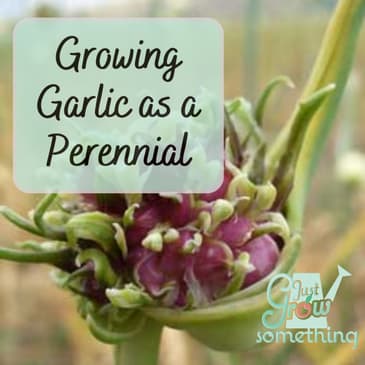
Right about now is the time that some of us are looking at getting our garlic cloves into the ground for next summer’s harvest. It really is a pretty simple crop to grow but it seems like seed garlic is getting more and more expensive to purchase. I generally save the best specimens from this year’s harvest and plant it in the fall, but our bulbs this year were far from impressive, none of them really worthy of saving (remember, we save the best and eat the rest) and I found myself having to order a lot of seed garlic this year. So on this episode of Just Grow Something I’m digging further into the idea of a perennial garlic bed.
This is something I explored a couple years ago and that I did unintentionally in my garlic bed from last year. So, I’ve gone down a rabbit hole of different ways to get a perennial harvest from one bed of garlic. It’s not as foolproof as, say, asparagus, where you plant it once and then just continue to harvest for the next 30 years. But, there are a whole host of ways to enjoy that garlic flavor we love while also protecting ourselves from the inflation that seems to be happening with seed garlic. Just one more way to become more self-reliant in our own gardens. Ready to tackle garlic as a perennial crop? Let’s dig in!
Resources and References:
Ep. 67 - When and How to Plant Your Garlic, Plus Tips for Warmer Climates
Just Grow Something Gardening Friends Facebook Group
Check out how you can become a patron on Patreon
Hosted by Simplecast, an AdsWizz company. See pcm.adswizz.com for information about our collection and use of personal data for advertising.
00:00:01
This is positively farming media right about Now is the time that
00:00:05
some of us are looking at getting our garlic cloves into
00:00:08
the ground for next summer's harvest.
00:00:10
It really is a pretty simple crop to grow, but it seems like
00:00:13
seed garlic is getting more and more expensive to purchase.
00:00:17
I generally save the best specimens from this year's
00:00:20
harvest and planted in the fall, but our bulbs this year were far
00:00:24
from impressive. None of them were really worthy
00:00:26
of saving. Remember, we save the best and
00:00:28
we eat the rest, and I found myself having to order a lot of
00:00:32
seed garlic this year. So on this episode of Just Grow
00:00:35
Something, I'm digging further into the idea of a perennial
00:00:39
garlic bed. This is something I explored a
00:00:41
couple of years ago and that I did unintentionally in my garlic
00:00:45
bed from last year. So I've gone down a rabbit hole
00:00:48
of different ways to get a perennial harvest from one bed
00:00:52
of garlic. It's not as foolproof as, say,
00:00:55
asparagus, where you plant it once and then just continue to
00:00:58
harvest for the next 30 years. But there are a whole host of
00:01:02
ways to enjoy that garlic flavor we love while also protecting
00:01:06
ourselves from the inflation that seems to be happening with
00:01:09
seed garlic. Just one more way to become more
00:01:12
self reliant in our own gardens. Ready to tackle garlic as a
00:01:16
perennial crop? Let's dig in.
00:01:18
Hey, I'm Karen and I started gardening 18 years ago in a
00:01:21
small corner of my suburban backyard when we moved to A5
00:01:24
acre homestead. I expanded that garden to half
00:01:26
an acre and I found such joy and purpose in feeding my family and
00:01:30
friends. This newfound love for digging
00:01:32
in the dirt and providing for others prompted my husband and I
00:01:35
to grow our small homestead into a 40 acre market farm.
00:01:38
When I went back to school to get my degree in horticulture, I
00:01:41
discovered there is so much power in food and I want to
00:01:44
share. Everything I've learned with as
00:01:46
many people as possible. On this podcast we explore crop
00:01:49
information, soil health, pests and diseases plant.
00:01:52
Nutrition, our own nutrition, and so much more in the world of
00:01:55
food and gardening. So grab your garden journal and
00:01:58
a cup of coffee and get ready to just grow.
00:02:01
Something now I did a full episode on garlic way back in
00:02:07
episode 40, and I will link to that in the show notes.
00:02:10
But let's do a quick overview on how we generally plant garlic as
00:02:15
an annual before moving on to talking about it as a perennial.
00:02:24
Garlic is a cool season crop, being planted very late in fall
00:02:29
or early in the winter and not harvested until about six months
00:02:32
later in the late spring or early summer.
00:02:35
Since planting is done in the fall, the early to Midsummer is
00:02:40
when you're going to end up ordering your seed garlic.
00:02:43
And let me tell you, I saw some astronomical prices on seed
00:02:47
garlic this year, and for the third year in a row it seemed to
00:02:50
be in shorter supply than before.
00:02:53
Now your first garlic crop should come from certified seed
00:02:57
garlic. So this is just to make sure
00:02:59
there are no diseases or anything coming along for the
00:03:01
ride when you plant. But once you get your first
00:03:03
crop, it is OK to cure the best ones and use those as your seed
00:03:08
garlic for the next season, just so long as there hasn't been any
00:03:10
kind of indication of disease. But if you're starting from a
00:03:14
very small amount of seed garlic, it may take you a year
00:03:17
or two to kind of build up the size of your crop to be able to
00:03:21
hold back enough to plant and also have enough to eat until
00:03:24
the next batch is ready. So there are two different types
00:03:27
of garlic. There's hard neck and soft neck.
00:03:30
The most obvious difference between them is their
00:03:32
appearance. The hard necks are called that
00:03:35
because they have a long flowering stem that grows
00:03:38
through the center of the bulb and it is very hard.
00:03:41
This flowering stock is called the scape.
00:03:44
Now generally the scape is removed from the bulb to force
00:03:47
the energy into the bulb growth rather than allowing it to
00:03:50
flower. This is important information
00:03:52
for us to know for later, so hold on to that.
00:03:55
Soft neck cultivars, on the other hand, yield A generally
00:03:58
larger bulb and a larger number of clothes than the hard neck,
00:04:02
and these are the types that you generally are going to see in
00:04:05
the grocery store. This much higher number of
00:04:08
cloves is likely a reproductive compensation for the lack of
00:04:12
that flowering stock. Soft necks do not usually
00:04:15
produce escape. Now, under stressful conditions
00:04:19
they may partially bolt and they'll grow a short pseudo stem
00:04:23
which will subsequently produce a smaller number of bulblets.
00:04:26
But this is the exception rather than the rule.
00:04:29
So generally if we want scapes, we want hard neck garlic.
00:04:34
Now, generally speaking, hard neck varieties tend to grow
00:04:37
better in areas with more severe winters because they require a
00:04:41
greater period of vernalization than soft neck cultivars.
00:04:45
So vernalization is the number of hours beneath a certain
00:04:48
temperature that it will need in order to be able to produce a
00:04:51
crop the next season. So a prolonged period of cooler
00:04:54
weather is ideal for hard necks. Soft necks, on the other hand,
00:04:59
tend to perform better in areas where the winters are milder.
00:05:03
So where I am in zone 6A, we can grow both hard neck and soft
00:05:07
neck. We're kind of right along that
00:05:09
line, and I usually do grow both just to make sure that I get
00:05:14
something because we can have some really brutal winters
00:05:18
sometimes and then sometimes it's pretty warm.
00:05:21
I did plant both last fall and just all of my bulbs performed
00:05:25
poorly this year. But I think that was more of a
00:05:28
lack of moisture than anything else and maybe a problem with my
00:05:32
soil composition in that bed. So let's talk planting.
00:05:37
The way we plant our initial crop is going to be the same
00:05:41
whether we plan to grow it as an annual or a perennial.
00:05:44
And it's relatively simple. Separate the cloves and leave
00:05:53
the skin intact. Space the cloves 4 to 6 inches
00:05:57
apart in rows spaced 12 to 18 inches apart.
00:06:01
The cloves should be planted with the pointed end up and the
00:06:04
blunt end with the roots down. Push each clove one to two
00:06:09
inches into the ground, firm the soil gently around it and that's
00:06:12
basically it. If you're gardening north of
00:06:15
zone 7, you'll want to heavily mulch your garlic to avoid frost
00:06:19
damage and frost heave. A good four to six inches of
00:06:23
straw or chopped leaves is a great mulch for garlic.
00:06:26
It will slowly flatten out as the winter progresses, and it
00:06:29
will not only protect the garlic cloves, but also provide a great
00:06:33
weed barrier in the spring when the growth starts again.
00:06:36
You know if you're in a climate that doesn't see a lot of heavy
00:06:39
freezes, the mulch may not be necessary, but I still recommend
00:06:43
at least a thin layer to help with the weeds and to help
00:06:46
retain moisture. Depending on when you plant, you
00:06:50
may see a little growth begin in the late fall and that's okay.
00:06:53
Frost damage on the early green growth that pops up isn't going
00:06:57
to be detrimental to the plant. The plant will go dormant and it
00:07:00
will begin growing again in the spring.
00:07:03
Now, if you want to be sure there isn't any above ground
00:07:06
growth in the fall, just plant as close to your Persephone
00:07:09
period as possible. That's the period where the
00:07:10
daylight hours drop below 10 hours per day.
00:07:14
Just make sure you plan to get the garlic in the ground before
00:07:18
it freezes solid or you'll be planting in the spring, which is
00:07:27
a good point. If you miss the planting dates
00:07:29
in the fall or you don't get your seed garlic ordered in
00:07:32
time, you can absolutely plant in the spring.
00:07:35
Just know that the bulbs won't get nearly as big as they would
00:07:38
if you plant in the fall. But hey, any crop of garlic is
00:07:41
better than no crop. So now that it's planted, how do
00:07:46
we turn our annual garlic crop into a perennial?
00:07:50
Well, first we need to be sure we're using hard neck garlic.
00:07:54
Remember, hard neck garlic produces a scape, and we remove
00:07:58
that scape before it opens in order to focus the plant's
00:08:01
energy into creating a nice sized bulb.
00:08:04
But if we leave that scape intact, it produces an humble
00:08:09
this is the flower, and it's actually a terminal pod that
00:08:13
produces bulbs or bulblets. Those bulblets are little clones
00:08:19
of that same garlic bulb that's growing under the surface of the
00:08:21
soil. It's not a seed.
00:08:23
It's literally a tiny little clove and there can be anywhere
00:08:27
from 20 to 200 of these little bubblets in each humble and
00:08:32
that's on just one scape. So these tiny little cloves can
00:08:37
be removed from the scape and used in the same way we use the
00:08:41
garlic cloves that we grow underground.
00:08:43
The flavor is very similar, they're just smaller.
00:08:47
But if we leave them on the scape for longer and we harvest
00:08:51
them when they're mature, well, now they can be planted in the
00:08:56
same way as the individual cloves.
00:08:59
They need at least two seasons and sometimes a little bit more
00:09:01
before they produce an actual differentiated bulb like we're
00:09:04
used to seeing. But that's a lot of return from
00:09:07
one garlic scape 20 to 200 cloves.
00:09:11
So that's just one way that we can get a bunch more garlic out
00:09:16
of our initial planting. The 2nd is to just leave some of
00:09:21
that garlic unharvested in the bed.
00:09:24
This is what I did unintentionally last season, and
00:09:28
this spring I had a bunch of garlic clusters sprouting up
00:09:32
where my garlic was last year. So what happened was each clove
00:09:36
of each of those forgotten garlic bulbs sent up a new
00:09:39
sprout in the spring. So when you plant garlic, you
00:09:42
plant those individual cloves, but these were never separated,
00:09:45
so they just came up as a dense patch of garlic shoots.
00:09:49
Just leave these alone. After a few years, that one
00:09:53
single garlic clove is going to have dozens of garlic shoots
00:09:58
sprouting in these small patches of soil in the garden.
00:10:02
These individual shoots can be pulled off of that cluster
00:10:05
anytime and used as green garlic.
00:10:07
This is similar to how we would use a green onion.
00:10:10
The flavor is less garlicly than a full size clove, but it's
00:10:13
definitely there. And then whatever we leave in
00:10:17
the ground, whatever remains of that clump of garlic is going to
00:10:21
produce scapes later in the season.
00:10:24
So then we can harvest those and use them as our regular garlic
00:10:28
scapes, or harvest only some of them and allow the rest to
00:10:33
produce those moblets. So as they dry, they may drop
00:10:36
off the plant and reseed themselves right next to the
00:10:39
clump that's already growing and you have a separate clump
00:10:42
starting the next season. So it's self seeding, it becomes
00:10:47
a perennial. You can also pull these clumps
00:10:50
up in the spring and separate out those individually sprouted
00:10:55
cloves and then replant them in the typical 4 inch spacing apart
00:10:58
from each other and allow them to grow the rest of the summer
00:11:01
to be harvested as those differentiated bulbs.
00:11:04
They'll take a little bit longer to get to maturity than fall
00:11:07
planted cloves and they may not get as big, but they will be
00:11:11
bulbs of garlic just like what you would expect.
00:11:14
There are lots of options here. And yes, I said that if you're
00:11:18
in a warmer climate you likely need to plant soft neck
00:11:21
varieties, but that's if you're determined to get those big
00:11:25
differentiated bulbs. You can absolutely plant hard
00:11:29
neck as a perennial in warmer climates and allow them just to
00:11:32
remain in the bed. You'll have green garlic to
00:11:35
harvest practically year round, and choose to plant some soft
00:11:39
neck alongside them for those bigger bulbs if you want to.
00:11:43
I think growing garlic as more of a perennial crop solves a
00:11:47
couple of problems for us. If what you're going for is the
00:11:50
flavor, you're definitely getting that, even if it's not
00:11:53
from what we would consider a traditional clove.
00:11:56
The bulblets are full flavored and can be harvested and dried
00:12:00
very easily, and they're super easy for grinding into garlic
00:12:03
powder. Allowing the garlic to grow in
00:12:06
clusters takes a lot less effort on the part of the gardener, and
00:12:10
allowing some of the scapes to remain intact gives us an almost
00:12:15
endless supply of seed garlic without ever having to buy
00:12:19
another bulb again. I'm going to move those clumps
00:12:26
from last season into a more permanent home at the same time
00:12:31
that I'm planting my fall garlic next week.
00:12:33
I'll let those clumps do their thing in their own bed, and I
00:12:37
will have a nice little perennial patch from here on
00:12:40
out. Let me know if you plan to try
00:12:42
this too. Until next time, my gardening
00:12:45
friends, keep on cultivating that dream garden and we'll talk
00:12:48
again soon. You.
00:12:49
Just finished another episode of the Just Grow Something podcast.
00:12:52
For more information about today's topic, go to just.
00:12:55
Growsomethingpodcast.com where you can find all the episodes,
00:12:58
show notes, articles, courses, newsletter, sign up and more.
00:13:01
I'd also love for you to head. To Facebook and join our
00:13:04
gardening community in the Just Grow Something Gardening Friends
00:13:07
Facebook group. Until next time, my gardening
00:13:09
friends keep learning and keep growing.