
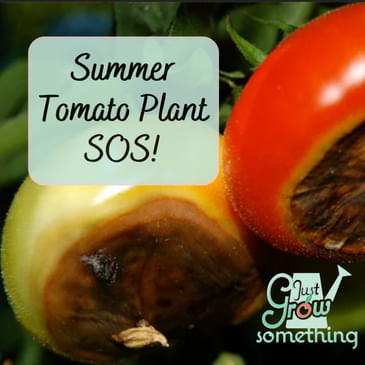
Is your summer tomato crop struggling with strange spots, brown mushy bottoms, or mysteriously vanishing leaves? You’re not alone! Mid-season brings a whole host of challenges for tomato gardeners, but with a little know-how, you can keep your plants thriving through to fall.
Today on Just Grow Something, I dig deep into the four biggest summer tomato problems: blossom end rot, tomato hornworms, nutrient imbalances, and common leaf diseases like Septoria and early blight. Learn how fluctuating moisture leads to blossom end rot (hint: it’s not just about calcium!), practical mulching and watering tips for every growing setup, including containers, raised beds, and in-ground gardens, and why choosing the right fertilizer at the right time can make all the difference.
I share a trick for spotting hornworms at night, how often to feed tomatoes in pots vs. beds, the signs and treatment of tomato leaf diseases, and the most effective organic control methods (from copper sprays to simple sanitation practices). I also share how to manage disease outbreaks, when to prune, and why fall tomato harvests are totally worth the effort.
Whether you’re a first-time tomato grower or a seasoned gardener facing a tough summer, this episode is packed with easy, practical solutions to keep your plants producing. Let’s dig in!
Save 20% on your new own-root rose plant at Heirloom Roses with code JUSTGROW at https://heirloomroses.com
References:
00:00:00
OK, my gardening friends, today we are talking tomatoes.
00:00:03
Specifically, what in the world is going on with your tomatoes
00:00:07
in the middle of the summer? So if the bottoms of your fruit
00:00:11
are turning brown and mushy, if the leaves have been
00:00:13
mysteriously disappearing overnight, the plants just look
00:00:17
pale and puny, or they are suddenly covered in funky spots,
00:00:22
hang tight. We are digging deep into what I
00:00:25
would consider to be probably the four biggest Midsummer
00:00:28
tomato problems Based on what you all send to me, Blossom and
00:00:33
rot, hornworms, nutrient imbalances and diseases.
00:00:38
So today on Just Grow Something, I'm going to break it down with
00:00:41
practical steps that you can take whether you're growing in
00:00:44
ground, in raised beds, or in containers.
00:00:47
Let's dig in. Hey, I'm Karen, and what started
00:00:49
as a small backyard garden 20 years ago turned into a lifelong
00:00:53
passion for growing food. Now as a market farmer and
00:00:56
horticulturist, I want to help you do the same.
00:00:58
On this podcast, I am your friend in the garden teaching
00:01:01
evidence based techniques to help you grow your favorites and
00:01:04
build confidence in your own garden space.
00:01:07
So grab your garden journal and a cup of coffee and get ready to
00:01:09
just grow something. So I get direct messages all the
00:01:17
time with pictures from people, especially this time of year
00:01:20
when it's like, Oh my gosh, what is going on with my tomato
00:01:24
plants? I also see this in a lot of the
00:01:26
Facebook groups that we're part of.
00:01:28
I haven't seen very many this year in the Just Grow Something
00:01:31
gardening friends Facebook group, which hint, hint, nudge,
00:01:34
nudge, if you're not in there, get in there.
00:01:37
So either I have educated you guys a lot about this and nobody
00:01:40
has any problems or it's just that, you know, you're not
00:01:43
asking in the group. But these are all the things
00:01:46
that I see, especially with beginning gardeners or somebody
00:01:49
who hasn't grown tomatoes before that they start to freak out
00:01:52
about. So that first one is blossom and
00:01:55
rot. Generally speaking, we can see
00:01:57
this at two times the year. Sometimes it is very, very early
00:02:02
in the season if you are living in a very rainy area or an area
00:02:07
where that you get like the heavy spring rains to start
00:02:09
with. And oftentimes this is shortly
00:02:11
after you have gotten your tomato plants in the ground.
00:02:14
That fluctuating water is going to tend to produce some blossom
00:02:18
and rot, at least in the first few fruits.
00:02:21
But then the plant kind of acclimates and it gets its thing
00:02:23
going. But then we also can see that
00:02:25
again here in the Midsummer and leaning in towards the late
00:02:30
summer, blossom and rot is a calcium deficiency, but it is
00:02:35
not a deficiency necessarily with the soil.
00:02:39
We don't necessarily have low soil calcium.
00:02:43
It is actually a physiological disorder disorder that is caused
00:02:48
by a calcium deficiency in the fruit itself.
00:02:51
Calcium is notoriously slow moving in soil and in plants.
00:02:58
This has a lot to do with its charge, the charge of the atom.
00:03:02
But essentially when we have fluctuating water availability,
00:03:08
that is going to block the calcium uptake.
00:03:12
So even if your soil has plenty of calcium in it, the plant
00:03:17
can't access it as well. And So what you'll see is these
00:03:22
sunken brown or black patches at the fruit blossom end, hence the
00:03:29
term blossom end rot. And oftentimes this starts to
00:03:33
happen around the mid summer. This, by the way, is not
00:03:38
restricted to tomatoes. You can get this in your
00:03:41
squashes, your zucchinis. You can get them in eggplant or
00:03:44
Peppers. So this isn't just, you know,
00:03:46
relating to our tomatoes, but it is something that we see most
00:03:49
frequently in tomatoes. The way to combat this number
00:03:54
one is by using mulch. If you can mulch really, really
00:03:58
heavily, that is going to help keep that soil moisture more
00:04:03
consistent. And then if you are having to
00:04:06
water once again, less frequent, more thorough waterings, we, we
00:04:11
want the roots to have access to the water.
00:04:15
That's what we mean by consistent moisture, not
00:04:18
necessarily that you are watering all the time.
00:04:22
We want to water deeply, but we want it to be sort of that
00:04:26
access to be fairly even. So less frequent, more
00:04:29
thoroughly, so deep and regular, but not short and sporadic
00:04:34
essentially is what we're going for.
00:04:35
OK, that's for your in ground beds, but also for your raised
00:04:39
beds. I mean, the same rules apply in
00:04:41
terms of using mulch to help trap that moisture and also to
00:04:44
keep the root zone cooler. But also in, in raised planters,
00:04:49
we want to double check our drainage.
00:04:51
So make sure that the runner, the water is not running off
00:04:55
before it soaks in, or make sure that you know when you're
00:04:58
watering very, very deeply or you're getting a very deep
00:05:01
rainfall that the bottoms of those beds are draining properly
00:05:05
as well. You don't have that those roots
00:05:07
sitting in water all the time. It's kind of a double edged
00:05:11
sword, like too dry and the calcium can't move, too wet and
00:05:15
the calcium can't move. So we just want to make sure
00:05:17
that it's a consistent level of moisture.
00:05:19
And then with containers, you might actually see this a little
00:05:24
bit more frequently than those of us gardening in like raised
00:05:28
beds or in ground. So because it is a little bit
00:05:32
more difficult sometimes to manage the moisture level in
00:05:36
pots. So I would always recommend
00:05:38
planting in the largest container you can for the plant
00:05:42
that you are growing. So for tomatoes, I would
00:05:45
recommend something that's a minimum of 5 gallons.
00:05:48
If you can get away with 10 gallons, that's even better if
00:05:51
that larger volume of soil is going to allow you to hold on to
00:05:55
more of that moisture. And so that's going to be better
00:05:58
for the plant. I would also recommend using a
00:06:02
balanced slow release type of a fertilizer that includes some
00:06:06
calcium because once again, remember we have a limited
00:06:10
volume of soil, which means that soil can hold a limited amount
00:06:14
of nutrients. So we need to be replacing those
00:06:17
nutrients. And oftentimes, you know,
00:06:19
potting soil and stuff isn't going to include a ton in terms
00:06:23
of calcium. So you want to make sure that
00:06:24
you are including some of this. Now you might hear, you know,
00:06:28
people talking about adding crushed egg shells or even a
00:06:30
Tums tablet that sort of can help, but it it isn't going to
00:06:35
help immediately. It's something that you would
00:06:37
want to do like as you are putting the soil together at the
00:06:40
beginning of the season or when you're planting the plant, so it
00:06:43
gets a chance to break down and release into that soil.
00:06:46
So just look for amendments that actually have some calcium in
00:06:52
them or something that says it's got the micronutrients right.
00:06:54
Once you see this blossom and rot on the fruit, there is no
00:06:59
way to reverse it. So you immediately just need to
00:07:03
go ahead and pull that fruit. If you want to, you can cut that
00:07:07
part off and the rest of it's going to be fine.
00:07:09
Obviously you have to use it right away.
00:07:12
So once you see it happening, you want to sort of take these
00:07:15
steps to make sure that you have a really good mulch around there
00:07:19
you are, you know, kind of seeing what the the moisture
00:07:23
level is like. Now, obviously, if you've been
00:07:24
in an area like us where it has just dumped buckets of rain off
00:07:29
and on it it the most of the summer, then there's only so
00:07:32
much you can do to fix that. Mulch is going to help.
00:07:36
So if you have a good layer of an organic mulch, this is going
00:07:39
to help to slow some of that water down and it gives the
00:07:43
chance of the soil to be able to absorb it rather than it just
00:07:47
running off and then hold on to it.
00:07:49
So this is going to help you a little bit, but at some point,
00:07:52
you know, the soil can only take so much and there's only so much
00:07:56
you can do. So, but if it's a case of
00:07:59
watering, then you can prevent the next fruit from getting that
00:08:04
blossom and rot if you can modify what it is that you are
00:08:07
doing as the gardener. OK, the second thing is those
00:08:12
tomato hornworms, If you've never experienced these guys
00:08:18
before it, it is amazing the devastation that these little
00:08:24
buggers can do just overnight. It can completely strip the
00:08:29
foliage off of a plant just in the overnight hours.
00:08:34
They're like these little ninjas right?
00:08:36
One day your plant looks fine, the next day you come out it
00:08:38
looks like someone took a weed whacker to them or just went
00:08:40
through and cut all of the the leaves off It's insane.
00:08:43
If you have seen these guys they are big fat green caterpillars.
00:08:49
They have a horn like thing on them.
00:08:52
That's hence the term hornworm. They blend in to your plants
00:08:57
like camouflage. You really have to know what you
00:09:00
are looking for when you are looking for these guys.
00:09:03
And they will mow down leaves, they will munch on the fruit and
00:09:08
they leave behind little dark droppings.
00:09:11
This is like their calling card. You almost know that you have a
00:09:14
hornworm before you see the defoliation.
00:09:16
If you recognize the worm poop, OK, This is how you handle them
00:09:20
because they have to be handled. They are so destructive.
00:09:23
It's it's it's crazy. A little trick that I learned
00:09:27
was to take a black light out after the sun goes down.
00:09:31
Hornworms glow neons on green under UV light and so if you go
00:09:38
out with a handheld black light after dark, you will be able to
00:09:42
very easily see them and then just hand pick them off.
00:09:46
OK, if you are squeamish, you are going to want to have gloves
00:09:51
on. Even if you're not squeamish,
00:09:53
you might want to have gloves on because these guys can really
00:09:56
grab on and you it's just very disconcerting to have them like
00:10:01
grab onto you while you're trying to throw them into your
00:10:03
bucket or whatever. OK, so, but you as soon as you
00:10:08
see this defoliation starting to happen, you need to go out and
00:10:11
inspect like every day, OK, because they, they likely there
00:10:17
are more of them than what you might think.
00:10:19
So check them early in the morning if you can look again in
00:10:22
the evening. If you've got the black light,
00:10:24
go ahead and use the black light.
00:10:25
They're going to glow like a neon sign.
00:10:27
Trust me. But if you don't have the time
00:10:29
to be doing that after dark, then just be vigilant about
00:10:31
going out there every time you're in your garden and just
00:10:35
look for them. Pick them off by hand, drop them
00:10:37
in some soapy water, or if you've got chickens, feed them
00:10:40
to the chickens. I will caution you, people have
00:10:43
said to hang on to the hornworms and for people who have bearded
00:10:47
Dragons so they can feed them to their bearded Dragons, please
00:10:50
don't do this. Because if those hornworms have
00:10:52
been feeding on the tomatoes or even your Peppers, I've had them
00:10:56
stripped by Peppers too, that means that they have been eating
00:11:00
a nightshade. And this can actually be toxic
00:11:03
to the lizards if they eat these hornworms.
00:11:06
So if you see that somebody is buying hornworms, most instances
00:11:10
these hornworms have actually been grown specifically to feed
00:11:14
to these bearded Dragons. And they aren't ones that have
00:11:17
been growing up wild and, and eating on these, you know, these
00:11:21
plants that can be toxic to them.
00:11:22
So don't do it that way. But their chickens, the chickens
00:11:24
aren't going to have any problem with them.
00:11:25
They can't eat enough of them to make them sick and if you have
00:11:31
your plants are in containers and you can isolate the affected
00:11:35
plant immediately, that makes it easier for you to keep them from
00:11:39
spreading until you actually can find them on the plant.
00:11:42
I'm telling you they are. They are really good at
00:11:44
camouflaging themselves so just check frequently and and get rid
00:11:48
of the little buggers as soon as you find them.
00:11:50
As a new rosebush Mama, I have been keeping an eye out for
00:11:54
pests and diseases in my plant from heirloom roses as it goes
00:11:58
through its first full season here.
00:12:00
The weather has been crazy wet and the humidity is high and
00:12:05
that's usually the perfect breeding ground for things like
00:12:07
black spot and surprisingly I haven't seen any problems thus
00:12:11
far. But if this is something that
00:12:13
you've struggled with, it helps to be sure that we are watering
00:12:16
at the base of the plant to keep the foliage dry, removing any
00:12:19
infected leaves so the fungus doesn't spread, and don't
00:12:22
compost those. Please get rid of them and be
00:12:25
sure to clean our pruners between cuttings to avoid
00:12:28
spreading it to other plants. Now, I've also been watching out
00:12:31
for aphids, which are notoriously attracted to roses,
00:12:34
which I did see early on on my plant, but I knocked them down
00:12:38
with a spray from the hose and waited for the ladybugs to come
00:12:41
in and do their job, which they did.
00:12:43
But there are sprays that you can use and beneficial insects
00:12:45
that you can purchase if you have a lot of roses and a lot of
00:12:49
these issues. In fact, heirloomroses.com has a
00:12:52
selection of recommended treatment items on their
00:12:55
website, including fungicides, natural insecticides, and even a
00:12:58
beneficial insect subscription. They truly do care about the
00:13:02
fate of your roses and they are ready to help.
00:13:05
It is not too late to get your own beautiful rose Bush settled
00:13:08
in this season by going to heirloomroses.com and using code
00:13:12
Just GROW to Save 20% at checkout.
00:13:15
I have bookmarked several new varieties to add to my garden
00:13:19
this year because I've been so impressed with how healthy and
00:13:21
resilient mine is, even while being grown in a container in a
00:13:26
very disease and pest prone location. heirloomroses.com with
00:13:30
code Just grow at checkout to save 20% on your new rosebush.
00:13:35
The link is in the show notes. So the third thing that we might
00:13:38
see at this point in the season is nutrient imbalances.
00:13:43
You know, our tomato plants by this point likely have been
00:13:46
fruiting pretty heavily and that heavy fruiting can deplete the
00:13:51
nitrogen and the iron and the magnesium in the soil and also
00:13:56
from within the plant. So you might start to see some
00:13:59
pale or yellowing leaves. This might signal that it's time
00:14:05
for you to give them a little bit of of food, some plant food,
00:14:08
or to amend that soil in some way.
00:14:10
Just be aware to not overfeed. We don't want excess nitrogen,
00:14:15
OK, because we're going to get a whole bunch of less lush
00:14:19
foliage, but we're not going to get much in terms of blossoms or
00:14:25
than actual fruit. So if you are gardening in
00:14:28
ground, then you can just add a balanced granular fertilizer
00:14:33
when your plants start to bloom or when you start to see them
00:14:36
having a problem and that's going to kind of be a slow
00:14:40
release. You can absolutely do like
00:14:43
compost tea or just side dress with some additional compost in
00:14:48
the mid season. This is going to help, although
00:14:50
I would say that, you know, the compost is probably not going to
00:14:55
do is not going to be quick acting, right.
00:14:57
We have to wait for that compost to sort of be bio active and
00:15:01
allow the microbes to come up and start to be able to move
00:15:04
those nutrients around. So I would recommend something
00:15:06
that is a liquid that is fairly fast acting.
00:15:09
It's going to get into that soil and it's going to be immediately
00:15:12
available to the plants while it's still feeding the microbes.
00:15:15
OK, if you're gardening in raised beds, same thing, you
00:15:20
know, you don't have as a restricted amount of soil volume
00:15:24
as if you were doing them in pots, but you do still need to
00:15:28
replace those nutrients probably more frequently than you would
00:15:33
if you are in in any ground bed. So if you can feed a little bit
00:15:37
more frequently, again, avoiding that high nitrogen once the
00:15:40
fruit has started to set, if you are in containers like pots,
00:15:45
then you likely want to be feeding at a minimum once a
00:15:50
month, but I would say every couple of weeks probably
00:15:53
depending on the volume of soil. And you can use things that have
00:15:58
those sort of calcium supplements.
00:16:00
So tomato tone I think is one of them.
00:16:03
That's kind of rebalances things a little bit.
00:16:05
But just make sure that you are using something that is, you
00:16:10
know, broad spectrum or I wouldn't say broad spectrum, but
00:16:12
that has a a wide variety of nutrients in it so that you're
00:16:16
not overfeeding one thing and underfeeding another in that
00:16:19
smaller volume. So if you have used a potting
00:16:24
soil that says, you know, it feeds for six weeks or it feeds
00:16:28
for three months or whatever, don't rely on that too much,
00:16:35
especially when it comes to like tomatoes, they are they are kind
00:16:38
of heavy feeders. And so I would absolutely, you
00:16:41
know, probably start feeding your plants within the first
00:16:44
month or so of of getting them planted transplanted, and then
00:16:48
just continue to do that for the rest of the season.
00:16:51
And no matter where it is that you are growing your tomato, you
00:16:54
kind of want to just watch the plant and not the calendar when
00:16:59
it comes to to feeding the soil. You know, if, if the plants are
00:17:03
starting to show signs that they just don't look healthy and if
00:17:08
we're looking at them turning yellow or pale or just kind of
00:17:11
looking sad, right? Like, yes, there is some natural
00:17:15
die off with some of these leaves.
00:17:17
The plant leaves usually lower down on the plant, they start to
00:17:20
die off as the demands move further up the plant because
00:17:24
that's where the plant is fruiting.
00:17:25
And so that's naturally going to happen.
00:17:27
But if it's excessive and it's moving further up the plant,
00:17:32
then we really need to make sure that we are feeding the plant.
00:17:34
So don't just go off of whatever the calendar says.
00:17:37
Oh, I'm, you know, I'm feeding once a month.
00:17:39
If your plants look like they need it, then absolutely give
00:17:41
them some nutrition. And then problem #4 is leaf
00:17:44
diseases. We talked about this last week
00:17:47
in terms of some of the fungal diseases that we might see.
00:17:51
But if you, you know, are in some place where these this
00:17:56
summer has been wet and it has been humid, it is absolutely
00:18:00
fueling outbreaks of Septoria leaf spot and early blight in a
00:18:05
lot of areas. A lot of the experts, the
00:18:07
horticultural experts are are just reporting a lot more fungal
00:18:11
pressure than usual during this year.
00:18:14
So Septoria leaf spots, right? You get these small little
00:18:19
circular spots with a Gray or a tan center to them.
00:18:23
They have a dark border. And inside these spots, you're
00:18:27
going to see these little black speckled fruiting bodies.
00:18:32
This is all going to start on the lower leaves and it moves
00:18:35
upward in the plants. Generally speaking, Septoria
00:18:37
doesn't actually affect the fruits directly, but it can
00:18:43
affect the foliage. And the effect of the foliage is
00:18:48
interrupting the photosynthesis. And that of course, is going to
00:18:51
affect how your plant's fruit. Not to mention, it's just going
00:18:54
to start to continue to take out all that foliage, which is
00:18:56
eventually going to take out the plant.
00:18:59
So the sooner you can get a hold of it, the better.
00:19:02
Early blight, which is an altenaria, this has larger brown
00:19:08
targeted like ringed leaf spots. They could be up to 1/2 an inch
00:19:14
and these absolutely can affect the fruit.
00:19:16
You also may see it on the stems.
00:19:18
So anytime you see a stem that has like this brown, you know,
00:19:23
it looks like a bull's eye almost, or it's got the rings
00:19:26
like you would from a, from a dart board, that's early blight.
00:19:30
This actually causes more severe defoliation than Septoria does.
00:19:35
And oftentimes here, it always seems like I get like the early
00:19:38
blight first and then it moves into Septoria 1 follows the
00:19:43
other. But again, usually this is in
00:19:45
the early spring, but Midsummer right now, we're seeing a lot of
00:19:50
this throughout the US because we just have so much more rain
00:19:53
than normal. We're also have areas that are
00:19:56
seeing so much more humidity than usual.
00:19:58
So if you start to see any of these start to occur in your
00:20:04
plants, you want to remove that infected lower foliage.
00:20:07
Now, we don't want to remove more than 1/3 of the overall
00:20:12
leaf mass because then you're really going to start to affect
00:20:15
the growth of the plant, the photosynthesis.
00:20:18
So do your best to kind of balance this if it's if it's
00:20:21
just the bottom, you know. 1218 inches or so and your plant is
00:20:24
already 3 foot tall? Then yes by all means pull all
00:20:27
of that off and do what you can. You also want to make sure that
00:20:30
when you are working in these plants that you sanitize all of
00:20:34
the tools that you are using. So a bleach solution like one
00:20:38
part bleach to 9 part water is really a good way to do this.
00:20:41
You can just have it in a bucket and swish it in there in between
00:20:44
plants. That way you are not moving it
00:20:46
from one plant to another. Same thing goes with your
00:20:49
gloves. If you're using gloves, you want
00:20:51
to make sure that you are using gloves specifically isolated to
00:20:54
these plants and that you are cleaning them in between uses.
00:20:58
Just like we talked about last week, increasing your airflow so
00:21:01
you know, proper spacing or staking up your crowded plants
00:21:06
is a really good way to sort of slow this down.
00:21:08
Making sure that we're using drip irrigation, making sure
00:21:11
that we're using mulch to prevent the splash dispersal of
00:21:16
these spores. And then if you have the
00:21:18
opportunity and you have had these problems in your tomatoes
00:21:23
before and you have the room to do it, you you likely want to go
00:21:27
ahead and rotate your crops and you don't want to put anything
00:21:31
in the same space that's in the Solon ACA family for about two
00:21:35
to three years. I know it's very difficult for
00:21:37
some of us to be able to do that because we just aren't gardening
00:21:39
in a very large space. But if you can do it or even
00:21:43
just take a year off from growing anything in the Solon
00:21:46
ACA family, then that's going to help with this.
00:21:49
You do have fungicide options. We talked about some of this
00:21:52
last week, sulfur or copper based sprays or dusts you can
00:21:57
use about every week to two weeks when you've got that
00:22:00
really wet weather going on. And that milk spray that we
00:22:05
talked about is going to help to a certain extent, not quite as
00:22:09
well on these two diseases as you would see on sale, a powdery
00:22:15
mildew, these are a bit more aggressive.
00:22:17
So I honestly would stick to in my instance, I stick to the
00:22:21
copper based sprays. I do not do any kind of
00:22:25
conventional, you know, synthetic things, Mancoseb or,
00:22:30
or any of those types of things. If it's going to require me to
00:22:33
spray something like that, that I'm just not going to, I'm going
00:22:35
to pull the plant or I'm going to, you know, try to prune off
00:22:38
as much as I can and then, you know, just let the plant do what
00:22:42
it's going to do. I, I, I'm not going to give up
00:22:45
the idea of using everything organic just to save a plant.
00:22:50
It that's, it doesn't make it worth it to me.
00:22:51
So that's on you. That's what you can decide for
00:22:54
you and your garden. But for me, I just, I tried to
00:22:58
stick with the organic methods. OK, so blossom and rot, right?
00:23:03
We want to mulch. We want to switch to some more
00:23:06
consistent watering. If our watering has been the
00:23:08
problem, supplement with some calcium in your raised
00:23:12
containers if that is a problem. If you haven't done any of that
00:23:16
yet, hornworms you want to be checking nightly, you know, go
00:23:19
out there with a black light or every morning, go out there.
00:23:22
You're just going to be hand picking these little buggers off
00:23:25
of there for nutrient issues. We want to feed moderately.
00:23:28
So if you are in a small container, this might mean
00:23:31
weekly that you have to be feeding these plants.
00:23:34
If you're out in a raised planter or in an in ground bed,
00:23:38
you might want a side dress. You just want to avoid excess
00:23:41
nitrogen once these plants have started to set their fruit.
00:23:44
And then of course, our buddies Septoria leaf spot and early
00:23:48
blight. Prune those lower leaves,
00:23:50
sanitize your tools, make sure that you've got a good airflow
00:23:54
going around your plants, use irrigation and mulch, rotate
00:23:58
those crops and then use a fungicide like copper when the
00:24:02
early signs appear. Tomatoes can sometimes be fussy
00:24:05
mid season. I mean, they, they start to seem
00:24:08
like they're just over it and they don't, they don't want to
00:24:12
be here anymore. And so they, they look, you
00:24:15
know, for all different kinds of ways to like just give up the
00:24:17
ghost and be done. But if you have a little bit of
00:24:20
know how, then you can keep your plants productive and very, very
00:24:24
happy right through into the fall.
00:24:26
And I tell you, if you're looking at a fall garden, don't
00:24:30
discount your tomatoes because once that heat sort of breaks
00:24:33
from the Midsummer into the late summer and we get to that fall
00:24:39
weather, tomatoes seem to kind of perk up a little bit.
00:24:42
They do still need the heat, but they just don't have the same
00:24:47
disease pressures and stuff or even the insect pest pressures
00:24:51
as they normally do. So if you can keep them going
00:24:53
until then, then I think that you will be very happy because
00:24:57
even tough seasons can be managed.
00:25:00
Until next time, my gardening friends, keep on cultivating
00:25:02
that dream garden, and we'll talk again soon.