
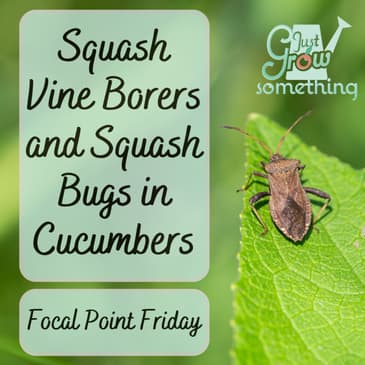
Well, I dropped the ball! This is a follow up to Tuesdays episode about problems in cucumbers. I failed to mention two pests that plague many gardeners - squash vine borers and squash bugs.
So, let's remedy this situation! Spend a quick 15 minutes with me while we talk about these pests and how to prevent them.
Hosted by Simplecast, an AdsWizz company. See pcm.adswizz.com for information about our collection and use of personal data for advertising.
00:00:00
Hello my gardening friends. This is a surprise Focal Point
00:00:03
Friday episode because I feel like I did you a disservice on
00:00:07
Tuesday. So this week episode 201, we
00:00:10
talked about problems with cucumbers and one of those
00:00:13
sections was talking about the pests that plague our cucumber
00:00:17
plants. And wouldn't you know it, I
00:00:19
completely failed to mention two of the biggest culprits of
00:00:24
killing off our cucumber vines, which are the squash vine borer
00:00:28
and the squash bug. Now, the reason that I forgot
00:00:31
about these I think is because I had cucumbers on the brain and I
00:00:35
had cucumber bugs specifically on the brain.
00:00:39
So the striped cucumber beetles, the spotted cucumber beetles,
00:00:41
the aphids, those types of things.
00:00:43
And in my garden, the majority of the pest problems that I have
00:00:48
with cucumbers are with those pests, specifically the cucumber
00:00:53
beetles. I do have the squash vine borer
00:00:56
and I do have the squash bugs, but they seem to relegate
00:01:00
themselves specifically to my zucchini plants and then into
00:01:05
like my winter squashes and stuff.
00:01:07
As a matter of fact, when I was out in the gardens yesterday, I
00:01:11
was in my zucchini plants and I was checking every single one of
00:01:15
those plants for the squash vine borer and for squash bugs.
00:01:18
We'll talk about that here in a second.
00:01:21
On almost every single one of my zucchini plants, I found the
00:01:24
squash vine bore eggs. On some plants I found multiple
00:01:28
eggs and there were some random squash bugs sort of in and
00:01:31
around that area too. None of my cucumbers had
00:01:35
evidence of either of these pests.
00:01:38
And those cucumbers are literally one row over from my
00:01:44
zucchini and my yellow squashes, I mean literally four or five
00:01:47
feet away. So in my yard, definitely the
00:01:51
preference for these insects is to go for the squashes.
00:01:54
But if you're not growing a lot of squash and you are only
00:01:57
growing cucumbers, or if you grow a lot of both and you just
00:02:01
happen to be in an area where, yes, your cucumbers do get
00:02:04
plagued by these guys, I wanted to cover those two for you to
00:02:08
make sure that you have as much information at your disposal to
00:02:11
be able to sort of keep them at Bay.
00:02:13
So let's talk about the squash bug first.
00:02:16
The big deal with these guys is that they overwinter as adults
00:02:22
and so as soon as it warms up in the spring, they are out and
00:02:26
they are looking for something to feed on and then something to
00:02:30
reproduce on. So it is very important to
00:02:34
remove any debris from the garden at the end of the season
00:02:39
to give these guys less places to or fewer places to
00:02:43
overwinter. Now I say that knowing full well
00:02:47
that a lot of us leave leaves and other things over the winter
00:02:52
in our beds as a way to mulch for the winter.
00:02:57
So and that kind of counts as debris.
00:03:00
So I just tend to make sure that I am cleaning up any squash
00:03:03
plants and anything that is in the same family in terms of
00:03:09
weeds because those can be alternate hosts.
00:03:12
So you want to bury or you want to compost all your plant
00:03:15
residues after harvest in order to give them, you know, fewer,
00:03:19
fewer chances to be able to overwinter.
00:03:22
The most effective approach to messing or to deterring the
00:03:27
squash bugs is to manage your plants for these pests every day
00:03:33
or at least every other day. That's kind of my, my habit is
00:03:36
every other day. So the first thing is I go
00:03:40
through my plants and I'm flipping the leaves up.
00:03:44
Now I'm doing this on zucchini, but again, this is for
00:03:46
cucumbers. You flip those leaves up and you
00:03:48
look underneath egg clusters of the squash.
00:03:51
Bugs are going to be located where the veins of the leaves
00:03:55
form AV and they are like a cluster of shiny yellow eggs.
00:04:02
You will know them when you see them.
00:04:04
You can crush these eggs. You can, you know, put a glove
00:04:08
on and coat it in petroleum Jelly and wipe them away that
00:04:11
way. I've seen people do duct tape
00:04:14
and, and pull them off that way. I just crush them.
00:04:16
I, I crush them right there on the, the leaf surface and maybe
00:04:21
even pull that portion of the leaf surface off and crush it
00:04:25
really good. Anytime you see any of the
00:04:27
adults, you want to pick them off and you want to kill those
00:04:29
on site. You can trap the adults by
00:04:32
placing a piece of cardboard underneath your plants and you
00:04:36
just let that sit overnight and then you come out in the morning
00:04:40
and uncover that cardboard really quick and then just kill
00:04:43
all the ones that you find underneath.
00:04:44
This is a very violent way of getting rid of these squash
00:04:47
bugs, but quite literally it is the only way to take care of
00:04:51
them because I don't know of any real beneficials that are
00:04:55
targeting squash bugs. I have also done row covers
00:05:01
early on to help at least deter them for a while.
00:05:04
And if we're talking about the diva cucumbers like we talked
00:05:08
about in Tuesday's episode that are parthenocarpic, you do not
00:05:11
need to uncover them in order for them to reproduce.
00:05:14
They do not need pollinators. So if the squash bugs are
00:05:18
repetitively every season are in your cucumbers, then you might
00:05:23
try growing that diva variety and covering the plants
00:05:27
immediately with an insect netting or a row cover and
00:05:30
leaving them covered, only uncovering them to work in the
00:05:33
plants to either trellis them or to weed or to harvest.
00:05:36
Now this doesn't always work because obviously there are
00:05:39
different types of cucumbers that we want to grow.
00:05:42
Not everything that I grow is that diva cucumber people you
00:05:46
know our markets like the sort of more traditional type of
00:05:49
cucumbers. The Divas are a thin skinned,
00:05:52
burpless type. If you want like a market more
00:05:54
76 or a straight 8 or one of the more traditional ones and
00:05:57
obviously you need the pollinators if you're doing
00:06:00
pickling cucumbers, you want the pollinators.
00:06:02
So if you are using row covers, you can start those early on to
00:06:08
at least help deter them for a little while, but then those
00:06:11
have to come off once the plants start to bloom.
00:06:14
In my plants this year, I am alternating between using that
00:06:20
Captain Jack's Dead bug, the Spinosad, and Elm Dirt's Shield
00:06:25
product. And I'm using it, like I said,
00:06:28
intermittently so that I can extend the amount of time that I
00:06:32
can use the spinocet. So far, the plants that I
00:06:36
treated have done fabulously well.
00:06:39
So I'm sort of doing a control right now.
00:06:40
And actually now I'm done with the control because I've seen
00:06:43
all I need to see. All the ones that are up by the
00:06:46
house were treated in that manner over the course of
00:06:49
several weeks. And I have had very, very few
00:06:52
squash bugs. I have had no squash vine borer
00:06:55
eggs on those plants and I've only seen a handful of clusters
00:06:58
versus the section in another field that was not being treated
00:07:02
in this in this manner. And that was the ones that had
00:07:06
all of the squash vine borer eggs on them.
00:07:09
So I'm definitely sort of leaning towards using that
00:07:12
combination for the rest of the season.
00:07:15
So let's talk about that squash vine borer.
00:07:17
This insect is like the bane of many garters existence,
00:07:21
especially if you grow cucumbers, any type of squash,
00:07:25
even loofah, that sort of thing. The adults of the squash vine
00:07:29
borer come out in the late spring and they lay eggs usually
00:07:35
at the base of the plants and it takes about a week for the
00:07:39
larvae to emerge and then they bore into the stem of the plant
00:07:45
and that's how they feed. So they will feed inside the
00:07:48
plant for a few weeks and then they come out and they Burrow
00:07:52
into the soil and that's where they pupate and they stay there
00:07:55
until the next spring and then they hatch, they become adults
00:07:59
and they start the cycle all over again.
00:08:01
This is where crop rotation can come in very, very handy if you
00:08:07
have the room, because if you are planting cucumbers in the
00:08:11
same space every single season, or in this case we can talk
00:08:14
squash too, it's the same thing. If or you're rotating squash and
00:08:18
then cucumbers, they're all in the same family.
00:08:20
So if you're planting something in the same family over and over
00:08:23
again, and this is the spot where those moths are emerging,
00:08:26
well, they've got their target right there when they come out
00:08:30
of the soil. So if you see the burrowed area
00:08:35
at the base of the plant where the larvae have dug in, you have
00:08:38
to cut open the stem and try to remove the larvae by hand and
00:08:42
destroy it. This is tedious, it doesn't
00:08:45
always work, It all depends on how large the larvae is as to
00:08:48
whether or not it has done so much damage to your plant that
00:08:50
it's actually going to already die.
00:08:52
So the step that you need to take before this is to prevent
00:08:57
those eggs from hatching in the 1st place.
00:08:58
Now, a lot of gardeners have sworn by wrapping foil collars
00:09:01
around the base of their plants to help prevent the moth from
00:09:04
laying the eggs. And yes, that does protect the
00:09:09
more tender area at the base of the plant.
00:09:11
But from what I have seen, the moth just moves further up the
00:09:14
plant. I have, you know, pretty heavy
00:09:17
layers of mulch around the base of my plants where it is most
00:09:21
tender. And that's not where I'm finding
00:09:23
the eggs. I am finding them further up the
00:09:25
stem. In fact, I found one right on
00:09:29
the stalk of one of the leaves, so it wasn't even close to the
00:09:32
stem. So I don't think they're super
00:09:35
preferential. And so I'm not sure that
00:09:37
covering the base is really going to do too much.
00:09:40
Now I have seen people, and there was one gentleman in
00:09:43
particular who stake their zucchini plants to thicken that
00:09:50
stem up a little bit to make it a little bit more difficult for
00:09:53
the vine bore to introduce itself into the plant.
00:09:58
So if you're you're trellising your cucumbers effectively,
00:10:01
hopefully that would strengthen that stem up a little bit more.
00:10:04
But I don't really think that's a very foolproof method either.
00:10:07
Honestly, the most foolproof method is almost the same thing
00:10:10
as what we do with the squash bugs.
00:10:12
You have to be out there checking every couple of days
00:10:15
and looking for the eggs and the eggs are easy to see.
00:10:18
It doesn't. You wouldn't think that they are
00:10:20
because they are tiny, but they are a tiny red dot, like a rust
00:10:25
red color. And once you've seen it, you
00:10:28
know exactly what you're looking for and you can see it every
00:10:31
single time. I have gotten to the point where
00:10:33
I don't even look anymore. Yes, I'm going through and I'm
00:10:36
looking and I'm, you know, lifting up the leaves and I'm
00:10:38
looking, but I am more just making sure that I am rubbing my
00:10:42
fingers all along the outside edge of the stem, all around it
00:10:47
to make sure that I am completely rubbing off any
00:10:49
possibility of that egg still being there.
00:10:53
So that's your first sort of line of defense is to prevent
00:10:56
that egg from hatching. And then if that does happen and
00:11:00
you see the spot where the larvae have dug in, then you
00:11:04
have to cut it open and see what you can do.
00:11:05
I have also heard of people injecting BT into the base of
00:11:10
their plants, bacillus syringes. And I don't know that I am the
00:11:14
proponent of that. You know, there are genetically
00:11:18
engineered crops that are engineered to have BT in the
00:11:22
tissue. And I'm not really sure I want
00:11:23
to be eating that either. So, you know, do what you need
00:11:27
to do, just save your cucumber plants.
00:11:30
But you know, that's, that's not going to be my first option.
00:11:34
I will also say that if again you can cover with insect
00:11:38
netting until it's time for the plants to be pollinated, that
00:11:41
would be a good idea. If you can determine what the
00:11:45
life cycle is of the squash vine bore moth in your area and wait
00:11:51
to plant your first cucumbers or squashes until after that cycle
00:11:57
is over, then you might have a fighting chance.
00:12:01
And this goes with the squash bugs too.
00:12:03
If there aren't any squash for them to feed on early in the
00:12:07
season when they emerge and that's the time when they're
00:12:10
supposed to be mating. The problem with squash bugs is
00:12:12
they meet mate continuously. So you will quite literally have
00:12:15
every single life stage of the squash bug on one plant.
00:12:19
It's just disgusting the stupid things.
00:12:22
But if you wait to plant your cucumbers until after the the
00:12:26
heaviest amount of pressure is, is over.
00:12:29
So instead of rushing to plant right at the very beginning of
00:12:32
the spring, you know, or, or the beginning of May, if you can
00:12:36
wait until, I don't know, the end of June, the middle of July,
00:12:41
cucumbers produce very, very quickly.
00:12:43
And so you are still going to get a ton of cucumbers.
00:12:47
And in this instance, you might actually get even more because
00:12:50
you're not having to fight the insect pressure.
00:12:53
So one final thing, and I didn't mention this on Tuesday's
00:12:57
episode, but if you find yourself or your plants, I hope
00:13:01
you're not finding yourself succumbing to these diseases.
00:13:03
I hope you're not finding your plants either.
00:13:05
But if you find that your plants are succumbing to insect rests
00:13:09
or to diseases or whatever it is, it is perfectly acceptable
00:13:15
and actually recommended for you to do a succession planting of
00:13:19
your cucumbers. As a matter of fact, cucumbers
00:13:21
are going to eventually sort of start reducing their production
00:13:25
anyway as they go into the summer.
00:13:27
And so if you planted them very, very early, you might see that
00:13:30
production start to wane. And by that point you might just
00:13:33
be done with cucumbers. You might be over the whole
00:13:34
thing, and that's perfectly fine.
00:13:36
But there's nothing that says that you can't plant a second or
00:13:39
even a third crop of cucumbers as the season goes on.
00:13:44
So oftentimes what I will do is I will plant cucumber plants and
00:13:48
then the next section that I plan on doing cucumbers, I will
00:13:52
go ahead and pop some seeds in the ground at the same time that
00:13:55
I'm putting the plants in the ground.
00:13:57
So I have one that's already, you know, maturing while the
00:14:00
other ones are germinating. And then, you know, about a
00:14:03
month later, I will do one more round directly from seed in the
00:14:07
soil. At this point, the seeds are
00:14:09
popping up or the seedlings are popping up so fast because the
00:14:12
soil is already so warm that they actually catch up fairly
00:14:15
quickly. So you can play around with
00:14:17
this, but if you start to see that your plants are dying or,
00:14:20
you know, they're having too many bugs or whatever, and
00:14:22
you're not able to get much in the way of, of plants or in the
00:14:25
way of, of, of harvest, then go ahead and try again.
00:14:29
You know, wait a little while and then go ahead and plant some
00:14:32
later on. You might actually be facing a
00:14:34
little bit less pest pressure. So I hope that was a good
00:14:38
addition to Tuesday's episode. I apologize for missing that.
00:14:42
I know there were several of you that asked that question, so I
00:14:44
figured I would address it right away and get you the information
00:14:46
that you needed. So happy planting and happy
00:14:49
Friday.