
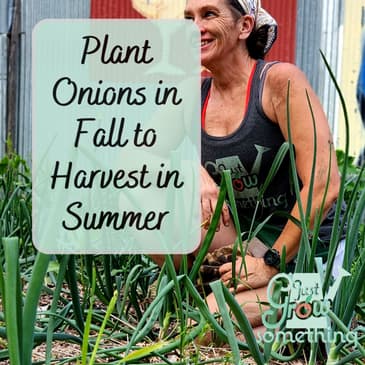
This is the episode so many of you have asked for and now is the perfect time because, in most locations, this is the time to be planting onion sets or seedlings to overwinter and harvest the next summer. Successfully growing full-sized onions for fresh eating and for storage seems to allude many of us, I had trouble with it the first few tries, for sure, and I think it boils down to a couple of things. First is planting depth and spacing, second is soil texture and nutrients, and third is the timing of the planting. Bonus points if you actually know which type of onions you should be planting in terms of long-day and short-day or day-neutral.
If none of what I just said made any sense to you, you’re not alone. So, today on Just Grow Something we’re going to review the very basics of growing onions but then dig deep into the techniques you can use for getting them planted now to successfully harvest those nice full fat onions in the spring. Let’s dig in!
References and Resources:
Save 20% on a Magic Mind Subscription: https://magicmind.com/GROWSOMETHING20 and use code GROWSOMETHING20
Beginner's Guide to Growing Onions
YouTube video on planting fall onions
Save 20% at https://heirloomroses.com using code JUSTGROW at checkout. Order now, save now, deliver later!
Just Grow Something Merch: https:/justgrowsomething.com/shop
Just Grow Something Gardening Friends Facebook Group
Check out how you can become a patron on Patreon
Bonus content for supporters of the Podcast! (buymeacoffee.com)
Hosted by Simplecast, an AdsWizz company. See pcm.adswizz.com for information about our collection and use of personal data for advertising.
00:00:00
This is the episode so many of you have asked me for and now is
00:00:05
the perfect time because in most locations this is the time to be
00:00:09
planting onion sets or seedlings to overwinter and harvest the
00:00:13
next summer. Successfully growing full-sized
00:00:16
onions for fresh eating and for storage seems to elude many of
00:00:20
us. I absolutely had trouble with it
00:00:23
the first few years for sure and I think it boils down to a
00:00:26
couple of things. First is planting depth and
00:00:29
spacing, the second is soil texture and nutrients, and the
00:00:32
third is the timing of the planting.
00:00:35
Bonus points if you actually know which type of onions you
00:00:39
should be planting in terms of long day, short day, or day
00:00:42
neutral. If none of what I just said made
00:00:45
any sense to you, you are not alone.
00:00:47
So today on Just Grow Something, we're going to review the very
00:00:51
basics of growing onions, but then we'll dig deep into the
00:00:55
techniques that you can use for getting them planted now to
00:00:59
successfully harvest those nice full fat onions in the spring.
00:01:04
Let's dig in. Hey, I'm Karen, I started
00:01:08
gardening in a small corner of my suburban backyard and now 18
00:01:11
years later, I've got a degree in horticulture and operate a 40
00:01:14
acre market farm. I believe there is power in food
00:01:17
and that everyone should know how to grow at least a little
00:01:19
bit of their own. On this podcast, I share
00:01:22
evidence based techniques to help you plant, grow, harvest
00:01:25
and store all your family's favorites.
00:01:27
Consider me your friend in the garden.
00:01:29
So grab your garden journal and a cup of coffee and get ready to
00:01:33
just grow something. Heads up, there's new merch in
00:01:44
the merch shop. I got my creative juices flowing
00:01:46
again for the fall and the winter season.
00:01:48
And if you are a gardening friend who also happens to be a
00:01:51
Swifty, or you know one that is, I am hoping you will appreciate
00:01:55
one of these designs in particular.
00:01:58
I will link to the merch shop in the show notes.
00:02:00
And if you are a seed patron or above on Patreon or a member on
00:02:03
Buy Me a Coffee, you should already have received your
00:02:07
fourth quarter discount code to the shop.
00:02:09
So check your login if you didn't see that in your e-mail.
00:02:12
Merch purchases are a fun way to support the podcast while also
00:02:15
getting a little something something for yourself.
00:02:17
But I know not everyone wants more stuff.
00:02:19
So if you want to do a one time monetary monetary monetary
00:02:25
support for the show, Buy Me a coffee.com/just Grow Something
00:02:31
is a really good place to do that.
00:02:32
And you can opt for recurring monthly support on both Buy Me a
00:02:36
Coffee and on Patreon if that's your jam.
00:02:38
All the links to all the things will be in the episode
00:02:41
description, in your player, in the show notes on my website at
00:02:44
justforsomethingpodcast.com. And if you have not taken
00:02:49
advantage yet of the discount code that was offered to us by
00:02:53
Heirloom Roses earlier in the year, it is not too late, but
00:02:56
you are running out of time. We have two weeks left to take
00:03:00
advantage of that. I got my order from them
00:03:03
probably about a month or so ago and I was so impressed by the
00:03:10
quality of the plant and how quickly it put on new growth.
00:03:14
And I already got 3 blooms on that brand new plant.
00:03:18
So you can still order now and use the discount that they
00:03:23
offered through October 31st and then just schedule your delivery
00:03:28
for next spring. Their website is
00:03:30
heirloomroses.com and the discount code is just grow to
00:03:35
save 20%. You will be so impressed with
00:03:38
the quality, I absolutely guarantee it.
00:03:41
And then finally, do not forget to answer the question of the
00:03:44
Month for October. What was your biggest failure in
00:03:48
the garden this year? So leave a comment below on
00:03:51
YouTube or Spotify, send me an e-mail or Adm on social media,
00:03:55
or post your answer in the Facebook group.
00:03:57
You have until October 31st to get me your answer and I will
00:04:01
absolutely share mine. All right, let's talk fall
00:04:09
planted onions. I'm going to review the basics
00:04:13
of growing onions really quickly because they are the same
00:04:16
whether you opt to plant in the spring or the fall.
00:04:19
I will also link to all of the previous onion episodes, the
00:04:24
blog post, and any videos in the note, including the recently
00:04:28
released YouTube video that I did about fall planting of
00:04:32
onions. I spent ten months recording
00:04:35
what was happening in the garden in one onion plot last year and
00:04:40
then I compiled it all into a video that released last Friday
00:04:44
and it has already gotten people's attention.
00:04:45
So if you want some visuals to go along with this episode, then
00:04:50
you can check that out too. And of course, I will link to
00:04:52
that in the show notes. Quick review of probably the
00:04:57
four major pain points that we often encounter in growing
00:05:01
onions. The 1st is growing the correct
00:05:04
type for where we are gardening. So onions are photo periodic.
00:05:08
That means they are sensitive to daylight, so they start forming
00:05:12
their bulbs based on day length. There are three different types
00:05:17
of onions, so there's short day, long day, and intermediate or
00:05:22
day neutral. Most onion varieties are going
00:05:25
to begin to form their bulbs when the temperature and the
00:05:28
number of daylight hours reach a very specific level.
00:05:32
So short day onions form their bulbs when the daylight hours
00:05:37
are between 10:00 and 12:00. OK, so shorter days, long day
00:05:42
onions don't start developing until the day length is at least
00:05:46
14 to 16 hours. So the longer days, right And
00:05:51
then day neutral or intermediate, they will start
00:05:54
bulbing during that sort of in between day length of anywhere
00:05:57
between 12 and 14 hours. The border between the long day
00:06:03
and the short day varieties lives roughly at the 36th
00:06:07
latitude north or the 36th parallel North of that you want
00:06:12
to plant long day onions. If you live or garden South of
00:06:15
that, then you want to plant short day onions.
00:06:18
Just about anybody can grow the day neutral varieties.
00:06:23
They will bulb just about anywhere, just they do best at
00:06:27
12 hours of daylight. But they're going to form bulbs
00:06:29
in just about any growing zone. So if you're unsure, then
00:06:33
they're always a good bet. But that's OK.
00:06:35
That's review point number one, right?
00:06:37
Make sure that you're growing the correct onions for your area
00:06:41
where you're gardening. The second pain point is the
00:06:46
planting depth and the spacing. So most gardeners plant their
00:06:50
onions way too deep the first few times they grow them.
00:06:53
So if you're growing from set, which is that little first year
00:06:57
bulb, right, the soil should only come up about halfway up on
00:07:01
that little bulb. The bulb needs room to expand as
00:07:06
it starts to form. If you're planting from
00:07:08
seedlings, they should only go about one inch deep into the
00:07:12
soil. And I'm serious when I say take
00:07:15
out a ruler and measure it on your pointer finger where an
00:07:19
inch is. You will likely be surprised at
00:07:22
how shallow that actually is. And it's a really good way to
00:07:25
kind of double check yourself when you're out in the garden to
00:07:28
make sure that you're not planting too deeply.
00:07:31
Now, the ideal soil texture is pain point #3 we are growing
00:07:35
bulbs, but they're not growing completely under the soil,
00:07:39
right? See pain point number one.
00:07:41
So the soil should be loose and fairly loamy, but it also should
00:07:47
be free of like, large rocks or stones that are going to cause
00:07:49
issues with the growth. But it's not like it needs to be
00:07:53
really sandy like what a carrot would prefer.
00:07:55
So I'm serious when I say you can grow onions just about
00:07:57
anywhere, so long as the soil is loose enough.
00:08:01
Yes, this can, you know, can include containers and pots or
00:08:04
whatever. Just recognize that if your soil
00:08:07
is very heavy with lots of clay that you may need to just loosen
00:08:12
it up and amend it a little bit. Since the plants are only going
00:08:15
to be about an inch in the ground, this is much easier to
00:08:18
do than with some other crops. And then finally, pain point #4
00:08:23
which is the timing of the planting.
00:08:25
Onions like to grow in cooler weather, but they need really
00:08:30
good top growth before they start forming their bulbs in
00:08:34
order to perform their best. So this means that generally
00:08:37
we're planting in the spring and we're trying to get the plants
00:08:41
or sets into the ground at a time when it's warm enough that
00:08:45
the soil can be worked and the roots of the plant can start to
00:08:48
settle in. But it's not so warm that it
00:08:51
gets too hot before the bulbs can start to form.
00:08:54
So this means that your timing of the planting is based on both
00:08:59
the weather conditions and the number of daylight hours.
00:09:03
You don't want to plant them just before your day length hits
00:09:08
the proper time for bulb growth because then they don't have any
00:09:10
time to put on that nice green growth on the top, which means
00:09:12
you're going to get much smaller bulbs.
00:09:15
But of course the soil needs to be warm enough for that root
00:09:17
growth, so the plants for the bulbs can get settled in and the
00:09:20
roots can feed that top growth. So in milder climates this is a
00:09:24
little bit easier to time, but in colder areas it can
00:09:27
absolutely be a wild roller coaster ride.
00:09:32
The coaster ride can happen in the fall too for sure, but the
00:09:35
effects are much less dramatic on the soil temperatures.
00:09:39
I will give you a perfect example of this.
00:09:41
We were just in Colorado a few weeks ago.
00:09:44
Our daughter was getting married on Friday and I was running the
00:09:46
Pikes Peak Marathon on that Sunday, the day of the wedding.
00:09:50
That Friday the weather was absolutely gorgeous.
00:09:55
Like mid 70s, sunny, light breeze, absolutely perfect on
00:09:59
the mountain. Okay Saturday.
00:10:02
The next day was also absolutely beautiful.
00:10:05
Sunday, just in time for me to run to the peak of the mountain.
00:10:10
It was crap. The weather was crap. 7 inches
00:10:12
of snow on the peak overnight, blustery winds down at the base
00:10:16
of the mountains. It was cold.
00:10:17
It got really cold heading up the mountain.
00:10:19
So bad that they actually cut the race short at the halfway
00:10:23
mark so we weren't even allowed up to the peak.
00:10:25
And then the next day, Monday, beautiful, back to being
00:10:29
beautiful. Like T-shirt weather, but none
00:10:33
of those conditions would have drastically affected the soil
00:10:38
temperature. OK, it was vastly different from
00:10:41
day-to-day to day as terms of air temperature, but the soil
00:10:45
temperature wouldn't really be affected by that at this time of
00:10:49
the year. That same back and forth in the
00:10:52
spring, though, can drastically change the temperatures of the
00:10:56
soil, especially if we're not using heavy layers of mulch.
00:11:01
Exposed soil is going to soak up that heat from the sun pretty
00:11:05
readily, and it makes it workable at the top.
00:11:08
But then a drastic overnight cold temperature can cause it to
00:11:12
freeze right back up again, because the sun's heat hasn't
00:11:16
really had time to penetrate deep enough into the soil to
00:11:19
prevent that from happening. So the back and forth in the
00:11:23
spring creates a little bit more of a delicate dance in terms of
00:11:27
timing than that same back and forth in the fall, which is why
00:11:32
I have started planting the majority of my onions in the
00:11:36
fall. And as a side note, when we went
00:11:40
to Colorado, one of the things that I packed to take with me
00:11:44
was my magic mind shots. I that might sound a little
00:11:47
weird, but hear me out. I took it while we were in Estes
00:11:51
Park for my daughter's wedding. And it gave me just kind of the
00:11:53
calm focus that I needed while we hustled around, getting
00:11:58
things done, attending events, shuttling people back and forth
00:12:00
across town. And then in Colorado Springs, I
00:12:04
made sure to take it the morning of my marathon.
00:12:06
It was absolutely the mental performance shot that I needed
00:12:11
as I was hustling my way up and down a mountain, trying to move
00:12:16
as as possible during the race, but also focusing enough on the
00:12:19
trail not to trip and fall on my face.
00:12:22
So there are certain routines that I have and specific
00:12:26
supplements that I always use right before a race.
00:12:29
And now Magic Mind has been added to that list.
00:12:32
It has proven itself for me in terms of the energy and the
00:12:35
mental clarity it gives me, which is why I am super stoked
00:12:39
to continue to be an ambassador for them.
00:12:42
Magic Mind has given me an all new code for you to use to give
00:12:47
a subscription a try. You go to magicmind.com/grow
00:12:51
something 20 and use Code Grow something 20 and this is the
00:12:56
number 20 to save 20% off of a subscription.
00:13:00
Which by the way, the subscription rate is already
00:13:03
discounted so you can use the code for 20% off of a one time
00:13:06
purchase too. But it makes so much more sense
00:13:09
to just get the subscription magicmind.com/grow Something 20
00:13:13
and use Code Grow Something 20 at checkout to get your own
00:13:19
mental performance shot. I will link to all of this in
00:13:22
the episode description and in the show notes.
00:13:26
So now that we've reviewed the basics in terms of growing
00:13:31
onions in general, let's talk planting onions in the fall.
00:13:35
Specifically planting onions in the fall to overwinter can give
00:13:40
you an early summer harvest and ensure that the onions get a
00:13:44
head start before the heat of the season.
00:13:48
It really does make the timing a lot easier.
00:13:52
OK, so here is sort of step by step on planting onions from
00:13:56
sets or seedlings with details about like different USDA
00:14:00
hardiness zones and lines of latitude.
00:14:02
So if you are in zones say 3 through 6 or 7, if you prefer
00:14:09
the ease of using the sets, the onion sets, this is you onion
00:14:14
sets in three through 6-7. If you prefer to use the sets
00:14:17
rather than planting them from seedlings, OK, you want to get
00:14:21
those onion sets in the ground about four to six weeks before
00:14:26
the 1st hard frost sort of. OK, This is definitely when
00:14:32
you're on it like in zones four and five.
00:14:34
This is absolutely true. So you're looking at probably
00:14:37
September in my area, you're looking about right now because
00:14:41
we're actually having our first hard frost tonight and we're,
00:14:45
you know, right on schedule October 15th.
00:14:48
The goal is to get the sets to establish roots, but not to
00:14:53
develop a whole bunch of large top growth before winter.
00:14:56
But I have planted as late as mid November in warmer years
00:15:02
with absolutely no problem. Again, it's more about the soil
00:15:06
temperature at this stage of the game and less about the air
00:15:09
temperatures and the daylight hours.
00:15:11
We just want them to get some root growth on them before they
00:15:15
go completely dormant. So in my experience you will see
00:15:19
some top growth depending on the air temperatures throughout the
00:15:21
winter. You can see this first hand in
00:15:24
that fall Planting Onions video that I did on YouTube.
00:15:27
When I show the onions in January, they all have long
00:15:31
green tops on them. But you do want to plant from
00:15:34
sets in these zones because that's how the really the only
00:15:39
way that they're going to be able to really survive in my
00:15:43
experience now in warmer zones. So again, in zone 7, you kind of
00:15:47
get to choose here whether you want to plant from sets or from
00:15:49
seedlings. But zone 7 through 11, you can
00:15:52
get away with planting them from seedlings anywhere where the
00:15:57
winter temperatures generally remain above 20°F.
00:16:01
You can overwinter the onions from seedlings instead of sets.
00:16:05
Again, the recommendation here is to do it about four to six
00:16:08
weeks before your first frost for you know if you're in zone 7
00:16:12
through 9. But again, this could be as late
00:16:15
as November depending on what your soil temperatures are.
00:16:17
For zones 10 and 11, you should likely be planting around
00:16:21
mid-december. OK, so soil prep and planting.
00:16:26
We talked already what onions kind of want in terms of that
00:16:30
loose soil. They also need it to be very
00:16:33
well drained. So if you can enrich it with
00:16:35
some organic matter, compost is fantastic for this.
00:16:38
We want the soil loose. We want to promote that healthy
00:16:40
root growth, but we do not want them sitting in water.
00:16:44
I actually had somebody ask me on that most recent YouTube
00:16:48
video where they live, they get 15 inches of rain a year and
00:16:53
wanted to know whether or not they were still able to be able
00:16:56
to do this planting in the fall and growing or growing onions at
00:16:59
all. And ideally you want a good
00:17:03
amount of water. You know, I mean, just along the
00:17:06
this, the lines of this, everything else that we grow
00:17:08
likes about an inch of water every week.
00:17:11
But if you are an area that sees a lot of heavy road and fall,
00:17:14
then it's very, very important for you to make sure that your
00:17:17
soil is very well drained. And if you do see that the areas
00:17:21
where you're growing tend to be water logged, you can also make
00:17:25
mounds. So if you mound the soil up and
00:17:29
you plant your onions along the top of that mound, along that
00:17:32
Ridge, that is going to give even more opportunity for the
00:17:35
water to drain away so that they're not sitting in root
00:17:39
logged or root logged water logged soil all the time.
00:17:44
APH of anywhere between 6:00 and 7:00 is fine.
00:17:46
They're not super particular about the pH.
00:17:50
You do want to fertilize at planting time.
00:17:53
OK, we're going to talk about that fairly in depth here in a
00:17:56
minute, but just know that at planting time you definitely do
00:18:00
want to be feeding. And then we'll talk about
00:18:02
another feeding schedule and what you should be feeding here
00:18:04
shortly. You you want to space your onion
00:18:07
sets about four to six inches apart in rows that are spaced
00:18:10
about 12 to 18 inches apart. I also will do additional onions
00:18:17
and plant them closer so I can harvest skinny little green
00:18:20
onions and then harvest again about a month later and harvest
00:18:24
spring onions and then get down to that final spacing of between
00:18:28
4:00 and 6:00 inches. But you want the final spacing
00:18:31
for your large bulb onions to be about four to six inches apart.
00:18:36
Get them watered in just to kind of help them get established.
00:18:39
And then as the weather starts to cool, you want to reduce the
00:18:44
water, right? We don't, again, want them
00:18:46
sitting in that water and we don't want it getting frozen
00:18:48
either. Mulch is going to help retain
00:18:51
the moisture. If it's very dry in the winter
00:18:53
where you are, you may occasionally need to water, but
00:18:55
again, don't let them get water logged.
00:18:58
We're going to talk a little bit more in depth about mulch, but
00:19:01
we do want to mulch these, especially in the colder zones.
00:19:05
If you are in zone 3 through 6 is absolutely going to be
00:19:08
necessary. You're going to want about two
00:19:11
to four inches after the ground begins to start to do that
00:19:15
freeze thaw cycle. This is going to help to
00:19:17
insulate those bulbs during the winter.
00:19:19
If you were in the warmer zones, 7 through 11, mulch is also
00:19:22
going to be a good idea. You just won't need as much and
00:19:24
it's less about insulating the plants or the bulbs at that
00:19:27
point and more about retaining the moisture.
00:19:31
You are going to want to remove some of this mulch in the spring
00:19:33
as the temperature rises. And we will touch on that again
00:19:35
here in a minute when we talk a little bit more in depth about
00:19:38
mulching. And then through the winter and
00:19:42
into the spring, right? If you are in those colder
00:19:44
zones, 3 through 6, the onion sets are going to remain
00:19:49
basically dormant through the winter.
00:19:51
But as soon as it starts to warm up, the soil starts to warm up
00:19:55
in the spring and the daylight hours begin to increase, they
00:19:59
are immediately going to start resume their growth.
00:20:02
So you want to keep that soil lightly moist through the
00:20:06
spring, especially as the weather warms.
00:20:08
And we'll talk about moving that mulch back.
00:20:10
In zones 7 through 11, your seedlings are actually probably
00:20:15
going to continue to grow a little bit over the winter, but
00:20:18
they again will put on more growth as the spring approaches.
00:20:23
For some of you like zones 10 and 11, this is actually the
00:20:27
best time for you to be growing onions and they will actively
00:20:31
grow all season long. And you will be harvesting a lot
00:20:33
earlier than somebody like I would just because this is the
00:20:37
coolest time of the year for you to be able to actually grow
00:20:40
these plants. And then once the spring growth
00:20:43
resumes, we're going to feed again.
00:20:45
We're going to side dress with some nitrogen rich fertilizer.
00:20:47
Again, we'll talk a little bit more about this in depth here in
00:20:49
a minute, but we're trying to promote that leafy growth in the
00:20:52
spring. That is what we're going for.
00:20:54
We want that lush green top before they start bulbing.
00:21:00
So what we feed and how we feed it is going to matter here.
00:21:06
OK, so let's get into the nitty gritty of mulch and frost
00:21:10
protection, OK? Obviously, if we are
00:21:12
overwintering these onions, especially someplace where it
00:21:15
gets well below freezing, we're going to have to protect those
00:21:20
onions in some way. And in most cases, this is going
00:21:24
to be done through the use of mulch.
00:21:26
Mulch is going to help to insulate the bulbs, it's going
00:21:28
to retain moisture, and it's going to suppress any weeds that
00:21:31
start popping up in the spring. Now, the best mulch option is
00:21:34
going to depend on your climate and what materials you have
00:21:37
available for you. My absolute favorite for this is
00:21:41
straw. It is one of the best mulch
00:21:42
materials for overwintering because it provides excellent
00:21:46
insulation, but it's also lightweight.
00:21:49
It's really easy to spread and it's going to break down slowly.
00:21:53
So you have a long term coverage option there.
00:21:57
And then once things start to heat up in the spring, you can
00:22:00
kind of leave a lot of that stuff in place and it will start
00:22:01
to break down eventually. The only the downside
00:22:05
occasionally to straw is that every once in a while you might
00:22:08
find some seeds from grains that could sprout and you know, that
00:22:11
could become a little bit weedy, but usually it's just kind of a
00:22:13
grass that pops up and very, very easy to pull out.
00:22:16
So if you were in zone 3 through 6 where the temperatures can
00:22:19
drop significantly in the winter time, for me, straw is
00:22:22
absolutely your best bet. Of course, zone 7 through 11 you
00:22:26
absolutely could use it too, You just won't need to use as much.
00:22:30
The second option is shredded leaves.
00:22:32
They of course they're free. So if you have deciduous trees
00:22:35
in your area, you can shred the leaves up before putting them
00:22:38
on. This part is actually important
00:22:42
because the kind of downside to shredded leaves is if they are
00:22:45
applied too thickly, the leaves can become like compacted and
00:22:49
really soggy which can lead to actual moisture related issues
00:22:53
like mold or even rot. So if you have leaves, make sure
00:22:56
that you are shredding them up in some way and then use those
00:23:00
as as a good protection. If you're in like zones 3
00:23:05
through 6, again, you're going to want them in a thicker layer.
00:23:09
Zones 7 through 11 you're only going to need about two inches
00:23:12
of these. Pine needles or pine straw is
00:23:16
also a good one if you are in the warmer zones.
00:23:19
It's a loose, very well draining mulch.
00:23:22
It's not going to compact. It does decompose slowly so you
00:23:25
won't have to replace them very often.
00:23:27
And contrary to what you may have heard, pine needles do not
00:23:31
raise the soils acidity significantly.
00:23:33
So they are perfectly safe to use with your onions.
00:23:35
They are not as insulating as other mulches.
00:23:38
So it's really great for weed protection and for trapping some
00:23:42
of that moisture in and really, really light cold protection.
00:23:46
But if you live somewhere where the wind, you get really heavy
00:23:49
winds through the winter, they may blow away.
00:23:51
So that may not be a best option for you.
00:23:53
So for me, mild climates 7 through 11 where their winters
00:23:58
are less harsh is going to be the best place to use pine
00:24:00
needles. Same thing with compost.
00:24:03
Yes, you should be adding compost no matter what.
00:24:06
It's going to help with that soil texture for the onions.
00:24:09
If you want to use it also as a mulch, it is going to provide a
00:24:13
little bit of insulation while it does that sort of enriching
00:24:17
of the soil, but it doesn't provide nearly as much coal
00:24:20
protection as straw or leaves. It will freeze just the same way
00:24:24
like your soil does, so again, much better suited for mild
00:24:28
winter areas. I would say this one's best,
00:24:31
like 9 through 11 where heavy mulching for frost protection
00:24:35
isn't really as critical. Grass clippings can also be used
00:24:38
here. It's also a really good way to
00:24:41
add the nitrogen that those onions are going to need.
00:24:44
But again, the caveat here is sort of the same with the as it
00:24:48
is with the leaves, where it can mat down if it's applied too
00:24:51
thickly, which is going to reduce the airflow and that
00:24:53
could potentially lead to rot. It also can heat up quickly
00:24:58
while it's decomposing, which in the late winter or the early
00:25:01
spring when you don't really quite want that much warmth,
00:25:05
that could actually cause a problem.
00:25:06
So I wouldn't use grass clippings as your only mulch.
00:25:09
But if you're going to mix it with some stuff, you know, in
00:25:11
the mild climates, climates where the frost isn't as severe
00:25:14
and a thin mulch layer is sufficient, then go ahead and
00:25:17
add, you know, grass clippings. That's fine.
00:25:20
How much mulch should you be using in the really colder
00:25:24
areas? Zones 3 through 6?
00:25:26
You want at least three to four inches just to provide enough
00:25:31
insulation against the freezing temperatures in the much colder
00:25:35
zones, and I'm talking 3 and 4. You very well may need to put
00:25:40
some heavy frost cloth on as well.
00:25:42
In fact, I almost guarantee that you will.
00:25:44
In my area I'm zone 6B. Last winter I did put some light
00:25:49
frost cloth on once we got into about mid January when I saw the
00:25:54
temperatures were really starting to dip.
00:25:57
Was it necessary? Maybe, maybe not.
00:26:00
It was more me just covering my bases and making sure that I
00:26:02
wasn't going to have any problems.
00:26:04
But if you're in three or four, even in some colder areas of
00:26:07
five, you probably do want to do this.
00:26:09
So three to four inches of mulch and then as you really start to
00:26:13
get to the cold parts of the winter, then go ahead and double
00:26:16
down with some frost cloth. In the milder zones, 7 through
00:26:20
11, two to three inches should suffice.
00:26:23
As a matter of fact, if you're in like 10 or 11, you probably
00:26:27
don't even need that. I would say 2 inches and you're
00:26:29
just worried about basically moisture retention at that
00:26:32
point. As spring approaches, we're
00:26:35
going to gradually start removing that mulch to allow the
00:26:39
soil to warm up and to encourage growth.
00:26:43
So the timing for removing the mulch depends on your weather
00:26:47
conditions in early spring. So if you are in the colder
00:26:50
climates, 3 through 6, we are going to move it, remove it
00:26:56
gradually once the temperatures start to get above freezing.
00:27:00
So this is usually between late March and early April.
00:27:03
If you're on the much colder zones, this might be late April
00:27:06
even into early May. What you want to do is watch for
00:27:09
the daytime temperatures that stay above 40 Fahrenheit or 4
00:27:13
Celsius, and nighttime temperatures consistently above
00:27:17
25 Fahrenheit or -3 Celsius. Onions are cold Hardy, but they
00:27:23
need the soil to warm up to resume active growth, so you
00:27:27
don't want to leave all of the mulch in place.
00:27:31
Removing the mulch too early can expose them to late frost
00:27:34
damage, but leaving it on too long may delay the soil warming
00:27:38
and the growth. So just start by pulling back
00:27:40
some of the mulch to expose the soil to sunlight and to air.
00:27:43
That's going to help to warm the soil up.
00:27:46
Just keep mulch or frost cloth on hand nearby.
00:27:49
So if you know a real cold snap is forecasted, you can cover the
00:27:52
onions again just to protect them a little bit.
00:27:55
And then fully remove most of the mulch other than a thin
00:27:58
layer to keep the moisture trapped in and to keep the the
00:28:00
weeds down. Once the risk of frost has
00:28:03
passed and the temperatures are consistently staying warmer now
00:28:06
in the milder climates, you can start removing the mulch much
00:28:09
earlier. Usually this is around late
00:28:11
February to early March. Those of you in 10 and 11, you
00:28:15
might not be pulling back your mulch at all.
00:28:17
You might just have that, you know, 2 inches and you're just
00:28:20
going to leave it there. But since the risk of hard frost
00:28:23
is lower in most of these zones, you can just uncover the onions.
00:28:27
As soon as the daytime temperatures consistently reach
00:28:29
around 50 Fahrenheit or 10 Celsius, those nighttime
00:28:32
temperatures at that point are going to be well above freezing.
00:28:35
At this point, the main purpose of the mulch is going to
00:28:38
suppress the weeds. And as the temperatures rise,
00:28:42
you do want the onions to benefit from warming that soil a
00:28:44
little bit. So just gradually thin it out
00:28:47
rather than removing it all at once.
00:28:49
It that allows the onions to adapt a little bit to the
00:28:51
warming temperatures without sudden exposure.
00:28:54
Just be ready to reapply it if an unexpected cold snap hits for
00:28:59
everybody. Basically, you're going to want
00:29:02
to check your weather forecast. So if your area is prone to late
00:29:06
frost or cold snaps in the spring, keep the mulch handy and
00:29:09
cover the onions again if you need it.
00:29:11
If your mulch there layer is particularly thick.
00:29:15
So again, us in the colder zones, we're talking three to
00:29:17
four. It's you should be doing this in
00:29:20
stages over a couple of weeks. You want to remove the mulch
00:29:25
when the soil feels slightly warm to the touch and it's no
00:29:28
longer soggy from the winter moisture.
00:29:32
We want to just let it warm up gradually, but we still want to
00:29:36
protect that soil. And so leaving a thin layer down
00:29:39
is what we're looking for. OK.
00:29:45
And finally, what is the scoop on fertilizing?
00:29:48
OK, if you plant in the spring, the general rule of thumb is to
00:29:54
feed at planting and then feed every four weeks until bulb
00:29:58
growth starts. Fall planted onions are similar
00:30:02
with a slight change in the timing.
00:30:05
So First things first, you know what I'm going to preach here?
00:30:08
Take a soil test, right? You want to know what you're
00:30:10
dealing with. In general, onions need more
00:30:14
nitrogen, but you may need to be adding phosphorus or potassium
00:30:18
based on your soil test. So no ahead of time because
00:30:22
these onions are going to be using the the fertilizer or the
00:30:25
nutrients at different stages. They're going to use it
00:30:28
differently at different stages, right?
00:30:30
So when you're planting in the fall, before you're planting
00:30:34
your sets or your seedlings or at the time you plant, this is
00:30:40
when you're going to do the first feeding.
00:30:42
A balanced fertilizer or a balanced amendment that has
00:30:45
equal parts nitrogen, phosphorus and potassium is perfectly fine
00:30:51
at this stage of the game, right?
00:30:54
Phosphorus is going to be particularly important for root
00:30:57
development, but the nitrogen also needs to be present as soon
00:31:00
as growth starts in the spring. So this, you know, even even
00:31:07
ratio of nutrients is going to be perfectly fine.
00:31:10
Unless you see that you've got plenty of phosphorus and
00:31:15
potassium in your soil, but you realize that you have a nitrogen
00:31:20
deficiency, then using a nitrogen rich amendment is fine.
00:31:25
1 to 2 lbs of a balanced fertilizer per per 100 square
00:31:28
feet of bed space is generally what the recommendation is.
00:31:31
But again, look at whatever it is that you're using and, and do
00:31:36
the do apply it appropriately. You want to work the fertilizer
00:31:39
into the top four to six inches of the soil before planting.
00:31:45
If you're doing it at planting time, you can mix this in as you
00:31:50
go. And then of course, if you're
00:31:52
using compost, you also want to mix it in when you're preparing
00:31:54
your bed. So if you can do all this just
00:31:56
before you plant, that is the best option.
00:32:00
Then you're just going to let them sit and don't do anything
00:32:05
in terms of feeding them over the winter time.
00:32:08
Once the onions resume growth in early spring, they will need
00:32:12
some additional nitrogen to fuel that leaf growth, which is
00:32:16
absolutely critical for that bulb formation later on.
00:32:20
So this is the time to be applying a nitrogen rich
00:32:24
amendment of some sort. So when they start to to pop up
00:32:28
in the spring and they start to grow their green tops, you're
00:32:32
going to want a side dress, which means kind of spreading
00:32:35
it, you know, along the side of where the plants are right side
00:32:38
dress with with nitrogen or a nitrogen fertilizer.
00:32:44
Do it sort of in a band that's about two to three inches away
00:32:47
from the actual onion plant because you don't want to burn
00:32:50
the roots. And then just do this about
00:32:54
every three to four weeks until the onions start to form their
00:32:59
bulbs. And again, if you planted these
00:33:01
at the right depth, you're going to be able to see as those bulbs
00:33:05
start to expand. So you will know.
00:33:07
But another good way to do this is is to mark on your calendar
00:33:11
when you're doing your garden plan or when you're doing your
00:33:13
planting, when you should be feeding these.
00:33:16
But then also when you expect them to start bulbing, you don't
00:33:20
want to continue feeding them a nitrogen fertilizer or amendment
00:33:24
after they start bulbing because it's not going to allow them to
00:33:27
focus on creating those large bulbs at that point.
00:33:29
OK. I generally don't use synthetic
00:33:33
fertilizers. I tend to use blood meal or
00:33:36
feather meal as my nitrogen source for this.
00:33:38
For the spring growth. It's a 1200, so it's it's
00:33:42
nothing but nitrogen. I do tend to use bone meal in
00:33:48
the fall when I plant. It is a 315 zero.
00:33:53
So this is excellent for root and bulb development because
00:33:55
it's got that high middle number, which is the phosphorus
00:33:58
content. It is a good first feeding at
00:34:00
planting time and then in the spring I will feed with feather
00:34:04
meal. Generally you can use fish
00:34:07
emulsion also. Fish emulsion gets nitrogen in a
00:34:10
much lower level, so it's a 511, so 5% nitrogen and then 1% each
00:34:16
of the phosphorus and the potassium.
00:34:18
That's very gentle on the plants.
00:34:20
So that's a really good one to use also for that early growth.
00:34:24
But what I stick to generally is bone meal in the fall and then I
00:34:27
will do a feather meal in the spring.
00:34:30
Essentially, planting onions in the fall to harvest the next
00:34:35
year follows the same rules for planting depth, soil texture and
00:34:40
nutrients, and the type of onion that you should be planting.
00:34:43
The main differences are the timing of the planting, whether
00:34:48
to plant from set or seedling based on where you're gardening,
00:34:52
when and how you feed the plants based on your soil test please,
00:34:57
and the amount of mulch or row cover that you will have to use.
00:35:01
I have had such great success with growing onions this way,
00:35:05
not just because of bulb size and ease of management, but also
00:35:09
because it takes one huge task off of my spring To Do List in
00:35:15
the gardens, which is always appreciated.
00:35:18
I encourage you to give it a try too, and I would love to hear
00:35:21
how you do. Until next time, my gardening
00:35:23
friends, keep on cultivating that dream garden, and we'll
00:35:25
talk again soon. Thanks for listening to another
00:35:28
episode of the Just Grow Something podcast.
00:35:31
For more information about today's topic and to find all
00:35:33
the ways you can get in touch with me or support the show, go
00:35:36
to justgrowsomethingpodcast.com. Until next time, my gardening
00:35:40
friends, keep learning and keep growing.