
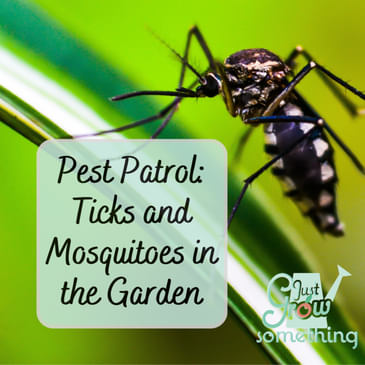
Summer gardening should be about sunshine and fresh veggies, not swatting and scratching. So, this week on Just Grow Something we dig into the science and strategy behind controlling two of the most irritating garden pests that go after the gardeners, not our plants: ticks and mosquitoes. Learn which ones are in your region, understand the risks they carry, and implement practical, research-backed solutions to protect yourself and your family while in the garden.
From landscape tweaks to personal protection hacks and a game-changing DIY mosquito trap, this episode has everything you need to enjoy your garden bite-free.
We cover:
- Common tick species by region and associated diseases
- Mosquito types and their disease vectors
- Natural vs. chemical repellent options
- Landscaping tips to deter pests
- How to build a “Bucket of Doom” mosquito trap
Let's dig in!
References and Resources:
Save 20% on your new own-root rose plant atHeirloomRoses.com with code JUSTGROW https://heirloomroses.com
https://homegrownnationalpark.org/mosquito-bucket-challenge/
https://www.mayoclinic.org/diseases-conditions/alpha-gal-syndrome/in-depth/tick-species/art-20546861?utm_source=chatgpt.com
https://extension.psu.edu/using-insect-and-tick-repellents-safely
https://www.canr.msu.edu/news/summer_safety_part_3_mosquitoes_and_ticks
https://cals.cornell.edu/integrated-pest-management/outreach-education/whats-bugging-you/ticks/managing-ticks-landscape
https://hawxpestcontrol.com/how-to-treat-standing-water-to-prevent-mosquitoes-in-your-yard
https://extension.sdstate.edu/how-avoid-being-dinner-preventing-tick-and-mosquito-bites
https://npic.orst.edu/factsheets/PicaridinGen.html
https://health.clevelandclinic.org/is-deet-bad-for-you-and-your-kids
https://ticksafety.com/about-ticks/seed-ticks-tick-bombs/
Just Grow Something: https://justgrowsomething.com
Just Grow Something Merch andDownloads: https://justgrowsomething.com/shop
Just Grow Something Gardening Friends Facebook Group:https://www.facebook.com/share/g/18YgHveF5P/
Check out how you can become a patron on Patreon: https://www.patreon.com/JustGrowSomething
Bonus content for supporters of the Podcast: https://buymeacoffee.com/justgrowsomething
Amazon storefront: https://www.amazon.com/shop/justgrowsomething
Karin Velez [00:00:00]:
For most of us, summer gardening can be an absolute joy until the buzzing and the biting begins. There are two pests in the garden that seem to be pretty much universal no matter where you are. And I'm not talking about pests for your plants, I'm talking about pests for your people. Ticks and mosquitoes. Around here we call this is it freckle or tick season. And we've had so much rain lately that the mosquitoes seem to be coming out we all day, every day and no matter where I'm standing, I hear them buzzing in my ear. We are constantly spraying ourselves down with all kinds of bug sprays. So today on Just Grow Something we are going to explore some science backed strategies to reduce tick and mosquito populations in and around our gardens.
Karin Velez [00:00:47]:
From landscaping adjustments to personal protection measures. By the end, you will be well equipped with practical tips to enhance your outdoor enjoyment while reducing disease and itch and overall irritation. Let's dig in.
Karin Velez [00:02:42]:
So it may come as no surprise to you that I was in the Girl Scouts. I'm definitely always been an outdoor kind of kid and I used to love going camping when we were little and when we lived in Colorado that meant camping up in the mountains. We were aware of like ticks and mosquitoes and stuff, but we were fairly young. It wasn't until I was in the Girl Scouts in Virginia and we started doing a lot of those sort of group camping trips into the wooded areas that were sort of along the Potomac that we were sort of, I don't know, indoctrinated. Ingrained, I guess. It was ingrained in us about being so super aware of ticks and to the point where it was almost a phobia for a while we were told, you know, the ticks would jump out of the trees and they would get into our hair and so we always had to wear bandanas on our heads, which, by the way, that's a myth. They don't actually jump out of the trees and land on you. But you know, it was so ingrained in my brain that ticks were so horrible and that we should Be so afraid of them. And we, of course, used to always do tick checks as soon as you were done with our camping trips or with our hiking trips or whatever. And I had never found a tick on me, ever. And then I remember we were coming back from a camping trip with the Girl Scouts, and I was riding home, my mom was driving, and I. We had done all the, you know, prerequisite tick checks before even getting in the car, and everything was fine. And I was just sort of leaning my head up against the window or leaning it on my hand, you know, as my. I was leaning against the window, and I remember just running my hand through my hair and pulling my hand out, and there was this tick on my hand, y' all. I lost it. Like, I have never been one who was afraid of bugs or was bothered by, you know, even snakes or anything else. But it had been so beat into my brain that ticks were like the enemy.
Karin Velez [00:03:29]:
That that one little instance of having that tick on my hand completely just threw me into a tizzy. And my mom just very calmly looked over and said, okay, roll down the window and flick it out the window. Like, why are you sitting there freaking out? Because I'd never found one on me. Right? Fast forward now. All of these years later, I am constantly surrounded by ticks. Constantly. We find them almost daily crawling on us. And I know for people who maybe are gardening in a more suburban or even urban area, that seems like something to freak out about.
Karin Velez [00:04:07]:
But we are just so used to it out here at this point, because, number one, the farm is surrounded by trees, and there are a lot of areas along the outer edges around the gardens that aren't mowed down very closely. And we haven't sort of created any, like, real natural perimeters between those areas. So the ticks travel. Right. And then. Don't get me started about the mosquitoes this year. It's absolutely ridiculous. So that is what sort of spurred this episode.
Karin Velez [00:04:34]:
I know it's the time of year when everybody starts to worry about these things and when they start to become a problem, especially if you're out there gardening in the very early morning or the late evening, that is when the mosquitoes really start to come out. And then, of course, you know, if you're in an area where most of us are, there are ticks of some sort, and they are vectors for diseases. So I thought this week would be a really good time to jump into understanding what it is that we're dealing with and then how to deal with it as we move through the gardening season. So the first thing that we have to do, just like everything else, is understand what we are dealing with. And we want to do this from a science backed sort of evidence based way. Right? Ticks are absolutely vectors with disease. Okay, let's start with the ticks. They are vectors for disease like Lyme disease and Rocky Mountain spotted fever.
Karin Velez [00:05:28]:
They thrive, arrive in wooded or brushy or grassy areas. They prefer a shaded environment. They love the high humidity. I mentioned the ticks here are awful. We are especially prone to seed ticks. So a seed tick is technically a tick in the second stage of its life cycle. So the life cycle of a tick is basically four stages. You have the egg, then you have the larvae, then you have the nymph, and then you have the adult.
Karin Velez [00:05:58]:
And then we kind of start all over again, right? Tick larvae are commonly referred to as seed ticks. They are very, very tiny. They kind of look like a little poppy seed with like six legs on them. They are incy beansy. Okay? At this stage of their life cycle, they have just hatched, but they have yet to find their first blood meal. And they need that blood meal to move on to the nymph stage. It is extremely tough for these little tick larvae to bite and penetrate our skin. So if you find a seed tick, generally speaking, it's just a matter of removing them, knocking them off, whatever, which a lot of the time you will get what are called tick bombs, seed tick bombs, which is like just this cluster of them, because again, they have all just hatched and you happen to walk through the area where they hatched and now they are all over your leg or your clothing, especially your clothing, because they can grab on very easily, but they can't hang on really well.
Karin Velez [00:06:58]:
So they're, generally speaking you can just take some duct tape rolled inside out, or you can take like a lint roller to just remove that grouping of the seed ticks. Now if you're being bitten by something that you think is a seed tick, which is generally what we end up with, it's likely in the nymph stage. So technically these are not seed ticks, but you know, I mean, they're so close to each other that generally there's kind of get lumped into the same sort of category. A nymph tick has had its first blood meal and therefore they very well may carry and transmit the pathogens that we are worried about in those larger adult ticks. So really, no matter the size or the stage, unless it is a literal seed tick like it, it has not bitten anything yet and it's just been hatched. The rest of them we do have to worry about. So what kind of ticks could you have in your area and what can they transmit? This likely isn't a complete list. Okay.
Karin Velez [00:08:03]:
That I'm going to share with you. And I only have information about the contiguous US So be sure to look up what is predominant in your area if you are unsure. But these are sort of the major tick species and their associated diseases by US Region. And we'll start with the Northeast and the Midwest. This also includes Key Kansas. Right. The first one is the black legged tick. This is the one that carries Lyme disease.
Karin Velez [00:08:25]:
It also carries a bunch of other ones, anaplasmosis and other, you know, lesser known ones. The one that we most are familiar with is Lyme disease. They inhabit the wooded and brushy areas, specifically in areas with high humidity. They are very active from early spring all the way through until late fall. They are the primary vector for Lyme disease in these regions. The other one that is common in this region is the Lone Star tick. So it is one that spreads tularemia. So if you've never, you've never heard of that before.
Karin Velez [00:08:59]:
That is also known as rabbit fever. It's a bacterial infection. It can cause a fever and skin ulcers and all kinds of, you know, weird things and large lymph nodes. There's also the southern tick associated rash illness or starry. But the one that you're poor, probably most familiar with is Alpha gal syndrome. And that is that red meat allergy that develops in people who maybe have been bitten by these Lone Star ticks. Right. These ones are populated in wooded areas that have sort of dense underbrush.
Karin Velez [00:09:31]:
They are most active from early spring through the late summer. They are known for aggressive feeding behavior and they are also starting to expand, expand their range northward as well. So this is something that you might have to worry about even further north than the areas that I just mentioned, the Southeast. You also have the Lone Star tick. It is extremely common and a significant vector for multiple diseases in the Southwest. But you also have the American dog tick, and this is the one. Not only does this one spread the tularemia, but this one also spreads the Rocky Mountain spotted fever. These guys like to hang out in grassy fields and low lying brush.
Karin Velez [00:10:13]:
They are active from the, in the spring and the summer months. They do prefer dogs, hence the name American dog tick. But they will bite humans. And they are very prevalent in the Southeast. On the west coast, you guys have the Western black legged tick. So very similar to our regular black legged. So black legged tick is Ixidiz skin scapularis. The western black legged tick is Ixidies pacificus.
Karin Velez [00:10:41]:
Okay, same thing. Also spreads Lyme disease and anaplasmosis. They're generally found in like the coastal scrub and forested areas. They are active late fall to early spring. So a little bit different than the black legged ticks we're working with here, but they are the primary vector for Lyme disease. On the west coast. You also have the Pacific coast tick. This is the one that spreads Rocky Mountain fever and Tularian Tuala remia.
Karin Velez [00:11:12]:
I can never pronounce that right. So this is very similar to the American dog tick. So again, both spreading that Rocky Mountain spotted fever and the tularemia. This one is also active spring through early summer. Less commonly bites humans, but still, still a potential vector on the west coast. Once we get into the Rocky Mountain region, it is the Rocky Mountain wood tick, also, again, spreads Rocky Mountain spotted fever, also spreads Colorado tick fever and that tularemia. Again, they like to be in those wooded areas at like the higher elevations and they are also active spring through early summer. So if you're doing those sort of elevation mountain hikes, that is the one that you want to look for.
Karin Velez [00:11:58]:
Of course, it's named for its prevalence in the Rocky Mountain region. So that is the main one to watch out for. And then in the Southwest, you've got the brown dog tick, which again spreads that Rocky Mountain spotted fever. It however, does hang out in urban and suburban areas and it is often found indoors. It also is active year round, especially especially in your warmer climates. This one does again, prefer dogs, but it can bite humans. And so this one is very unique because of its indoor habitat preference. This is, I think, the only one that we have that really prefers to be or is often found indoors.
Karin Velez [00:12:41]:
And then there's another one that is sort of an emerging concern, and this is the Asian longhorned tick. So it is a potential vector for a bunch of different diseases. Research is ongoing for this one. This one is actually usually found in grassland and in pastures and it's often found on livestock. So this was first identified in the US in 2017. And the problem with this one is that it is capable of reproducing without mating, which means that it has a huge potential for very, very rapid population growth. So these are active spring through fall. So this is something that you would have to worry about.
Karin Velez [00:13:25]:
Again, normally we think about ticks and we think about wooded areas. Or really tall grass and that sort of thing. These guys are actually in the grasslands and the pasture. So that is a new thing that we get to worry about with these types of ticks.
Karin Velez [00:15:27]:
okay, so it's not just the ticks that have different species or genre that are diverse throughout the US and have different diseases associated with them. Mosquitoes are the same thing. So mosquitoes are generally known for transmitting West Nile virus and Zika virus, but there are other illnesses that they can transmit too. They One thing that is universal about mosquitoes is that they breed in standing water and they are usually most active during dawn and dusk. But but as evidenced by what has been going on here with the super high humidity levels from all of the rain lately, I don't know if you guys can hear that, but it is raining again. So the mosquitoes have been out. They have been loving life. I've been getting buzzed and bitten midday lately. And of course, just like ticks, there are different breeds and different types of mosquitoes that all live and breed in different geographic regions. And they are responsible for spreading diseases differently, too. I mean, I hear you, Florida, when you talk about mosquitoes, the sign of dinosaurs, okay, you have your own sort of little breed down there.
Karin Velez [00:16:15]:
So let's break down the mosquitoes a little bit. We have the 80s mosquitoes. Okay, not 80s as in like a number, but A, e, D, E, S, 80s mosquitoes. These ones are known for their very aggressive daytime biting and their role in transmitting several significant diseases. So you have the yellow fever mosquito. You have the Asian tiger mosquito. You have Aedes atlanticus, which is distributed, like, in the southeast U.S. from Texas to Maryland.
Karin Velez [00:16:47]:
So the yellow fever mosquito is primarily in the southeast and the southwest and parts of California. It is increasingly being found in urban areas. It is transmitting dengue fever, Zika, yellow fever, and there's a couple of other ones that they're doing, too. These prefer to lay their eggs in artificial containers with standing water. So your flower pots, your buckets, discarded tires that are laying around. They definitely prefer feeding on humans. And they are very active during daylight hours. So throw out the window what you, you know, learned about.
Karin Velez [00:17:21]:
Okay, well, they're active most of dawn and dusk. Not these guys. Okay. The Asian tiger mosquito. Those are also found in the Southeast, but they are also found in the mid Atlantic and the Northeast and parts of the Northwest. They are expanding their range because they have figured out how to adapt to cooler climates. And they also spread dengue and Zika. So they utilize both natural and artificial containers for laying their eggs.
Karin Velez [00:17:49]:
So not only is it standing water in, like, your flower pots and other things, but also pools of water that are just sitting around. They are very. They are actually capable of surviving in cooler temperatures. This is another aggressive daytime biter. And they feed on both humans and animals. And then we have Atlanticus. This one is again, southeastern US From Texas to Maryland. It is a potential vector for yellow fever and the keystone virus.
Karin Velez [00:18:15]:
They lay their eggs in temporary pools and containers. Now, the next thing we have is the culex mosquitoes. These ones are primarily active during dawn and dusk, and they are known vectors for several encephalitic viruses. Okay, so we have the northern house mosquito. So this is the northern U.S. and southern Canada. It arrives in urban and suburban areas. This is the one that is most likely the one that is bugging you at your picnic if you are in the northern U.S.
Karin Velez [00:18:45]:
or southern Canada. Right. This one transmits West Nile virus. It also transmits St. Louis encephalitis. It prefers stagnant water sources, so clogged Gutters, storm drains, bird baths, that sort of thing. Then we get into Tarsalis, culex, tarsalis. This is one in the Midwest and the Western US also spreading that West Nile virus, also spreading St Louis encephalitis, but it also is a vector for western equine encephalitis.
Karin Velez [00:19:14]:
So if you are a horse person, this one is pertaining to you as well. So it's not just the garden, it's also dealing with our animals too. And these ones utilize a variety of water sources, including fresh water, but also polluted water. Okay. And then we have the southern house mosquito, which is in the southern U.S. including the Gulf Ghost states, also spreading west nile and the St. Louis encephalitis. These are commonly found in urban areas.
Karin Velez [00:19:37]:
They breed in polluted water sources. So this is something that if you are gardening in an urban area, you might be kind of coming in contact with. And then we have the Anopheles mosquitoes. These are the ones that are the primary vectors for malaria. Now, currently, malaria cases are rare and they are typically imported, but we do have two varieties of the mosquitoes. One is an eastern, one is a Western. They are both potential vectors for malaria. And the, the one on the east coast tends to prefer clean, very slow moving water sources, so like ponds or marshes.
Karin Velez [00:20:14]:
The west coast one tends to utilize a variety of water sources, including like rice fields and irrigation ditches. Okay. But again, you know, the malarial transmission is a bit rare, so not quite what we have to worry about other than them just being a general pain. And then we have the Colocetta mosquitoes, and these are the ones that are known in their role for transmitting eastern equine encephalitis. So these are through the eastern and central US they are the. Primarily what they transmit is this eee, and they transmit it among bird populations. But then humans become infected through these other vectors that are going from the birds to the humans. Right.
Karin Velez [00:21:00]:
So there's all kinds of different ways that this is done. These guys breed in freshwater swamps and marshes. Now, of course, Florida, you have those giant mosquitoes, the galley nippers, or Sorophora ciliata. Okay? These are the giant mosquitoes in Florida that are known for their size and their aggressive feeding habits. For those of us who are not in Florida, if y' all, this is not a joke, okay? These Galli nippers are about 20 times the size of our usual mosquitoes, and they have the bite to match. These guys are capable of biting through clothing. So if we're used to wearing like long sleeve clothes to protect ourselves from mosquitoes. Yeah, that doesn't work with these guys.
Karin Velez [00:21:45]:
And they are not picky eaters. They will target pets, they will target wild animals and they will do humans. Okay. They like floodwaters as their sort of nurseries, which is why they are also referred to as floodwater mosquitoes. Now the good thing about these guys, if they're if is something, is that while they are a nuisance, they have not been documented to transmit mosquito borne illness to humans. So that is like their only saving grace because they are known to be carriers of heartworm. And we know how that happens with dogs. That's, you know, they get by the mosquitoes and then they end up with heartworm.
Karin Velez [00:22:21]:
So yeah, the Florida ones are big and nasty, but it, you know, and their bite hurts, but at least they're not, you know, possibly transmitting any diseases to us. Okay, so now that I have either fascinated you with this discussion or completely grossed you out, how do we deal with these pests in and around our gardens so that we and our pets don't become an all you can eat buffet? So the first thing that we can do is to sort of make some adjustments to our landscaping, our yards, our garden areas to deter these pets. Yes. And the first part of that is to eliminate any standing water. So we should regularly be emptying and scrubbing out containers that collect water. So our bird baths, our plant saucers, any buckets that we have sitting around. Right. We also should be ensuring that our gutters are clean and free flowing so that we don't have that sort of water accumulation.
Karin Velez [00:23:19]:
The same thing goes with any areas under like our faucets where our hoses are attached for watering the garden. Or if we have downspouts that maybe are backing up or they're dumping a lot of water there. We need to worry about sort of managing how that water flows and getting it moving again. The other thing too is if you do have things like bird baths, then you might want to consider installing one of those little pumps that creates a little fountain or otherwise keeps the that water moving a little bit because the moving water will discourage the mosquito breeding. Okay. The second thing to do is to maintain short grass and to clear the vegetation. So if you have a lawn area that is around your garden, you actually want to keep that mowed pretty continuously and remove any leaf litter or brush to reduce that tick habitat. That's also going to reduce the humidity that kind of attracts the, the mosquitoes as well.
Karin Velez [00:24:20]:
You also want to prune any overhanging branches to allow the sunlight to kind of penetrate because that is also going to create a less hospitable environment, especially for the ticks, but it's also going to allow that area to sort of dry out if it has been very humid. And that's going to keep the mosquitoes away as well. Of course, if we're creating pollinator habitats or native, you know, insect habitats around the edges of our garden, areas that are very tall and full of natives, that's fine. We don't want to get rid of that. We're not going to want to clear those out. But we likely don't want to be sort of meandering through those areas either, because that's a great place for ticks to hang out, especially those little seed tick bombs that can cling to us if we go anywhere near them. Okay. And then one thing that we have sort of failed to do here, which I really probably ought to consider doing, is creating a physical barrier.
Karin Velez [00:25:18]:
So if you can create sort of a three foot wide barrier of wood chips or even gravel between your, you know, garden area and any wooded areas, or even between your lawn, if there's an area that you hang out with, you know, in the, in the yard and any wooded areas around, that is actually going to restrict the tick migration into the areas that you are using like recreationally. I think this is something that we're really going to have to focus on doing as this tick problem seems to continuing to get worse. And this also applies to like, if you have children's like play equipment or anything, or if you've got your patios out there, keep them away from like the yard edges and the trees because you're, you're more likely to be encountering these ticks the closer to the trees you are. Okay. Personal protection too. Like, you know, wearing light colored clothing, wearing long sleeve shirts and long pants. Again, if you're in Florida, I get it, you know, you guys have those ginormous ones that can bite through the clothing. But for the rest of us, this is going to help to prevent the mosquitoes for sure from getting in.
Karin Velez [00:26:26]:
And then if we can tuck our pants into our socks and tuck our shirts into our pants, that is going to prevent the ticks from reaching our skin. I will fully admit that I am not good at this. Okay. I am very typically, especially in the summertime gardening in a pair of running shorts and a tank top. Maybe just a sports bra. Like, I, I'm sorry, it's a free for all out there. It's it's hot. I don't want to be completely covered up like that.
Karin Velez [00:26:56]:
So I do the next best thing, and I use insect repellent. Okay? So if that's something that you're wanting to do, use an EPA registered insect repellent, specifically one containing deet. Now, I want to dispel some misnomers about the use of deet, because it has been demonized in the past, and I, you know, followed right along with that with most people. If you're not familiar with what DEET is, it was created in 1946 by the U.S. army or researchers with the U.S. army anyway, because the soldiers who were fighting in World War II were also fighting against war mosquitoes, and they needed this repellent, Right? They started using it in the civilian realm in, like, 1957. There were sort of reports, and I'm using that term loosely, I would say probably more anecdotes of health concerns surrounding the use of deet. And there was a really hard push there for a while for people not to use it, especially with kids or during pregnancy.
Karin Velez [00:27:59]:
Everything that has been studied has shown that when it is used appropriately, DEET is fine. Now, that doesn't mean that there haven't been any reactions to deet. It's a chemical, right? So. And people often react to chemicals. Some people might get rashes or irritated skin after using a product that has DEET in it. It can also irritate your eyes if you get it too close, but that's pretty much any bug spray. There have been very rare reports of seizures associated with deet, but according to the National Pesticide Information center, most of those cases followed people drinking the products with DEETS in them or otherwise using them in ways that, like, didn't follow the recommended guidelines, whether it was intentionally or, you know, by accident. So that's reassuring, right? But overall, the reactions to DEET are few and far between, given the hundreds of millions of people who use it every year.
Karin Velez [00:28:54]:
I use it, I use it religiously because I'm on the farm. I'm doing endurance runs through the woods. I go camping. I am much more comfortable using a product with DEET and maybe having some rare side effect than I am comfortable contracting something like West Nile virus or malaria or Lyme disease or Rocky Mountain Spotted fever or Alpha Gal syndrome or Zika virus, any of these things. Okay. I would much rather take my chances with the DEET than I would with all of those other things. Okay? But if you're not comfortable with deet, I'm not trying to convince you to use it. There is an alternative, at least here in the US and I know overseas as well, and that is to use something that contains picaridin.
Karin Velez [00:29:42]:
So Picaridin is an insect repellent. It works for mosquitoes and ticks and chiggers and all those kinds of things. It is a synthetic compound that was first made in the 1980s, and it was made to resemble the natural compound piperine, which is what's found in the group of plants that are used to produce black pepper. So picaridin was used really widely as an insect repellent in Europe and Australia. It's only been available in the US since, like, 2005. So. And I have not seen seen any of the concerns surrounding Picaridin that I have seen with deet. So that one might be an option for you if you are just not comfortable using the deet.
Karin Velez [00:30:23]:
Right. Another measure too, rather than just spraying yourself, is to apply permethrin to your clothing. So this is going to give you added protection specifically against the ticks and also those giant Florida mosquitoes that like to bite through the clothing. Okay. Okay. So if you can get your hands on some permethrin, just put them on your clothing, and that's going to help keep the. The ticks away. Of course, there are homemade remedies, Right.
Karin Velez [00:30:47]:
You can make a spray yourself. I have done this tons of times, right? Oil of lemon, eucalyptus, or citronella, essential oil blended with some witch hazel. So one part oil to 10 parts witch hazel. Just spray it on your skin. That is a very, very simple recipe. I have also done a mix of essential oils along with some rubbing alcohol and the witch hazel and a little bit of water. So you just add all the essential oils to your spray bottle and add like a tablespoon of the alcohol and like a half a cup of the witch hazel and then just fill the rest away with water and shake it up really good and just spray it to your skin. Okay.
Karin Velez [00:31:21]:
I have done one like this that had rosemary oil, eucalyptus, and tea tree oil. That was pretty effective against the mosquitoes for sure. But when it comes to the ticks. Sorry, I'm going for the deet. Okay. And then finally, you know, in terms of personal protection, just make sure that you are checking yourself for ticks after outdoor activities. So, you know, if you've been outdoors, whether it's in the garden or doing anything else, check yourself, check your kids, check your pets. And also showering within two hours of being out in the garden can actually help to remove any Unattached ticks.
Karin Velez [00:32:00]:
But your best bet in terms of the mosquitoes is definitely going to be making sure that you are covered up and using a bug spray of some sort. And so finally, what are some sort of tailored tips for different gardening setups? If you are gardening in ground, you want to make sure that you are implementing proper drainage to prevent any water from pooling. So if you have an area in your garden where the water tends to run down towards one area and then it pours schools at the base, you may need to do some work to create better drainage. Put in drain tile, dig a trench, get it to, you know, get move further on away from the garden so that you don't have that water pooling because that is just attracting the mosquitoes to start laying their eggs. You know, I always encourage using mulch that's going to suppress the weeds. Right. So that we don't have the weeds coming up. And again, you're, it's holding on to all of that humidity, all that moisture.
Karin Velez [00:32:55]:
So that's a great place for mosquitoes to hang out. But then of course, it getting taller like that is also a great place for the ticks to hang out. But we do want to avoid excessive mulch because we don't want to retain too much moisture and attract those pests in that manner. I have always found straw to be really good at helping the moisture to wick away, because straw, the strands of the straw are hollow, they tend to allow for a little bit better airflow, which also means water flow. So there's gaps that are within the straw. It just, it holds up better, it holds its structure better, and it allows that water to drain through into the soil underneath so it doesn't mat down. It doesn't like hold that moisture so much compared to something like say, wood chips or hay that are just going to suck up all that moisture and it's going to hold it right there. So not only is that not so super great for the plants at that point, but it's also going to attract those pests.
Karin Velez [00:33:56]:
So use the mulch, but use it strategically. We want to suppress the weeds. We want to, you know, retain the moisture in the soil, but we don't want it so deep or to use a material that's going to retain it all and attract those pests. Okay. In your raised garden beds, you want to make sure that you are using materials that allow for adequate drainage. I never am a proponent of putting bottoms on our raised beds. I think they should always be open to the soil underneath, regardless of how bad that soil is, because it's going to allow for the natural microbes, but then also it's going to allow for adequate drainage. Now, of course, if you have to put it on a patio or on, you know, a concrete or something, then that's a completely different story.
Karin Velez [00:34:38]:
But if you're out in the actual ground area, then make sure that bottom is open, make sure that, that it's got some drainage. You also want to make sure that you are checking, checking in and around those beds to make sure that you don't have any standing water. Because if we think about it, we are constructing these beds regardless of what we're making them out of the soil underneath. Again, unless you're gardening on a patio or, you know, on a concrete, you know, pad somewhere, if you are out in the ground or on the ground, those beds are going to shift. The materials inside that bed are going to settle. That ground underneath the bed may settle in one way or another, which means you might end up with, with some uneven points in and around those beds. So make sure that you are checking, especially after heavy rainfall, that's a really good time to see whether or not you have any standing water around the outside of the beds or even in one corner of the bed. And then if you're working with really small containers, just make sure that you are not over watering as you are promptly emptying those saucers that are under your pots.
Karin Velez [00:35:42]:
And you, you know, just check, make sure that we are reducing the humidity levels and we're not giving that standing water and allowing those mosquitoes to breed freely. Ideally, we are eliminating the standing water. We are maintaining our landscape areas, keeping the grass short, pulling out the leaf litter, pruning the vegetation back to reduce those tick habitats and keep the humidity levels down to keep the mosquitoes away. Right. We want to eliminate any potential breeding sites for the mosquitoes. We want, we want to try to create a barrier, so wood chips or gravel or something to separate our gardening areas from any wooded areas. We want to protect ourselves, so wear the appropriate clothing. Not me, but we can use insect repellents when we are out there in the garden.
Karin Velez [00:36:27]:
And then, of course, after we're done working out in the garden, make sure that we are thoroughly checking ourselves for ticks and taking a quick shower afterwards to get rid of anything that we might miss. And then finally, we have a technique that I am going to be utilizing this year because the mosquitoes have gotten to be so bad. And this is a technique that uses buckets to trap and get Rid of the mosquitoes. And we call this the bucket of doom. Okay, so Doug Tallamy, he is an American entomologist, he's an ecologist, he's a co conservationist, he is a professor in the department of Entomology and Wildlife Ecology at the University of Delaware. All around really smart guy. He's written several books, he's co authored a bunch of papers. Anyway, he has also founded the, oh, what's it called? National park in my homemade.
Karin Velez [00:37:23]:
Homemade national park I think is what it's called. And he has issued the mosquito Bucket Challenge. The reason for this is because you notice that I didn't mention fogging or spraying for mosquitoes as one of the ways that we should battle them. And the reason for this is because mosquito fogging is not only toxic, but it is also mostly ineffective. These sprays really kill much more in the way of beneficials like butterflies and bees and lightning bugs than they do adult mosquitoes. They only kill about 10% of the adult mosquitoes. And according to Doug Tallamy, in order for that to be really effective at mosquito control, those sprays would need to kill upwards of like 90% of them. And they just don't do that.
Karin Velez [00:38:12]:
So the idea is to target the mosquitoes in their larval stage instead. So we've already talked about the fact that mosquitoes lay their eggs in standing water. Well, this bucket of doom gives them a place to do that and then it stops that. Okay, so what do you need? You need a bucket. Five gallon bucket works. Okay. Any large container that holds water will be fine, plus you need some water. Okay.
Karin Velez [00:38:37]:
You're also going to need like a handful of dead leaves or grass clippings. I just have like weeds that I've pulled from the garden or whatever. Toss it in there. And you also want to get mosquito dunks. So mosquito dunks are these like pucks of material that contain Bacillus thuringiensis israeliensis. So bti, you've heard me talk about BT before, It is a bacteria that is, that is really good at attacking like caterpillars and that sort of thing. Well, this is the same type of a thing. It works on the mosquito larvae.
Karin Velez [00:39:16]:
Okay. Very widely available online, most hardware stores. You can find them at the garden centers, whatever. So then you also want to have like a bucket lid or some wire mesh or just a sturdy stick. This is going to depend on whether or not you have kids and pets around. So here's the thing. Okay? This is what you do. You fill the bucket about 2/3 of the way with water.
Karin Velez [00:39:36]:
And then we're going to make it funky. Okay. We want to add that plant debris, so whether it's dead leaves or grass clippings or the weeds from your garden, whatever, and shove it in there. We want to make this water stinky. You know what happens when you've, like, had a bucket out in the garden and you've collected your skewers, vegetable scraps, or you've collected the weeds that you've been, you know, that you've been pulling. And then you leave that bucket sitting somewhere and it, like, rains and you forget about it, and there it creates that funk. Yeah, we're trying to create that funk on purpose. Okay.
Karin Velez [00:40:10]:
We want to leave plenty of water surface area so the mosquitoes have room to land and lay their eggs. And then we want to break up that mosquito dunk. We're just going to break it up into fourths, and we're just going to put one quarter of that dunk into the bucket. Now, here's the thing that you. You need to worry about. If you have kids around or pets around that might get into this bucket, you want to add a lid that has plenty of large holes drilled into it so the mosquitoes can get in. Or you can do, like, wire mesh secured across the top with zip ties or put a heavy rock on it or something. But if you don't have kids or pets, you can just put a stick in the bucket so that leans up and out above the rim.
Karin Velez [00:40:52]:
So if you have a small animal that falls in there or beneficials that land in there, they have a way to kind of crawl out. That's it. That's all you're going to do. Water, vegetation, a lid of some sort or a stick, and that mosquito dunk a quarter of it. And then you stick that bucket in a quiet, like, shady area away from your house or any place else. Right. It's going to draw the mosquitoes over there to go ahead and lay their eggs in there. But when that larvae hatches, that mosquito dunk is going to take care of the problem for you.
Karin Velez [00:41:21]:
That is the easiest way to reduce the amount of larvae or the amount of mosquitoes that are coming in your yard without worrying about spraying anything toxic in and around. So every yard is different. Try a spot that stays sort of damp and quiet. Put it in the corner of a yard or wherever, and I will put a link in the show notes to, to this method. As a matter of fact, today's show actually has a ton of resources in terms of the sources where I got all this information, plus, you know, things about tick safety and this mosquito bucket challenge from Homegrown national park, and all the different things about DEET and Picaridin and all that kinds of stuff. So I encourage you to take a look in the show notes if you're on the email list. Those sources were already listed in this morning's email, so you should have those at your ready. All right, my gardening friends, this episode was full of a lot of information about some little buggies that we don't want to have in our garden, especially the kind that are munching on us or on our pets.
Karin Velez [00:42:22]:
So hopefully it gave you enough information to be able to go out and do something about it so that we can be a little bit more comfortable in our gardens this summer. Until next time, my gardening friends, keep on cultivating that green garden, and we'll talk again soon.