
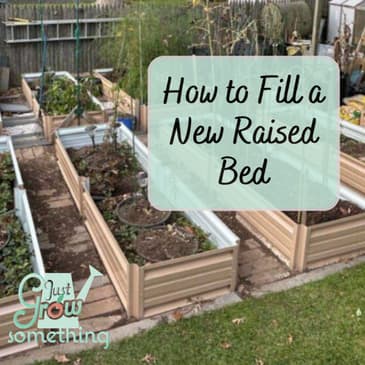
This week we tackle one of the biggest questions in raisedbed gardening – how to fill it! It can be daunting, staring at this gaping box, trying to figure out how you’re going to fill 18” or even 36” of depth without going broke.
So, today on Just Grow Something, we’re digging into the dirt – literally – on how to fill your new raised bed. We’ll cover the different materials you can use to get your garden bed off to it’s best start for your plant’s sake, but also for your wallet’s sake. And, we’ll talk about the materials you don’t want to use, even if it’s just to fill space in the bottom of a very deep bed, and the alternatives. By the end you’ll have a pretty good idea of where to start and where you’ll end up so your raised bed materials can settle in over the winter and become the beautiful loamy soil you’ll want to plant into in the spring. Let’s dig in!Save 20% and get free shipping on your new raised bed from PlanterBoxDirect.com by using code JUSTGROW20, now until October 15th!
For full show notes and transcript head to https:/justgrowsomethingpodcast.com/episode/layer-by-layer-how-to-fill-a-new-raised-bed-ep-267
Hosted by Simplecast, an AdsWizz company. See pcm.adswizz.com for information about our collection and use of personal data for advertising.
00:00:00
In the first week of this special series on raised bed
00:00:03
gardening, we talked about how to decide the proper dimensions
00:00:07
for creating a new raised bed in your garden.
00:00:09
Last week we talked about the different materials that we can
00:00:12
use to build those beds and options for purchasing or
00:00:15
repurposing. This week we tackle one of the
00:00:18
biggest questions in raised bed gardening.
00:00:20
How do you fill it? It can be daunting staring at
00:00:24
this gaping box, trying to figure out how you're going to
00:00:27
fill 18 inches or even 36 inches of depth without going broke.
00:00:33
So today under Score Something, we're digging into the dirt
00:00:36
literally, on how to fill your new raised bed.
00:00:40
We'll cover the different materials that you can use to
00:00:42
get your garden bed off to its best start for your plants sake,
00:00:46
but also for your wallet's sake. And we'll talk about the
00:00:49
materials that you don't want to use, even if it's just to fill
00:00:53
space in the bottom of a very deep bed.
00:00:55
And the alternatives? By the end, you will have a
00:00:58
pretty good idea of where to start and where you'll end up so
00:01:01
your raised bed materials can settle in over the winter and
00:01:05
become the beautiful loamy soil you'll want to plant into in the
00:01:08
spring. Let's dig in.
00:01:10
Hey, I'm Karen, and what started as a small backyard garden 20
00:01:14
years ago turned into a lifelong passion for growing food.
00:01:17
Now, as a market farmer and horticulturist, I want to help
00:01:20
you do the same on this podcast. I am your friend in the garden,
00:01:24
teaching evidence. Based techniques to help you.
00:01:26
Grow your favorites and build confidence in your own garden.
00:01:29
Space. So grab your garden.
00:01:31
Journal and a cup of coffee and get ready to just grow
00:01:33
something. So before we dig in, I have a
00:01:39
little bit of a maintenance tip for you as we head into the
00:01:43
fall, specifically for your tomatoes and your Peppers and
00:01:48
eggplants and some of the other veggies that may take longer
00:01:51
than 30 days from the time they flower to the time you will get
00:01:56
the finished fruit. So if you have something that is
00:02:00
going to take longer than 30 days, then if when you are about
00:02:04
four to six weeks prior to your next or your first anticipated
00:02:09
frost, which is what we're at right now, at least in my area,
00:02:14
now would be the time that you want to start pruning and
00:02:17
topping those plants. If we think about this in terms
00:02:21
of the energy availability in the plant, if you have a flower
00:02:26
that is going to take say 45 days to produce a fruit and you
00:02:32
are only 30 days ahead of when your first frost is supposed to
00:02:36
hit, then obviously that fruit is not going to get to maturity
00:02:40
before the plant dies off. So we want to conserve that
00:02:44
energy. We don't want the plant putting
00:02:46
any energy into those new blooms.
00:02:49
And I know that this is painful because right now, if you have
00:02:52
had any break in your summer heat at all, you're likely
00:02:56
seeing a bunch of your plants suddenly putting on all of these
00:03:00
blooms. I know my tomatoes and my
00:03:03
Peppers specifically right now are doing this.
00:03:05
I have tons of brand new blooms all over the place, but our
00:03:10
first usual frost date is around October 20th or so.
00:03:15
That's only about four weeks away.
00:03:16
I know that none of those flowers are going to get to
00:03:21
maturity at this point. So my best bet in order to give
00:03:26
all of that energy, redirect all of that energy out of the plant
00:03:30
into those existing fruits that already are on the plant and are
00:03:36
working on getting to maturity, is by removing all those other
00:03:40
blooms. You can do this really easily by
00:03:43
just walking across the tops of your plant.
00:03:45
So that's usually where you see is like this fresh green growth
00:03:47
going on and all these new blooms, you can just kind of
00:03:50
start lopping off the tops of them and that is going to
00:03:54
redirect that energy down into the existing fruits.
00:03:57
You might have to do this several times because you know
00:04:02
what happens when you cut off the top of one of some of these
00:04:05
plants where it's going to try to send out these side shoots
00:04:08
around where that topping happened, right?
00:04:10
And then it's going to try to flower.
00:04:11
So this might be something that you have to do a couple of
00:04:14
times. But I have seen really good
00:04:17
results with doing this, like I said, in like tomatoes and
00:04:21
Peppers and even eggplant, just to sort of let the plant utilize
00:04:26
its energy in a way that is most beneficial to me as the
00:04:29
gardener. We want it pushing that energy
00:04:31
into creating more mature fruits that we'll be able to go ahead
00:04:35
and harvest. You can do the same thing too.
00:04:38
If you still have like winter squashes or pumpkins that are
00:04:41
flowering but very obviously are not going to get to maturity at
00:04:44
this point, you can either just remove those blooms or you can
00:04:51
chop the vines if necessary. You can cut them off where that
00:04:55
brand new growth is going and just allow them to continue to
00:05:00
put their energy into the fruits that are closer to the root zone
00:05:03
that, you know, might have a chance to actually, you know,
00:05:06
finish before the end of the season.
00:05:08
My only caveat to that is with those sort of more succulent
00:05:13
types of of vines, like winter squashes where they're really
00:05:18
thick, you might be opening up that plant to the possibility of
00:05:22
some diseases if you have pathogens that can enter into
00:05:27
the vine from the areas where those get cut off.
00:05:30
So if you're only growing a few of these squash plants, my
00:05:34
advice would be just to take the blooms off and allow them to
00:05:37
finish growing out the rest of the squash and pumpkins.
00:05:40
But if you have a ton of them and it's just faster for you to
00:05:42
go through and just sort of chop them all off, then, you know, be
00:05:45
my guest. But either way, we want to be
00:05:47
pruning and topping anything that is going to take longer
00:05:51
than 30 to 45 days to get from flowering to fruiting.
00:05:55
And we want to do this about four to six weeks prior to our
00:05:58
first anticipated fall frost. OK, so I know what I normally
00:06:05
use to fill up my new raised beds, and I know what I advise
00:06:08
my clients to do and what I help them do in their own gardens.
00:06:11
But to prepare for this episode, I really did kind of want to do
00:06:15
a little bit of a deep dive into the different gardening forums
00:06:18
and places where, you know, these questions are being asked,
00:06:21
just to see what questions were being asked about this topic so
00:06:26
we could address them. Questions about soil recipes and
00:06:30
cheap ways to fill beds absolutely dominated the
00:06:34
discussions around this. OK, so gardeners were often
00:06:37
asking about what the ratio of topsoil to compost is and
00:06:40
whether or not they should add sand to the mix and how to layer
00:06:43
in the materials. So let's take a look at 3:00
00:06:48
university Extension Service recommendations and three
00:06:53
gardening expert recommendations and we'll kind of compare them
00:06:57
and we'll see. We'll see what each one of them
00:06:59
says and we'll figure out where to go from there, Right.
00:07:02
So UMN Extension recommends filling beds with roughly 2/3 to
00:07:07
1/2 topsoil and 1/2 to 1/3 plant based compost.
00:07:12
They also said to add sand if your native soil is very clay.
00:07:16
They warn that too much compost can dry out very quickly and
00:07:20
that potting soil alone also dries out very quickly.
00:07:23
UMD extension suggests mixing compost and purchase topsoil in
00:07:28
a one to two or one to one ratio.
00:07:29
So pretty close to what UMN recommended.
00:07:34
They basically said the only difference was if you're talking
00:07:36
about filling beds that are on hard surfaces to do equal parts
00:07:41
compost and a soil less mix and then add about 20% topsoil.
00:07:47
And then UVM extension also suggests mixing topsoil with
00:07:53
compost. Ratio is about 1:00 to 1:00 to
00:07:56
maybe only about 20% compost and then lightening up heavy soil
00:08:00
with peat Moss or cocoa corps. So those are our three
00:08:03
university extension, you know, recommendations fairly similar
00:08:08
to each other. If you look at some of the like
00:08:12
online experts, we have Nicole Burke from garden area and she
00:08:17
encourages filling the beds completely with soil and
00:08:21
compost. So using a weed barrier of some
00:08:23
sort at the bottom and then adding in, you know, basically a
00:08:27
one to one ratio of of topsoil and compost Also recommends
00:08:32
adding fall leaves in six inch layers and then topping it with
00:08:36
eight to 10 inches of the soil. Liz Jaros from Epic Gardening
00:08:42
also recommends layering cardboard at the bottom, filling
00:08:45
the taller beds halfway with logs and branches and leaves.
00:08:48
So this kind of forms a passive compost and then just making
00:08:52
sure that the top 12 inches contains a high quality soil.
00:08:58
She was emphasizing that the compost layer basically
00:09:00
comprises about 25% of that top layer.
00:09:05
And then we have Mel's mix. If you don't know Mel, this is
00:09:09
Mel Bartholomew. He was the originator of the
00:09:11
square foot gardening method. And the mix that he has always
00:09:15
recommended or had always recommended was 1/3 coarse
00:09:19
vermiculite, 1/3 peat Moss, and 1/3 blended organic compost.
00:09:25
And what they mean by blended compost is basically using about
00:09:29
5 different compost sources and blending them all together.
00:09:33
So getting, you know, mushroom compost and worm castings and
00:09:38
some forest products or whatever, and then blending
00:09:40
those all together and that being your compost source.
00:09:42
OK, so that's six different versions of what we should be
00:09:47
using and how we should be layering in our raised beds.
00:09:51
Some of them are similar to each other, some of them are very
00:09:53
different. Is it any wonder that gardeners
00:09:56
are confused about what to use and which of these is going to
00:10:00
produce the best results, Right? How do we know?
00:10:04
So let's demystify this just a little bit by analyzing the
00:10:08
common components in each of these suggestions, and then
00:10:14
we'll modify those suggestions to account for like our budget
00:10:18
and maybe available materials. So excluding Mel's mix, which is
00:10:23
essentially A soyless mix, all of the other recommendations
00:10:26
include topsoil. So that's obviously component #1
00:10:30
the reason we want topsoil is not we don't just want a full
00:10:34
container of nothing but compost.
00:10:37
This is partly for texture and it's partly for the microbes.
00:10:42
We've talked before about the need for microbes in our soil to
00:10:45
help release the nutrients from our compost and move those
00:10:48
nutrients into the plant roots. If you pile nothing but compost
00:10:52
into your raised bed, you will eventually get soil, but it will
00:10:59
take about a year for that compost to really break down to
00:11:04
be a texture that plants like and to have nutrients readily
00:11:09
available for what we're planting.
00:11:11
And honestly, we don't want to wait that long, right?
00:11:14
So the topsoil we add is going to inoculate the other
00:11:18
components with the microorganisms that we need, and
00:11:22
it's going to contribute to that texture that we want.
00:11:25
Your first choice for topsoil would be to take something from
00:11:30
your own yard. Yes.
00:11:32
Even if the texture isn't great, like the heavy clay that I have
00:11:36
here, that topsoil is going to have your native good little
00:11:41
buggies in it. That can go to work right away.
00:11:44
The compost and the other amendments will fix the texture
00:11:48
problem for all but the worst of the soils.
00:11:50
OK, your second option is to purchase local topsoil, which
00:11:56
you can often do from the same local places where you would buy
00:12:00
your compost. And then of course, the third
00:12:02
option is just to buy bags of topsoil from the garden center.
00:12:06
It does seem kind of weird to be buying dirt, but a gardener's
00:12:11
got to do what a gardener's got to do, right?
00:12:14
So the second common component in all of these recommendations
00:12:19
is compost. Now, I think the Mel's mix is
00:12:23
actually on track with this when suggesting a blend of different
00:12:28
types of compost. But use what you have available
00:12:32
to you, right? This is where we start to look
00:12:34
at availability of materials and also affordability of the
00:12:40
materials, right? If the only thing that you can
00:12:41
get your hands on is a bagged compost from the garden center,
00:12:46
then use that. If, however, you have access to
00:12:51
that and some mushroom compost, then do a blend of both.
00:12:56
If you also happen to have a neighbor who has rabbits who is
00:12:59
willing to share the pellets, or you live near a horse farm that
00:13:02
has like piles of aged horse manure, then add that.
00:13:06
Now notice that I said aged manure.
00:13:09
Well, composted manure. That's even better.
00:13:14
I would prefer that. But herbivore manure that has
00:13:17
been aged for about four months, that's fine too.
00:13:20
If you're going to be using this bed very soon after building it
00:13:25
and not letting it sit for a minimum of four months, which
00:13:29
intent? This is why we're doing this in
00:13:31
the fall and not in the spring, right?
00:13:33
But if you're going to use it right away, then I really would
00:13:36
recommend sticking with things like rabbit, goat, alpaca or
00:13:40
sheep manure. It's got a little bit less
00:13:42
nitrogen content than like chicken manure or horse manure
00:13:46
or cattle manure, unless it's really well compested.
00:13:50
But if you're building it now and you're not planting until
00:13:54
the spring, then any of those aged manures will be fine.
00:13:58
I do not recommend fresh manure of any kind other than that
00:14:04
rabbit manure that we mentioned. And I will leave a link in the
00:14:06
show notes to the Focal Point Friday episode I did about that
00:14:09
a couple of years ago. That has all of the pertinent
00:14:11
information as to why. But just understand that fresh
00:14:14
manure is not a good thing to be adding to your raised beds
00:14:18
unless it has been aged other than the rabbit manure.
00:14:22
OK, so Next up we're going to talk about the places where
00:14:26
these recommendations kind of stray from each other and then
00:14:29
what I do in my own garden when filling new raised beds.
00:14:33
I am really turning into a raised garden bed girly for
00:14:38
sure. You know, I'm a little bit of a
00:14:40
data geek and I have seen such a major difference in my yield per
00:14:45
square foot of garden bed between my raised beds and my in
00:14:50
ground beds that I am just continuing to convert more and
00:14:54
more space around my farm to planters.
00:14:56
It's why I decided to do this whole series and it's why I
00:14:59
reached out to my favorite raised bed company, Planter Box
00:15:02
Direct. Their beds are made in the US by
00:15:05
a small local New York business using 100% US steel and up to
00:15:11
30% of that steel is recycled, while all the steel used in the
00:15:15
bed construction is 100% recyclable.
00:15:18
So in 20 or 30 years, if the bed starts to break down, then yeah,
00:15:24
it can be recycled into something else, maybe even a new
00:15:27
raised garden bed. Join the Raised bed garden
00:15:30
revolution by choosing from the wide range of options at Planter
00:15:35
Box direct.com and use this month's special code Just Grow
00:15:40
20. From now until October 15th you
00:15:43
will save 20% off of your order and get free shipping.
00:15:47
Planterbox direct.com with code Just grow 20.
00:15:51
The link is in the show notes. OK, so a few of these sources
00:15:56
that I pulled recommended adding peat Moss to the bed mix.
00:16:01
Now, I love peat Moss for its water absorption capacity and
00:16:06
for like adding texture to the bed, but there are a lot of
00:16:11
concerns around the sustainability of the product as
00:16:15
a whole. So much so that it's now being
00:16:17
banned from being sold in Europe and I have generally stayed away
00:16:20
from it unless it's a component in my potting soil and it's only
00:16:24
being harvested from managed bogs in Canada.
00:16:27
That's highly specific, right? So what are our alternatives?
00:16:32
Coconut choir, worm castings, cocoa holes, rice holes, pine
00:16:36
bark, these all have different ways that they help with the
00:16:42
structure and water retention of the soils in the same way that
00:16:46
like peat Moss whip. So if the topsoil that you're
00:16:50
using seems very heavy and the texture needs to be broken up a
00:16:56
bit more so than what the mixture of compost is going to
00:16:59
do for it, and you don't have a good mix of composted materials
00:17:04
to use, try adding one or more of those suggestions that I just
00:17:08
made. If your topsoil contains a lot
00:17:12
of clay, then you might consider adding some sand to the mix as
00:17:17
well. Now before warned, sand is going
00:17:19
to really change how the soil drains and too much can actually
00:17:25
make it drain too much. So clay soil doesn't drain well.
00:17:30
So adding soil will help with this.
00:17:32
Just be sure that you have a bunch of other organic material
00:17:36
mixed in there, like the different components and stuff
00:17:39
that we talked about, along with things like warm castings or
00:17:42
rice holes or whatever. Otherwise, clay and sand alone
00:17:47
will pretty much make concrete when you add water.
00:17:51
So let's avoid this, OK? And if you don't have very heavy
00:17:54
clay soils as your topsoil component, then there really is
00:17:58
no need to add sand right away. In fact, too much sand means you
00:18:03
likely won't hold on to nearly as much water or as many
00:18:07
nutrients as many a gardener in South Florida can likely attest
00:18:11
to. Now you may have noticed that
00:18:15
only two of our sources recommended any other natural
00:18:19
materials like leaves or twigs for our raised beds.
00:18:22
And I would venture to say that the reason for this is because
00:18:26
the university sources like to give recommendations that are
00:18:30
going to give you a fairly predictable outcome.
00:18:34
So recommending a specific ratio of compost to topsoil as your
00:18:40
main components makes sense. But you'll notice the gardening
00:18:44
experts from the other two non university sites are the ones
00:18:48
recommending adding leaves and other materials, likely because
00:18:53
they know a lot of us gardeners are looking to fill raised beds
00:18:57
as frugally as possible. And adding twigs and branches
00:19:01
and leaves is a good way to fill the bed with some organic
00:19:04
materials that may be readily available and free.
00:19:09
And they're also going to eventually break down into those
00:19:12
nutritive components while they're filling up some space at
00:19:15
the same time at the bottom right.
00:19:16
I like this approach and it's something that we do here when
00:19:19
we're filling in our new raised beds, which I will talk about
00:19:21
here in a minute. Now, the only one of these
00:19:26
sources to recommend adding vermiculite is Mel's mix.
00:19:31
I think this is because this is specifically a mix that does not
00:19:35
include topsoil. It's a soil less blend and there
00:19:39
needs to be something in the blend that helps with moisture
00:19:44
retention and aeration and nutrient availability.
00:19:49
So vermiculite doesn't contain nutrients itself, but the
00:19:53
structure of the vermiculite traps and holds water and
00:19:58
nutrients and then it releases it back to the plant roots as
00:20:01
it's needed. Plus.
00:20:03
It's very lightweight and so that helps to just hold air
00:20:06
space within the soil for the plant roots to infiltrate into.
00:20:10
So I'm not opposed at all to using vermiculite if you need to
00:20:15
lighten up the soil in your raised beds.
00:20:18
As a matter of fact, I've actually advised garden clients
00:20:22
with in ground beds in specific situations to use vermiculite
00:20:27
for all the reasons I mentioned and more.
00:20:31
But if your goal is to do this as inexpensively as possible,
00:20:35
you may not want to add another purchase to the list.
00:20:38
So this is one of those components that I would say use
00:20:42
if needed or if you're specifically following the Mel's
00:20:46
mix formula. It's not my favorite because I
00:20:50
mean the Mel's mix itself, the vermiculite is fine, but the
00:20:52
Mel's mix itself is not my favorite because it is lacking
00:20:57
that topsoil components and I find that to be very important.
00:21:01
But to each his own. So what do I do with my raised
00:21:07
beds and how do I help my clients build theirs?
00:21:09
That's up next. So when building a new raised
00:21:13
bed, I will usually start with a really good layer of cardboard
00:21:18
at the bottom of the bed because it will help to choke out any of
00:21:22
the weeds that might be trying to come up, any of the native
00:21:24
grasses that might be there. And at the same time, it breaks
00:21:28
down quickly enough for those good guys to get through right.
00:21:32
You could also do this with, like we talked about last week,
00:21:35
burlap sacks or whatever. Even if your soil is absolute
00:21:39
junk underneath and you would never be able to grow anything
00:21:43
in it, it is still important for the microbes and the worms.
00:21:48
Yes, there are likely worms in there, even if it's junky, to be
00:21:52
able to get up and get through into the soil that is eventually
00:21:55
going to be in your raised bed. So a good layer of cardboard is
00:21:59
great. I used to recommend putting like
00:22:03
a weed barrier down the bottom. I don't recommend that anymore
00:22:07
because I have seen how a lot of these weed barriers will break
00:22:09
down over time. Most of them are made out of
00:22:12
plastics of some sort. They tend to shred.
00:22:15
That's also leaving micro plastics in there.
00:22:17
So it is something that I no longer recommend.
00:22:20
A girl has a prerogative to change her mind, right?
00:22:23
OK, with more information we can recommend different things.
00:22:27
So it doesn't really matter whatever size bed you have, I
00:22:31
always start with that cardboard and then I layer a base layer of
00:22:35
whatever carbon sources are available.
00:22:39
So for you, this might be things like twigs and sticks that are
00:22:42
laying around in the yard, large rotting logs if you're filling a
00:22:46
very deep bed. So if you want one of those tall
00:22:49
36 inch beds so you don't have to bend over, that's a lot of
00:22:53
soil to have to fill. So you know, old logs are
00:22:56
really, really good for this. Cardboard, shredded newspaper
00:23:00
and any other like non slick paper products, shredded leaves,
00:23:04
straw I've used chopped up like dried corn husks and the stalks
00:23:09
that go with it. Even the dried corn cops you can
00:23:12
use, like if you're building these beds right now, you can
00:23:16
use the dead dried plants from this year's garden to fill the
00:23:20
space in the bottom, just so long as they don't have any
00:23:22
like, plant diseases or any kind of bug infestations, right?
00:23:25
These things can all form the base layer of our garden beds.
00:23:29
They're dry, they're fibrous, and most importantly, they take
00:23:33
up space. OK.
00:23:35
And as they break down in the bottom of that bed, they are
00:23:39
going to provide the structure for the humans that will
00:23:43
eventually develop. This is why I don't understand
00:23:47
why none of the university extensions recommend this.
00:23:50
And I don't know if it's because, like, the availability
00:23:53
of these items is iffy. Not everybody has access to it.
00:23:56
That might be, I don't know. But, you know, this is very
00:24:00
similar to the role that these fibrous materials play in a
00:24:04
compost pile. So just about any brown material
00:24:08
that you would put into a compost pile can go in the
00:24:10
bottom of your raised bed as you fill it.
00:24:12
So these materials are not only going to save us some money in
00:24:15
terms of the cost of filling the bed, but they're also providing
00:24:20
air space for the other components to break down.
00:24:23
And that's going to give room for the little microbes to move
00:24:26
around and do their work. Plus they're also going to help
00:24:29
with some of that drainage, too. What I don't want you to do is
00:24:33
to follow the suggestions of people who say just to take
00:24:37
plastic nursery pots and put them upside down in the bed to
00:24:41
take space, especially when you're trying to fill those
00:24:44
really deep beds. Please don't do this like we
00:24:47
just talked about with the weed fabric, that plastic is going to
00:24:51
break down. It is going to leach.
00:24:54
We don't know what the consequences of that are at this
00:24:56
point and there's just not enough research.
00:24:58
So don't do this please, If you really need to fill space at the
00:25:03
bottom of a very large bed and you don't have, you know, logs
00:25:08
or or large limbs or anything, or something that's organic to
00:25:11
fill the space by a straw Bale. Take the straps off of it, set
00:25:15
it down into the bed, take the straps off of it and kind of
00:25:18
judge it apart and you know, let it fall apart a little bit in
00:25:21
the bottom of that bed and then start adding your other
00:25:24
materials. Yes, it's carbon.
00:25:26
It's going to break down eventually, but in a really deep
00:25:29
bed, it's not going to steal all of the nitrogen from the plants
00:25:33
because your plant roots are going to be in those top 6
00:25:36
inches for the most part, especially in the early part of
00:25:38
the season. And if you're doing this in the
00:25:40
fall to plant in the spring, that's less of a worry because
00:25:45
it's going to have the entire winter to start to break down.
00:25:47
So just don't use plastic, please.
00:25:50
If you want something permanently taking up that
00:25:52
space, then grab some large terracotta pots and turn those
00:25:56
upside down to take up the space, but just don't use
00:25:58
plastic, please. OK, now you want this first
00:26:02
chunky layer, right? All these chunky bits to take up
00:26:06
about all but the top 6 or 8 inches of the bed.
00:26:10
So let's think about that for a second.
00:26:12
We are recommending 18 inch deep beds.
00:26:14
So you have about a foot's worth of space in those 18 inch beds.
00:26:19
Obviously more if you're doing a very deep 36 inch bed to fill in
00:26:24
with a bunch of chunky stuff, right?
00:26:26
That might seem a little high at first as it's piled up, but that
00:26:29
is OK. It is going to compress as you
00:26:32
add the other components on top, and then it's going to compress
00:26:35
even more as it begins to break down South.
00:26:39
This next layer is where I will add any aged or composted
00:26:45
manure. So the nitrogen from this layer
00:26:47
is going to be able to move in both directions.
00:26:49
So it's going to go down into that lower carbon layer beneath
00:26:52
it to start to break that stuff down, but it can also move up
00:26:56
into that next soil layer above. And this is what we want.
00:26:59
We want to go in both directions.
00:27:01
If you don't have any manure to add at this stage, that is OK.
00:27:05
We're going to move forward with the soil components and this is
00:27:08
where a lot of gardeners end up getting tripped up, right?
00:27:12
What you put into this layer is what your plants, you know, in
00:27:18
that first season are mainly going to rely on for their
00:27:22
growing medium and for their nutrition.
00:27:25
So the thing that we want to steer clear of when we're adding
00:27:29
this soil component is using straight garden soil or black
00:27:34
soil or topsoil that you buy in the bags at the garden center or
00:27:37
have brought in by a truck or whatever, right?
00:27:40
If you get one of those bags and you break it open, yes, it is
00:27:43
very dark, but it is very, very dense.
00:27:46
The structure of this soil is very dense and likely if you are
00:27:50
digging this up out of your yard, it is also likely going to
00:27:53
be very dense unless you were pulling it from an existing
00:27:56
garden bed, which would also be kind of a cool idea.
00:28:00
But you know, if you're purchasing these things, these
00:28:02
soils are intended to be used like as an additive to an in
00:28:05
ground bed to improve their structure.
00:28:08
So we only want to use this as just one component in the soil
00:28:13
layer of our raised beds. It should not be used by itself.
00:28:16
This also goes, by the way, if you're doing things in small
00:28:20
containers, like if you're growing things in a pot, like on
00:28:23
your back deck, you do not want to go out and just dig up your
00:28:26
soil and throw it into that pot and then try to grow something
00:28:29
in it. It will very quickly compact
00:28:31
because there's again, nothing holding that air space open.
00:28:35
And so you're going to have just a clump of soil in that pot,
00:28:39
which is going to continue to shrink down and shrink down.
00:28:42
And there won't be any space in there for those roots right now,
00:28:47
if you can find topsoil that is already being sold in
00:28:52
combination with compost, now we're talking.
00:28:55
OK, this is getting us much closer to creating this sort of
00:28:58
loose, well draining soil that is also full of nutrients.
00:29:01
This is exactly what we want. If you can find pulverized
00:29:05
topsoil, which basically just means that it has been ground
00:29:08
down to a texture that is nice and fine.
00:29:10
Not super chunky, that's even better.
00:29:12
But anything labeled topsoil should be fine.
00:29:14
Now you want to mix the soil. If you don't have, you know it
00:29:18
already pre mixed, you can't buy it pre mixed.
00:29:20
Then you want to get the topsoil or dig it up out of your yard
00:29:22
and then you want to mix it in equal parts with the compost.
00:29:26
OK, now we are getting close to that sort of texture and
00:29:29
nutrient content that we want. And like I said, if you have
00:29:33
decent topsoil from your own property that you can use, use
00:29:37
it. It is going to contain some of
00:29:38
those native microbes that are essential for getting the
00:29:42
nutrients to the plants. So if you have an area like
00:29:45
that, you need to level off, I mean, especially if you're
00:29:49
building a new raised bed area and you need to level that spot
00:29:53
out, then use that soil, right? Mix it into the beds.
00:29:57
Just make sure that you include that compost component with it.
00:30:01
That is a key. So carbon layer, manure layer,
00:30:05
topsoil and compost combo or you know the just the topsoil and
00:30:09
then add your compost. And like we said, a mix of
00:30:12
compost is preferable, but use whatever is convenient and
00:30:16
within budget. Mix it into that topsoil layer
00:30:19
and the combination of those two should comprise the top 6 inches
00:30:24
of your bed. Now, Speaking of compost, if you
00:30:28
have compost that you have been making at home but it isn't
00:30:33
quite finished yet, go ahead and use that, but use it as part of
00:30:38
that lower layer of bulk, right? It's not going to heat the bed
00:30:43
up so much while it's breaking down that it would be
00:30:44
detrimental to your plants and it's going to take up some of
00:30:47
that space. Just keep the unfinished stuff
00:30:50
in the lower portion of the bed, like where you would put the
00:30:54
manure. So if you have manure, then go
00:30:57
ahead and add your unfinished compost to that.
00:30:59
If you don't have menor, then let your unfinished compost take
00:31:01
that place. If you have finished compost
00:31:04
from your own pile, then you want to be using that in the top
00:31:07
six layers of the bed. OK, Hopefully it's making sense
00:31:10
to you the way that we're layering this.
00:31:14
Once all the components are in place, I highly recommend
00:31:19
putting the bed to bed for the winter with a layer of mulch.
00:31:23
I love straw mulch. Use whatever you have, but think
00:31:26
of it in terms of like tucking the soil away for the winter to
00:31:30
break down and prepare for spring.
00:31:32
The mulch protects the soil. It helps insulate those microbes
00:31:36
and retain the moisture that they need to be able to move
00:31:40
around and do their jobs, and it also protects that soil from
00:31:43
blowing off with any heavy winter winds.
00:31:47
Then in the spring, just pull back the mulch, mix the top few
00:31:50
inches up a little bit just to kind of check the texture and
00:31:54
you really should just be ready to start planting now.
00:31:57
If you don't love the texture in the spring and you feel like it
00:32:01
needs more time to really be ready, but you're ready to plant
00:32:05
now, there is nothing wrong with adding a layer of regular
00:32:10
potting soil to the top couple of inches to help keep this, you
00:32:14
know, move the spring planting along a little bit.
00:32:17
This soil layer we're talking about should be the top 6 inches
00:32:20
of your container. We want a good texture and a
00:32:23
good nutrient content there. So the reason that I might use
00:32:26
potting soil as one of those components is because it has
00:32:30
that great texture. If you're using the right
00:32:32
potting soil, be particular here, OK?
00:32:35
But it also likely contains vermiculite.
00:32:38
And of course, we already talked about how that's going to aid in
00:32:40
the structure and the water retention.
00:32:42
And it also has some nutrients that are usually added to it and
00:32:45
that's going to be immediately available to those plants.
00:32:48
So even if you're waiting for that compost down there to
00:32:52
become a little bit more active, you may just be able to use the
00:32:56
potting soil on the top and there's going to be some of some
00:32:59
nutrients immediately available, right?
00:33:01
You may not need to do this at all.
00:33:03
You might uncover your bed in the spring and it's beautiful
00:33:05
and glorious and you can start planting right away and it's no
00:33:07
big deal. But if you uncover the bed in
00:33:09
the spring and it just doesn't seem ready, or maybe you waited
00:33:13
too long to put the beds together and they haven't had
00:33:16
enough time to sit like as long as they needed and you need to
00:33:19
start planting. Potting soil is a really good
00:33:22
way just to kind of jump start a bed that you're going to be
00:33:24
using right away. So your raised bed layers,
00:33:31
chunky brown carbon layer, followed by manure if available,
00:33:36
and any unfinished compost if you have it, followed by a
00:33:39
combination of topsoil and finished compost and then top
00:33:44
that with mulch. That's it.
00:33:46
Refresh it at the end of the season with some fresh compost,
00:33:49
put it to bed for the winter with a new layer of mulch, and
00:33:52
you will have raised garden beds functioning for you for years to
00:33:56
come. Look, if you found today's
00:33:59
episode helpful, if I answered any questions for you, and you
00:34:02
have a new gardener who is looking to a build a raised bed
00:34:06
or two for next year, send this episode to them please, or even
00:34:10
share it to your socials. I truly believe anybody can be a
00:34:14
successful gardener with just a little bit of knowledge, and
00:34:17
raised beds are a really productive way to do this.
00:34:21
Until next time, my gardening friends, keep on cultivating
00:34:24
that dream garden, and we'll talk again soon.