
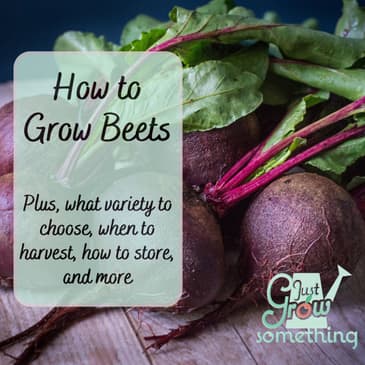
If you didn’t plan for a fall garden and maybe have changed your mind a little bit and want to give it a go, you might be looking for something you can very quickly put into the ground and grow directly from seed. Enter beets. They will happily germinate in almost any temperature of soil and they greatly appreciate the cooler days of fall when they are coming to maturity. They’re not fool-proof, because there is a little effort needed in terms of thinning in most cases and they do need a nice, loose soil to produce those beautiful round roots, but there is nothing that beats the flavor in the fall of a sweet, roasted beet alongside other root vegetables. Or, my go-to snack or addition to my salads, pickled beets, and my new favorite, beets roasted in air fryer. Even my husband admits those are good and he swears beets taste like dirt.
So, today on Just Grow Something we’re talking beets! How to grow them, what type to grow for your area, and why does it seem that even when we carefully space our beet seeds out in the garden that we end up having to thin them anyway? So many seedlings! Let’s dig in!
References and Resources:
Explore Cornell - Home Gardening - Vegetable Growing Guides - Growing Guide
Garden Insect Netting (affiliate)
Garden Frost Cloth/Row Cover (affiliate)
Hosted by Simplecast, an AdsWizz company. See pcm.adswizz.com for information about our collection and use of personal data for advertising.
00:00:00
If you didn't plan for a fall garden, and maybe you've changed
00:00:03
your mind a little bit and you want to give it a go, you might
00:00:05
be looking for something you can very quickly put into the ground
00:00:08
right now and grow directly from seed.
00:00:10
Enter beets. They will happily germinate in
00:00:13
almost any temperature of soil, and they greatly appreciate the
00:00:16
cooler days of fall when they're coming to maturity.
00:00:18
They're not foolproof because there is a little effort needed
00:00:21
in terms of thinning in most cases, and they do need a nice
00:00:24
loose soil to produce those beautiful round roots, but there
00:00:28
is nothing that beats the flavor.
00:00:31
Get it in the fall of a sweet roasted beet alongside other
00:00:35
root vegetables, or my go to snack or addition to my salads,
00:00:39
pickled beets and my new favorite beets roasted in the
00:00:43
air fryer. Even my husband admits that
00:00:45
those are good and he swears beets taste like dirt.
00:00:48
So today on Just Grow Something, we're talking beets, how to grow
00:00:51
them, what type to grow for your area, and why does it seem that
00:00:55
even when we carefully space our beet seeds out in the garden
00:00:58
that we end up having to thin them anyway?
00:01:00
So many seedlings. Let's dig in.
00:01:04
Hey, I'm Karen, I started gardening in a small corner of
00:01:07
my suburban backyard and now 18 years later, I've got a degree
00:01:10
in horticulture and operate a 40 acre market farm.
00:01:13
I believe there is power in food and that everyone should know
00:01:16
how to grow at least a little bit of their own.
00:01:19
On this podcast, I share evidence based techniques to
00:01:21
help you plant, grow, harvest and store all your family's
00:01:25
favorites. Consider me your friend in the
00:01:27
garden. So grab your garden journal and
00:01:29
a cup of coffee and get ready to just grow something.
00:01:40
So is anybody else kind of over it in the garden right now?
00:01:45
Is it horrible of me to admit that when I have an almost full
00:01:48
two months of market season left to go?
00:01:51
It's the end of August, it's hot, it's super muggy here.
00:01:54
The weeds have definitely gotten the better of me and honestly,
00:01:57
in most of my garden areas I just don't care anymore.
00:02:00
I'm OK to admit it and I get it. A lot of you are in the same
00:02:04
position. We know the only areas right now
00:02:07
that are properly weeded are where the fall garden has gone
00:02:10
in because I don't need the competition from, you know, the
00:02:13
weeds against the seedlings or any little sprouts that are
00:02:15
coming up. My planter box direct planters
00:02:18
are all nicely weeded because those are super easy to
00:02:20
maintain. But the spaces in between them,
00:02:23
yeah, they're threatening to overtake the edges of the
00:02:25
planter at this point. So I'm just tired and it's a
00:02:28
mess, and that's OK. I'm not too proud to admit that.
00:02:32
You know, I mean, even the second round of our squashes are
00:02:34
already succumbing to the squash bugs, and the cucumber beetles
00:02:36
are just demolishing things. So we're at that point of the
00:02:39
season where we're tired and frustrated and just over it.
00:02:43
I love the summertime. I really do.
00:02:45
I'm just tired. And I think a lot of you can
00:02:48
relate. But fall is around the corner.
00:02:51
And that's when I breathe a sigh of relief because not only does
00:02:54
the weather give us a break, but so do the insects.
00:02:57
And the weeds tend to slow to a crawl.
00:02:59
So we're not, you know, fighting as much.
00:03:01
So we're just trying to make it through until then.
00:03:05
It also doesn't help that Starbucks and Target and like
00:03:08
everybody else suddenly went into pumpkin spice panic mode
00:03:11
like a month early this year. It's got me thinking about
00:03:14
nothing but fall. So if we're thinking about fall,
00:03:18
let's think about beets, right? Beets are the perfect veggie to
00:03:23
plant for the fall garden, and now is the time to do it in most
00:03:26
areas. So let's just do a quick primer
00:03:28
on how to grow them. The scientific name for beets is
00:03:32
Beta vulgaris. They are in the amaranth, the
00:03:35
ACA family. This is the Amaranth family.
00:03:37
They are in a subgroup that Chena Podoitiers.
00:03:41
I love that word. Sounds like it should be a song.
00:03:43
Chena podoitier. Anyway, that they also include
00:03:47
things like spinach and Swiss Chard and sugar beets and
00:03:51
mangles. So they used to be referred to
00:03:53
as Chena Bodaisier, Chena pedecia, yes, Chena pedecia.
00:03:57
But now they're under the amaranth, the Amaranthe AC.
00:03:59
So anyway, you guys don't care about that.
00:04:01
They're all in the goosefoot subfamily, just like spinach.
00:04:04
So beats are grown for both its root and its tops, but they were
00:04:09
originally domesticated in ancient Middle East specifically
00:04:14
for just the greens. They weren't messing with the
00:04:16
roots back then. They were grown by the ancient
00:04:18
Egyptians and the Greeks, but by the time the Romans started
00:04:21
messing around with them, they were growing them for their
00:04:23
roots too. So ethnobotanically, both the
00:04:27
roots and the greens have been used in traditional medicine for
00:04:31
hundreds of years to treat all kinds of things like
00:04:34
Constipation, gut and joint pain, dandruff, and bad blood,
00:04:39
whatever that means. It sounds like a Taylor Swift
00:04:41
song. That's why beets are currently
00:04:44
being studied for possible health benefits in things that
00:04:48
are related to blood. So your diabetes, high blood
00:04:50
pressure, vascular function, that type of thing.
00:04:53
And all those facts aside, beets are just really good for you.
00:04:58
They're a good source of fiber and folate and manganese and
00:05:00
potassium and vitamin C and iron.
00:05:03
And I think it's the iron content that has LED researchers
00:05:08
to look at the different blood disorders that beets can be
00:05:11
helpful for. And it's the nitrates in beets
00:05:13
that are helpful in reducing blood pressure.
00:05:16
All very, very good things for you.
00:05:18
But let's talk about the flavor. Yes, I can see where they get
00:05:22
the reputation for tasting like dirt, especially if you've never
00:05:26
had them prepared properly. Yeah, they're going to taste a
00:05:29
little bit earthy, but if you roast them alongside like other
00:05:34
root vegetables, it really brings out the natural sugars
00:05:36
and the beets and they get sweet and almost caramel.
00:05:39
I've been doing them in the air fryer all summer and they are
00:05:42
super quick and delicious. But I am a sucker for a pickled
00:05:46
beet. It's one of my favorite things
00:05:48
to throw in a salad or on top of cottage cheese.
00:05:50
So if you need a good beet pickle recipe, hit me up.
00:05:54
I am happy to share mine. Let's talk about growing them.
00:05:57
One thing that we need to think about when we're choosing a beet
00:06:00
variety is the average number of days to maturity.
00:06:03
Because depending on the conditions that you're growing
00:06:05
in, you're going to look for one that is going to best fit those
00:06:09
growing conditions. The average number of days can
00:06:11
be anywhere from 55 to 70, some as long as 80, 90 days.
00:06:15
So those early maturing varieties, you're looking at
00:06:18
about 50 to 55 days. Red Ace and Early Wonder are two
00:06:22
of those, your standard varieties, which is most of the
00:06:26
commonly grown varieties like Detroit Dark Dread.
00:06:29
These take about two months, so 60 to 65 days to reach maturity
00:06:33
and then you have some late maturing ones, certain specialty
00:06:35
varieties or the larger varieties that are really meant
00:06:38
for like long term storage and your sugar beets.
00:06:41
These all take 70 days, maybe even longer.
00:06:45
These are all really good too for succession planting.
00:06:48
So if you have a fairly long growing period either in the
00:06:52
spring or in the fall or both, you can certainly choose a
00:06:56
variety from each one of these categories.
00:06:58
An early, a standard anelay, plant them all at the same time.
00:07:02
And that way you have them maturing at different times
00:07:05
through the season so that you kind of get a continuous harvest
00:07:08
without getting backed up on beets.
00:07:10
Now if you're like me and you do want sort of a bunch of them all
00:07:13
at once at a certain point so you can pickle a bunch of them
00:07:16
to get them put away for the season, then that's a different
00:07:18
story. But if you want to do some
00:07:20
succession plantings without having to plant every couple of
00:07:23
weeks, choosing multiple varieties out of each of these
00:07:25
categories is a great way to do it.
00:07:27
Then you can either harvest them really early as little baby
00:07:30
beats, or you can leave them in the ground for longer for larger
00:07:33
roots. Just remember that the days to
00:07:35
maturity are referring to the time from planting the seed to
00:07:39
when the beet root is fully developed and ready to harvest.
00:07:43
And the standard size is about, I want to say two inches is what
00:07:48
they're considering fully grown. You can also harvest the greens
00:07:54
while the beet is growing if you do it sparingly so that you're
00:07:58
not going to disturb, you know, the, the growth of the root
00:08:02
itself. Or there are varieties that are
00:08:04
grown specifically for their greens, like they've been bred
00:08:08
to produce little to no root at all, so that all you're getting
00:08:11
is the greens. Of course, you could do what I
00:08:14
do and just grow Swiss Chard instead.
00:08:16
So I will grow the beets for their roots.
00:08:19
And if I happen to get really great tops on them, fine, then
00:08:21
I'll use those too. But for the tops, I actually
00:08:24
just grow Swiss Chard. And for anybody who thinks that
00:08:27
beets taste like dirt, Swiss Chard is a little bit more mild.
00:08:31
So it does have that sort of earthy flavor, but not quite as
00:08:33
strong as the beets. So there's a hot tip for you.
00:08:36
So when we are deciding where to plant our beets in the garden,
00:08:42
beets do prefer full sun, but they can also tolerate part
00:08:46
shade. So this actually makes them a
00:08:49
really good late summer planted crop because we can take
00:08:54
advantage of this ability to grow in the part shade if it's
00:08:58
still really hot where we are while we're planting for our
00:09:01
fall garden. So if you have a taller summer
00:09:04
crop that is already in place, you can plant your beets on one
00:09:07
side of them to take advantage of the morning sun.
00:09:11
But then when the the real heat of the day kicks in the
00:09:14
afternoon, they'll be on the other side of those taller
00:09:16
plants and they'll be able to shade those beets because they
00:09:19
do like to come to maturity when it's a little bit cooler out.
00:09:21
So you can take advantage of the fact that they do OK in part
00:09:25
shade. The other thing that you could
00:09:28
take advantage of is the fact that beets will do OK in low
00:09:31
fertility soil. So they do prefer sort of a
00:09:36
sandy loose, you know, soil that allows for those roots to expand
00:09:41
with no problem. So lots of good organic matter,
00:09:44
but they aren't super fussy about the nutrient level.
00:09:49
They don't do well in heavy clay, I've experienced that
00:09:52
myself. So you are going to have to
00:09:54
amend accordingly if you do have heavy clay soils.
00:09:56
Or just grow them in raised beds or planters.
00:09:59
I've actually had success with both.
00:10:01
I have stopped trying to amend my clay soil in place and
00:10:06
instead I have begun to just layer layers of compost on top
00:10:10
every single year and not turn it under.
00:10:13
And that way I'm not even really having to deal with the clay at
00:10:16
all. All that compost is breaking
00:10:18
down into nice, you know, lovely soil when it's combined with
00:10:21
what I'm using for mulch. And so I don't even dig it under
00:10:25
anymore. So the beets have done really
00:10:26
well on that. They've also done very well in
00:10:28
my raised planters. So the soil structure is
00:10:30
important because you know when that soil is nicely aerated,
00:10:35
beets do really well, but they will, they will tolerate low
00:10:38
fertility, but they won't tolerate as acidic soil.
00:10:41
So if you've got aph that's less than six point O, like don't
00:10:44
plant your beets there. Don't plant them near where your
00:10:46
blueberries are now. The one thing they are fussy
00:10:50
about with nutrients though is low boron.
00:10:53
And you likely are not going to know if you have low boron soil
00:10:58
unless your beets start to show signs.
00:11:01
So if you've got really poor root development, they're like
00:11:03
severely stunted or they are really wonkily shaped for no
00:11:06
reason whatsoever, or you cut them open, there are dark brown
00:11:10
patches in the inside. Or if you're trying to grow
00:11:13
sugar beets and they're just not sweet, there's there's not a
00:11:15
real good sugar content to them. You very well may have low
00:11:19
boron, but you're not going to know for sure until you take
00:11:22
that soil and you send it off for a university extension soil
00:11:25
test because home test kits are not going to check for boron.
00:11:29
So in most places you're not going to have this problem.
00:11:31
But if you see those signs and symptoms in your beats, then
00:11:34
yeah, I would send it off. And all you're willing to do is
00:11:36
like add some Borax and that will that will take care of it.
00:11:41
Yes, Borax, the washing soda type stuff, you can just do a
00:11:44
light application of that and that'll generally help take care
00:11:46
of your boron deficiency. So when we are planting our
00:11:50
beets, we want them if you're doing it in the spring, about
00:11:53
two to four weeks before your last expected frost in the
00:11:56
spring. When we're doing them for a fall
00:11:58
harvest, it's going to be a late summer.
00:12:00
Usually you know 6 to 8 weeks before that, that first frost in
00:12:04
the fall if you are in an area that has very mild summers.
00:12:09
So if your highs don't really get above 75 Fahrenheit during
00:12:13
the summertime, you can actually plant beets from spring all the
00:12:17
way through the summer and into the fall.
00:12:19
So just succession after succession of them for two to
00:12:22
three-week intervals. If you really like beets, If you
00:12:25
are in an area like mine though, where it does get hot in the
00:12:27
summertime, don't mess with the beets.
00:12:29
They they might germinate but they're not going to grow very
00:12:32
well. So you really want to stick to
00:12:33
the sort of the spring and then the late summer for fall
00:12:35
plantings. You do want to direct sow these
00:12:38
into the soil. You can transplant them
00:12:41
technically, but it really is not worth the effort getting
00:12:44
them started indoors. And when you disturb the roots
00:12:47
to pot them or to transplant them out into the garden, that
00:12:50
can actually cause those roots to get all wonky.
00:12:52
So just directly sow them in the ground and honestly, they are
00:12:58
going to germinate in a really wide range of temperatures, like
00:13:01
50°F all the way up to 85 Fahrenheit.
00:13:04
They will still, in fact they will still germinate if it's as
00:13:06
cool as 40 Fahrenheit or as high as 90 Fahrenheit.
00:13:10
It's just going to be a lot more slower to germinate at that
00:13:14
lower temperature and it's going to be a little spotty at the
00:13:16
higher temperature. But that tells you what a wide
00:13:19
range of temperatures we can sow them in, right?
00:13:22
So it's only going to take them about 5 to 8 days to pop up out
00:13:25
of the soil unless it's in those much colder soils and then it
00:13:29
can take as long as two weeks. You do want to space them.
00:13:32
You want to put about an 1/2 an inch deep.
00:13:34
These don't need to go really deeply into the soil because we
00:13:36
want them to be closer to the surface.
00:13:38
So those roots can sort of pop up as they start to grow and
00:13:42
then about an inch or two apart in your row.
00:13:46
If you're putting your rows about 12 to 18 inches apart, you
00:13:49
can also sort of broadcast see these and make sure that they
00:13:53
are about two inches apart when you do this because either way
00:13:56
you are going to have to thin these.
00:13:58
So usually I will do this in two stages.
00:14:01
The first is when they get about two inches tall, I will try to
00:14:04
go through with a pair of scissors at the soil line and
00:14:07
cut them off. And then I'll do it again to
00:14:09
where the final distance between them is about three to four
00:14:13
inches just to give the roots a good amount of space to develop.
00:14:17
And the reason I say you are going to have to thin these, it
00:14:20
doesn't matter how well you go through and space them out when
00:14:24
you're planting them, there are multiple seed embryos in every
00:14:28
single one of those seeds. So technically what you're
00:14:31
planting is like a seed ball and there are usually two to four
00:14:35
viable seeds in that little seed ball.
00:14:38
So you're going to have no choice but to go through and
00:14:41
thin them down to that three to four inch spacing because you're
00:14:44
going to have three to four plants sprouting out of the same
00:14:48
little hole. So it's going to take some
00:14:51
effort, I promise you, but it's OK.
00:14:53
I always use these thinnings. I just throw them into my salads
00:14:57
because they're, they're great little, you know, greens,
00:14:59
they're little micro greens and they're fantastic.
00:15:02
The only time that you won't have to do this will be if you
00:15:05
are planting a mono germ variety.
00:15:08
So a single embryo seed, one that I have planted before is
00:15:12
Moneta. It was from Johnny C.
00:15:14
They take about 70 to 80 days. I've had decent luck with them.
00:15:19
I have sometimes noticed that the germination will tend to be
00:15:22
spotty, and I don't know if that had to do with my growing
00:15:25
conditions or if it's the fact that the reason that beet seeds
00:15:30
are kind of bunched into that seed ball is because they
00:15:34
naturally don't have a fantastic germination and maybe that's why
00:15:37
Mother Nature designed it that way.
00:15:39
I don't know. But if you really want to avoid
00:15:42
having to worry about thinning them, then just find yourself a
00:15:44
mono germ variety and you can plant beets with companions.
00:15:50
So Bush beans, lettuce, radishes, any of your brassicas.
00:15:53
So broccoli, cabbage, all those guys.
00:15:55
My favorite though is to plant them with onions because onions
00:15:59
are really good for keeping away pests like flea beetles.
00:16:02
And the flea beetles always plague my beets eventually if
00:16:06
they're being grown by themselves.
00:16:07
So they just do, they just decimate them.
00:16:11
Onions and beets like the same soil texture, right?
00:16:14
So an onions will grow. They have a, those narrow
00:16:17
upright leaves. They don't cast very much shade
00:16:19
down. So that's allowing the beets to
00:16:20
receive plenty of sunlight. In the meantime, the beet greens
00:16:24
can provide some ground cover and some shade lower down.
00:16:27
That's going to help to suppress the weeds around the onions,
00:16:29
which the onions will absolutely appreciate.
00:16:31
The care requirements for onions and beets are about the same.
00:16:34
They both prefer well drained soil.
00:16:36
They like the consistent moisture.
00:16:38
They prefer the full sun makes them really easy to manage
00:16:41
together, but since the beets can tolerate that part shade, if
00:16:45
the onion top growth starts to get a little overzealous, the
00:16:48
shading isn't really going to affect the beets very much.
00:16:51
And in most instances your onions are going to be in place
00:16:55
for way longer than your beets are, so they're not going to
00:16:58
crowd each other out. You can pull the beets, harvest
00:17:00
the beets well before the onions start to get to their huge size.
00:17:04
The only caveat to this is that when we're growing onions, they
00:17:09
like to be side dressed with nitrogen several times during
00:17:12
their their top growth stage. But too much nitrogen for the
00:17:17
beets can actually lead them to get these really nice leafy
00:17:21
tops, but not a whole lot in the way of root development.
00:17:24
So just be aware of this if you are planning on growing your
00:17:27
beets with your onions, and I mentioned beets and onions like
00:17:31
the same things in terms of even moisture.
00:17:34
And so you are going to either water your beets fairly
00:17:38
consistently, but you don't want them to be overlogged.
00:17:41
You want the soil evenly moist. So they need, you know, whatever
00:17:44
our typical one inch of water per week is for the most of our
00:17:47
garden, either from rainfall or from irrigation is what your
00:17:50
beets are going to prefer. And of course, it's always best
00:17:53
to water them at the soil line because we don't want to wet the
00:17:56
foliage because that can lead to disease.
00:17:58
We'll talk about that here in a minute.
00:18:00
I also always of course recommend mulch, but I
00:18:03
understand that when we're growing root vegetables that
00:18:05
were directly sowing into the soil, it can be a little bit
00:18:08
difficult to mulch around those plants.
00:18:10
So what I do is I will mulch 2 to 3 inches across the entire
00:18:15
area where I plan to grow my beets, assuming that there's
00:18:18
already plants there, you know that I'm companion planting
00:18:20
with, I'll plant, I'll just push the the mulch around those.
00:18:24
But wherever I'm going to plant the beets, I will actually just
00:18:26
pull the mulch to the side down their little row and then go
00:18:31
ahead and plant the beets that way and then allow them the week
00:18:35
or so it takes for them to start to germinate.
00:18:38
Once I go through that first round of thinning them out by
00:18:42
clipping them off at the soil line, I'll start to use that
00:18:45
mulch a little bit closer to the plants.
00:18:47
You don't always, you don't want them right up against there
00:18:49
because that can cause them to rot, but just a little bit
00:18:51
closer. And then the second time I go
00:18:54
through and mulch, I will do that final kind of judging to
00:18:57
get them close to where those roots are going to be forming
00:19:00
because this is going to help retain that moisture.
00:19:02
So the it'll help keep that soil evenly moist.
00:19:05
It's also going to help suppress the weeds though, and it's going
00:19:08
to keep the soil cool because these are a cool weather crops.
00:19:11
So they do prefer it to be cooler.
00:19:13
And again, if we're planting for fall, that soil is already going
00:19:16
to be, you know, pretty warm. So we want to protect it as much
00:19:19
as possible. So any organic mulch, you know,
00:19:21
straw, grass clippings, leaves, whatever is going to do the
00:19:24
Chuck. Now, what about those pests?
00:19:26
OK, I talked about the flea beetles.
00:19:28
That's the one that we deal with the most.
00:19:31
But you may also experience leaf miners, leaf hoppers, web worm,
00:19:36
beet, army worms and aphids. So our first line of defense on
00:19:41
all of these is insect netting or row covers.
00:19:44
Usually it's row covers in the very early spring just because
00:19:47
that's what I have on hand because I'm covering everything.
00:19:50
And I will usually once it starts to warm up, because it
00:19:55
does start to get really hot under those row covers.
00:19:57
I, I don't want the beets to get too warm.
00:20:00
So I will take off the row covers and I will put on an
00:20:03
insect netting. Now if I'm growing them
00:20:06
alongside onions and the onions are starting to get real tall
00:20:09
and we don't want them pressing up against that insect netting,
00:20:12
I may have to take it off. Yes, the onions help to protect
00:20:17
against the flea beetles, but if I have aphids or something else
00:20:19
coming in here they might become an issue.
00:20:22
Leaf hoppers too sometimes are an issue as well.
00:20:24
So I have used First Saturday Lime to dust across the tops to
00:20:28
help keep things away. I have used Elm Dirt's strike to
00:20:32
keep them away. You know, a lot of the time if
00:20:36
you're not planning on eating the beet greens, you might not
00:20:41
even worry about some of these pests because once the beets
00:20:44
have gotten to a good size, the damage that these pests are
00:20:47
doing at that stage doesn't seem to affect the growth of the root
00:20:50
too much. And if you're not dusting or
00:20:52
spraying things, you are giving some of the natural predators a
00:20:56
chance to be able to come in and take care of them.
00:20:58
So most of the time, if it's aphids, then obviously you're
00:21:00
going to start to see, you know, green lace wings or your lady
00:21:04
beetles. So, but if you really do, you
00:21:06
know, need to get them knocked off of there or if you want to
00:21:08
eat those greens, then I recommend keeping them covered
00:21:11
or using something to keep the bugs off of the leaves because
00:21:14
those beet greens are mighty tasty to a lot of different
00:21:17
insects. And as far as the beet diseases,
00:21:20
we generally are trying to plant these during the cooler damper
00:21:24
times of the season, usually in the early spring.
00:21:27
If you're in an area where you get a lot of fall rain, that can
00:21:30
actually, you know, spread fungal diseases to your beets
00:21:33
just like any other garden plant.
00:21:35
So if you're having things like, you know, downy mildew, powdery
00:21:38
mildew, that sort of thing again for Saturday lime or of of milk
00:21:41
and water spray, anything you can do to change up that leaf pH
00:21:47
is going to help with that. Other sides like sulfur, neem
00:21:49
oil, these can also help. There is a disease also that is
00:21:52
particular to beets. It's called Circospora leaf
00:21:55
spot. It will just eat up the tops on
00:21:58
the really, really young plants. If you experienced this, you're
00:22:01
just want to make sure that you rotate your crops each season.
00:22:03
You don't want to plant anything that's in the same family that
00:22:06
those Chinna podoitiers. So no, no Chard, no spinach
00:22:10
before or after you plant beets, make sure that you are kind of
00:22:12
rotating around just kind of help keep that disease at Bay.
00:22:16
One other one that beets are susceptible two is another one
00:22:20
that a lot of plants like cucumbers or, and anything else
00:22:24
really is can be affected by and that is mosaic virus.
00:22:27
And the problem is that mosaic virus cannot be cured.
00:22:30
So once it's in your crop, it's there for the season.
00:22:33
So you just have to watch for the signs, which is pretty
00:22:36
distinctive. So it's going to be the leaves
00:22:39
they're going to be modeled with like yellow and white and these
00:22:41
light and dark green different spots like a mosaic.
00:22:45
That's where it gets the, the, the name from.
00:22:47
And they're going to be bumpy or blister, like the leaves are
00:22:51
going to kind of be crinkled. The plants are going to be
00:22:53
stunted. If you end up with mosaic virus,
00:22:56
first of all, you have to remove all of those infected plants or
00:22:58
it is just going to continue to spread to all of the other ones.
00:23:01
And you do not want to put these in your compost pile because
00:23:03
your home compost pile is not going to get hot enough to kill
00:23:07
off that virus. You're going to have to burn
00:23:08
them or throw them out with the garbage.
00:23:10
As much as I hate putting any kind of green matter, you know,
00:23:13
into the garbage, this is a case where you don't want them in
00:23:15
your compost. And then just make sure that you
00:23:17
are disinfecting all of your garden tools because it will
00:23:20
spread from that particular plant to every other plant
00:23:23
that's susceptible in your garden.
00:23:24
So and then the only other thing in beets too is if you've ever
00:23:28
had potato scab, then beets are also susceptible to that.
00:23:33
This I think is mostly prevented by just keeping your beets
00:23:37
evenly watered and that way they don't develop those hard spots.
00:23:40
We don't have much of a problem with that here.
00:23:42
So I just mulch the beets really well and they just do just fine.
00:23:45
So what about harvesting our beets?
00:23:47
You can really harvest your beets anytime.
00:23:50
Once they start to get bigger, whatever your preferred size of
00:23:53
beat is, then that's fine. I have seen people who like to
00:23:56
keep them as baby beets because they're easier to just pickle
00:24:00
whole at that point or they just like them small like that.
00:24:03
I mean, you know, once they get to the size of a golf ball,
00:24:05
that's a really good size. It's entirely up to you.
00:24:08
The smaller beets are going to be a little bit more tender.
00:24:10
The larger ones are definitely going to have a more robust
00:24:12
flavor. And if you look for those really
00:24:14
big storage beets, those are specifically bred to to hang on
00:24:19
and be firm for a really long time.
00:24:21
So just make sure that you know what it is that you're planting.
00:24:24
When you go to harvest them, you want to loosen the soil around
00:24:28
the beets. Either you can use a garden fork
00:24:30
or if your soil is nice and loose, you can just use your
00:24:31
fingers and get down underneath there and sort of lift them up
00:24:35
and loosen them up before you pull them up by the greens.
00:24:38
Always make sure that you're doing this first because
00:24:40
sometimes those beads can get a real deep taproot and they'll
00:24:43
have all these little fine roots coming off of them and it will
00:24:46
hold on to that soil incredibly well.
00:24:49
And you might pull on the top and all of a sudden the tops are
00:24:52
in your hand and the root is still down there in the soil.
00:24:54
So make sure that you are loosening up around and
00:24:56
underneath before you pull that top.
00:24:59
And again, once you've harvested them, don't forget you can do a
00:25:02
succession planting. You can do multiples of these.
00:25:04
So every few weeks, you know, or like I said, plant multiple
00:25:07
varieties with different maturity dates all at the same
00:25:10
time. And that way there's kind of
00:25:11
continuing to come on when you are ready to store them.
00:25:16
They will do really well for a couple of weeks in the
00:25:18
refrigerator if you remove the greens.
00:25:20
The greens, if you leave them on, are going to continue to
00:25:23
draw moisture out of those roots into the atmosphere.
00:25:26
And that's going to cause them to go soft, just like with our
00:25:28
carrots. So make sure that you're cutting
00:25:30
the tops off of them before you put them in the refrigerator.
00:25:34
If you want them to store longer than that, you can do them in a
00:25:37
sort of root cellar situation. So if you have some place that's
00:25:39
cool and dark very consistently, then you can store them that
00:25:43
way. I prefer to pickle mine or you
00:25:46
can just can them or you can even freeze them for long term
00:25:49
storage. So one other thing to note about
00:25:55
beets, if you are a seed saver, we're going to talk about saving
00:25:59
seeds here in a couple of weeks, but just know that beets are
00:26:02
biennials. So if you want to save the
00:26:05
seeds, you are going to have to allow some of those roots to
00:26:08
overwinter and then leaf out and produce seeds in the second
00:26:12
year. Now, if you are someplace with
00:26:14
fairly mild winters, this likely isn't going to be too much of a
00:26:17
problem for you. But if you are someplace where
00:26:20
the, you know, soil freezes solidly during the winter time
00:26:24
or it gets bitterly cold, you might have to put down several
00:26:27
layers of really thick mulch to get them through the winter.
00:26:30
Maybe even cover with some row covers.
00:26:33
You never know. It's worth a try.
00:26:34
If you decide that you want to collect those seeds, they're
00:26:38
fairly easy to collect. They're just going to come up on
00:26:40
a stock and then once that flowers and produces the seed,
00:26:43
you let it naturally dry sort of on that stock and then just
00:26:46
store them in a cool, dry place for a future planting.
00:26:49
So not only are beets really good for us, they can also make
00:26:53
good use of spots in our garden that might be less than ideal
00:26:58
for other crops, especially in the fall.
00:27:00
They are one of those crops that I term as a split succession
00:27:05
crop, one that takes around 60 days to get to maturity.
00:27:08
So you can plant it once in the spring and then you can skip the
00:27:11
summer and then you can plant again on in the late summer for
00:27:14
fall. And of course, beets are also
00:27:16
good for interplanting among other crops to make the most out
00:27:19
of your space. So if you can get past the taste
00:27:21
of the dirt, I'm kidding, They really are really good.
00:27:25
I encourage you to give Beats a try in your garden for the fall,
00:27:29
and then maybe you'll like them so much that you'll plant them
00:27:31
again in the spring. Until next time, my gardening
00:27:34
friends, keep on cultivating that dream garden, and we'll
00:27:36
talk again soon. Thanks for listening to another
00:27:38
episode of the Just Grow Something podcast.
00:27:41
For more information about today's topic and to find all
00:27:43
the ways you can get in touch with me or support the show, go
00:27:46
to justgrowsomethingpodcast.com. Until next time, my gardening
00:27:50
friends, keep learning and keep growing.