
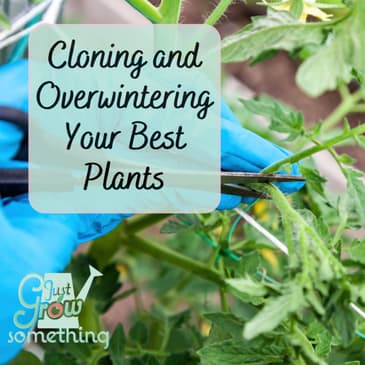
Whether you live in a climate that allows for a veery long growing season or you’re like me and need to cram as much growing into a shorter season as possible, cloning is a shortcut to making the most of our best plants. In some cases it even makes sense to overwinter some of those plants so next season starts off weeks ahead of schedule.
So, today on Just Grow Something, we’re talking about the importance of cloning plants as a strategic shortcut to enhance gardening productivity. I’ll explain the key differences between cloning and seed saving, and the various methods of cloning, including water propagation and the use of rooting hormones, and the layering method. We’ll also talk about how to overwinter plants effectively and which ones are worth the effort, troubleshooting common issues, and the best practices for maintaining plant health during the winter months. Let’s dig in!
Key Takeaways:
Cloning allows gardeners to replicate successful plants for the next season.
Seed saving can lead to genetic reshuffling, while cloning preserves the exact traits of a plant.
Water propagation is an easy method for cloning many herbaceous plants.
Rooting hormones can significantly improve the success rate of cloning woody plants.
Layering is a method that allows plants to root while still attached to the parent plant.
Overwintering can help maintain productive plants for early spring planting.
Different plants require different care when overwintering, including light and temperature adjustments
Resources:
Download my free cloning guide at https://justgrowsomethingpodcast.com/clone
Hosted by Simplecast, an AdsWizz company. See pcm.adswizz.com for information about our collection and use of personal data for advertising.
00:00:00
All right, my gardening friends, it looks like maybe my first
00:00:04
frost is finally ready to hit here and take out the summer
00:00:08
annuals in my garden. And despite me saying that I'm
00:00:12
really ready for the garden to be done for the year, I know I'm
00:00:16
going to be missing it in probably just about a month or
00:00:19
so, and I'm going to have that itch to do something.
00:00:22
If you live in a climate that allows for a very long season or
00:00:27
even some winter gardening, or if you're like me and we tend to
00:00:32
try to cram as much growing into a shorter season as possible.
00:00:36
Today we are talking about a strategic shortcut.
00:00:40
Cloning your best plants and where it makes sense,
00:00:44
overwintering them so that next season starts weeks ahead of
00:00:48
schedule. So if you've got a pepper plant,
00:00:50
say, that has crushed it this year or a Rosemary plant that
00:00:54
finally is thriving, we're not saying goodbye.
00:00:58
We are making copies. And then maybe we're tucking
00:01:01
those originals in for winter. So today under Score Something,
00:01:05
we're going to talk about cloning versus saving seeds, the
00:01:09
different ways that we can clone our most productive plants, what
00:01:12
we can overwinter to jump start next season and which ones are
00:01:17
best to avoid by the end. You will have a step by step
00:01:20
workflow that you can follow this weekend to preserve your
00:01:24
best specimens for next season. Let's begin.
00:01:27
Hey, I'm Karen and what started as a small backyard garden 20
00:01:31
years ago turned into a lifelong passion for growing food.
00:01:34
Now as a market farmer and horticulturist, I want to help
00:01:37
you do the same. On this podcast, I am your
00:01:40
friend in the garden teaching evidence based techniques to
00:01:43
help you grow your favorites and build confidence in your own
00:01:46
garden space. So grab your garden journal and
00:01:48
a cup of coffee and get ready to just grow something.
00:01:54
So we're going to talk a couple of different cloning methods
00:01:58
today. And if you need a reference
00:02:00
sheet for everything that we are talking about, I've got you.
00:02:03
I made a handout to go with this episode so that you will have a
00:02:08
CHEAT SHEET on which plants prefer which type of cloning
00:02:12
method and then how to perform that method.
00:02:15
And then also tips for overwintering.
00:02:17
So you can get that download by going to
00:02:19
justgrowsomethingpodcast.com/clone and I will leave that link in
00:02:25
the show description. So why would we want to clone
00:02:30
our garden plants rather than saving seed?
00:02:33
And don't get me wrong, seed saving is fantastic and I want
00:02:37
you saving the seeds from your best and most beautiful
00:02:42
specimens every year if they are an open pollinated variety.
00:02:48
But seed saving is sort of a genetic reshuffle if you are not
00:02:54
working with a very stable, open pollinated variety.
00:02:58
So if you grew hybrids and you save the seeds, they are not
00:03:03
necessarily going to reproduce true to type, meaning it may not
00:03:08
be the same tomato for example that you grew this past season.
00:03:12
And even if you are working with a stable variety and you do have
00:03:16
really strong isolation, meaning you kept that variety from cross
00:03:21
pollinating with any other open pollinated variety and then you
00:03:25
save those seeds, you still aren't guaranteed to get the
00:03:29
same type of growth from that plant the next year.
00:03:33
You're going to get the same variety.
00:03:35
So you're going to get the same type of tomato in general, but
00:03:39
you're not going to get the same growth habit necessarily.
00:03:44
Contrary to this, cuttings are clones.
00:03:49
And so if you were super happy with the growth habit this year
00:03:54
of that plant and how well it produced or how well it survived
00:03:59
pressure from certain insects or certain diseases in your garden
00:04:03
this year, then cloning is going to keep those exact traits.
00:04:09
It is quite literally the copy and paste button for your
00:04:13
garden. OK, so let's split this into a
00:04:17
couple of different buckets. You have plants that root really
00:04:21
well just in water, and then you have plants that root really
00:04:25
well or prefer having some rooting hormone and some sort of
00:04:30
a medium to to start rooting in. So things that root really
00:04:35
easily in water are things like herbaceous herbs, specifically
00:04:40
anything that's in the mint family.
00:04:42
So mint or oregano basil really does well with just rooting in
00:04:48
water. Cilantro and parsley can be hit
00:04:51
or miss. You can root them in water.
00:04:54
Sometimes it takes them longer to draw those roots or it make
00:04:57
one or two take one or two tries to actually get this.
00:05:01
But it's worth a shot. And then if it doesn't work for
00:05:04
you, you can always try doing it in a rooting hormone with some
00:05:07
medium. Probably most infamous of of all
00:05:11
of these is tomatoes. You can root the suckers from
00:05:15
your tomato plants super easily, which means you can be out there
00:05:20
pruning those suckers off of your plants during the year,
00:05:23
taking those suckers, dropping them into a jar of water, and
00:05:27
creating a whole new plant. This is really great for people
00:05:33
who are gardening in really, really hot climates where you
00:05:36
have to be very specific about when you are growing your
00:05:38
tomatoes. So in a lot of the more southern
00:05:41
US areas, you are growing tomatoes very, very early in the
00:05:47
year and then you're not growing tomatoes at all during the
00:05:50
hottest part of the summer. But then you can plant again
00:05:54
later on in the year as the weather starts to cool off
00:05:57
because your season is really that long, but it's just too hot
00:06:01
to grow those tomatoes in the summertime.
00:06:02
So if you grow determinate varieties of tomatoes, meaning
00:06:07
they ripen or they mature very, very quickly, and they sort of
00:06:11
all come on in a very short period of time.
00:06:14
And then you take cuttings from those tomato plants, the ones
00:06:18
that are doing the best for you in your garden, and you root
00:06:22
those inside through the summertime when it's too hot for
00:06:26
things to grow outside. And then you turn around and you
00:06:28
replant those cuttings. All of those clones are going to
00:06:32
perform the same way that those ones did in the spring for you
00:06:37
during your late, you know, your early fall into your late fall,
00:06:41
you're getting a whole other round of tomatoes.
00:06:44
This also works in areas like mine for a second crop of our
00:06:50
most productive determinant plants.
00:06:53
So if I throw a round of determinant plants out there
00:06:56
that I know we're going to produce fairly early and they're
00:06:59
going to produce, you know, most of their crop over a three-week
00:07:02
period and then they're pretty much done, I can take those
00:07:06
cuttings and I can do a whole second planting Midsummer
00:07:10
because my summers are not too hot for tomatoes to grow.
00:07:13
As a matter of fact, they love the weather here in the
00:07:15
summertime, with the exception of the humidity.
00:07:18
That's a whole other story. But it's a really great way for
00:07:21
me to take those determinant plants, not have to worry about
00:07:24
starting them all from seed and babying them, getting that same
00:07:27
production quality of the ones that did the best with very,
00:07:31
very little effort. And I can plant those as a
00:07:33
succession. OK, So this is just some reasons
00:07:36
why you might want to go ahead and do clonings rather than, you
00:07:40
know, starting from seed over and over again.
00:07:43
Now, some of the things that prefer to be cloned using a
00:07:47
rooting hormone plus some sort of a medium are things like
00:07:52
Peppers. You can root these in water, but
00:07:55
they are definitely much more reliable in a mix with that
00:07:59
rooting hormone. And if the idea of using a
00:08:01
rooting hormone is kind of scary to you, trust me, it is super
00:08:05
basic. It is super easy.
00:08:06
It's actually very easy to find. You can get little bottles of
00:08:09
just powdered rooting hormone from the garden center.
00:08:13
You just look. You can also order it online.
00:08:15
There's a lot of different ways you can get it.
00:08:17
It's it's very inexpensive. You're quite literally just
00:08:20
dipping the end of the cutting into this powder before you put
00:08:26
it into a medium like perlite or vermiculite or a seed starting
00:08:29
mix. OK.
00:08:30
The same thing goes with eggplant.
00:08:32
It's also going to prefer this rooting hormone and using some
00:08:36
sort of medium. Do you have to use the rooting
00:08:38
hormone? Not necessarily, but I find that
00:08:42
you definitely get better success, especially with things
00:08:45
like Rosemary because it's semi woody.
00:08:49
It definitely benefits from using that hormone and then any
00:08:53
of those softwood cuttings from time or stage.
00:08:57
So we have these perennials in our gardens that are going to
00:09:01
put on softwood growth early in the season.
00:09:05
You can take cuttings of those and dip them in the hormone and
00:09:09
start them that way. You can also take some of the
00:09:12
semi hardwood later on and do this.
00:09:15
And so it's definitely, you know, more successful to use the
00:09:20
rooting hormone, but you can just try popping them into some
00:09:23
seed starting mix. You're just going to have to
00:09:24
make sure it stays really, really well watered.
00:09:28
We also have sort of a third group and this is the group of
00:09:32
plants that can be started or cloned from the layering method.
00:09:38
And so things like strawberries with their runners, right, Those
00:09:40
above ground stolons that they send out, cane berries, things
00:09:45
like pumpkins or squash or cucumbers, anything that has a
00:09:48
vining section. So we'll talk about the layering
00:09:51
method sort of later on. These may or may not necessarily
00:09:54
be things that you want to clone, but there's always the
00:09:57
possibility. And so of course, we're going to
00:09:59
teach you how to do it right. So we're going to start with the
00:10:01
water propagation method. This is really, really easy.
00:10:06
You get very fast results if you're using the right plant and
00:10:10
it's kind of gives you a little bit of easy success to get you
00:10:13
started on your cloning journey. So the first thing that you want
00:10:16
to do is just take about a four to six inch cutting from the
00:10:21
plant that you're trying to clone.
00:10:22
Now with tomatoes, again, the easiest thing to do is just
00:10:26
those suckers that you're cutting off.
00:10:27
But you can really take just a tip cutting of just about any
00:10:31
one of these herbaceous sort of plants or your your flowering
00:10:35
annuals root like tomatoes. You want to strip the leaves
00:10:40
from like the lower third of that cutting that you take off
00:10:44
you. We don't want leaves sitting in
00:10:48
the water that we're rooting in. So just pop the cuttings into a
00:10:53
jar of water. Make sure that you have leaves
00:10:55
out of the water line. We don't want it to get the
00:10:57
water funky because that's what's going to happen.
00:10:59
And then you're just going to take this jar and you're going
00:11:01
to put it in a spot in the house.
00:11:03
It's got bright indirect light. We don't want like a really hot
00:11:09
S facing window that's going to cook these plants.
00:11:13
I have a window in my kitchen that is perfect for this water
00:11:18
propagation method. It faces east, so it gets the
00:11:22
early morning sun. And then as the sun moves over
00:11:24
the house, it's just getting ambient light.
00:11:26
And it seems to be like the perfect spot.
00:11:28
So think something like that where it's just getting morning
00:11:30
sun or some really good ambient light.
00:11:32
You do want to change the water every couple of days.
00:11:34
We don't want that water to get stagnant.
00:11:37
And then after, you know, a week or two, you're going to start
00:11:41
seeing these plants pull roots. We call it pulling roots and you
00:11:46
know, with tomatoes and basil and mint, I see this pretty
00:11:52
quickly as long as the conditions are right, that light
00:11:57
is necessary. So we want to make sure that
00:12:00
it's getting the right amount of light.
00:12:01
Once you see these start to pull roots, it can look like little
00:12:05
like sort of white bumps at 1st and then those roots are going
00:12:07
to start coming out after they're about two inches long or
00:12:10
so. Then you can pot that plant up
00:12:13
into a lightweight potting soil and now you have a whole brand
00:12:19
new plant, right? It's literally that easy.
00:12:22
And I do this all the time. In fact, I've done it
00:12:26
unintentionally before when I have cut some basil and brought
00:12:29
it into the house and I didn't use all of it.
00:12:31
So I just threw it into a jar and stuck it just in my kitchen
00:12:35
and it got enough light where it started to pull roofs.
00:12:38
So, you know, it can happen unintentionally too.
00:12:41
That's how easy it is. Now if you want to use the the
00:12:44
rooting hormone and medium method, this is great.
00:12:48
Some plants just do better going straight into a medium with just
00:12:51
a little bit of help. So it's the same idea, clean
00:12:54
pruners and you're taking a cutting.
00:12:56
But you also want to make sure that you have a small pot or
00:12:58
tray on standby that has some seed starting mix or like a one
00:13:04
to one mix of perlite to vermiculite or maybe just one or
00:13:08
the other. These plants aren't super picky
00:13:10
and then some rooting hormone, either that powder or there's
00:13:13
also a gel that you can use. In this instance, you want about
00:13:17
a four to six inch cutting again and we're still going to remove
00:13:21
those lower leaves. You do want to make sure that
00:13:23
you have a good cluster of leaves at the top.
00:13:27
The key here is to take a pencil or something and pre poke a hole
00:13:32
in the medium that you're going to use to grow these in because
00:13:35
you don't want the rooting hormone to wipe off of of the
00:13:39
cutting as you poke it into the soil.
00:13:42
OK, so poke a little hole in your growing medium.
00:13:47
You're going to take your cutting and you're going to dip
00:13:48
the cut end into some water and then dip it into your hormone
00:13:53
powder and just kind of tap the extra off and then put that into
00:13:57
your little pre poked hole. And then just firm the medium up
00:14:01
around the stem. It's going to stand up if you've
00:14:03
got it deep enough. And that's it.
00:14:06
That's all you have to do if you want to maybe miss it a little
00:14:09
bit. And a lot of time these plants
00:14:13
do better if they have some sort of a clear Dome or bag or
00:14:18
something to help track the humidity in.
00:14:21
So I have just used like a loose salad bag and pop it over the
00:14:27
top. You can use a little plastic
00:14:29
sandwich bag, anything over the top that's going to be open at
00:14:32
the bottom to let the airflow come in.
00:14:33
But it's going to help to trap the moisture a little bit.
00:14:36
If you are doing this in the summertime and you live some
00:14:39
place where it's humid, you can absolutely do this outside.
00:14:43
You don't have to worry about the bag.
00:14:44
I have done this with what was it that I did this past summer?
00:14:49
Oh, mosquito plant, citronella. I was taking cousins of
00:14:52
citronella and I just had them outside out near my greenhouse
00:14:56
in an area where they were a little bit out of the direct
00:14:59
sun, but it was definitely humid.
00:15:01
And so they rooted just fine. But again, you know, I made sure
00:15:04
to poke the hole in that medium and dip them into the hormone
00:15:09
and pop them in. And I think I had about a 75%
00:15:12
success rate on those guys. So just you want it to be humid
00:15:15
and then again, you're going to put it in some place that's got
00:15:18
some bright indirect light. Now with this method, if you
00:15:22
were covering it like this, especially if it's dry in your
00:15:25
house, you're still going to want to sort of vent that plant
00:15:29
a little bit. So make sure that that plastic
00:15:31
is loose around the bottom. And you, you know, every once in
00:15:37
a while, especially like when you're watering it, you can take
00:15:39
that off and just give it some air, little bit of water and
00:15:42
then go ahead and cover it back up again.
00:15:44
You want the the growing medium to remain damp.
00:15:49
We don't want it to be sopping wet.
00:15:52
OK. And like I said, great
00:15:54
candidates for this are things like Peppers, eggplant,
00:15:57
Rosemary, thyme, sage, anything that is a slower grower and also
00:16:03
anything that has got sort of that woody stem to it.
00:16:07
Now there is a difference once we start potting these up
00:16:14
between the the roots that grow in the water and the roots that
00:16:18
grow in the potting medium. And so when we're potting up our
00:16:22
clones, we kind of have to understand the difference
00:16:24
between water roots and soil roots.
00:16:27
They differ a little bit in their structure and their
00:16:31
adaptation to their respective environment.
00:16:34
So when you look at water roots, you're going to see they are
00:16:37
typically thinner, they are white and they are a bit more
00:16:41
fragile than soil roots. The soil grown roots are a
00:16:45
little bit thicker, they're brown, they're sturdier.
00:16:48
OK. When we're potting up, we have
00:16:50
to remember that these water roots have developed in a low
00:16:55
oxygen environment. They've been in water.
00:16:58
And yes, there is oxygen in water, obviously, and by us, you
00:17:02
know, changing out that water as we are pulling those roots,
00:17:08
that's helping to keep that oxygen refreshed.
00:17:09
But it's still a waterlogged condition.
00:17:12
And that's OK. These these roots are grown
00:17:15
specifically to be able to pull, you know, nutrients from water.
00:17:20
Soil roots are a little bit different and they're built to
00:17:23
transport water and nutrients from soil into the plant.
00:17:28
And they're also meant to anchor that plant firmly in in place.
00:17:32
So whereas the water roots are adapted to survive in water or
00:17:37
very wet soil, soil roots are optimized for obviously growing
00:17:41
in the soil for terrestrial plants, right?
00:17:44
So what this means is if we want to successfully propagate plants
00:17:50
in water and then transition them from water to a soil
00:17:54
environment, that they're going to need a little extra attention
00:17:58
sometimes to get off to their best start.
00:18:00
So if you were to take your tomato clone from that jar of
00:18:05
water and then take it out directly into the garden, plant
00:18:09
it, and just sort of let it fend for itself, you're likely going
00:18:13
to get less than a 50% survival rate at best.
00:18:17
Unless you are in a particularly rainy season.
00:18:20
Those water roots aren't going to have the structure number
00:18:25
one, to really be able to hold that plant up very well and #2
00:18:28
to be able to pull water and nutrients from the soil.
00:18:32
So you either would need to be sure that you are planting that
00:18:36
plant fairly deep and that you are watering very, very
00:18:40
frequently after transplanting into the garden and then slowly
00:18:43
backing off as the plant developed those terrestrial
00:18:46
roots, which is going to be kind of a guessing game.
00:18:50
I mean, is it possible that you could just like take a cutting
00:18:53
from a tomato plant and shove it right into the garden then and
00:18:57
there and allow it to root that way?
00:18:59
Yeah, sure. If you can pay attention to it
00:19:02
and keep it from getting super wilty and make sure that you are
00:19:04
watering it a ton. And if you're doing this from a
00:19:08
cutting that was inside and you're taking it outside, well,
00:19:11
now you're going to have to worry about the elements in the
00:19:13
garden as the plant gets settled in since we haven't like gotten
00:19:16
that poor plant acclimated to the outside yet, right?
00:19:20
Or you could just pot it up into a smaller container.
00:19:24
So we're taking it out of the water.
00:19:25
We're putting it into a potting mix in a small container.
00:19:29
We're making sure to keep that soil very, very moist for like
00:19:33
the first week to 10 days and then slowly back off.
00:19:38
Because then if it's in that little container, we can check
00:19:42
the progress of those roots by just tipping the plant out of
00:19:46
its pot every once in a while to check with that root mass is
00:19:49
doing. So kind of like what we would do
00:19:51
with a seedling that we've started from seed to make sure
00:19:54
that the roots aren't getting root bound in there.
00:19:57
We want to check and see what that root mass is doing.
00:20:00
So we can do the same thing with these to make sure that those
00:20:03
soil roots are sort of. Forming and then we know once
00:20:06
it's gotten itself established in the pot and you can see that
00:20:09
good root growth, then we can take it outside and we can
00:20:13
harden that plant off in the same way that we would any other
00:20:16
seedling before putting it out into the ground.
00:20:21
So that really is the best approach for something that we
00:20:25
have rooted in the water. Now if with our clones that are
00:20:27
rooted with a hormone and in some sort of potting medium,
00:20:31
obviously we don't have to quite worry about that transition from
00:20:34
the water roots to those terrestrial soil roots.
00:20:37
But you still want to go through the hardening off process to
00:20:39
make sure that that plant is acclimated to the outside.
00:20:43
In fact, in both cases, this is especially important if you have
00:20:47
taken these cuttings from like end of season plants outdoors to
00:20:53
create clones, but then you've had them indoors all winter
00:20:56
before planting them out in spring.
00:20:58
So do yourself and the plants a favor and make sure that they're
00:21:01
hardened off before you put them back outside into the garden.
00:21:05
OK, So what about that group of plants that really does prefer
00:21:08
the layering method? Layering means that you are
00:21:13
rooting a plant while it is still attached to the parent
00:21:19
plant and then you are separating them later.
00:21:23
This has a few advantages because it reduces the stress
00:21:28
from the baby plant. Basically, you know you're
00:21:31
letting it grow these roots while it's still being fed by
00:21:35
the parent plant, and so you're not worried about nutrients or
00:21:39
anything at that point. And then once it has really
00:21:41
rooted in, then you just kind of cut ties with that parent plant
00:21:45
and you have a whole new plant. This is very apparent when we
00:21:49
have strawberries. We have strawberries that send
00:21:52
out those runners. They have those above ground
00:21:54
stolons. And at the very end of that
00:21:57
stolon is a new little baby leafy plant.
00:22:00
And if you pin that runner into like a small pot of mix or you
00:22:06
know, if you want to do it right in the ground, this is the most
00:22:09
the most common way to do it is just to let it root right in the
00:22:12
spot in the garden where you want it to kind of spread.
00:22:15
But if you want to make clones of your strawberry plants, you
00:22:18
can plant them elsewhere or you want to put them into like a
00:22:21
green stock planter or something like that.
00:22:23
You can just put small pots of mix right beside the mother
00:22:27
plant and just pin that runner into that small pot.
00:22:30
You just have to keep them evenly moist.
00:22:32
And then once the roots have settled into that pot, again, we
00:22:36
can kind of tip it and see whether or not that root mass is
00:22:39
formed. Once those roots fill that pot,
00:22:41
then OK, snip. We're going to we're going to
00:22:43
cut that umbilical that's connecting the mother plant to
00:22:47
that runner, to that little baby plant.
00:22:49
And now you have a whole new plant that you can plant
00:22:51
elsewhere. OK.
00:22:53
When we do this with cane berries, so raspberries or
00:22:57
blackberries, generally speaking, you just take this
00:23:00
year's new growth and you can do what we call tip layering.
00:23:04
So you're going to bend the tip of that Raspberry or BlackBerry
00:23:09
cane into the soil and pin it there, and that is automatically
00:23:15
going to start roots. This is how BlackBerry plants in
00:23:18
the wild reproduce. They basically just kind of lean
00:23:21
over and they tip themselves into the soil and that new tip
00:23:25
roots and now you have a whole new plant and just kind of
00:23:28
continues on from there. That's how these BlackBerry
00:23:31
brambles form. You can do the same thing with
00:23:34
your ones that you're growing at home with some Raspberry plants.
00:23:39
They do better and some blackberries too.
00:23:41
They do better by taking soft wood cuttings and doing that
00:23:45
whole, you know, rooting hormone into a, you know, a, a potting
00:23:50
soil. So you can absolutely do it that
00:23:52
way too. Elderberry is also a good one
00:23:55
for this too. You can take, you know, fresh
00:23:58
growth from an elderberry plant at the end of the season and you
00:24:01
can cut them and you can root them in the same way, a little
00:24:04
rooting hormone and, and stick it in the soil and you're good
00:24:07
to go. And often times, depending on
00:24:09
where you are, elderberry isn't going to need the rooting
00:24:11
hormone. You can quite literally cut them
00:24:13
and shove them into the soil and you're going to get a whole new
00:24:15
plant. Just make sure when you're doing
00:24:18
these clones that you're labeling them.
00:24:21
So especially if you have multiple varieties, like, OK,
00:24:23
I've got these raspberries and I've got these blackberries, and
00:24:25
they all look very similar. When they're coming up as new
00:24:28
plants, you want to make sure that you are labeling them so
00:24:31
you're not mixing up the varieties.
00:24:32
You know in your Berry patch. You can also do this layering
00:24:37
sort of technique with any of your vining curcubits.
00:24:40
So pumpkins, winter squashes, cucumbers, right?
00:24:44
We can do this same thing. This is especially helpful with
00:24:49
cucumbers because sometimes, depending on where you are, your
00:24:54
cucumbers are sort of short lived or they just don't seem to
00:24:59
produce as much in the later weeks as they do early on.
00:25:03
So the easy thing to do is just to pick a healthy internode.
00:25:07
Remember, the internode is that spot on the stem that is between
00:25:10
the nodes. The nodes are where those leaves
00:25:12
come out, so all you have to do is pick a healthy section of
00:25:16
that and just kind of scrape or nick the underside really
00:25:19
lightly lay it down and pin it to the soil and then cover it
00:25:23
with like an inch of the same soil or a mix of some sort and
00:25:28
just leave the tip exposed. In about a week or two, you're
00:25:31
going to have roots that are coming out from where you made
00:25:35
that nick and then you can just cut it off and put it in a pot
00:25:39
and now you have a brand new plant.
00:25:42
I mean, it really is that easy. So that's the layering approach.
00:25:44
And you can also often do this with house plants too.
00:25:47
That's a whole other story. All right, so that's cloning.
00:25:51
What about overwintering plants? When do we maybe want to just
00:25:57
keep the whole plant? Some species are perennials in
00:26:02
frost free areas, so like Peppers, right?
00:26:05
It's not a perennial in my area because we have frosts in
00:26:08
freezes. But if you don't get a frost,
00:26:11
yeah, Peppers tend to grow year round.
00:26:14
So those types of plants can absolutely be carried through
00:26:17
the the winter, you know, if we give them the right conditions.
00:26:22
When we might want to do this is if we have a plant that is
00:26:25
either really slow to mature or it is exceptionally productive.
00:26:30
And for me, this generally means my pepper plants, I always call
00:26:34
Peppers here is sort of a fall crop because yes, they start to
00:26:38
produce in the summertime, but they really shine like late
00:26:44
summer. Early fall is when I have tons
00:26:46
and tons of Peppers and they're usually the last thing that I'm
00:26:49
picking all the way up to our first frost.
00:26:53
I still have pounds of jalapenos and cayenne Peppers and bell
00:27:00
Peppers out there in the gardens right now, just waiting on the
00:27:04
first frost to hit. So if I have these plants that
00:27:09
take so long to start producing during the season, it might be
00:27:13
beneficial to me to be able to dig up a handful of those plants
00:27:18
to bring them into over winter so that I can put them back out
00:27:21
again in the early spring as soon as the soil warms up.
00:27:24
So I have a much more mature specimen that's going to start
00:27:28
producing right away. In addition, I could also be
00:27:32
taking cuttings of of those plants.
00:27:35
So I'm picking the best and the most beautiful specimens to
00:27:39
bring in an overwinter. Then I'm also taking cuttings.
00:27:42
So I'm reproducing that genetics.
00:27:44
I'm cloning it literally so that I will not only have those
00:27:48
larger mature plants to put back outside in the garden to start
00:27:51
reproducing or start producing immediately, but then I'm also
00:27:54
going to have all the little baby clones that are also going
00:27:57
to get planted out right. So I'm kind of, you know,
00:28:00
covering my bases on both ends. So if we're talking about
00:28:04
Peppers and in most instances it's any plant that we're going
00:28:08
to overwinter, you have two options.
00:28:10
You either do sort of a dormant storage where you're pruning
00:28:15
these plants back, you're giving them very minimal light, very
00:28:19
minimal water, and you're keeping them at around 50 to
00:28:22
60°F and they just kind of sit there, right?
00:28:27
That's dormant storage. Then we have semi dormant or
00:28:31
what I call houseplant mode. So you're still doing a little
00:28:34
bit of a pruning, but you are keeping them at, you know, your
00:28:39
house room temperature. So anywhere from 60 to 70°F is
00:28:43
really good under a more bright light.
00:28:47
And that is going to just sort of maintain them.
00:28:50
You're going to give them water more frequently.
00:28:53
You are going to give them a little bit of plant food, but
00:28:56
that's going to keep them not actively growing, but just kind
00:29:00
of hanging out and staying green.
00:29:02
This is the one that I've had the most success with the
00:29:05
dormant storage for me. And I think part of my problem
00:29:08
was before that I that I pruned back too much.
00:29:11
I've seen videos with Peppers and eggplant and these other
00:29:15
types of plants that you might overwinter where they get pruned
00:29:19
back really heavily and you're stripping all the foliage and
00:29:21
you're just cutting it down to nothing but a little Y.
00:29:25
And then you're tucking them away with, you know, very little
00:29:28
light and just maybe water once a month.
00:29:31
And I have always had a very difficult time bringing a plant
00:29:34
back out of that deep of a dormant stage.
00:29:36
So I tend to lean towards even if I'm doing dormant storage,
00:29:42
leaving some of that those leaves on there to kind of keep
00:29:46
them, I don't know, a little bit less dormant, I guess through
00:29:50
the winter time. But the semi dormant or
00:29:52
houseplant variety or mode of this is has definitely worked
00:29:56
better for me. You can do this with with
00:29:58
eggplant as well. The the woodier types tend to
00:30:01
overwinter better than maybe your small miniature type
00:30:04
eggplants. You can also do this with herbs
00:30:06
too. So if you have, you know, the
00:30:08
big woody herbs like Rosemary that maybe isn't going to
00:30:11
survive over the winter, but you've spent all summer growing
00:30:14
this beautiful big Rosemary plant, Absolutely bring it in.
00:30:17
Treat it like a house plant. You can do the same with thyme
00:30:19
or sage or oregano. The the more herbaceous ones
00:30:25
don't seem to do as well. Like you can do parsley as long
00:30:30
as it's getting enough light. But for me, basil has never
00:30:33
really overwintered well. It always seems to just drop its
00:30:37
leaves off. And of course, that's the part
00:30:39
that we want to use, right? So I tend to do cuttings from
00:30:43
basil and just root them that way rather than trying to
00:30:48
overwinter them. If you're going to do this, you
00:30:52
do want to change out that soil. So when you dig up the plant,
00:30:56
you really want to sort of shake out those roots, spray all of
00:31:00
that soil out of there and you want to pot them up into fresh
00:31:04
potting mix. Make sure that you are checking
00:31:07
for insects. If you need to use an
00:31:09
insecticidal soap or something to keep any of those extra
00:31:13
little buggies outside because you don't want them inside,
00:31:16
right? And that's going to give you a
00:31:18
better chance. Make sure that you're giving
00:31:20
yourself enough time to do this to where these these pots, these
00:31:24
plants can settle into their pots after you have refreshed
00:31:27
this mix. And that's going to give you
00:31:30
that advantage of being able to bring those big plants back
00:31:34
outside again and and get them started in the spring off to a
00:31:38
much faster start. Tomatoes can technically
00:31:43
overwinter indoors, but unless you really have good strong
00:31:47
lights and a lot of space, I really do recommend just taking
00:31:51
clones and starting them over again rather than dragging a big
00:31:56
old plant inside. Because again, the tomatoes
00:31:58
don't take quite as long to start producing as like a pepper
00:32:03
plant does or an eggplant does. And so it may not be worth it to
00:32:07
you to try to bring in a tomato plant and try to overwinter it.
00:32:12
You're just better off taking taking those clones, rooting
00:32:14
them in water, and then treating them as little baby plants
00:32:16
through the winter time until it's time to plant those
00:32:19
outside. So to decide whether or not this
00:32:24
is something that you want to do in terms of overwintering, just
00:32:29
kind of, you know, use your USDA growing zone and your particular
00:32:33
house conditions to decide. So if you are somewhere like
00:32:36
zone 8 through 10 where you have mild winters but you do still
00:32:41
see like a frost or a freeze, oftentimes you can overwinter
00:32:46
Peppers and eggplant and these things outside as long as you
00:32:48
have some protection or you're in unheated greenhouse.
00:32:52
As long as you can cover them and keep them protected when you
00:32:56
do actually have a frost. The if you do do this, I would
00:33:00
still say take some cuttings as some insurance to if you really
00:33:04
want to keep that plant going, just to make sure that you know,
00:33:07
if you do get a hard freeze that takes out your plants, you still
00:33:10
have a backup, right? If you're in zones six to seven.
00:33:15
So this is more like my climate. I would say overwinter those
00:33:19
plants indoors, you know, go dormant if your house is is
00:33:23
regularly, you know, I kept it a very cool temperature, semi
00:33:27
dormant. If you've got enough bright
00:33:28
light, eggplant likes a little bit more light than the Peppers.
00:33:32
So just kind of keep that in mind.
00:33:34
That's the way that I have done it most successfully is that
00:33:37
sort of houseplant mode. If you were in zones 5 or
00:33:42
colder, I would stick to clones plus maybe a few of your best
00:33:48
plants in pots if you have a bright enough light.
00:33:51
Dormant storage does work great if you've got a 50 to 60°F
00:33:55
space, but keep in mind that those plants are going to be
00:33:59
indoors for longer in your area than in other regions just
00:34:04
because they're going to go back outside much later in the spring
00:34:08
because you take longer to warm up.
00:34:10
So you have to decide whether or not it's worth it to you to keep
00:34:13
a a large plant indoors for that amount of time rather than maybe
00:34:18
just taking the clones and then some things that maybe aren't
00:34:22
worth the square footage to overwinter.
00:34:25
Your zucchinis and most of of your winter squashes really
00:34:29
don't need to be overwintered. They grow very, very quickly.
00:34:32
Plus when they're indoors, they tend to sort of sprawl and
00:34:36
unless you really have a bunch of really good grow lights,
00:34:39
they're not going to do very well.
00:34:40
So it's just not worth taking up the room or the effort to
00:34:45
overwinter anything you know of your summer squashes or your
00:34:48
zucchinis. Cucumbers, same thing.
00:34:50
Unless you are legitimately running like an indoor setup
00:34:55
where you plan to actually harvest off of these things, it
00:34:59
doesn't make any sense to be trying to overwinter any of
00:35:02
these. The same thing goes for like
00:35:04
your annual greens, whether that's lettuces or spinach or I
00:35:09
don't know, kale or anything like that.
00:35:11
It is just makes more sense to just do succession sewings of
00:35:15
those outdoors instead of trying to clone them.
00:35:17
And then in terms of overwintering, you can actually
00:35:20
grow fresh specimens of these indoors.
00:35:24
You just need a little bit of a lighting setup and then you can
00:35:26
harvest through, you know throughout the winter off of
00:35:28
these. So there is no need to bring
00:35:30
like your mature specimens of kale or Shard or anything else
00:35:34
indoors. I would just start fresh with
00:35:37
fresh seed. So about some troubleshooting,
00:35:40
if your cuttings in your in your soil start to get really wilty
00:35:45
or they start to collapse, you might be leaving too much leaf
00:35:49
load at the top or your humidity might be too low.
00:35:53
So you can try trimming off that leaf area, adding a humidity
00:35:56
Dome or a bag, and then just keeping that medium, you know,
00:36:00
barely moist, not not dripping wet.
00:36:03
If you're talking about water propagation, maybe your cuttings
00:36:06
are starting to rot. That could mean that the water
00:36:10
is too warm where you've got it sitting, or that water is
00:36:14
stagnant. So either try moving it to a
00:36:16
cooler spot, change your water more frequently, or if that's
00:36:20
not working, maybe try some perlite or some vermiculite that
00:36:24
is going to, you know, hold that moisture level, but maybe not
00:36:27
have it in the water the whole time.
00:36:29
If you're rooting in a medium and you're not seeing any roots
00:36:36
start to pull after three weeks. So if you're doing like your
00:36:39
Peppers or you're doing Rosemary, you might need to bump
00:36:44
up the temperature just a little bit, make it a little bit warmer
00:36:47
in the area where they're trying to root and maybe sort of
00:36:50
refresh it. So refresh that cut and cut
00:36:52
some, some the you know, some of the end off of it and then use
00:36:57
some fresh hormone, put it back in the soil again and then and
00:37:00
then warm it up a little bit. In terms of overwintering, If
00:37:06
you start to see the leaves drop, if you're you're putting
00:37:10
them either in the dormant or semi dormant stage, this is
00:37:13
normal, right? We're not actively growing.
00:37:16
So it's normal for those leaves to drop.
00:37:18
Just keep an eye on it so it's not dropping like all of the
00:37:22
leaves. If the, if the stems start to
00:37:26
shrivel, then you're likely not giving it enough water.
00:37:29
So if you're in the very dormant stage, you might want to just
00:37:32
give it one really good deep drink and then resume wanting
00:37:36
watering sparingly, which is about, you know, once a month or
00:37:39
so. If you're keeping it in the
00:37:41
house plant stage, give it a really good deep drink and then
00:37:45
you want to probably be watering about once a week.
00:37:48
And then if you end up with spider mites, this is probably
00:37:50
the most common pest that we end up seeing indoors in
00:37:54
overwintered plants, but you can also get aphids as well.
00:37:58
We want to make sure that we're increasing that airflow.
00:38:00
So if you need a fan, that would be great.
00:38:03
Rinse the plant off, do an insecticidal soap treatment on
00:38:06
like a five to seven day cycle until you've completely cleared
00:38:09
out any of the aphids or the spider mites.
00:38:12
For spider mites too, you can also use AQ tip dipped in
00:38:16
rubbing alcohol for really stubborn infestations.
00:38:20
My mom used to do this all the time with her house plants.
00:38:22
You'd get spider mites for whatever reason.
00:38:24
You just go through and you, you know, you dip your Q-tip into
00:38:28
the rubbing alcohol and you go through and get each one of the
00:38:30
bees and underneath the leaves. And yes it can take some time,
00:38:33
but if you have a really stubborn infestation then this
00:38:35
is really the best way to go. So frequently asked questions.
00:38:42
Can you clone a plant that has had disease?
00:38:45
In most cases I would say skip it.
00:38:48
You want to clean or clone from clean stock only.
00:38:52
Just like when saving seeds. We only want to clone our
00:38:55
biggest and our best plants. The only exception to this would
00:38:59
be if the plant had a disease and it survived and then it went
00:39:04
on to produce beautifully for you throughout the rest of the
00:39:07
season and then you're trying to reproduce that resiliency,
00:39:12
right? In that instance, then yes, go
00:39:16
ahead and clone that. You have a very specific result
00:39:18
in mind, but be sure that you are taking cuttings from
00:39:22
sections of the plant that are currently disease free.
00:39:25
We do not want to be bringing that disease indoors.
00:39:30
And then how long from cutting to getting a transplantable
00:39:34
clone? If you're water propagating, so
00:39:37
your herbs and your tomatoes, that sort of thing, you're
00:39:39
looking at about a week to two weeks.
00:39:42
I have seen this happen in just a matter of like the roots start
00:39:46
pulling in a matter of two or three days.
00:39:48
And so I'm able to pot up in about a week.
00:39:51
Typically you're looking at about a week or so for those
00:39:53
roots to really start to pull and then you're potting up once
00:39:55
those roots are about two inches long.
00:39:57
So anywhere from a week to 14 days for the plants that you're
00:40:01
rooting in a potting mix of some sort, you're likely looking at
00:40:06
about two to four weeks, sometimes longer depending on
00:40:11
how slow those roots are going. So with these you know the more
00:40:15
woody specimens or those slow growing ones like Peppers.
00:40:19
You definitely didn't have a little bit of patience.
00:40:22
Don't give up. If you don't see after a week or
00:40:25
10 days that there's any roots pulling it can take a really
00:40:27
long time, so just have some patience.
00:40:30
After the first month or so, if you're still not seeing any
00:40:34
results, then you might try refreshing the end of that, that
00:40:37
cutting, dipping it in some more rooting hormone, and sort of
00:40:40
starting the process all over again.
00:40:43
A common question is whether or not you need grow lights and if
00:40:46
you're rooting new plants. Normally just a bright indirect
00:40:51
window is going to be fine. If you don't have a window that
00:40:55
has enough light, you can put it under lights, but you really
00:40:58
just need like a regular fluorescent light.
00:41:00
That's really enough as long as it's on the, you know the plant
00:41:03
for about 8 hours a day. If you're trying to overwinter
00:41:06
plants and you're doing like the semi dormant, you know,
00:41:10
houseplant mode, then yes, lights are going to help a lot.
00:41:14
But again, if you are somebody who has house plants and you
00:41:18
have the lights where that house plant normally sits, you can
00:41:21
just slide them on next to your regular house plants, right?
00:41:24
That level of light is going to be fine for dormant storage.
00:41:27
You definitely don't need grow lights.
00:41:29
Ambient light from whatever source is going to be just fine.
00:41:33
And then what pot size would you want to overwinter a pepper or
00:41:37
another large plant in? One to three gallons is plenty,
00:41:41
especially since we're going to be pruning these back.
00:41:44
If you have bigger plants that you're trying to do, you can put
00:41:47
them like in a 5 gallon pot. Usually we only do this if we're
00:41:50
planning to actually have them fruit indoors.
00:41:53
So if you're wanting to continue to grow these plants, like your
00:41:57
pepper plants, and you're putting them under grow lights
00:41:59
and you're actively getting them to grow, then yes, you're going
00:42:01
to want it to be in a bigger container.
00:42:03
But I usually just use two gallon nursery pots, dig the
00:42:07
plant up, knock all the dirt out of it, spray it down and
00:42:10
actually trim the roots back a little bit, give it some fresh
00:42:12
potting soil, put it in there and call it good.
00:42:15
OK, so hopefully that has given you an idea of what plants you
00:42:20
can clone and how. Why would we want to do that?
00:42:23
And you know, the plants that you can actually bring in to
00:42:27
overwinter indoors. If this method caught your
00:42:31
attention, remember I've got that free CHEAT SHEET that I
00:42:34
made for you with all the types of plants and they're cloning
00:42:38
method and how to do it and all the good stuff.
00:42:40
Just go to justgrowsomethingpodcast.com
00:42:43
clone and I will put that link for you in the show description.
00:42:47
Until next time, my gardening friends, keep on cultivating
00:42:50
that dream garden, and we'll talk again soon.