
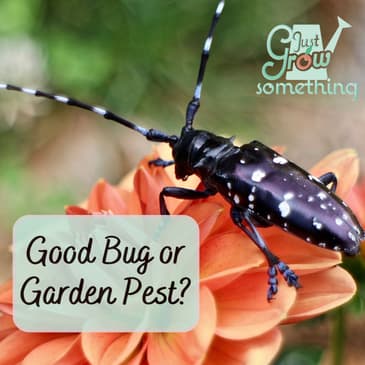
Are all bugs in your garden bad news? Not at all! In fact,some insects are your best allies when it comes to pest control and plant health.
Today on Just Grow Something, we’re talking about howto tell the difference between beneficial insects and destructive garden pests—even if you’re not an entomologist. Learn how to identify common bugs based on their behavior, body features, and habitat, and discoverwhich insects you want to attract to your garden and which ones to manage quickly.
Whether you’re a new gardener confused about who’s chewing on your cabbage, or a seasoned grower wanting to attract more natural predators to your space, this episode has practical tips for observing, identifying, andunderstanding the insects in your garden.
In This Episode, You'll Learn:
- The role of beneficial insects in natural pest control and pollination
- How to visually identify insects based on body shape, wing type, behavior, and feeding habits
- Examples of common garden pests like aphids, squash bugs, and hornworms
- Identification tips for good bugs like ladybugs, parasitic wasps, lacewings, and hoverflies
- Why local resources like university Extension services and conservation departments are your best tool for regional pest and beneficial ID
- How to build a garden that attracts and supports beneficial insects
- Why not all creepy crawlies need to be squished—some are silently helping your garden thrive!
Let's dig in!
References and Resources:
Save 20% on your new own-root rose plant at HeirloomRoses.com with code JUSTGROW https://heirloomroses.com
Get 10% off and FREE shipping on my favorite raised planters at Planter Box Direct using code JUSTGROW10: https://planterboxdirect.com/?ref=593BugGuide.net – Community-supported insect ID tool
Episode 24 - Aphids! https://justgrowsomethingpodcast.com/episode/ep-24-garden-talk-tuesday-aphids
Just Grow Something: https://justgrowsomething.com
Just Grow Something Merch andDownloads: https://justgrowsomething.com/shop
Just Grow Something Gardening Friends Facebook Group:https://www.facebook.com/share/g/18YgHveF5P/
Check out how you can become a patron on Patreon: https://www.patreon.com/JustGrowSomething
Bonus content for supporters of the Podcast: https://buymeacoffee.com/justgrowsomething
Amazon storefront: https://www.amazon.com/shop/justgrowsomething
Hosted by Simplecast, an AdsWizz company. See pcm.adswizz.com for information about our collection and use of personal data for advertising.
00:00:00
We talk a lot as gardeners about how to do things in the garden
00:00:05
that deter pests specifically the insect pests, that likes you
00:00:08
to holes in our leaves. Devour our fruit, and just
00:00:11
generally, lay waste to all of our hard efforts.
00:00:14
We also talked about attracting beneficial insects to the
00:00:18
Garden, both pollinators and predators.
00:00:20
What we don't talk about as often is how to identify, which
00:00:25
of those Critters is beneficial and which is causing Havoc.
00:00:29
Sometimes they can look very similar to each other and
00:00:32
sometimes the ones that look, the most menacing are actually
00:00:36
the good guys ever seen a ladybug larvae.
00:00:38
Yeah, those tiny little orange and black alligator.
00:00:41
We want those in the garden. So today in just grow something,
00:00:45
we're talking insect identification, how do we know
00:00:49
what? Insects in our garden are pests
00:00:52
in our region. And how do we even start to
00:00:54
identify these pests? By the end of the episode?
00:00:57
You'll know what steps to take to find out, what's good, what's
00:01:01
bad and how to tell the difference let's dig in.
00:01:04
Hey, I'm Karen. And what started as a small
00:01:07
backyard garden 20 years ago turned into a lifelong passion
00:01:11
for growing food. Now, is a market, farmer and
00:01:13
horticulturist. I want to help you do the same
00:01:15
on this podcast. I am your friend in the garden,
00:01:18
teaching evidence-based, techniques to help you grow your
00:01:21
favorite and build confidence in your own garden space.
00:01:24
So, grab your garden journal, and a cup of coffee and get
00:01:27
ready to just grow something. Before we jump in, this is your
00:01:34
gentle reminder to add nutrients to your containers.
00:01:38
If you are growing in pots or small Planters, yes, we should
00:01:41
be amending our containers in some way.
00:01:45
And sometimes in the same way that we do our larger Planters
00:01:49
and our in-ground containers. But, but the smaller stuff, we
00:01:52
may not always feel the need to add compost or refresh the soil,
00:01:56
as often as we should the smaller the volume of soil.
00:02:00
The more quickly, the soil nutrients are going to be
00:02:04
depleted, especially if we have a very demanding planes in that
00:02:07
soil. So, we need to be adding some
00:02:11
food of some sort for that soil. And for those plants, if you've
00:02:16
got a lot of containers and you don't want to buy specific plant
00:02:20
food for each one, depending on what it is that you're growing
00:02:22
in each one. That's okay.
00:02:24
Just get yourself a balanced Amendment and followed
00:02:27
directions for using that Amendment on the package.
00:02:30
I like a liquid version. And I like to do it about once
00:02:34
every two weeks or so, or maybe once per month, depending on
00:02:36
what I'm growing. But a granulated version is
00:02:39
fine, too. If you want to work that into
00:02:41
the soil and then just let it slowly release into that soil,
00:02:45
over a period of six rate weeks. Just make sure that you are
00:02:48
feeding those plants so they can continue to produce for you all
00:02:53
season long or for as long as they are viable.
00:02:57
Also, shout out to Rook my newest Patron over on patreon.
00:03:02
Rick has joined at the bicar in a coffee level to support my
00:03:06
caffeine habit while I'm over here cranking, these episodes
00:03:09
out to you, if you want to be like rook and other patrons who
00:03:13
are supporting this show in different ways you can head to
00:03:15
patreon.com slash just grow something or buy me a coffee.com
00:03:21
slash just grow something for both monthly or one-time option
00:03:24
to support the show. Both of those links are always
00:03:27
in the show notes, thank you, Rick, for your support.
00:03:30
It really does mean a lot this episode was inspired by a
00:03:38
comment that I got from Manda on Spotify for the episode that we
00:03:42
did on companion planting myths and tips that was episode 246
00:03:48
She said can you please do an episode on beneficial bugs
00:03:51
versus the damaging one? I struggle to identify the good
00:03:55
and the bad ones. That was a great suggestion.
00:03:59
So here we are today. If you ever have a suggestion
00:04:02
for an episode, feel free to comment on the episode in
00:04:06
Spotify or on YouTube you can also send me a DM on socials or
00:04:11
just send me an email to grow at just grow something podcast.com.
00:04:15
I read every single comment and every single message and every
00:04:18
single email and I am happy to have suggestions for Content
00:04:22
after four years of doing this every single week.
00:04:25
So thank you for the suggestion, mana on we go. so, Understanding
00:04:31
which insects are beneficial and which ones are harmful is really
00:04:36
crucial for maintaining a healthy garden.
00:04:38
Ecosystems, we obviously don't want the insects that are going
00:04:41
to continue to predate on our things that we are trying to
00:04:45
grow to be able to each or even just for the beauty of them.
00:04:48
And we also want to encourage the beneficials that are in
00:04:52
there at without damaging them. So we don't want to just blanket
00:04:55
Lee being, you know, spraying insecticides or using things
00:04:59
that might hurt the pollinators and all.
00:05:02
So the other beneficials that you know, kind of do pest
00:05:06
control for us. so, Just to kind of Define what it is that we're
00:05:12
talking about when I'm saying beneficial insects, I'm talking
00:05:15
about those insects that play very vital roles, like
00:05:18
pollination or Pest Control meaning they predate on other
00:05:24
insects and decomposition. So for instance, ladybugs
00:05:29
specifically ladybug larvae, they consume large quantities of
00:05:33
aphids. All right of course we're all
00:05:36
thinking about bees bees are our essential pollinators and I'm
00:05:39
not talking about honey. Bees necessarily goes are
00:05:41
imported here in North America. If you're someplace over in
00:05:45
Europe, then yes. Maybe you know the bees, the
00:05:47
honey bees are you know, doing a lot of the pollination there but
00:05:50
our native pollinators here as well are native bees, but all,
00:05:54
so butterflies and that sort of thing, even things like pill
00:05:59
bugs. They are very good for breaking
00:06:01
down that detritus. That is in our soil, or on top
00:06:05
of our soil. So those data indicating matter
00:06:08
and breaking that down. So it works its way as fresh
00:06:11
hummus into our soil, right? These are all beneficial things
00:06:15
that we want happening in our Gardens.
00:06:17
The pest insects are the ones that can damage what we are,
00:06:23
growing by feeding on the leaves, or the stems, or the
00:06:27
roots, or the fruits, or just by transmitting diseases through
00:06:33
that, feeding activity, or even pollination activity.
00:06:38
So, you know, it may not be necessarily that they're feeding
00:06:41
is destroying the plant but then in that point they transmit a
00:06:44
disease and that disease ends up damaging the plants.
00:06:49
So Aphids for example, they suck the sap from the plants, they
00:06:53
can also spread viruses, but in most instances it's about, you
00:06:56
know, the damage that they do, if they get to be overwhelming
00:07:00
for a plant, a lot of plants can handle a little bit of aphid,
00:07:03
predation, but once it starts to get overwhelming, then they
00:07:06
start to succumb cucumber beetles.
00:07:08
They don't necessarily damage the plants as much as you might
00:07:11
think. They damage the fruit.
00:07:12
They can absolutely damage the actual cucumber itself, but as
00:07:16
their feeding on the plant, they are actually transmitting
00:07:20
bacterial Wilt and that is what eventually ends up killing off
00:07:24
your cucumber plant. Those pill bugs that I
00:07:27
mentioned. Yes, they are beneficial in the
00:07:31
garden because they are eating that dead and decaying matter.
00:07:34
And so it's turning that matter back into nutrients in the soil
00:07:37
and really good hummus for the soil.
00:07:39
But in two high of a quantity in the garden.
00:07:43
They can also cause damage to the crops that we are trying to
00:07:46
grow if there isn't enough in the soil for them to be breaking
00:07:49
down. And they are being attracted to
00:07:51
those copious amounts of mulch that we're laying down and that
00:07:54
mulches too close, maybe to our plants or it's trapping a lot of
00:07:58
moisture. And we've had a really, really
00:08:00
rainy season. Then the pill bugs will, you
00:08:03
know, be there in Mass. There's nothing for them to eat,
00:08:06
so they start to eat your plants or the roots of your plants.
00:08:10
I've, you know, how to radishes damage here recently, because of
00:08:13
the high number of pill bugs had a friend message me saying, oh
00:08:16
my gosh, these pill bugs are eating my lettuces.
00:08:18
What do I do? So, don't ever let anybody tell
00:08:20
you that pill bugs. Don't eat your plants, they
00:08:22
absolutely do, but they generally will do it.
00:08:25
When they're is a mass amount of them and they don't have
00:08:28
anything else. To chew on are they don't have
00:08:30
anything else to eat, right? So, these are all things that we
00:08:33
have to concern ourselves with and we talk about something
00:08:35
being a pest. When we are trying to identify.
00:08:40
What is in our Gardens in terms of good bug versus bad bug,
00:08:44
right? There are a couple of different
00:08:46
resources that I'm going to recommend to you and places for
00:08:49
you to start. I always think it's a great idea
00:08:52
to start with your local University, extension service
00:08:56
and or your State's Department of Conservation.
00:09:00
This is going to give you very region specific information on
00:09:07
insect ID. You know, I talk a lot about
00:09:11
squash bugs and Vine borers and cucumber beetles because again,
00:09:15
those are the bane of my existence in one of the largest
00:09:18
crops that I grow out here. People in other areas of North
00:09:22
America have no idea what those things are because they just
00:09:26
don't exist in that area or they are so few and far between that
00:09:30
it's not something that they have to concern themselves with.
00:09:33
They don't need to identify those insects. but, In their
00:09:38
area. It may be Melanie worm or
00:09:40
pickleworm, which I have never seen and I would have no reason
00:09:44
to worry about what a melon more a pickle worm looks like or how
00:09:47
to keep them out of my garden because we don't have those
00:09:49
here, so your University extension service.
00:09:54
Oftentimes, they are going to have places on their website,
00:09:57
that is going to talk about the crops that are most commonly
00:10:01
grown in your area. Whether that is a commodity type
00:10:05
crop or it is something that gardeners are growing and every
00:10:08
University extension is different, you know.
00:10:11
It varies from state to state but this is, you know, a general
00:10:14
rule of thumb for your extension services.
00:10:16
They're going to have that information somewhere on the
00:10:18
site and under the description of each of those things,
00:10:21
oftentimes they will tell you what the insect pests are.
00:10:27
That predate on, that particular crop for your particular area.
00:10:32
So, you know, if I go to a general website that says, okay,
00:10:37
you know if you're growing squashes you could potentially
00:10:41
have these insect pests. And it gives me a whole laundry
00:10:47
list of insects that might predate on squash, that's not
00:10:52
getting me anywhere. Because now, I think I have to
00:10:54
figure out what 12 different insects look like when maybe
00:10:57
only three of those actually exist in my state.
00:11:01
So starting with your University extension service or again going
00:11:04
to your Department of Conservation.
00:11:05
They oftentimes are also going to have lists of insect pests
00:11:11
for your particular state or at least your region that is going
00:11:15
to give you a place to start. So as you are planting your
00:11:21
garden or you are even just planning your garden and what it
00:11:24
is that you want to grow. You might want to familiarize
00:11:26
yourself ahead of time of what you might want to be looking
00:11:30
for. So another resource that you can
00:11:33
use or other resources, you can use online, are things like bug
00:11:38
guide.net. This is an online community and
00:11:40
a database that is how hosted by Iowa State University.
00:11:44
So it offers a lot of information and identification
00:11:47
assistance for North American insects and for my non-north
00:11:52
American listeners. I apologize.
00:11:54
I am not super familiar with all the resources that you have, but
00:11:58
I'm hoping that there is something that is the
00:12:00
equivalent. In your area to like our
00:12:03
University extension service or our Departments of conservation
00:12:06
that will help you all with regions, specific information.
00:12:09
And then maybe you have something like a bug guide dot
00:12:12
net. That does for you what they do
00:12:14
for us here in North America. It is specific to you know,
00:12:19
identifying North American insects and it's really good,
00:12:24
it's got pictures, it's got all kinds of things.
00:12:26
It's got a search function in there that will help you to
00:12:28
break down. You know, the identifying
00:12:31
characteristics of what it is that you're searching for and
00:12:33
help you to find it. You can also use Google and
00:12:39
other search functions to help you.
00:12:41
Identify these insect pests. Particularly, if you are able to
00:12:46
use Google's lens function, it's very very helpful to take a
00:12:52
photo of the insect that might be in question and then use your
00:12:58
Google Lens search in order to be able to find images that are
00:13:02
very similar to what Google Lens sees in your photos.
00:13:05
So your guide for this is going to make sure that you're getting
00:13:08
as close up as possible, you're showing as much detail as
00:13:11
possible. You're kind of cropping out and
00:13:14
anything extra that might be in that photo so that the search
00:13:17
function. Can actually focus on just what
00:13:19
it is that, you want it to identify and then see what you
00:13:22
can find. That is very similar, then Trace
00:13:26
that image back to where it originated and make sure that it
00:13:30
is a trusted source for identification.
00:13:32
So, again, a University, extension website, Maybe it does
00:13:37
lead back to bugguide.net or some other service that is
00:13:40
helping to identify insects. The thing about using these
00:13:44
online searches is that you need to be very specific about what
00:13:49
information you are entering into these resources and how you
00:13:53
enter it in order to be able to really narrow down the search
00:13:57
and we will get to that in here in a second, okay?
00:14:00
And then finally, if you can get your hand on something like a
00:14:05
Peterson's Field Guide for insects, this is what I use.
00:14:10
And the only reason I even have this is because I got it as part
00:14:14
of my undergrad studies. So it has a lovely pictured.
00:14:20
He to the principal orders of insects in the front and the
00:14:25
back cover, and it has a really cool.
00:14:27
So sort of method for being able to Identify or break down what
00:14:33
you're looking at. By asking very specific
00:14:37
questions. Does it have wings, does it not
00:14:40
have wings? You know, if it does have wings,
00:14:42
is it got you know, two parts to the wings?
00:14:45
Is it have four parts to the wings?
00:14:46
Are they visible all the time? Are they not?
00:14:48
Are they talked under, you know, and then it goes on to the next
00:14:52
thing and the next thing. And the next thing in bite order
00:14:55
of elimination, essentially it goes all the way through the key
00:14:59
until it finally gets you To at least the family that that
00:15:05
insect falls into and then you can go and look up the family
00:15:09
and it has all kinds of pictures in it of what the insects are
00:15:14
that fall into that family that are most common and so it gives
00:15:18
a description of each one of those insects and it shows a
00:15:21
picture, you know, breaking it down and makes it a lot easier
00:15:23
for you to figure out. Okay, if you figured out that
00:15:26
this insect is in the family homoptera, then we break it down
00:15:31
into the cicadas and The Hoppers and the white flies and the
00:15:36
aphids and then it breaks it down into.
00:15:38
Okay, well this is what a plant Hopper looks like and this is
00:15:40
what a white fly looks like. So it is very, very handy for me
00:15:46
and somebody who is very nerdy when it comes to this kind of
00:15:51
stuff. But I understand that not
00:15:54
everybody has a Peterson Field Guide for insects sitting on the
00:15:58
bookshelf in their office. For these particular things.
00:16:02
Something that you want to pick up, its really great.
00:16:03
All so for like when you go on a hike, And you see something that
00:16:07
you've never seen before. If you can take a picture of it
00:16:09
and come back, you can actually, you know, use this guide and a
00:16:14
very clear photo of the insect that you're trying to identify
00:16:17
to go through and figure out what it was.
00:16:19
You were actively looking for. But also you know the things
00:16:23
that this field guide talks about in terms of its
00:16:26
identification are really essential for helping us enter
00:16:31
in those parameters into an online search as well. the
00:16:35
identification of insects is not that much different from iding,
00:16:43
a bird or a mammal or a plant, even if it's just a matter of
00:16:47
knowing, What to look for? And then using a process of
00:16:53
elimination, essentially, to figure out what we're looking
00:16:56
at. The thing that complicates
00:16:59
identifying insects is that there are so many different
00:17:04
kinds. I think in North America alone,
00:17:06
there are over 88 species of insects.
00:17:12
And a lot of them are really really small, which makes it
00:17:16
hard to see all the different parts that we need to see in
00:17:19
order to recognize those parts in order to ID them.
00:17:22
So, you know, yeah, this is not something that is easy to do and
00:17:26
it's people, you know, people spend their entire careers
00:17:29
identifying insects and and finding new ways to identify
00:17:33
them. And then we also have to take
00:17:34
into consideration that a large portion of these insects look,
00:17:38
completely different as larvae and as or juveniles as they do
00:17:46
as adults. So, I mean, remember, the
00:17:48
ladybug larvae I mentioned. Yeah, looks nothing.
00:17:51
Like a ladybug when it's in its infancy, right?
00:17:54
So I am going to try to give you some key information that you
00:17:59
can use to help narrow down your search.
00:18:02
When you are trying to identify an insect in your garden, the
00:18:06
more information you have, when you go and do that search, the
00:18:10
closer, you'll get you absolutely want to start with
00:18:14
understanding. What it is that you might be
00:18:16
looking for. Again, making sure that, you
00:18:19
know, what insect pests or beneficials are prevalent in
00:18:24
your area by looking at University extension or looking
00:18:28
at your department of conservation or natural
00:18:30
resources or whatever. And then understanding these
00:18:33
basic insect identification techniques.
00:18:36
So you can enter your search and be more accurate.
00:18:41
I am super excited that my rose bush from Heirloom Roses has its
00:18:47
first Bloom of the Season. It opened up this week and there
00:18:51
is another one not far behind and I cannot wait to see how
00:18:54
many I get this year after I got three immediately after I
00:18:58
planted it last fall. The one thing I'm paying
00:19:01
attention to is the nutrition of the plant and Heirloom Roses has
00:19:05
me covered on that one with all kinds of options on their
00:19:08
website. They have multiple options for
00:19:10
feeding your roses and one thing I'm obsessed with and that's the
00:19:14
mint compost. Mint compost is exceptional, at
00:19:18
providing. Moisture, retention in Sandy dry
00:19:20
soils, while also rich in natural humans to help break up
00:19:24
hard, clay soils, if you're planting your rows in the
00:19:27
ground, your I, of course, opted for a container from my roads.
00:19:30
And the mint compost can also be used as a mulch, top dressing
00:19:34
around my rose bush to help repel aphids and spider mites.
00:19:38
And the other damaging insects that Talking about today that
00:19:42
like to play our roses head to heirloom roses.com, pick out
00:19:46
your beautiful rose plants, add some soil, amendments, and some
00:19:50
mint compost and use code. Just grow at checkout to save
00:19:54
20%, heirloom roses.com with code, just grow the link as
00:19:59
always is in the show notes. Okay.
00:20:02
So what are the basic sort of insect identification techniques
00:20:09
that we can use in order to track down what it is that we're
00:20:15
looking at? The first thing to do is
00:20:18
identify its physical characteristics.
00:20:19
Now, This is going to be a lot easier.
00:20:23
If you can take a picture and then you have time to sit and
00:20:28
look at the darn thing and figure out what it is that
00:20:32
you're looking at. If you try to do this on the
00:20:34
Fly, I mean, yes. Unintended I guess it makes it a
00:20:39
little bit more difficult because you're trying to think
00:20:41
back in your brain, okay, what am I supposed to be figuring out
00:20:44
what? So, you know, I get it.
00:20:46
If you have your phone with you out in the garden, you can snap
00:20:49
a picture great. This makes it easier if you
00:20:52
happen to be out there with a notebook in your, maybe taking
00:20:54
notes in your garden journal, wink, wink nudge.
00:20:58
Then you might be able to write down some quick notes about
00:21:01
this, but just know that this is going to take some practice in
00:21:04
in figuring out what it is that you're looking at.
00:21:06
So, you know, don't beat yourself up if this sounds like
00:21:08
it's hard. the first thing that you want to do is, Note its body
00:21:14
shape and size. So is it elongated?
00:21:17
Is it oval? Is it more round?
00:21:20
How big is it? And if you can kind of compare
00:21:23
this to something else that is stable in the garden.
00:21:25
So, you know, if you see it land on a flower and then it flies
00:21:30
away and you're trying to approximate its size.
00:21:32
Well, then measure the size of the flower and then you can add
00:21:34
that in there. This is an insect that is, you
00:21:36
know, 0.25 inches long, or it's four centimeters or whatever it
00:21:41
might be, okay? So the body shape and the size
00:21:44
are some identifying characteristics Coloration and
00:21:48
marking, this is something else. So what colors does it have,
00:21:52
does it have any distinctive patterns or spots on it?
00:21:56
And when we talk about the colors, you know, is it orange
00:22:00
and black? And where is the orange?
00:22:02
And where is the black? Is it happen?
00:22:04
Orange. Body with black wings, does it
00:22:06
have, you know, orange and black wings with a black body?
00:22:09
All of these things are very particular information that you
00:22:13
could be entering into these search engines or into these
00:22:16
online resources. That is going to help you
00:22:18
further identify what it is that you're looking at.
00:22:21
So determine whether or not it has wings.
00:22:26
Whether or not those wings remain visible at all times, say
00:22:30
like a dragonfly, or if it's something that it tucks
00:22:34
underneath a hard shell, like certain Beatles, okay?
00:22:38
If you can count the number of wings, it's a single set of
00:22:42
wings. Are they dual sets of wings like
00:22:44
again on a dragonfly where it has two larger ones, and then
00:22:47
two smaller ones behind it. Also, what about its legs?
00:22:51
How long are the legs are they tucked up underneath its body?
00:22:55
Are they out splayed out to the side.
00:22:57
These are things that you can you know, put in as another
00:23:00
identifier, another one that's really good.
00:23:03
Is whether or not it has antennae if it does have
00:23:06
antennae How long are they antenna?
00:23:09
And what is the shape? There are some very specific
00:23:12
shapes to antenna that will indicate what family that insect
00:23:18
is in. Does it look like a fan?
00:23:20
Is it straight with like a little ball at the end of it?
00:23:23
Like, we typically think of, oh, and antennae are those actually
00:23:26
antenna or are they eyeballs. That's the other thing.
00:23:29
Make sure you understand what it is.
00:23:31
It's you're looking at. So that is why it's really a
00:23:34
good idea if you're trying to ID something that you take a
00:23:36
picture of it, okay? The next thing that we want to
00:23:39
observe is its behavioral traits.
00:23:43
Specifically, we are looking at feeding habits.
00:23:47
So what does it doing? When it's eating, is it chewing
00:23:52
on the leaves? Is it sucking the sap or is it
00:23:55
praying on another insect? Right?
00:23:58
This is going to let us know number one, if it's a problem in
00:24:02
the garden, if it's chewing the leaves, or if it's sucking the
00:24:04
sap or if it's praying under insect, that's likely a
00:24:08
beneficial insect. In our garden.
00:24:10
The feeding habits of the insect is going to indicate to us what
00:24:14
its mouth parts are like. And so we have you know biting
00:24:18
mouth parts, we have sucking mouth parts and we have chewing
00:24:21
mouth parts and so these are things that we can use to
00:24:24
identify the insect, the time that it is active in, the garden
00:24:29
is also important. Is it during the day, or is it
00:24:32
more at night? Obviously, a lot of us aren't
00:24:34
out there in our Gardens, in the pitch black.
00:24:37
But if you're out there very, very early morning, like Dawn,
00:24:41
or if you're out there late at night, or late in the evening,
00:24:43
when it's dust, you know, our pollinators and our beneficials,
00:24:47
a lot of the time are really most active between.
00:24:50
Like 10 a.m. and 3 p.m. So if you're out there very
00:24:54
early morning, just as the sun is coming up and you're seeing
00:24:56
this insect activity, it very well, may be something that's
00:24:59
left over from the overnight hours.
00:25:02
Same thing as you're going late into the evening, the Moon is
00:25:06
coming out. The Sun is going down.
00:25:08
If you have a lot of very active insects out there, those also
00:25:12
might be more nocturnal insects and that is going to help you
00:25:15
determine what it actually is. And whether or not, it's a good
00:25:18
guy or a bad guy, right? And then all so consider, you
00:25:23
know, its habitat, its location. Where was the insect found was
00:25:29
it on specific plants? Was it in the soil?
00:25:33
Was it out and flying around the flowers Its Behavior and where
00:25:41
you're finding, it is all going to be something that's going to
00:25:44
help narrow down what it is that you're looking at and keep in
00:25:48
mind. A lot of insects can be
00:25:51
recognized. By their General parents as
00:25:56
belonging to a specific family and that's going to give you
00:25:59
some really good information. So, you know, you know you you
00:26:02
generally know what like a grasshopper looks like.
00:26:05
You don't necessarily need to know what kind of grasshopper it
00:26:08
is. Because, you know, most
00:26:09
instances, The Grasshoppers are not going to do things that are
00:26:12
really, really good for your garden.
00:26:13
So if you have too many of them, I might be a problem. but, The
00:26:17
closer you look. And the more information that
00:26:20
you have about the insects body parts, its behaviors its habits.
00:26:26
The more likely you will be to track down the insect, the
00:26:30
actual insect that you are. Looking at on one of your
00:26:32
resources, and get more info is to whether or not, it's always a
00:26:37
pest or if it's only sometimes a pest, if it's there in Mass
00:26:41
again, like, you know, the Pill bugs, or even grasshoppers, or
00:26:46
if it's something that's always a beneficial or, you know, it's
00:26:50
always one of the bad guys, right?
00:26:51
So I mean look we have some very common beneficial insects
00:26:56
ladybugs and generally speaking, this is all ladybugs and when I
00:27:02
say all ladybugs, I mean anything that is in the Cox of a
00:27:05
Cox in Nelly, I think I said that properly Cox and yellow Day
00:27:10
family. Um, we do have certain ones here
00:27:15
specifically in Missouri that are not like the ladybugs that
00:27:20
we are used to, in terms of, you know, eating the aphids and that
00:27:24
sort of thing. They're a Japanese ladybug I
00:27:27
believe or Japanese lady Beetle. That tend to congregate in the
00:27:33
fall around, door jambs, Etc, and they can actually bite you
00:27:36
but they also are beneficial. They tend to be treated rollers
00:27:40
rather than you know, dwelling down on our Gardens and so yes,
00:27:44
they again can be a nuisance if they are there in Mass.
00:27:50
So even though all ladybugs are predators of aphids and mites
00:27:55
and other soft body insects, where they reside and what type
00:28:00
of ladybug they are is going to determine whether or not they
00:28:02
are helpful in your garden or if they are helpful in other ways,
00:28:06
maybe up in the trees, but can be a pest if they are a mask
00:28:09
Gatherings, right? Green lacewings.
00:28:12
Anything in the Christopher De family.
00:28:15
They are larvae feeds on aphids and caterpillars and other
00:28:20
pests. So those are good guys to see in
00:28:23
your garden generally speaking and anything in that family
00:28:25
parasitic wasps, okay? These are going to lay eggs
00:28:29
inside or on the past like the caterpillars, of course, that's
00:28:32
going to lead to the pests demise obviously.
00:28:36
Hover flies surface, the adults, pollinate flowers.
00:28:40
So those are great in terms of being a pollinator, the larvae
00:28:45
also eat aphids so, and among other things, too, I know
00:28:48
there's a few other things that the hoverflies will also predate
00:28:51
on. So, These are good guys to keep
00:28:53
in the garden regardless of where you are.
00:28:55
And then these big-eyed bugs, this is Geo courses, no Geo
00:28:59
chorus, sorry species, they feed on mites, they also eat insect
00:29:04
eggs and small insects. So these are all good guys that
00:29:07
we want in the garden. Of course, really common Garden.
00:29:10
Pests aphids, I don't know of anywhere in Northern or North
00:29:16
America that doesn't have aphids in some way.
00:29:19
These are those really small soft body insects that suck on
00:29:23
the plant sap. They lead to very distorted
00:29:25
growth. If you get them in Mass, this is
00:29:28
what a lot of our beneficials do actually predate on.
00:29:31
In fact, these are such a problem for gardeners that I
00:29:33
actually did a standalone afib episode way back in episode or
00:29:40
in season 1. I think it might have been like
00:29:42
episode 8 or something like that.
00:29:44
So that should tell you exactly how many people complain about
00:29:48
having aphids as a problem. Tomato hornworms.
00:29:51
This is another big one for a lot of people that was very
00:29:55
large fat caterpillars that can defoliate a tomato plant very
00:30:00
rapidly. These are also tobacco hornworms
00:30:03
and I actually have to look it up.
00:30:04
I cannot remember whether or not they are the same And they just
00:30:07
go by two different names or if they're actually two different
00:30:11
insects. I have to look that one up, I
00:30:13
don't remember Japanese beetles. This is one that a lot of people
00:30:16
have problems in Sometimes they are overwhelming in their
00:30:22
numbers and other times we have had to where we've just seen a
00:30:25
handful of them and then that's it.
00:30:27
So I'm not familiar enough with their life cycle to be able to
00:30:31
tell you whether or not they sort of Go In Waves.
00:30:33
I do know that we used beneficial nematodes the year
00:30:38
after we realized we had a really bad Japanese beetle
00:30:42
problem, because they overwinter as grubs in the soil and they
00:30:48
feed on a wide range of plants. They will skeletonize the leaves
00:30:54
and they seem to be have a particular affinity for fruit
00:30:57
trees and rose bushes. And there's one other thing too.
00:31:03
I think that of anyway they especially are a problem when
00:31:06
they start to become, you know, an overwhelming new sense.
00:31:10
Squash bugs. You know, I had to mention
00:31:11
squash bugs, they go after squash, right?
00:31:13
And they also go back to, you know, some of the related
00:31:16
plants. They'll go after your cucumber
00:31:17
plants, if you if you allow them to they'll even go hang out in
00:31:20
your tomato, plants. If you don't, they don't have
00:31:21
anything else to eat. So they're gonna cause the
00:31:23
wilting and you know, death of your plant.
00:31:26
Rose saw flies. These are the larvae that feed
00:31:30
on rose leaves. They create this sort of window
00:31:33
painting effect. This is something else that is
00:31:35
very common for folks. I have not seen them here yet.
00:31:39
Hoping my heirloom Rose stays clean of these pests.
00:31:43
I have not seen them, I haven't looked up to see whether or not
00:31:45
that's something that we have to worry about here.
00:31:47
I do know the Japanese beetles go after them.
00:31:49
So I am just keeping an eye out this season.
00:31:54
I am looking to replace some of the last few wooden raised beds.
00:31:59
I have in my kitchen garden with new beds from plants for box
00:32:03
direct. I'm not one to waste money or
00:32:05
materials just for Aesthetics. So I've been doing this slowly
00:32:08
over the past few years as the wooden beds that we built begin
00:32:12
to break down. It's not just that they look
00:32:14
awful which they do. But there are literally falling
00:32:18
apart at the seams and they're not holding the soil in properly
00:32:21
anymore. I love planter box directs
00:32:24
Planters because they're UV coated.
00:32:26
So they're not going to break down on me and I can get them in
00:32:29
any color combo. I want and in so many different
00:32:32
style as and sizes, three of the beds.
00:32:35
I'm replacing are tiered bets, but they're in a very narrow
00:32:38
strip on my driveway. The good news is I can choose
00:32:41
from Cascade Planter's. Just like the ones I already
00:32:44
have only sturdier or I can configure two long boxes, just
00:32:50
for that specific space, with all of the options that planter
00:32:53
box direct has on their Website and they go together in mere
00:32:57
minutes for me to be able to jump right in and get them
00:33:00
filled so I can continue on with my gardening season.
00:33:04
You can save 10% and score free shipping on your new raised
00:33:07
Planters by going to planter box direct.com and using Code just
00:33:11
grow 10 at checkbox. Planter box direct.com with
00:33:16
code, just grow 10 for 10% off and free shipping on my favorite
00:33:20
Garden Planters. The link is in the show notes.
00:33:24
So, like we've talked about before, we really want to
00:33:28
regularly, inspect our plants for signs of insect activity.
00:33:33
Good bugs. Bad bugs in different, right?
00:33:36
We want to know what is going on in and around our plants so that
00:33:41
if we do start to see damage, we know what insects have been most
00:33:45
prevalent out there and we're going to know what to look for.
00:33:49
Take clear photos of anything that you don't recognize as
00:33:56
something in your garden, whether it's good or bad, you
00:33:58
know. And that way you can go and you
00:34:00
can use all of these identifiers for a search.
00:34:03
Now, how do you do this? You know, I am have been a long
00:34:08
time, the Google Queen, like I can find just about anything on
00:34:11
Google with a little bit of time, but I have to have the
00:34:13
right information and you have to know what to put in to the
00:34:16
search. Be as specific as possible.
00:34:19
You can enter something like flying insect that eats
00:34:26
cucumbers, that has Two wings. That tuck under a hard shell
00:34:34
that are yellow and black. And fly during the day.
00:34:40
Alright, whatever search engine you type that into is going to
00:34:44
take all of that information and it's going to pair it up with
00:34:47
whatever and you likely are going to come up with the answer
00:34:51
of a cucumber beetle. But again, if you can take the
00:34:55
photo that is going to narrow it down, if you can use like Google
00:34:59
lens and take the photo and all. So add in that additional
00:35:04
information, then you are going to get much clearer results or
00:35:09
at least you're going to have fewer results to shift through,
00:35:12
okay. All in all.
00:35:15
We want to avoid taking any immediate reaction.
00:35:18
So before removing, or destroying an insect out of your
00:35:23
garden, make sure that, you know, what its role is in your
00:35:26
garden ecosystem. I know, You know, there's this
00:35:31
sort of knee-jerk reaction sometimes, like, you see some
00:35:33
damage on your plant, and then you see these insects there and
00:35:37
you make the automatic assumption.
00:35:38
That that thing that is on your plant is responsible for the
00:35:44
damage to that plant, and that may not necessarily be the case.
00:35:47
The other thing too is to understand if it is a beneficial
00:35:51
insect that is just not beneficial when it is in your
00:35:55
garden and mass. Remember what I said about the
00:35:57
pill bugs? I get messages.
00:35:59
Especially this time of the year when the soil tends to be very
00:36:02
damp around here all the time. And I get messages from people,
00:36:06
like, oh my gosh, I have these pill bugs, they are just
00:36:09
destroying my garden, how do I get rid of them?
00:36:12
And my answer to that is always you relocate them, you don't
00:36:18
destroy them. So I give tips and tricks for
00:36:20
how to remove the pill bugs from the garden.
00:36:23
Which, by the way, my favorite trick is to cut a potato in half
00:36:26
and put the cut side down into your garden beds in and around
00:36:31
the plants that are being predated on and the pill bugs
00:36:35
will more attracted to the moisture and the decay under
00:36:38
those potatoes and they will gather underneath those potatoes
00:36:42
slices and start to feed on them.
00:36:44
So then all you got to do is walk out.
00:36:46
With a little container of some sort pick up your potato, you
00:36:50
know, tap it into the bucket to drop all the pill bugs off and
00:36:52
put the potato back down again and just keep doing that over
00:36:55
and over again. You will remove a large, you
00:36:57
know, number of the population out of your garden bed, and you
00:37:00
can go and relocate it someplace else into a different, you know,
00:37:04
area of your yard, or your garden or whatever, we don't
00:37:07
want to get rid of these insects because they actually are
00:37:10
helping in the garden, there's just too many of them at the
00:37:13
moment, right? The other thing too, is when you
00:37:15
have an insect that is predating, on your insects, on
00:37:18
your insects, on your plants, we want, we want insects per dating
00:37:21
insects all so, but if you have insects that are predating on
00:37:24
your plants, Make the determination as to whether or
00:37:28
not that damage is actually significant enough to warrant.
00:37:32
Killing off that insect. Because like, I've mentioned
00:37:35
before with aphids, if you have aphids and you are doing what
00:37:39
you can to encourage a really good ecosystem in your garden,
00:37:43
you might find that after a few days of their being some aphid
00:37:48
activity. You start to see ladybug
00:37:50
activity, and they very quickly, keep each other in check.
00:37:53
So I'm never a proponent of removing, an insect or harming
00:37:57
an insect in the garden. Before understanding what is
00:38:00
role is in that Garden ecosystem, but also
00:38:03
understanding whether or not you have any predators that can come
00:38:05
in and feed on that inceptive, okay?
00:38:10
I I don't know if it's I I don't want to say it's like oh, you
00:38:14
know all things deserve to live or whatever.
00:38:16
I mean that might be part of it, but I think it really is if we
00:38:19
are trying to be balanced in our Gardens and we are trying to,
00:38:23
you know, avoid a monoculture and we're using all these
00:38:26
interplanting techniques and everything else and it doesn't
00:38:28
make any sense to All Sorts or remove something else.
00:38:30
That is a part of that ecosystem.
00:38:31
Yeah. Well unless it's a squash bug,
00:38:34
and then by all means, go right ahead.
00:38:39
And of course, one more thing that we want to do, I know this
00:38:42
is all about identification, you know, of the insects but we
00:38:44
really do want to plant a diversity of vegetables and
00:38:48
flowers to attract and support those beneficial insect
00:38:52
populations. And that is going to help us.
00:38:54
If we understand the different roles at the various insects
00:38:57
have in our garden, it helps us make informed decisions that are
00:39:01
not just going to promote our plant health and maybe give us
00:39:05
some peace of mind, but it's also going to promote that
00:39:08
ecological balance. And I think the long the longer
00:39:11
we do that in our own Gardens, the better off we are going to
00:39:14
be each successive season thereafter.
00:39:17
So if we can observe our Gardens very, very closely utilize our
00:39:22
local resources for identification and online
00:39:26
resources. When we make sure that we trust
00:39:28
the source, we can foster environments that support
00:39:32
beneficial insects and ones that predate on those harmful insects
00:39:36
and have a better and healthier Garden overall.
00:39:41
Until next time my gardening friends, keep on cultivating
00:39:43
that dream garden and we'll talk again soon.