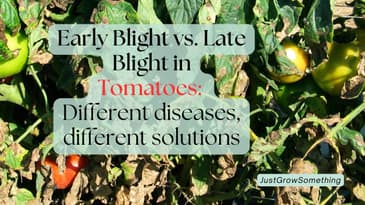
In this episode, I break both diseases down in plain language: what they look like, where they show up on the plant, what conditions favor them, how fast they move, what happens if you ignore them, and exactly what to do when you find either one. Whether you’re seeing spots on your lowest leaves or a whole section of your garden that looks like it got hit by frost overnight, this episode will help you figure out what you’re looking at and what to do next.
Let’s dig in.
References and Resources
Captain Jack’s Copper Fungicide - https://amzn.to/43DKqAn
Penn State Extension — Tomato Diseases and Disorders in the Home Garden:
https://extension.psu.edu/tomato-diseases-and-disorders-in-the-home-garden
Penn State Extension — Scouting and Identifying Tomato Diseases:
https://extension.psu.edu/scouting-and-identifying-tomato-diseases
Penn State Extension — Tomato-Potato Late Blight in the Home Garden:
https://extension.psu.edu/tomato-potato-late-blight-in-the-home-garden
University of Georgia Extension — Common Tomato Diseases in Georgia (Bulletin B1285):
https://extension.uga.edu/publications/detail.html?number=B1285&title=common-tomato-diseases-in-georgia
UGA Extension, Madison County — Tomato Troubles:
https://site.extension.uga.edu/madison/2021/08/tomato-troubles/
University of Minnesota Extension — Late Blight of Tomato and Potato:
https://extension.umn.edu/disease-management/late-blight
Michigan State University Extension — Organic Management of Early Blight on Tomato (Hausbeck Lab):
https://www.canr.msu.edu/hausbeck/Uploads/PDF/FS_Organic-Management-of-Early-Blight-on-Tomato.pdf
UC ANR / UC IPM — Late Blight of Tomato (Phytophthora infestans):
https://ipm.ucanr.edu/agriculture/tomato/late-blight/
Pacific Northwest Pest Management Handbooks — Tomato Late Blight:
https://pnwhandbooks.org/plantdisease/host-disease/tomato-solanum-lycopersicum-late-blight
Cornell University — Disease-Resistant Vegetable Varieties (late blight resistance):
https://www.vegetables.cornell.edu/pest-management/disease-factsheets/disease-resistant-vegetable-varieties/
Midwest Vegetable Production Guide — current fungicide recommendations for late blight: https://mwveguide.org/
USAblight.org — national real-time late blight tracking and outbreak alerts (when it’s working?): http://usablight.org/
Quick-Reference: Early Blight vs. Late Blight at a Glance
Pathogen type | Early Blight: true fungus (Alternaria solani) | Late Blight: water mold / oomycete (Phytophthora infestans)
Ideal temperature | Early Blight: 68–77°F (warm) | Late Blight: 60–78°F (cool to mild)
Where it starts | Early Blight: oldest/lowest leaves first | Late Blight: anywhere on the plant, no pattern
Lesion appearance | Early Blight: dark bullseye with concentric rings, yellow halo | Late Blight: large irregular dark oily blotch, gray-green edge, no rings
Underside of leaf | Early Blight: dark spores in lesion center | Late Blight: white downy/powdery growth at lesion margins in humidity
Speed | Early Blight: slow and progressive, weeks to months | Late Blight: explosive, can kill plant in ~14 days
Fruit symptoms | Early Blight: sunken dark spot at stem attachment | Late Blight: firm dark brown spot starting at fruit shoulders
Overwinters as | Early Blight: debris/soil/seeds in warm climates | Late Blight: infected potato tubers, volunteer plants
Fungicide type | Early Blight: copper, sulfur, standard fungicides | Late Blight: oomycete-specific only — NOT standard fungicides
Response urgency | Early Blight: act promptly, manageable with cultural controls | Late Blight: emergency response, remove immediately, notify extension and neighbors
------------------------------------------------------------------------------------------
Just Grow Something: https://justgrowsomething.com
Gardening Courses: https://justgrowsomething.com/courses
Just Grow Something Merch and Downloads: https://justgrowsomething.com/shop
Just Grow Something Gardening Friends Facebook Group: https://www.facebook.com/share/g/18YgHveF5P/
Check out how you can become a patron on Patreon: https://www.patreon.com/JustGrowSomething
Feed my coffee habit: https://buymeacoffee.com/justgrowsomething
Amazon storefront: https://www.amazon.com/shop/justgrowsomething