
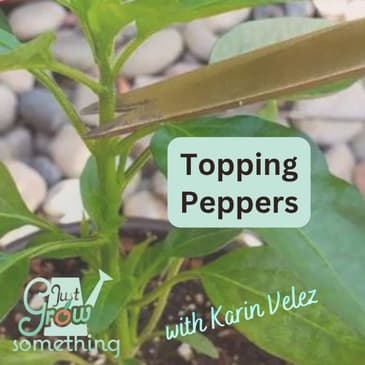
The subject of whether you should top your pepper plants can bring on a pretty strong debate among gardeners. That’s because this is one of those topics where the answer genuinely is: it depends. And I mean that in a very specific, evidence-based way that comes down to two things: your climate and your pepper type.
I’ll be straight with you, I do not top my peppers. We are in a zone 6b in west central Missouri and our season is just short enough that for our large sweet peppers, by the time a topped plant recovered and loaded up with new fruit, I’d be in a race with the first frost, so I don’t love my odds of winning. And for our smaller peppers, both hot and sweet, they branch naturally. They’ve never needed my help getting bushy and they generally end up so loaded with fruit there’s no need for me to create new growing points.
But that does NOT mean topping is wrong. In fact, if your growing season is long enough and you are growing the right type of pepper, there is a solid, research-grounded argument for it and I want to make that argument fairly today.
Let's dig in!
References:
Illinois Extension (University of Illinois) — Frillman, N. (2021). “Pruning tomatoes and peppers for healthier plants and a stronger harvest.” Flowers, Fruits, and Frass Blog. https://extension.illinois.edu/blogs/flowers-fruits-and-frass/2021-05-17-pruning-tomatoes-and-peppers-healthier-plants-and
Nebraska Extension — “Garden Peppers.” University of Nebraska–Lincoln Extension Publications. https://extensionpubs.unl.edu/publication/967/html/view
University of Minnesota Extension — Ask Extension response on topping pepper plants (2021). https://ask.extension.org/kb/faq.php?id=740168
University of Minnesota Extension — Weisenhorn, J. Ask Extension response on topping for yield (2016). https://ask.extension.org/kb/faq.php?id=333053
University of Maryland Extension — Home and Garden Information Center. Ask Extension response on topping chile plants (2024). https://ask.extension.org/kb/faq.php?id=869966
University of Minnesota Extension — “Growing Peppers in Home Gardens.” https://extension.umn.edu/vegetables/growing-peppers-home-gardens
Peer-Reviewed Research:
Humadi, F. (1980). “Effects of plant growth retardants and mechanical topping on growth and yield of pimiento pepper (Capsicum annuum L.).” Dissertation, University of Tennessee. Tennessee Research and Creative Exchange. https://trace.tennessee.edu/utk_graddiss/7869/
Buczkowska, H., & Najda, A. (2001). “Impact of plant topping on chemical composition of sweet pepper fruit.” Zeszyty Naukowe Akademii Techniczno-Rolniczej w Bydgoszczy. Rolnictwo, 46, 33–37.
Cao, D., Chabikwa, T., Barbier, F., Dun, E. A., Fichtner, F., Dong, L., Kerr, S. C., & Beveridge, C. A. (2023). “Auxin-independent effects of apical dominance induce changes in phytohormones correlated with bud outgrowth.” Plant Physiology, 192(2), 1420–1434. https://doi.org/10.1093/plphys/kiad034
Avent, A. R., & Armitage, A. M. (2015). “Effects of Paclobutrazol and Pinching on Ornamental Pepper.” HortScience / Journal of the American Society for Horticultural Science. ResearchGate: DOI 10.21273/HORTSCI.
Hu, Q., Wei, Y., Gan, X., Zhang, O., Huangpu, J., Hu, B., & Wu, L. (2016). “Effects of pruning methods and harvest time on yield and benefit of pepper in greenhouse.” Jiangsu Agricultural Sciences, 44, 182–185.
Resources:
Just Grow Something: https://justgrowsomething.com
Gardening Courses: https://justgrowsomething.com/courses
Just Grow Something Merch and Downloads: https://justgrowsomething.com/shop
Just Grow Something Gardening Friends Facebook Group: https://www.facebook.com/share/g/18YgHveF5P/
Check out how you can become a patron on Patreon: https://www.patreon.com/JustGrowSomething
Feed my coffee habit: https://buymeacoffee.com/justgrowsomething
Amazon storefront: https://www.amazon.com/shop/justgrowsomething
Get 10% off and FREE shipping on my favorite raised planters at Planter Box Direct using code JUSTGROW10: https://planterboxdirect.com/?ref=593
Hosted by Simplecast, an AdsWizz company. See pcm.adswizz.com for information about our collection and use of personal data for advertising.
[00:00:00] Alright my gardening friends, let me ask you something. Have you ever been in a gardening group? Online, at the plant sale, wherever, right? And someone mentions that they top their pepper plants and suddenly it's like you accidentally walked into a debate about something very sacred. Half the room swears by it, the other half thinks that it's the worst thing you can do, and everybody has a story to back their side up. That's because this is one of those topics where the answer genuinely is.
[00:00:30] It depends. And I mean that in a very specific evidence-based way that comes down to two things, your climate and your pepper type. Welcome back to Just Grow Something. I'm Karin Velez, a market farmer with over 20 years experience growing peppers, and I will be straight with you. I do not top my peppers. We are in zone 6B in West Central Missouri and our season is just short enough that for our large sweet peppers by the time it tops it's just a little bit.
[00:01:00] If I don't top my peppers, I would be in a little bit. If I don't top my peppers, I would be in a race with the first frost. So I don't love my odds of winning. And for our smaller peppers, both the hot ones and the sweet ones, they just branch naturally. They've never needed my help getting bushy, and they generally end up so loaded with fruit that there is no need for me to create new growing points.
[00:01:20] That does not mean that topping is wrong or bad or something that you should not do. In fact, if your growing season is long enough and you are growing the right type of pepper, there is a solid research-grounded argument for it, and I want to make that argument fairly today.
[00:01:39] So, we're going to talk about the science of why topping works when it works. We're going to lay out the honest pros and cons with your climate and your pepper variety in mind. And if you decide that it's right for your garden, I'm going to walk you through exactly how and when to do it and what to expect afterwards. Let's dig in.
[00:02:04] Before we jump into the good peppery stuff, this week's shout-out goes to everyone who has been telling me about your seed starting results and your healthy transplants this spring. Hearing that your pepper seedlings finally took off or that you finally got a good germination rate on your parsley or you finally got broccoli to the transplant stage for the first time, that, honestly, is the fuel that keeps this podcast going.
[00:02:30] So, keep those notes and messages coming. I read every single one of them and I absolutely respond to them. And if you're having problems with a transplant, yes, I've had a few of those messages too. I am super happy to help if I can, so keep those messages coming too. Okay, as we start this, let's make sure that we are all talking about the same thing.
[00:02:55] Topping a pepper means cutting off the central growing tip, the top of the main stem. While the plant is still young. The cut is made just above a leaf node or a pair of branches. And the goal is to interrupt the upward growth of the main stem and redirect the plant's energies into the side branches, which is creating a wider, bushier plant with more fruiting points.
[00:03:21] Now, you might also hear it called pinching, decapitation, or tipping. And they all mean essentially the same thing at the plant level. Here's where it gets interesting. Because this isn't just a gardening hack. It's actually plant physiology. All plants have what's called apical dominance. The growing tip, the apex of a plant, produces a plant hormone called auxin.
[00:03:51] That auxin flows downward through the stem and in combination with other hormones, actively suppresses the growth of the side buds, the axillary buds, that are sitting in the joints between the stem and the leaves. The tip of the plant is essentially telling those side buds, stay put, I'm in charge of growing right now. A 2023 study published in Plant Physiology confirmed that auxin from the shoot tip
[00:04:15] and its downstream effects on hormones like cytokinin are key regulators of bud outgrowth. And that removal of the shoot tip, essentially decapitating the plant, releases those axillary buds to grow. So when you remove the apex, auxin production from that point drops dramatically. Cytokinin, which promotes branching, is no longer suppressed in the same way. The side buds gets the signal, hey, you're free to grow now.
[00:04:44] This is the exact mechanism behind topping. You are physically removing the source of apical dominance and triggering a branching response. The plant responds by activating the dormant buds below the cut, each of which becomes a new growing tip. And each new tip is a potential new fruiting site. This is the same way we harvest basil and rosemary and other herbs, so that they become nice little bushes rather than one long skinny plant.
[00:05:13] So essentially, topping peppers encourages a stout growth habit and a stronger stem, as well as more flowers and fruit, particularly in the taller growing capsicum varieties that are at a higher risk of maybe collapsing in heavy winds. So after topping, you will notice new shoot growth emerging from the nodes below your cut within a few days. Each branch that grows from those nodes can itself be trimmed again,
[00:05:41] and each cut produces another Y fork, making the plant progressively bushier. Again, this is how we harvest basil. This is why heavily topped plants can develop a very wide, low canopy. Now, one note from the research is worth mentioning here. A study of pimento peppers found that topping resulted in higher yield in the first harvest, but did not significantly impact total yield for the entire season.
[00:06:11] And this is an important nuance. Topping front loads the branching and can increase the total number of fruiting sites, but that doesn't automatically mean more total pounds of peppers. It means more smaller harvest distributed across more branches. And there was a separate study that found that topped sweet pepper plants produced fruits higher in vitamin C and sugars compared to untopped plants,
[00:06:41] which is an interesting quality benefit, but the primary reason that most gardeners top is for yield and structure, not necessarily nutrition. Okay, now let's make the honest argument for topping, because there are real practical benefits. You just need the right conditions for them to pay off. The single biggest factor in whether topping makes sense for you is your growing season length. Topping causes a temporary setback.
[00:07:09] The plant has to redirect its resources, grow new branches, set new buds, and then flower before you see any fruit from those new branches. In practice, most growers report a delay of like two to four weeks from the expected first harvest compared to an untopped plant. So if your frost-free growing window for peppers is 150 days or longer, so we're thinking like zone 7 through 10 here,
[00:07:38] most of the southeast, the southwest, and the west coast of the U.S., that two to four week delay is almost entirely absorbed by your much longer season. You will likely finish the season with more total fruiting sites and a harvest that is spread across more of the season. And in truly warm climates like 9 and 10, where peppers can be grown as perennials that overwinter outdoors,
[00:08:04] topping is less of a one-time decision and more of an ongoing management strategy. You top the plant branches, you harvest, you may top again. The plant just keeps going. Okay, so like in warm Florida climates, peppers can produce for extended periods when they are managed and pruned appropriate like this. The general guidance is that gardeners in zone 7 or warmer with frost-free periods of five months or more
[00:08:33] are the strongest candidates for topping. Now, not all peppers respond the same way to topping, and this is one of the things I wish more people talked about. Small fruited varieties, so jalapenos, serranos, cayennes, Thai peppers, shishitos, banana peppers, most of your ornamental varieties, these all tend to respond very well to topping. These plants often have a very naturally upright growth habit,
[00:09:01] and without intervention, they can become tall and kind of leggy. By topping them early, you are encouraging a wider lower canopy that supports more fruiting branches and is just more structurally stable. So, you know, these taller varieties are really good candidates for topping for this exact reason. Now, for container gardeners growing small hot peppers in pots, topping is especially worth considering.
[00:09:27] A compact, bushy plant fits a container much better than a tall, leaning one. And container plants are often grown by people who want a continuous harvest from a small space, which is exactly what a well-branched pepper is going to give you. And the third argument for this is, if you want better airflow and disease prevention, taller, spindly plants with very dense central growth can trap humid air around the foliage and the fruit. That moisture is exactly what fungal diseases,
[00:09:56] like botrytis and powdery mildew and bacterial issues, thrive in. A lower, bushier plant with good branch spacing allows air to move through the canopy more freely. You combine this with removing the lower leaves from the bottom, like 6 to 12 inches of the plant, then you get significantly better airflow and less soil splash onto the foliage during rain or irrigation. This isn't a magic bullet for disease, but if you are in wet or humid climates
[00:10:25] where fungal diseases are a constant challenge, then the structural benefits of topping are worth factoring into your decision. And then the final argument for this would be if your plants are already very tall at transplant. Sometimes you start seeds just a little too early and life gets busy, and by the time you transplant, you have a tall, leggy pepper seedling that has been living under a grow light for weeks longer than you had planned. If this was a tomato plant,
[00:10:54] it might not be that much of a concern because we could always bury that stem deeper in the soil. But in the terms of a pepper, in this scenario, topping it at transplant or shortly after it gets established can help reset the plant's architecture before it goes into the ground. This is a different context, though, than proactively topping a pepper for the yield benefits. Here you are correcting a structural problem and you're encouraging the plant to branch more naturally from the start
[00:11:24] rather than continuing to grow a tall, weak central stem. Okay, now let's flip it because there are just as many good reasons not to top your peppers, and I want to give those equal weight. The first one would be if you have a very short growing season, and this is kind of the one that I live with personally. I mean, it's not super short, but it is the most important reason in the don't top your peppers column.
[00:11:53] If you are in zones four, five, or six, or really anywhere with fewer than 150 frost-free days for peppers, topping introduces a delay that you may not be able to afford. This could actually compromise your yield if you live on a short season climate, especially someplace in like the northern US, right? So this is not a recommended practice for like Minnesota gardeners, okay? And there are some extension services that explicitly state don't do this,
[00:12:23] like Nebraska Extension. They're very direct. A pepper growing guide says that pepper plants should not be topped at transplanting time, specifically because topping removes the area of the first flower buds and it delays the first fruit set and the harvest. And that delay, while it's manageable if you have a really long season, can mean the difference between a ripe fruit and frost-killed green peppers in a very short one. So think about it this way. If your window for growing peppers
[00:12:51] runs from mid-May transplant to first frost in late September, that's roughly four and a half months. A two to four week delay from topping could push your first large fruited harvest right up to or past your frost date. And that's probably not a trade that you wanna make. So for me, the answer has been consistently no. I'm not willing to gamble my bell pepper harvest on a technique that was designed for climates that have a lot more runway than I do.
[00:13:19] And that kind of goes for the second argument, which is the large fruited variety. So bell peppers, poblanos, banana peppers, like large banana peppers, those other large fruited varieties are a different conversation than your small hot peppers or your very small sweet peppers. These varieties are already bred and selected to grow with strong central leaders and a natural canopy. They branch on their own at what we call the Y fork, right?
[00:13:47] The main stem splits into two or more branches naturally as the plant matures. So that natural branching point is where the first flowers form. And the branches that develop from there are already very well positioned for fruit production. Topping a bell pepper can actually disrupt this natural architecture. Some research suggests that topping large fruited varieties may not improve the total yield and can in some cases reduce it,
[00:14:15] particularly if your total leaf area is reduced in a way that limits photosynthesis, especially during that critical fruit fill period. So a large fruit, like a bell pepper, needs a significant amount of photosynthetic output to get those bell peppers to size up and ripen fully. And there's a timing problem specific to these larger peppers. Even if you are in a long season climate, the additional weeks required
[00:14:43] for large fruited peppers to develop and ripen after the plant rebounds from topping are weeks that you may not want to spend waiting. Small hot peppers size up fast, but bell peppers take time and every delay compounds that. And then something that the pro topping crowd sometimes kind of glosses over is that a lot of these pepper varieties, especially the smaller hot peppers, already branch very naturally
[00:15:12] and pretty enthusiastically, honestly, without any intervention from us whatsoever. If your pepper plant has already split into two or more main stems at the Y fork, there is genuinely no need to top it. The plant already has done the branching work for you. So cutting into a plant that is already branching doesn't give you more branching. It just sets the plant back. So take a look at your plants before you make any cuts. If you can see that there are two clear stems
[00:15:40] emerging from a central fork near the base, you already have a branched plant. So just let it grow. Okay, so I want to be honest with you about like the research landscape here because I think it matters. There is some peer-reviewed research on pepper pruning. This is primarily from European and Asian commercial greenhouse production systems where the season length is controlled
[00:16:09] and the plants are grown under optimized conditions. And so there's been research on fruit quality and there was that study on the pimento yield and there was another study on the pruning methods in greenhouse pepper production. And they all offer very useful insights. But University of Minnesota Extension, when you ask them directly about topping pepper plants, they state that they found no reliable reference
[00:16:36] recommending topping or pinching growing tips in their context, right? University of Maryland Extension said the same thing. No solid research-based information exists to recommend a specific approach to topping for yield increases. That doesn't mean topping doesn't work. It means the evidence is genuinely context-dependent. And a lot of the boldest claims that you see online about, oh, these are gonna triple your yield
[00:17:06] are not backed by peer-reviewed field trials in home garden conditions. So be appropriately skeptical for this. All right, you've weighed the pros and cons. Your growing season is long enough. You're growing small fruited peppers and you have decided to give it a go. You are going to top your peppers, all right? Here is exactly how to do it. The first thing is to choose the right time.
[00:17:34] Timing is everything with topping and this is where a lot of gardeners go wrong. The ideal time to top a pepper is when the plant is still young and actively in its vegetative growth phase. This is before it has set significant flower buds or fruit. It's also when the plant is approximately six to eight inches tall and has produced at least four to six sets of true leaves.
[00:18:01] And when the plant is healthy and actively growing, not stressed from transplant shock or drought or pest pressure. So for most gardeners, starting peppered plants indoors and transplanting in late spring, this means topping either a few weeks before transplant when the seedlings had gotten to that six to eight inches under lights or shortly after transplant, once the plant has established
[00:18:30] and resumed its active growth, typically about one to two weeks after going in the ground. So, you know, there are a lot of the research or a lot of the advice from the university extension says to wait until the transplants are established and actively growing in the garden before making any cuts. And I think this is smart. A plant that is still recovering from transplant shock does not need the additional stress of topping. And if they haven't gotten that large before being transplanted,
[00:18:59] then you very well may stunt them if you try to cut them ahead of time. Do not top in mid-summer. This is a really critical mistake. If you wait until July or August to top, if you are living here in the Northern Hemisphere, you are introducing a two to four week delay right as your season is shortening. You will almost certainly end up with a full branchy plant that is loaded with unripe peppers when frost arrives.
[00:19:28] So top them early or don't top them at all. Make sure that you are using clean, sharp scissors or pruning shears, a clean cut heals faster and it reduces the risk of introducing fungal or bacterial pathogens at the wound site. So make sure you have wiped your blades with some rubbing alcohol before and after cutting, especially if you're working with multiple plants. And then here's how you identify the cut point. Look at the top of your plant and find the main growing tip.
[00:19:57] It's the newest, most tender growth at the very top, the very apex of the plant. And now look slightly below it for a set of healthy lateral branches or leaf nodes. You want to cut just above those nodes, leaving them intact on the plant. The nodes below your cut are what will activate. The two or more buds at those nodes will each grow into a new main stem. Make your cut cleanly at a slight angle to allow the water to run off
[00:20:27] rather than to pool on the cut surface. And then afterwards, the plant is probably gonna look a little rough for a day or two. That's normal. You do want to water consistently and avoid letting the plant dry out significantly during recovery. Stressed plants heal more slowly. You want to hold off on any heavy feeding immediately after topping. Wait until you see new growth emerging before you reserve a normal fertility or feeding routine.
[00:20:54] Watch for new growth at the nodes below the cut. You should see it within three to seven days if you are growing under good conditions. And then once the new branches are about two to three inches long, you can consider whether to top them again. Each additional cut creates another Y fork and more potential fruiting sites, but it also adds more recovery time. So one or two rounds of topping
[00:21:24] is usually plenty for home gardeners. And then you just wanna be sure that you remove any flower buds or early blooms that develop in the first one to two weeks after that topping. Now this might feel counterintuitive, but if you allow the plant to set fruit immediately after topping before the new branches have fully developed, that can actually limit the bushing response that you were trying to achieve. So we're trying to redirect that energy. So make sure you remove those blooms.
[00:21:53] So a realistic timeline after you top your plants, assuming that you have good growing conditions, for the first one to maybe three days, the plant is gonna kind of look flat. New growth hasn't emerged yet. This is fine. It might look a little pouty. That's okay. By the time you hit day three through maybe seven, so within the first week, you should start to see those new shoots begin to emerge from the nodes below where you cut.
[00:22:21] And then by the second to third week, you're gonna see those new branches are visibly growing and your plant is starting to fill out a little bit. After that, we're looking at about three to five weeks or so, then you're gonna start to see those flower buds start to appear on the new branches. So about six to eight weeks after you have topped that plant, you should start to see the first fruit from the new branches beginning to develop.
[00:22:48] This is the approximate harvest delay window compared to an un-topped plant under the same conditions. So by the time you hit weeks 10 to maybe 12, a well-topped small pepper plant will probably be fully loaded with fruit across multiple branches simultaneously, which is the payoff that you were working toward. So what you will notice is that your harvest
[00:23:15] tends to be more spread out over a longer window rather than front-loaded. This is great if you want a continuous harvest throughout the season. It can be a drawback if your main goal is one big early harvest, say you're canning or preserving or you're using it for something specific, okay? Now, one genuinely fun thing about topping peppers is that the cutting that you remove does not get tossed in the compost pile. It is a potential new plant.
[00:23:44] So if you place that cutting in water with the cut end submerged, within about a week or two, you will likely start to see roots start to pull from that cutting. So once the roots are about an inch or so long, you can pot that cutting up. And now you have a new rooted pepper cutting that is genetically identical to your original plant. You have a clone and you have just skipped the seeding stage entirely. Okay, so let me give you a quick reference
[00:24:13] to take away from today to figure out whether or not topping your peppers is a good idea for you. It's okay or a good idea for you to top your peppers if you are in a zone seven or warmer with a growing season of 150 or more frost-free days. You are growing small fruited varieties. So jalapenos, serranos, cayennes, thai peppers, shishitos, ornamentals, all the little ones, right? Your plants are naturally growing tall and leggy
[00:24:43] and need some structural correction. You are growing peppers in containers and you want a more compact, manageable plant. And you've already been growing peppers successfully and you just want to experiment with this technique, okay? Then by all means, go for it. Go ahead and top your peppers. But if you are in zone six or colder, meaning you have fewer than 150 frost-free days, you are growing large fruited varieties, bell peppers, large sweet peppers.
[00:25:13] If your plants have already naturally forked into two or more main stems at the Y, if you got a late start and your plants are not yet transplanted or fully established, or if you are newer to growing peppers and you want to focus on the fundamentals first, then maybe we should skip topping those peppers, get a little more experience under our belts and maybe try the experiment later on. So when in doubt, try it on half your plants, label them, watch them
[00:25:43] and then compare at the end of the season. Use your garden journal, take notes. What's your yield like? What's the growth habit like, right? This is exactly the kind of experiment that makes you a better gardener. And it is one that I will be doing this year with a couple of my varieties so I can share the side-by-side comparisons with you because I am kind of on that edge of growing zones, right? We shifted to 6B, right? That next line is zone seven.
[00:26:12] Our summers tend to be a little bit warmer here lately, a little bit longer between actual frost. So with those smaller varieties, we might be able to see some results there. But I'm gonna do this side-by-side and I will share it with you when I have the results. Your own garden data in your own climate with your own varieties will always be more useful than any general recommendation, including mine. All right, my gardening friends,
[00:26:41] that is the honest research back case for and against topping your peppers. The short version, long season, small peppers, it's probably worth trying. Short season, large peppers, probably leave them alone. If you do decide to top, then do it early, do it clean, give the plant time to recover, and don't expect miracles. Expect a different kind of harvest that is spread across more of your season. And if you decide not to top, know that you are not leaving anything on the table.
[00:27:11] Well-grown, well-supported, un-topped peppers are absolutely productive. Don't let anyone tell you otherwise. In the show notes, I am going to link to the Illinois Extension article on pruning tomatoes and peppers, the Nebraska Extension Pepper Growing Guide, the relevant Ask Extension Q&As from the University of Minnesota and the University of Maryland, and all the research citations that I mentioned today. Everything is there for you to dig into it further.
[00:27:40] Next week, we are going to be celebrating our 300th regular episode of this show. And I have a few ideas of what I want to talk about, and I don't think you're going to want to miss it. So be sure to give the show a follow from wherever you're listening, or subscribe if you are seeing me on YouTube. Until next time, my gardening friends, keep on cultivating that dream garden, and we'll talk again soon. Thank you.