
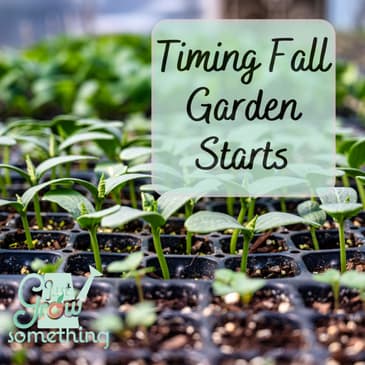
On this Focal Point Friday, we go back to Episode 101 and talk about three important things to consider when starting plants for the fall garden: germination time, days to maturity, and harvest window.
Episode Resources:
Ep. 101 - How to Prepare and What to Grow in Your Fall Garden
Just Grow Something Gardening Friends Facebook Group
Check out how you can become a patron on Patreon
Positively Farming Media Podcast Playlist on Spotify
Hosted by Simplecast, an AdsWizz company. See pcm.adswizz.com for information about our collection and use of personal data for advertising.
00:00:00
Welcome back, my gardening friends, to another focal point.
00:00:02
Friday Episode Let's spend just a few minutes together reviewing
00:00:06
A snippet of information from a previous episode, highlighting a
00:00:09
new topic, or quickly focusing on a current event in the Food
00:00:12
and Agriculture world. Let's get down and dirty.
00:00:16
Now, what's important here is timing your fall planting.
00:00:20
Just like when we're planting in the spring, there are three
00:00:24
different things that you have to take into consideration when
00:00:26
you're figuring out when. You should be starting your
00:00:29
seeds and when you should be transplanting, and then when you
00:00:33
should be actually putting your seeds directly into the ground.
00:00:36
You want to think about the germination time, the days to
00:00:39
maturity, and then your harvest window.
00:00:42
So germination time. The days to germination
00:00:45
sometimes are listed on the seed packets, and sometimes they're
00:00:48
not. A lot of the time there's
00:00:49
something that you kind of have to look up, but the days to
00:00:53
germination are going to differ a little bit.
00:00:56
Depending on how you're starting them, when you're starting them
00:00:59
for the fall garden versus the spring, in most instances for
00:01:02
the spring we're starting them indoors.
00:01:05
So it's a kind of a carefully controlled environment a little
00:01:09
bit, but it's generally not quite as warm as if, say, you
00:01:14
were to start them now and start them outside.
00:01:17
So right now, my fall brassicas, I started those seeds outside in
00:01:22
the greenhouse. Well, it routinely gets up to be
00:01:25
100 to some odd degrees in that greenhouse in the middle of the
00:01:27
summertime, in the middle of the day.
00:01:29
So those suckers popped up like within a couple of days.
00:01:32
I think it was two days before I started seeing most of those
00:01:36
plants start popping up, and then by the end of the third
00:01:38
day, almost all of them had germinated.
00:01:40
That's a stark contrast for the I want to say it was 8 days at
00:01:46
least. For those to germinate in the
00:01:48
spring when they were downstairs in my little seed germination
00:01:51
area. So take that into consideration
00:01:54
when your timing, when you're going to start your seeds, if
00:01:57
you're starting them indoors or if you're starting them outside,
00:02:00
the next thing that you want to look at is days to maturity.
00:02:03
So how long is it going to be from the time that those plants
00:02:07
come up to the time that you're going to get a chance to harvest
00:02:11
them? Remember, when you're looking on
00:02:13
these seed packets, a lot of the time those days to maturity are
00:02:16
from transplants. So it makes a difference if you
00:02:21
say if something says, well it's 50 days to maturity, but it
00:02:25
takes 7 to 10 days for it to germinate and then you don't
00:02:28
transplant it out for another two to three weeks.
00:02:31
You have to take that into consideration to base your
00:02:34
timing on that. And then you also want to take
00:02:37
into consideration the harvest window, so something like green
00:02:39
beans. You're generally going to be
00:02:41
harvesting over a two to three-week period versus carrots
00:02:46
where well, you're either going to dig them all at once because
00:02:49
they're all mature or you're going to dig the smaller ones
00:02:51
1st and then leave the rest of them in the ground for a little
00:02:54
while. How long of a window do you
00:02:56
have? Once you have all of these
00:02:59
things sort of figured out, that's when you Add all that up.
00:03:04
And you go and you look at your first frost date and then you
00:03:08
start counting backwards from there.
00:03:11
Once you figure out that date, that's going to tell you the
00:03:14
date that you should be starting your seeds for your own
00:03:17
transplants. And then obviously, if you're
00:03:19
going to be buying transplants elsewhere, you can take off that
00:03:23
germination time and the time that you're growing them before
00:03:27
you put them in the ground and just base it on the days to
00:03:30
maturity and the harvest window. This also, you would also take
00:03:34
into consideration the days to maturity in the harvest window
00:03:37
if you're planting directly from seed.
00:03:40
So things like green beans or peas or beets and carrots, the
00:03:44
things that you're planting directly into the soil, you're
00:03:47
just wanting to figure out the germination time plus the days
00:03:51
to maturity plus the harvest window.
00:03:54
You don't have to worry about that couple of week period where
00:03:56
you're growing those seedlings on before transplant.
00:04:00
So really the timing is going to depend on what it is that you're
00:04:04
growing, how you're starting it, if you are starting it, or
00:04:08
whether or not you're going to be buying them from seedlings
00:04:11
and then whether or not you're planting them directly into the
00:04:13
soil or starting them ahead of time.
00:04:16
Now if you don't have a first frost, you still need to be
00:04:21
timing these things because. You're going to hit your
00:04:24
Persephone period. That period where your daylight
00:04:27
hours drop below 10 hours a day. Once you hit that part of the
00:04:32
year, your plants pretty much stop growing.
00:04:36
So if you even if you're in a milder climate and you don't
00:04:39
actually get a frost, you still have a deadline for when you
00:04:42
want to get these things into the ground.
00:04:45
Thanks for joining me on this focal point Friday.
00:04:47
I'll be back again on Tuesday for another regular.
00:04:49
Episode of the Just. Grow Something podcast.
00:04:52
So until next time, my gardening friends, keep on cultivating
00:04:54
that dream garden and we'll talk again soon.