
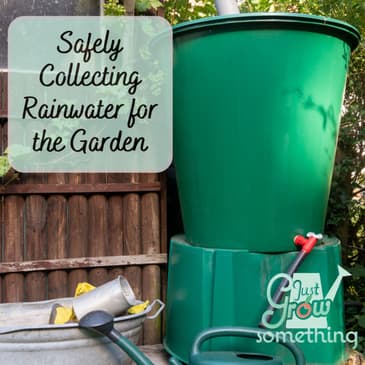
If you're in an area that is facing a drought this summer, like I am, you might be thinking of ways to combat it in the garden. Enter the rain barrel!
Home gardeners often use rain barrels to collect rainwater from roofs as a supplement to summer irrigation. Rainwater is a natural and unchlorinated water source for plants, but rooftop runoff can be contaminated by chemical and biological pollutants.
Today we talk about the practicality of rain barrels, possible contaminants and where they come from, and how to safely use rain barrel water in the garden. Let's dig in!
Resources and Citations:
Chang, M., M.W. McBroom, and R.S. Beasley. 2004. Roofing as a Source of Nonpoint Water Pollution. Journal of Environmental Management 73: 307–315.
Chen, J.J., R.C. Beeson, Jr., T.H. Yeager, R.H. Stamps, and L.A. Felter. 2003. Evaluation of Captured Rainwater and Irrigation Runoff for Greenhouse Foliage and Bedding Plant Production. HortScience 38(2): 228–233
de Kwaadsteniet, M., P.H. Dobrowsky, A. van Deventer, W. Khan, and T.E. Cloete. 2013. Domestic Rainwater Harvesting: Microbial and Chemical Water Quality and Point-Of-Use Treatment Systems. Water, Air, and Soil Pollution 224(7).
Lim, K.Y., and S.C. Jiang. 2013. Reevaluation of Health Risk Benchmark for Sustainable Water Practice through Risk Analysis of Rooftop-Harvested Rainwater. Water Research 47(20): 7273–7286.
Shuster, W.D., D. Lye, A. de la Cruz, L.K. Rhea, K. O’Connell, and A. Kelty. 2013. Assessment of Residential Rain Barrel Quality and Use in Cincinnati, Ohio. Journal of the American Water Resources Association 49(4): 753–765.
POTENTIAL CONTAMINANTS IN RESIDENTIAL RAIN BARREL WATER (HOME GARDEN SERIES), Washington State University Extension
100-Year-Old Way to Filter Rainwater in a Barrel - The Prepper Journal
Just Grow Something Gardening Friends Facebook Group
Check out how you can become a patron on Patreon
Positively Farming Media Podcast Playlist on Spotify
Hosted by Simplecast, an AdsWizz company. See pcm.adswizz.com for information about our collection and use of personal data for advertising.
00:00:01
This is positively farming media.
00:00:04
So here in Missouri, the majority of the state is either
00:00:10
in abnormally dry conditions all the way up through extreme
00:00:15
drought. In our county here in West
00:00:17
Central Missouri, we are in a severe drought classification
00:00:21
according to the US Drought Monitor, which means that soil
00:00:25
cracks are large and deep. Surface water levels are very
00:00:29
low, trees are stressed and vegetable produce is smaller and
00:00:33
yields are decreased. And we are absolutely seeing all
00:00:36
of these signs in our area just South of us and to the east of
00:00:40
us. They are in that extreme drought
00:00:44
category which includes things like building foundation damage,
00:00:47
occurring burn bans, hay and water for cattle is very
00:00:53
limited. Producers are hauling water in
00:00:55
mature tree, death is common, ponds are drying up and then
00:00:59
mandatory water restrictions are implemented.
00:01:02
And I know that we aren't the only ones that are facing this.
00:01:05
We faced it last year and that was more widespread than it is
00:01:10
this year, but it certainly is occurring all over and more
00:01:13
frequently. So in times when we get to
00:01:17
severe or extreme drought and we may start to see those water
00:01:21
restrictions, it's not uncommon for home gardeners to turn to
00:01:25
using rain barrels to collect rainwater from their roofs as a
00:01:30
supplement to their summer irrigation.
00:01:32
It makes sense. Rainwater is natural, it's
00:01:35
unchlorinated, and it's a great source for our plants and even
00:01:39
for our animals. But rooftop runoff can be
00:01:44
contaminated by chemical and biological pollutants, either
00:01:48
from atmospheric deposits or from the roofing material
00:01:52
itself, or, you know, from birds and other critters that happen
00:01:56
to come across our roof. On today's episode of the Just
00:02:00
Gross Something podcast, we're going to look at residential
00:02:04
rain barrel water safety. Why it can be important to use
00:02:09
rain barrels, especially if we're trying to reduce storm
00:02:11
runoff in more suburban areas. The practicality of collecting
00:02:16
rainwater, what contaminants we might find in our rain barrels,
00:02:20
where they come from, and how to prevent them from contaminating
00:02:24
anything in our gardens. Let's dig in.
00:02:27
Hey, I'm Karen and I started gardening 18 years ago in a
00:02:30
small corner of my suburban backyard when we moved to A5
00:02:33
acre homestead. I expanded that garden to half
00:02:35
an acre and I found such joy and purpose in feeding my family and
00:02:39
friends. This newfound love for digging.
00:02:41
In the dirt and providing for others prompted my husband and I
00:02:44
to grow our small homestead into a 40 acre market farm.
00:02:47
When I went back to school to get my degree in horticulture, I
00:02:50
discovered there is so much. Power in food.
00:02:52
And I want to share everything I've learned with as many.
00:02:55
People as possible. On this podcast, we explore.
00:02:58
Crop information, Soil health. Pests and diseases plant.
00:03:01
Nutrition, our own nutrition, and so much more in the world of
00:03:04
food and gardening. So grab your garden journal and
00:03:07
a cup of coffee and get ready. To just grow something.
00:03:11
So we have kind of a unique situation with our farmhouse.
00:03:15
There is actually a giant concrete cistern that is
00:03:20
underneath our back deck. And it came with the house.
00:03:23
It was it was built with the house, and it holds a ton of
00:03:27
water. And the first couple of years
00:03:29
that we were here, we actually did use that water mostly for
00:03:33
our livestock. Somewhere along the way the the
00:03:37
feed inlets have gotten blocked and the the pipes that lead to
00:03:43
it have become detached. We needed to be able to drain it
00:03:46
and clean it and we haven't done that yet.
00:03:48
But trust me when I say we are seriously considering just
00:03:52
revamping that whole system and being able to use that cistern.
00:03:56
I think it holds about 1500 gallons of water, but that would
00:04:01
all be run off from our roof. We have in the past also done
00:04:07
just your standard rain barrel and this is more like what
00:04:10
you're going to see in most residential areas is just a
00:04:13
garden rain barrel. In general, those are favorable
00:04:19
things. They're they're better for
00:04:21
specifically reducing stormwater runoff in neighborhoods than
00:04:25
maybe rain gardens or bioswales or other types of trenches,
00:04:30
which can be more expensive and can kind of be, you know, looked
00:04:33
upon unfavorably by, say, your homeowners association.
00:04:38
But, you know, rain barrels, hey, you're collecting the
00:04:41
water, You're reducing your water bill.
00:04:43
And so it can be a good, you know, motivation for people to
00:04:47
be able to put these in, especially when we're facing
00:04:49
droughts and possibly water restrictions and you are growing
00:04:54
a garden. Now it is interesting to note
00:04:57
that rainwater collected from rooftops has been tested on
00:05:01
plants, in containers and those that are in gardens and
00:05:05
landscapes and. Good results have been seen with
00:05:08
these with no apparent plant disease or disorder problems in
00:05:12
several of the studies that I saw.
00:05:15
But rain barrel water is untreated and so there are
00:05:19
legitimate safety concerns about exposing us and our pets and our
00:05:25
garden produce to possible contaminants.
00:05:29
So there are many studies that have shown that rain barrels are
00:05:32
reservoirs for toxic materials and pathogenic microbes.
00:05:36
So these kind of fall into two different categories.
00:05:38
You've got biological and you have chemical.
00:05:41
The biological contaminants would be things like bacteria,
00:05:44
cyanobacteria, fungi, protozoa. That bacteria also includes
00:05:49
fecal bacteria. And then chemical contaminants
00:05:52
would be things like metals, heavy metals, specifically
00:05:56
different particulates and pesticide residues.
00:05:59
So researchers have looked at the different loads of the
00:06:03
nutrients that might be in there, this heavy metal content,
00:06:06
the pesticide residue. And in North America, the main
00:06:10
concerns are fecal contaminants and heavy metals.
00:06:14
When you look at other countries, it's different.
00:06:17
Overseas, say Germany, France, we're looking at heavy metals,
00:06:21
nutrients, pathogens. In the Netherlands, it's heavy
00:06:25
metals and mosquitoes. Australia, you're looking at
00:06:27
heavy metals, mosquitoes and pathogens.
00:06:30
So they've kind of broken it down in international rainwater
00:06:33
collection studies going back as far as 1996 to see what we are
00:06:37
at most risk from now. The contaminants, especially the
00:06:42
chemicals, are actually carried through the atmosphere and then
00:06:47
they're deposited by wind or rain onto our roof surfaces.
00:06:50
So particulates, heavy metals, sprayed materials like
00:06:54
pesticides. Land on our roof.
00:06:57
And then, of course, they're washed into those collector
00:06:59
barrels the next time it rains. And those pesticides can remain
00:07:04
potent for weeks or even months after entering into the rain
00:07:09
barrels. And then, of course, we have
00:07:11
those biological contaminants. These can come from the tree
00:07:14
canopies, or they're deposited directly by birds or squirrels
00:07:18
or raccoons or whatever other animals decide to crawl across
00:07:22
our roofs. And our biggest concern here of
00:07:25
course is feces, because they are a source of pathogenic
00:07:28
bacteria and viruses and all kinds of stuff that can very
00:07:32
easily survive in a rain barrel. In fact, they did a long term
00:07:39
study back in 2013 or that ended in 2013.
00:07:43
That found unexpectedly high levels of coliform bacteria.
00:07:48
Those are the things that are used as indicators of human
00:07:50
pathogenic bacterias. That water was consistently
00:07:54
above what the US EPA standards are for coliform bacteria, which
00:07:59
says something considering sometimes what the EPA standards
00:08:02
are now, even though those levels were alarmingly high in
00:08:09
those studies. It does not appear that there
00:08:11
were any reports of illnesses related to the rain barrel
00:08:15
water, and the authors of the studies also saw that those rain
00:08:20
barrels contained really good microbes and a very rich
00:08:24
microbial community, that that actually probably contained
00:08:28
predators that fed on that harmful bacteria, which likely
00:08:31
controlled the levels of that bad stuff.
00:08:34
So All in all. We shouldn't be afraid of
00:08:38
collecting our rainwater, but there are some things that are
00:08:41
going to affect that rainwater quality and ways that we can
00:08:45
kind of increase it. So the roofs themselves are also
00:08:50
going to affect that, that quality of that rainwater,
00:08:53
right? We've got metal flashing,
00:08:54
there's gutters, there's galvanized nails.
00:08:57
So those things are all going to be sources of heavy metals.
00:09:00
They contain things like zinc and lead and chromium.
00:09:04
And then if you have a composite roof, those shingles are going
00:09:08
to contribute contaminants. There's roofing membranes and
00:09:11
tar paper. And then again, they're going to
00:09:14
collect those pesticides that come in just on the air.
00:09:19
So the greater the slope of your roof.
00:09:24
The more likely it is that these contaminants are going to end up
00:09:28
in your rain collection because you know it's less likely that
00:09:32
they're going to remain on the the surface simply because it
00:09:34
takes less rainfall to make it run off of a sloping roof.
00:09:38
So those contaminants are going to wash off the the roof more
00:09:41
frequently. The more rough the surface of
00:09:44
the roof is, the more likely it is that it's going to catch and
00:09:48
retain those wind deposited particulates and and the fecal
00:09:52
matter. Metal roofs have lower
00:09:56
concentrations of biological contaminants, but obviously
00:09:59
they're going to have higher levels of some of those heavy
00:10:02
metals. Asphalt shingles contain lead,
00:10:06
not really something we want green roofs, which we usually
00:10:10
say are really good as far as filtering water.
00:10:12
And environmentally they have been found to have things like
00:10:15
arsenic and other heavy metals from the growing mediums that
00:10:18
are being used. So these are all things that we
00:10:20
just need to be taking into consideration when we are
00:10:24
looking to install rain barrels. I still think that they are an
00:10:30
absolutely valuable source of additional water for our gardens
00:10:34
and even for our landscapes. And there are simple research
00:10:39
based practices that we can use to take advantage of the rain
00:10:43
water that we can collect from our roofs that are going to
00:10:46
reduce the risks of contamination.
00:10:49
On us and our gardens, which includes of course protecting
00:10:52
our produce. We'll talk about that right
00:10:54
after this. So some of the action items for
00:11:05
gardeners, we're using roof collected rain barrel water.
00:11:09
The first thing is to know your local pollution issues if there
00:11:13
is a history of airborne pollutants from.
00:11:15
Local industry or agriculture in your area?
00:11:19
Then you likely want to have your rain barrel water tested
00:11:24
for a lot of these contaminants just to be on the safe side.
00:11:28
You also want to avoid collecting rainwater when the
00:11:31
air quality is really low, and I know that has been an issue in a
00:11:36
lot of different places here recently.
00:11:38
Whether it's smoggy or there are really low wind speeds, or you
00:11:42
know, there's the temperatures have have gotten kind of crazy.
00:11:45
I mean, you generally know when the air quality is low.
00:11:48
That also adds to the contaminants that might possibly
00:11:51
run off of your roof. If you've used a Moss removal
00:11:54
product on the roof, you don't want to be collecting the water
00:11:57
immediately following that. And then of course, if you know
00:12:00
that pesticides have been recently applied nearby, it
00:12:03
doesn't take a lot. You don't want to be collecting
00:12:07
the water at that point. You also want to make sure that
00:12:11
you are using good hygiene when it comes to the barrels.
00:12:16
Specifically, we want to keep them really tightly sealed so
00:12:20
that we don't end up with mosquitoes.
00:12:23
So it whether it is some sort of a cover completely on top or
00:12:28
it's a a filter combined with a cover, whatever it is, we want
00:12:32
to prevent the mosquitoes from being able to get in there and
00:12:34
breed. And there are larvacides too
00:12:38
that you can put in rain barrels.
00:12:41
They're pesticides. They have to be labeled for rain
00:12:43
barrel use. But they will take care of the
00:12:47
mosquito larvae if you do end up with some in there.
00:12:50
But to me, honestly, I mean, I don't want the pesticides
00:12:52
running off my roof into my rainwater, so why would I want
00:12:55
to intentionally add it? So of course we're not drinking
00:12:59
this water and we shouldn't be giving it to our pets to drink
00:13:02
either. This is just for our gardening
00:13:05
and our landscapes. So don't drink it.
00:13:08
Don't touch your eyes or your mouth.
00:13:10
After you've handled it, wash your hands.
00:13:12
After you've used the rain barrel water and then just make
00:13:14
sure that you are cleaning the rain barrels regularly to make
00:13:17
sure that you are removing any sort of residual contamination.
00:13:22
We have had IBC totes which I don't know if you've seen them,
00:13:27
they are sort of opaque, so they're not solid all the way
00:13:29
around and we've used those in the past for rainwater
00:13:34
collection. And those need to be cleaned
00:13:36
much more frequently because they actually would develop
00:13:38
algae in the inside because the the sun could get through.
00:13:42
So I know, we know having to clean it is kind of a pain in
00:13:46
the in the butt, but it's definitely, it's definitely
00:13:49
worth it and it's definitely necessary.
00:13:51
You also want to make sure that you are washing your produce
00:13:54
that's coming out of your garden before eating it.
00:13:57
If you are using rain water to water your garden, this is
00:14:02
specifically important for leafy greens.
00:14:05
There's a reason why every time we hear a major recall on
00:14:11
produce, a lot of the time it is a leafy green of some sort.
00:14:14
They are very susceptible to contamination, especially with
00:14:19
anything that is a waterborne pathogen.
00:14:22
Fruits too are also kind of susceptible to this, so tomatoes
00:14:26
and cucumbers. So you definitely just want to
00:14:28
be making sure that you are cleaning your produce before you
00:14:31
are eating it. And then the other thing here
00:14:33
too to do is to install a diverter.
00:14:36
So that way you can direct that first flush of rainwater runoff
00:14:43
into like your lawn. Or you can build a little rain
00:14:45
garden or something just away from the collector barrels
00:14:48
because that first flush of harvested rain is going to have
00:14:52
the highest levels of contaminants.
00:14:54
This is also. You know going to be the case if
00:14:57
you are have been in a drought situation and you haven't had
00:15:00
rain on that roof for a very long time, a lot more material
00:15:05
is going to be deposited on the roof and into the gutters during
00:15:09
that dry period. So as tempting as it would be to
00:15:12
immediately start collecting whatever rain would start coming
00:15:15
down in, when you're in the middle of a drought, it really
00:15:19
is important to flush away. That that first rainfall because
00:15:24
it is going to move those deposited materials off the roof
00:15:26
and into your gutters and then into your rain barrel.
00:15:30
When you're setting up a rain barrel you want to make sure
00:15:32
that you are have some sort of a screen or other filter in place
00:15:38
that is going to prevent the roof debris from entering the
00:15:41
rain barrel. So a leaf screen or other some
00:15:43
some other type of a gutter cover up on your roof to start
00:15:49
with. Is going to be a good way to do
00:15:52
this. And then also having an
00:15:53
additional one in the feedspout that that feeds into your
00:15:58
barrels. So the more screens, leaf
00:15:59
screens and things that you can put in place is going to help to
00:16:03
keep that stuff from ever entering the barrel in the 1st
00:16:05
place and then using activated charcoal filters before you feed
00:16:12
the water into the garden. So these are going to remove the
00:16:16
sediments, they're going to remove the organic contaminants.
00:16:19
Some of the mineral contaminants, they're not going
00:16:22
to do anything for the heavy metals, but they will do just
00:16:26
about everything else. And you can use just a regular
00:16:29
activated charcoal filter. I actually found a fantastic
00:16:33
reference that came from an old book out of I think it was the
00:16:38
early 1900s and it's called Household Discoveries.
00:16:45
And it was written, let me look here, Household Discovery's
00:16:49
revised edition and Encyclopedia of Practical Recipes and
00:16:53
Processes, and this is copyright 1908.
00:16:58
And so in this book they talk about a way to create a charcoal
00:17:03
filter for your rainwater. And this stands up, I think,
00:17:07
over the last 100 or so years as a way that you would be able to
00:17:11
safely use your rainwater. And it actually.
00:17:14
This cleans it to the point where it could possibly be
00:17:16
drinking water. So it talks about taking a
00:17:19
barrel or an oak tub that's never been used and creating a
00:17:23
false bottom about 3 or 4 inches from the bottom of it and then
00:17:27
putting perforated holes in it and covering it up with a clean
00:17:30
piece of white canvas. And then layering on some clean
00:17:35
pebbles about 3 to 4 inches deep and then layer of sand and
00:17:40
gravel and then coarsely granulated charcoal.
00:17:44
Tamping that down and repeating that until you get about a foot
00:17:50
from the top and then adding a three inch layer of pebbles and
00:17:53
covering it with canvas as a strainer.
00:17:55
Now they just created a charcoal filter and something that we pay
00:17:59
a lot of money for. You could do this on a smaller
00:18:02
scale with say a 5 gallon bucket.
00:18:05
So that you're able to collect the maximum amount of rainwater
00:18:08
in your barrel, but then still filter it safely through that
00:18:12
little charcoal filter. There are lots of ways to do
00:18:16
this. I just thought it was very
00:18:17
interesting that 100 years ago, of course they already had this
00:18:19
technology because, well, they didn't have our technology.
00:18:24
I think it bears repeating that, you know, this rainwater
00:18:29
collected from rooftops has been tested, OK?
00:18:33
It's been tested on plants. In containers, in the ground, in
00:18:37
landscapes, in our gardens, and in all cases, there were good
00:18:42
results. There were no apparent plant
00:18:44
diseases or disorder problems. And even though these safety
00:18:49
concerns are legitimate and we want to err on the side of
00:18:52
caution, there weren't any reports of anybody getting sick
00:18:56
from this either. So I absolutely am a proponent
00:19:01
of using rainwater collection. I think especially as we get
00:19:06
into a situation where there's less and less fresh and clean
00:19:10
water available to use, it's going to be even more important
00:19:14
for us to use these sort of non potable water sources.
00:19:19
To do things in our lawns and our gardens and our landscapes
00:19:23
because it's an increasingly difficult resource for us to be
00:19:28
able to get, especially now that we again are having more and
00:19:31
more problems with drought. And also, you know, areas that
00:19:34
are chronically dry or seasonally are very arid, I
00:19:38
think it's important. So hopefully this gives you a
00:19:41
little bit of encouragement if you are in an area where you're
00:19:44
starting to see some drought. Or where maybe you had one last
00:19:48
year and it's not a good feeling to be in.
00:19:50
Consider some rain barrels. Just consider doing it safely.
00:19:54
Until next time, my gardening friends, Keep on cultivating
00:19:57
that dream garden and we'll talk again soon.
00:19:59
You just. Finished another.
00:20:00
Episode of the. Just grow something podcast.
00:20:02
For more information about today's.
00:20:04
Topic go to just. Growsomethingpodcast.com where
00:20:07
you can find all the episodes, show notes, articles, courses,
00:20:10
newsletter, sign up and more. I'd also love.
00:20:13
For you to. Head to Facebook and join our
00:20:14
gardening community in the Just Grow Something Gardening Friends
00:20:18
Facebook group. Until next time, my gardening
00:20:20
friends, Keep. Learning and keep growing.