
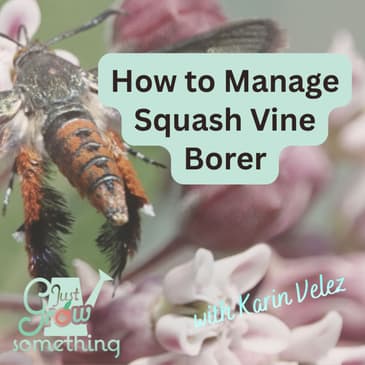
Every year, gardeners across the country watch their squash plants collapse overnight and have absolutely no idea why until it’s too late. The culprit is the squash vine borer, and it is one of the most misunderstood pests in the home garden.
In this episode, Karin Velez breaks down the full life cycle of the squash vine borer, including regional timing differences that explain why gardeners in Florida, Missouri, and New Hampshire are fighting very different battles. She covers the remedies that likely don’t work (no matter how many gardening blogs swear by them), the strategies that actually do, and how to build a prevention plan before you ever see a moth.
Whether you’ve been battling these for years or just lost your first plant to a mystery wilt, this one’s for you. Let’s dig in.
Quick-Reference: Squash Vine Borer Management at a Glance
Most susceptible crops: zucchini, yellow summer squash, acorn squash, Hubbard squash, pumpkins (Cucurbita pepo)Less susceptible crops: butternut squash, cucumbers, melons, watermelon
Diagnostic sign: frass (greenish-yellow sawdust) at the base of the stem near a small hole
South: first flight May, 2 generations possible, adult activity May–October
Mid-country (MO, KY, OH, IN, VA): first flight mid-June, peak June–July
North (MN, WI, NH, PA, SD): first flight ~June 20, peak July 10–15, mostly finished by August 1
West Coast: rarely affected
What works: pheromone traps for monitoring, floating row covers (on clean ground), planting date manipulation, variety selection, timed stem sprays (spinosad, Bt, pyrethroids before larvae enter), fall tillage, post-harvest sanitation, surgical larva removal if caught early
What does not work once larvae are inside: all foliar insecticide applications
Episode References
Insect Netting: https://amzn.to/4vuYp7sUniversity Extension Resources
University of Kentucky Entomology — Squash Vine Borer (EF-314), Ric Bessin: https://entomology.ca.uky.edu/ef314Ohio State University Extension — Squash Vine Borer Damage and Management: What to Look for and When to Act (ENT-0106): https://ohioline.osu.edu/factsheet/ent-0106
Illinois Extension — Squash Vine Borer: https://extension.illinois.edu/insects/squash-vine-borer
Illinois Extension — Managing Squash Vine Borer in the Garden (Good Growing blog): https://extension.illinois.edu/blogs/good-growing/2022-07-15-managing-squash-vine-borer-garden
Illinois Extension — Squash Vine Borer Has Arrived: https://extension.illinois.edu/blogs/over-garden-fence/2024-08-20-squash-vine-borer-has-arrived
UMass Amherst Extension — Squash Vine Borer (CAFE Vegetable Fact Sheet): https://ag.umass.edu/vegetable/fact-sheets/squash-vine-borer
Penn State Extension — Squash Vine Borer: https://extension.psu.edu/squash-vine-borer
University of New Hampshire Cooperative Extension — Managing Squash Vine Borer Problems in New Hampshire (Dr. Alan T. Eaton & George Hamilton): https://extension.unh.edu/resource/managing-squash-vine-borer-problems-new-hampshire-fact-sheet
South Dakota State University Extension — Biology and Management of Squash Vine Borer in the Garden: https://extension.sdstate.edu/biology-and-management-squash-vine-borer-garden
University of Minnesota Extension — Squash Vine Borers: https://extension.umn.edu/yard-and-garden-insects/squash-vine-borers
University of Wisconsin-Madison Division of Extension — Squash Vine Borer: https://hort.extension.wisc.edu/articles/squash-vine-borer-melittia-curcurbitae/
eOrganic (USDA) — Biology and Management of Squash Vine Borer in Organic Farming Systems: https://eorganic.org/node/5300
ATTRA Sustainable Agriculture — Squash Bug and Squash Vine Borer: Organic Controls: https://attra.ncat.org/publication/Squash-Bug-and-Squash-Vine-Borer-Organic-Controls/
Peer-Reviewed Research
Middleton, E. (2018). Biology and Management of Squash Vine Borer (Lepidoptera: Sesiidae). Journal of Integrated Pest Management, 9(1), 22. https://academic.oup.com/jipm/article/9/1/22/5061838Canhilal, R., & Carner, G.R. (2007). Bacillus thuringiensis as a pest management tool for control of the squash vine borer. Journal of Plant Diseases and Protection, 114, 26–29. https://link.springer.com/article/10.1007/BF03356200
Canhilal, R., Carner, G.R., Griffin, R.P., Jackson, D.M., & Alvarez, D.R. (2006). Life history of the squash vine borer, Melittia cucurbitae, in South Carolina. The Journal of Agricultural and Urban Entomology, 23, 1–7. http://scentsoc.org/Volumes/JAUE/v23/1.pdf
Just Grow Something: https://justgrowsomething.com
Gardening Courses: https://justgrowsomething.com/courses
Just Grow Something Merch and Downloads: https://justgrowsomething.com/shop
Just Grow Something Gardening Friends Facebook Group: https://www.facebook.com/share/g/18YgHveF5P/
Check out how you can become a patron on Patreon: https://www.patreon.com/JustGrowSomething
Feed my coffee habit: https://buymeacoffee.com/justgrowsomething
Amazon storefront: https://www.amazon.com/shop/justgrowsomething
Get 10% off and FREE shipping on my favorite raised planters at Planter Box Direct using code JUSTGROW10: https://planterboxdirect.com/?ref=593
Hosted by Simplecast, an AdsWizz company. See pcm.adswizz.com for information about our collection and use of personal data for advertising.
[00:00:00] Every year, gardeners across the country watch their squash plants collapse overnight and have absolutely no idea why until it's too late. At the farmer's market, I inevitably have multiple gardeners come up clearly frustrated and they say something like, my zucchini looked perfect last week, now the whole plant just fell over. What happened? And the answer, unfortunately, 90% of the time is squash vine borer.
[00:00:28] And if you just got chills up your spine, then you likely have dealt with this pest before. Squash vine borer is one of the most predictable, most well-timed, and most devastating plants in the vegetable garden. It overwinters in your soil, it emerges on a schedule tied to accumulated heat, not the calendar. It lays its eggs at the base of your plants, and by the time you see that telltale pile of sawdust-like frass on your stems, the larvae are already inside and most of the plants are in your garden.
[00:00:58] Most of what you can do from that point is limited. Welcome back to Just Grow Something, I'm Karin Velez, horticulturist, market farmer and garden consultant, and I have had a personal, very hands-on relationship with squash vine borer for a very long time. I have lost plants to it, I have saved plants from it, I have tested methods that did not work at all, and I have landed on a short list of things that actually genuinely do work.
[00:01:24] So, today we are going to walk through the full picture, the biology, the regional timing differences, the misinformation that is absolutely everywhere online, and the strategies that science actually supports. Because if you are planting squash and you are not thinking about squash vine borer before now, you are probably already behind. Let's dig in.
[00:01:49] So, before we jump in, real quick, shout out to everyone who has reached out after the mulch episode a few weeks back asking how to apply mulch around squash plants without creating a pest habitat underneath it. And that is a perfectly timed question, as it turns out. Squash vine borer is exactly the kind of thing where your mulch strategy does matter, and we will touch on that today. So, if you have asked me that question, welcome to the follow-up that you didn't know was coming.
[00:02:23] And as I am looking at my notes for this episode, I can see it's probably going to be another long one, so strap in, my gardening friends. We are going to get into it, okay? Before we get into what to do about squash vine borer, we need to understand what we're actually dealing with. Because the biology of this pest is exactly why so many of the popular remedies fail.
[00:02:47] So, the squash vine borer, Melidia cucurbitae, is not a beetle or a grub. It is a moth, but it is a very strange moth. It is what we call a clear-wing moth, which means it mimics a wasp. The adult flies during the day, which is unusual for moths.
[00:03:07] It has a metallic greenish-black front wing, clear hind wings with dark veins, and a bright orange-red abdomen that is dotted with black spots. And it has hairy orange and black hind legs. It's like a flying Halloween decoration. Now, at first glance when it's flying around, it really does look like a wasp or a hornet darting around your garden. A lot of gardeners see it and they don't think anything of it.
[00:03:34] Which is a mistake, because that moth is looking for your squash plants. So, it's kind of important to know the full life cycle of this pest, because it really is the key to everything that comes later. Squash vine borer overwinters in the soil as a pupa. Okay, so this is different from like squash bugs who overwinter as adults.
[00:04:03] The pupa is tucked about two inches down inside its cocoon. And it's been there since late summer of the year before. So, in the spring and the early summer, depending on where you live, that pupa develops into an adult moth and then emerges from the soil. That adult moth's only job is to find host plants and lay eggs. Each female can lay 150 to 200 eggs.
[00:04:32] Laid singly, like one at a time, at the base of squash and pumpkin stems. And also on the leaf stems. And occasionally you'll find them on the undersides of leaves if they kind of get lost in their directions. The eggs are small. They're flat. They're like reddish brown ovals about the size of the point of a pencil. They are easy to miss. But once you know what they look like, you kind of learn how to key in on them when you're scouting for these.
[00:05:02] So, those eggs are going to hatch in about one to two weeks. The larvae that hatch are tiny at first. But within hours of hatching, they bore into the stem of the plant. So, once a larvae is inside the stem, it feeds on the plant tissue internally for about four to six weeks. Which is disrupting the vascular system of your plant. That's the xylem and the phloem that move water and nutrients through the plant.
[00:05:29] So, when you see your squash plant suddenly, like, wilt. Even when the soil is moist and you've been watering consistently. That is what is happening. The plant cannot move water anymore because that pipeline has been destroyed from the inside. So, after the larvae have finished feeding, they exit the stem. They burrow back into the soil. They spin a cocoon. And they pupate. And that's where they overwinter until the following summer. And then the cycle starts all over again.
[00:05:59] So, the hallmark sign of a squash vine borer infestation is frass. This is a greenish-yellow to maybe orangey, brownish kind of sawdust-like material that gets pushed out of the entry hole at the base of the stem. It might be mixed with some plant sap. It kind of looks like wet sawdust that's just piled at the base of the vine near a small hole.
[00:06:27] So, if you see that, the larvae are already inside. Squash vine borer primarily attack the Cucurbita pepo species. So, that's like zucchini, yellow squash, acorn squash, hubbard squash, and most of our pumpkins. So, these are your highest risk plants. Butternut squash is Cucurbita moschata. And so, it has a harder, narrower stem.
[00:06:56] And it's a little bit more resistant to this. Now, it's not immune, but it is actually a less susceptible option. Other options that we have trialed here with some success include tromboncino squash and cacuzza squash, all for basically the same reasons. The cucumbers and the melons and the watermelons, these don't generally become very good hosts for squash vine borer. They might visit them, but they are rarely going to sustain significant damage.
[00:07:24] So, if you've been losing your cucumbers to a mystery wilt, squash vine borer is probably not the culprit. You're likely dealing with bacterial wilt. And that's spread by cucumber beetles. And that is a different pest and a different episode. So, when we're looking at squash vine borer, oftentimes what we're looking at is a timing problem. And this is where a lot of the online advice that you might see regarding squash vine borer kind of falls apart.
[00:07:52] It's the timing of when the pest emerges. Because squash vine borer does not operate on the same schedule in every part of the country. The timing of the emergence is determined by what we call degree days or degree day accumulation. Essentially, we're looking at how much heat has built up in the soil and the environment since winter.
[00:08:19] So, as you can imagine, this is going to change from year to year. Squash vine borer moths typically emerge after about a thousand degree days have accumulated. And we're using a base threshold of 50 degrees Fahrenheit. So, what that means without tracking or doing the math or whatever is basically like in a warm year, they're going to emerge earlier. In a very cool slow spring, you know, then they might be coming out a week or more later.
[00:08:49] The calendar is a rough guide. Your local conditions are what actually matter. So, I'm going to kind of walk you through the regional picture. Because if you're in Missouri versus Maine versus Mississippi, you are dealing with very different timelines. If we're looking at the deep south, this is, you know, zones 8 through 10, Florida, Texas, Louisiana, the coastal Carolinas. The squash vine borer can have two full generations per year.
[00:09:18] So, the first adult flight in Florida may begin as early as mid-May. And the adults can be present from May all the way through October. So, the implications of this are pretty significant. So, if you're in Florida or in a similar climate, if you plant squash in the late spring and expect to harvest through the summer, you are going to encounter the squash vine borer.
[00:09:42] And the management strategy in these climates is often to plant really early, like as soon as the soil reaches 60 degrees Fahrenheit, so that you can get a harvest in before the first flight peaks. And then some growers try to do a second planting, like in the late summer after the activity has dropped off. So, again, you know, closer to October. So, then in that sort of transition zone, which is like zone 6 and 7,
[00:10:10] so Missouri, Kansas, Kentucky, Tennessee, Virginia, the Mid-Atlantic, Ohio, Indiana, this is where we fall, right? So, in 6B here in West Central Missouri. And in this middle band of the country, squash vine borer is typically a mid-June pest. So, like in Kentucky, the University of Kentucky says that, you know, the adults emerge between late April and mid-August. So, that main flight concentration is in June through July.
[00:10:39] You know, Ohio State University, they put their emergence at early to mid-summer, typically June, which is coinciding with that early squash flowering. So, and some places in Ohio, you may end up having a partial second generation if you have a warmer year. So, in our kind of zone, June really is the critical month, right? The moths emerge, they find your plants, they lay eggs through June and July, and then the larvae spend the rest of the summer inside your vines.
[00:11:08] This is why every year around, you know, the beginning to middle of June, so now, I start watching for that wasp-looking moth darting around the squash beds because that is the signal that the clock is ticking. If we look at the northern states, so zones 4 and 5, we're looking at Minnesota, Wisconsin, Michigan, the Dakotas, New England, upstate New York, Pennsylvania, squash vine borer typically only has one generation per year, lucky you.
[00:11:36] In New Hampshire, the University of New Hampshire has done actual pheromone trap data collection, and their records show that the first moths typically appear in traps around June 20th. The peak flight happens between, you know, July 10th and 15th, and by about August 1st, the catch rates drop below threshold in most of the years. But again, even though this is going to give you a little bit more of a predictable window
[00:12:03] in warmer years, that's going to change, right? So specifically like 2010 and 2013, for example, you might get a second generation because you've got those warmer years, and so you might like have late, you know, moth activity, you know, even up into in the middle of August, right? So again, your climate matters, the heat accumulation matters. If you're looking at like Minnesota, Wisconsin,
[00:12:31] you're looking at activity from late June through early to mid-August, Pennsylvania, first emergence is around mid to late June, South Dakota, about the same time, late June, early July. If you are gardening on the West Coast, squash vine borer is largely not your problem. This guy is rarely found west of the Rocky Mountains. So if you're in the PNW, California, any of those areas, you actually may not have to worry about it at all.
[00:13:01] Now, of course, there are other squash pests, but, you know, squash vine borer is not going to be your problem. It is primarily an eastern and central U.S. problem. So basically, the idea is just to know your region's approximate window, and then in your own garden, set a pheromone trap. We'll talk about those in the next segment. Just so you can figure out when the adult moths are actually active in your yard that year,
[00:13:29] because your garden's degree day accumulation is going to be more precise than anything you read on the internet, including anything that I tell you right now. So let's talk about the remedies, because if you search squash vine borer on the internet, you will find a long list of suggested fixes, and some of them are genuinely effective,
[00:13:58] but a lot of what you will find is not backed by research. So we're talking correlation versus causation here, right? And in some cases, following that advice might actually cost you your plants. So the first suggestion is about spraying insecticides after the larvae are inside the stem. So basically, after you've already seen that frass. This is the single, probably most common mistake that gardeners make
[00:14:25] when they discover that frass at the base of the squash plant. They reach for a spray, and the spray does nothing. Once squash vine borer larvae have bored into that stem, they are protected, you know, from essentially all your foliar insecticide applications. It doesn't matter what product you reach for. If the larvae are already inside, spraying the outside of the plant is not going to reach them. So once they're inside the vine,
[00:14:53] these insecticide applications are largely ineffective. They're only effective as a prevention measure applied to the stems before and during that egg laying window. And only when they're timed correctly to target the eggs or the very newly hatched larvae before they make their way into the stem. And we'll talk about timing a little bit more in the next segment.
[00:15:19] The next suggestion that you'll see would be wrapping the stems with foil or nylon stocking material or sports bandages or something, anything like that, right? This one gets shared constantly in gardening groups. And so the idea is just to wrap the base of the stem to physically prevent the female moth from laying eggs at the base. Now, in theory, this makes sense. In practicality, you have a little bit of a limitation there
[00:15:49] because, you know, oftentimes those barriers are not going to completely cover the area so the moths can still lay eggs on the plant. That squash stem and its base are very irregular. So sometimes that material is hard to keep in place. And the moths don't just lay their eggs on the stem. They can go on the upper stem. They can go on the leaf stems. They can go on the other plant parts as well. So while this might be part of a control strategy,
[00:16:19] it can't be the only control strategy because there are failure points there. And then there's also suggestions for companion planting or repellent plants. And you know I am a huge proponent of interplanting as a sort of strategy, right? You'll see lists online of companion plants that supposedly repel squash vine borer.
[00:16:42] So, you know, using blue hubbard as a trap crop or using nasturtiums or tansy or other plants as repellents. So trap cropping and companion planting strategies specifically for squash vine borer are not necessarily, you know, well supported by the research that is specific to this pest. I will say on a large scale.
[00:17:10] So from like a farm standpoint or a very large garden where you have a lot of room, we can do perimeter trap cropping, right? So this is basically planting a sacrificial blue hubbard squash around the perimeter of a planting area. And so we're trying to concentrate all that egg laying away from your main crop. But you also have to be covering the main crop, protecting the main crop.
[00:17:35] You also have to actively monitor and manage that blue hubbard trap plant. And so this is not a passive solution. It does require some effort on the part of the gardener. And if you have a very small garden, this might be a little bit more difficult to do, especially since the blue hubbard squash is going to take up a very large amount of room. Is it a solution? Yes, absolutely. It works. It works for other things too, like squash bugs, which we have used it for.
[00:18:05] So I'm not saying don't do it. I'm just saying it's not a passive solution. And just like everything else should probably be a part of a layered approach. The idea that planting nasturtiums or other repellent pests near your squash to deter the squash vine borer moss. Again, not any solid evidence behind it. I do want you to experiment in your garden and to keep records. That is always valuable.
[00:18:33] But we don't know if this is correlation versus causation. I'm not going to tell you that planting a ring of nasturtiums is going to protect your zucchini because the data doesn't say that. And the data certainly doesn't say it in my own garden, which in my garden, my records are what matters, right? So same thing with your garden. So again, something else that could be a layered approach.
[00:18:55] Do we recommend interplanting things to help keep the insect pests from being able to land on their preferential plant the number of times they need to to take the activity that they want to take, whether that's laying an egg or eating it or whatever? Yes, because that is going to help. But again, it can't be the only solution. Neither can crop rotation. Okay. Yes, crop rotation is a legitimate tool in managing the squash vine borer.
[00:19:24] And we will talk about that as part of a complete strategy. But crop rotation alone in a small home garden especially is not going to protect you from the squash vine borer. Squash vine moths are very strong flyers. They can travel up to a half a mile from their emergence site to find a host plant. Okay.
[00:19:46] So in a home garden setting, rotating your squash bed 20 feet means practically nothing to a moth that can cover a half a mile. So even in larger like farm operations, fields often need to be rotated more than five miles away for the rotation to really meaningfully reduce that local squash vine borer population. Now, again, this doesn't mean that you shouldn't rotate. You absolutely should rotate if you can for a lot of different reasons.
[00:20:12] But don't rely on rotation as your primary squash vine borer defense. And then we have BT. That's Bacillus thuringiensis. And this is one of the most nuanced topics in squash vine borer manage.
[00:20:28] So the research basically tells us that BT is not effective against squash vine borer once the larvae are inside the stem because BT has to be ingested to work. And the larvae are protected from those foliar sprays once they have entered the plant.
[00:20:49] Now, there is research from Clemson University that showed that if you use a commercial BT formulation and you apply it to the stems before and during the egg laying period, it is as effective as, you know, the standard that they were comparing it to basically. Because anything we're doing in research, you have to have a standard you're comparing it to. And then, of course, you have to have your control, right? So the key application was timing and frequency.
[00:21:18] So BT sprayed on the stem surface before the larvae enter can be ingested by those newly hatching larvae as they try to bore through the plant. The problem is that BT degrades very quickly in UV light. So this requires consistent reapplication like every five to seven days during the moth flight window.
[00:21:42] But what about what you've seen online about people injecting BT into the stem of the plant after they see that the frass indicates that there is a larvae present? So there is research on this, but the findings were not favorable to injection specifically. The most recent study that I could find was from 2007. Again, this was also conducted at Clemson University.
[00:22:08] And that study directly compared BT stem injection versus foliar spray just to the stem surface. And what they found was that the injection and the spray application methods basically produced similar results.
[00:22:27] But those trials were designed as preventative or early intervention applications, not as a rescue treatment after the frass was already visible. And the injection method was less effective in that instance than the spray application. So the core problem with this BT injection after you have seen the frass appear and you know that you have a larvae inside is that BT is not systemic.
[00:22:57] It is not a systemic that works in the vascular system of the plant. So if you are injecting the BT into the interior hollow of the stem, so remember, you know, especially with zucchinis, they get these hollow stems to them. And then you have the meat, I guess, of the walls of the stem, right?
[00:23:20] So if you're injecting BT into that interior hollow, it's not entering the vascular system, which is within the walls of the stem. And BT is only effective if it's ingested by its target. So by the time the frass is visible, the larvae is already tunneling through the walls of the stem. It's not sitting in the hollow interior.
[00:23:42] So flooding that hollow with BT solution doesn't reliably place that bacteria where the larvae is actively feeding. So there is a very thin research base on this. And we also have that sort of delivery problem. The larvae is in the stem wall, not the hollow interior. The BT isn't going to find it there unless you are attempting to make injections at multiple sites along the stem wall.
[00:24:09] And you're only going into that tissue, not all the way through. And then you're likely killing the plant anyway, right? And, you know, how many times are you going to go through and try to poke holes into this stem of this poor plant to try to save it from the bug that's in the inside that's killing it, okay? Anything that we see online as proof, and I'm using air bunnies here, is likely correlation, not causation.
[00:24:36] I'm not saying it doesn't sometimes work because somebody got lucky. I'm just saying that BT is not a simple yes or no. So applied correctly before the larvae enter the plant and then reapplied consistently, yes, it can be effective. Applied after the fact, whether it's a spray or it's injected, you are likely not going to see a result.
[00:25:01] Okay, so now that I have poo-pooed all over the solutions that you likely have seen online, let's talk about what the research and the resources actually do support. The best management strategy for squash vine borer is a layered one. That thing that we call integrated pest management, right? We have talked about this before. No single approach wins by itself.
[00:25:26] The strategies that work best are used in combination with each other, and most of them have to happen before you see the damaged plant. So the first strategy is to monitor for the adults with pheromone traps. This is sort of the foundation of everything else on this list. You cannot time your interventions if you don't know when the moths are flying. And by the time you see them, it might be too late.
[00:25:50] So if you use pheromone traps, there are a couple of different versions of this. There are yellow bucket traps that have squash vine borer lures in them. They have these little, you know, paper cardboard ones that have the lure in the inside. You can find them online. I get mine from Harris seed, I think is where I've gotten mine. These are the most reliable way to detect adult moth activity in your garden. Okay.
[00:26:19] You want to get these set out before the date that you expect the adults are emerging and flying. So typically we want to put these out late May or early June, depending on where you live. And we want to check them at least once a week. If you are catching five or more moths per week, you absolutely need to take some action. The lures typically last around four to six weeks before they need to be replaced. Of course, sometimes this depends on how much rain you get.
[00:26:48] Last year we were under a deluge for quite some time when I had my traps sitting out and I had to go and replace them once or twice. Just like everything else, you know, I say record this in your garden journal. Write down the date of your first catch each year. Over a few seasons, you will sort of develop your own garden's emergence calendar, which is going to be much more accurate for your specific location than any general guideline that you can find.
[00:27:17] So, but I have to be very clear. When we say trap, okay, these pheromone traps are a monitoring tool. They are not a control method. They're not going to catch enough moths to reduce the population pressure on their own. Their value is just in telling you when to act. So that next strategy to follow up with would be floating row covers. This is the most effective physical management tool for squash vine borer and notably squash bugs.
[00:27:47] And it's something that I do every single year now when I am planting squash. Row cover is that spun fabric that allows light and water and air to pass through, but it physically prevents the adult moths from reaching the plant to lay the eggs. You can also just use insect netting. And what you choose to use is going to depend on where it is that you garden. And sometimes that row cover can be too warm for the plants for the long term, unless you are living someplace further north,
[00:28:17] in which case you kind of get a little bit of a bonus where you're warming up the soil at the same time and you're trapping in that warm air. Otherwise, you can use insect netting. And I will link to the one that I use in the show notes. To use it effectively, you need to observe two things. The ground under the row cover should not have had any squash growing in it in the previous season.
[00:28:42] Because remember, the squash vine borer pupae might already be in that soil if you had them the previous year. So if you put the row cover over top of it, now you're just going to trap them inside with your plants, which is just going to make the situation worse. Okay, so again, a little bit of crop rotation going on here. Okay, so cover crops work best when you rotate your crops. The second thing is that you're going to have to remove the row covers once the female flowers appear
[00:29:08] to allow pollinators in order to be able to get fruit set. So in most of our summer squashes, you are going to see the male flower showing up first. And after a few days or a week or so of just the male flower showing up, then the female flowers are going to show up. And you know the difference between the two because the female flowers have that little proto fruit at the base of the flower. So squash requires pollinators. They cannot self-pollinate.
[00:29:36] So, you know, the question is when and how to remove the covers without exposing the plants to the squash vine borer during that peak moth flight. So what's been recommended on a commercial basis, right, from everything that I read, they say to delay removing the row cover until 50% of the female flowers are open. And that is going to not negatively impact the yield.
[00:30:04] The other approach is removing the covers in the evening and then replacing them in the morning, which allows the native bees, which are early morning pollinators, to access the flowers during the time when the squash vine borer are typically less active. Remember, these are moths, but they fly during the day and they rest on leaves in the evening. So, you know, this timed removal kind of takes advantage of the difference in the activity periods.
[00:30:34] The other thing you could do is to self or to hand pollinate, which is what I have done in the past. And that is basically uncover and pick a male flower, pull the petals back, go along with the male flower to tickle all the female flowers, and then put the row cover back on again. Now, when you're like me and you're planting hundreds of squash plants, this is not a super effective thing, at least not for the long term. I have done it for the first two weeks and then pulled everything off and said, no, go for it, okay?
[00:31:04] But if you're only doing this with a few plants, this might be very effective. The thing about the row cover or the insect netting is it needs to be secured very well all along the edges. Moths will find gaps, all right? We've learned this the hard way. One edge of the row cover left loose because it keeps blowing up is all it takes for a moth to get underneath and lay a full round of eggs.
[00:31:30] The third strategy is manipulating your planting dates. Now, this one requires knowing your region's timing and being willing to adjust your planting schedule. So like in northern states like Minnesota, Wisconsin, up into New Hampshire, where that adult flight is concentrated in late June through mid-July, a late planting strategy can really skip all of the damage.
[00:31:55] If you plant squash seeds in early to mid-July after that peak moth flight has passed, those plants will not be in the ground during that main egg laying window. So this is a really good strategy. Squash planted late in the season, especially in the northern climates, you're going to experience less squash vine borer damage because the plants mature after the adults have completed their egg laying. The trade-off is that you're compressing your growing window and your harvest,
[00:32:23] which also, unfortunately, in the northern areas is already short as it is. But in a short season garden, a late planted zucchini that you can actually harvest from might be more valuable than an early planted one that doesn't give you anything because it collapses in July, okay? If you're in the southern U.S., well, then the logic flips. So you want to plant early enough to harvest a crop before that peak activity starts,
[00:32:50] especially if you're someplace that gets two rounds of them, right? So like in Florida, those early planted squash are going to experience much less damage because the plants can complete their development before that main moth flight. Another approach that works at the home garden scale and even at the market garden scale is staggered plantings, which is what we have done. Instead of planting all of your squash at once,
[00:33:16] plant a first round in the early summer and then a second succession in late June or early July. If the first planting gets hit by squash vine borer, then you have a second planting that's coming in behind it. The fourth strategy is variety selection. So if you have had a consistent, severe squash vine borer problem for multiple seasons, you might consider shifting to less susceptible crops for a season or two. So again, we mentioned butternut squash.
[00:33:40] Squash, cucurbit muscata, anything that's in that species is consistently being identified as more resistant to squash vine borer than like our cucurbit pepo types. So those yellow squashes, zucchini, acorn squashes, hubbard squashes. If you want to keep growing these, and I understand completely if you do, because I also love my zucchini, then the other management strategies on this list need to be a part of your plan.
[00:34:08] But if you can switch out for a season or two, butternut squash, tromboncino, cucuza, and then go back to your other squashes, that likely will help to break that life cycle. The fifth strategy would be a timed insecticide application to the stem. So if you choose to use insecticides, and this is either conventional or organic, the application timing and the target location are both critical here.
[00:34:35] So sprays are applied to the basal stem of the plant. That is the first few feet of the vine from the soil surface. And this is mainly where the female moths lay their eggs and where the newly hatched larvae are attempting to get into the stem. The goal is to contact the eggs or the larvae in that narrow window before they break through the stem.
[00:35:01] Once they're inside, then the application window has closed like we already talked about. Conventional insecticides used for squash vine borer are like pyrethroids. For organic production, the two options are generally spinosad and BT. Okay, so what they have found is four weekly applications of the spinosad during the moth flight
[00:35:28] has given them really decent controls. And it was pretty comparable to the conventional pyrethroid. Spinosad also has residual activity longer than BT, which means it sticks around longer. Remember we said BT has to be reapplied more frequently. But we have to know that the spinosad is also toxic to bees when it's wet. So when you're using spinosad, you should be doing it in the evening after the pollinators
[00:35:55] have stopped visiting the flower so it can dry before they come in contact with it. For the BT to be effective, it has to be applied to the stem surface again during the egg laying and that early hatch window. And like we mentioned before, it has to be reapplied about every five to seven days because that UV light degrades it. We also need to make sure that we are directing that at the basal stem specifically. And as always, read and follow the pesticide labels which are legally required to be followed.
[00:36:25] And that is why we say, say it with me, the label is the law. Your sixth strategy with this would be soil tillage, which might surprise you. But because the squash vine borer overwinters as a pupae in the soil, then fall and spring tillage can disrupt the overwintering populations because you're exposing that pupae to drying
[00:36:51] out and to the cold and to predators, birds that want to come down and just pick them up and take them away. Okay. So if you are, you know, harvesting in the fall, then you might break up the soil then. And then you cover everything for the, for the winter time, pull it back, do some, some tilling or something again in the spring, just to turn that soil over and expose it to anything that wants to be able to come down and predate on the pupae or to, to dry them
[00:37:20] out and then continue on with your season. Now, this is not a silver bullet. Remember, moths can fly in from nearby areas, but in a really well managed garden, at least tilling something up or turning it over in the fall is going to at least remove a portion of the population that would otherwise be hanging out and showing up immediately the following summer. Again, I am not a huge proponent of tilling just for tillage sake. I love if we can manage our soils without disrupting all the microbiota and everything that are in it.
[00:37:50] But if you have an SVP problem, then we want to try to do something about that. Then tillage might be an option. Okay. And then of course, what goes along with this as your final strategy would be post harvest sanitation. So I got the end of the season removing and destroying any infested vines. Don't compost them, especially if they still contain a larvae because larvae in infested vines
[00:38:15] are still developing and they can keep, they can pupate in that compost pile if it's not getting hot enough. So the better approach is to remove the vines, seal them in a bag and throw them away or bury them really deeply well away from your garden beds, whatever it is. We want to make sure that we're removing that infested plant material so that it limits how many larvae are able to complete development and get back into the soil. So when the damage is already done, is there anything that you can do? And I mean, let's be real about it.
[00:38:45] A lot of you listening to this right now, you are going to find yourselves in the situation where there already is frass at the base of your squash plants. So let's talk about what you can try. The first one is surgical removal of the larvae. And this is genuinely a technique that is a true intervention, right? And that needs to be done when the damage is caught early on. And there are only a few entry points that are visible.
[00:39:13] So essentially, you are using a sharp knife or even a literal scalpel. And you're going to carefully slit the vine lengthways near where the entry hole is. Okay, so you'll see the frass. And beneath it, you might find the larvae. It is cream colored. It's got a brown head. So it's a little caterpillar. It's usually maybe an inch long or so. So that's what you're going to remove and destroy.
[00:39:40] Okay, and then this is the important part. Bury the damaged section of the vine under several inches of moist soil. We are trying to encourage the vine to develop those adventitious roots from that buried section. So we need to water it consistently to support that sort of recovery.
[00:39:59] This can work if you catch the infestation early, especially if you have only one or a few entry points and if your vine has not already been severely compromised. It is more of a triage tool than a reliable control method, but it is worth trying when you're already in damage mode. I have saved plants this way. Not every time, but sometimes.
[00:40:24] The second thing that you can try is rooting the vine at nodes. So squash vines can root along the stem at nodes when they contact moist soil.
[00:40:37] So deliberately mounting the soil over several points along the vine sort of upstream from where you suspect the larval damage is can actually get those sections of vine to develop roots before the main stem is fully compromised. And so then the plant might be able to maintain enough of its vascular function to move that water and those nutrients around to be able to survive and continue producing.
[00:41:04] Now, this works better on those longer vining types that have already put on enough stem length to have multiple potential rooting sites. It's a little bit less useful when you have those really compact bush type varieties where the main stem is the whole plant. But this is a technique if you have a vining type squash. Egg removal by hand.
[00:41:27] If you're finding eggs on your stems, and again, we're looking for small, flat, like reddish brown ovals that are laid. It's just one little dot at the base of the stem or on the leaf petioles. We can remove those before they hatch. That is a legitimate intervention. So you can actually just try wiping stems down with a damp cloth periodically, like every few days. Okay, this theoretically can remove the eggs before they hatch. I have done this.
[00:41:57] Now, it's tedious, right? Especially when you have several hundred plants, which is why I just wipe the stems. But, you know, if you're going to go through and look for the eggs, you have to know what you're looking for. So look up what the pictures of what this looks like. But if you're in the middle of peak moth flight and you're not using row cover, then checking your stems for eggs like twice a week and removing them is a legitimate part of an integrated approach, right?
[00:42:26] Integrated pest management. And then sometimes the only thing that you can do is know when to walk away. Okay, sometimes a plant is just too far gone. Multiple larvae. The main stem is compromised at the base. It's like split open at this point. The vine is already wilting beyond recovery. At that point, the most useful thing that you can do is remove the plant, destroy the infested material,
[00:42:55] and start over with a late succession planting if your season will allow for it. Okay? Like we talked about in the northern climates, a late planting in early July can still produce zucchini before the frost. Okay, this is not admitting defeat. We are just adapting.
[00:43:16] Squash vine borer is a predictable pest with a predictable life cycle and a predictable window of vulnerability. The reason that so many gardeners lose their squash to it every year is because a lot of the popular advice online is full of remedies that target the wrong stage or the wrong time or in the wrong way.
[00:43:42] So know your regional emergence window. Put out a pheromone trap before that window opens up so you know when the moths are actually flying in your garden. If you're using row covers or insect netting, use them on ground that didn't have squash last year and have a plan for pollination before you need to remove them. Consider staggering your planting so a second crop is coming in behind your first.
[00:44:07] And do your fall tillage and sanitation to remove the population that overwinters in your beds. Of course, all of the resources I referenced today will be linked in the show notes. Read them. They are excellent. They are free. And they are significantly more useful than most of what you will find if you search for this topic on social media. And while you're digging through the show notes, I would love it if you would actually follow the show
[00:44:35] if you haven't already, whether you're on YouTube and you can hit the subscribe button or you are in your favorite podcast player and you just hit the follow. That way you know when new episodes drop and you will not miss any of this practical information. Until next time, my gardening friends, keep on cultivating that dream garden, and we'll talk again soon. Bye. Bye.