
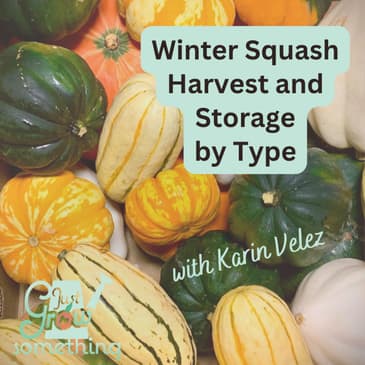
Winter squash gives you almost no obvious warning before it's ready, and pulling it too early is one of the most common mistakes gardeners make. And that mistake costs you flavor, sugar content, and months of storage life. In this episode, we're breaking down exactly how to read maturity on butternut, acorn, spaghetti, delicata, and storage pumpkins: the rind test, the ground spot, and the specific cues for each type. Then we'll cover what to do with a squash patch when frost is bearing down on you, why curing helps some squash and actively ruins others, and how to set up a storage space that gets you squash on your table well into the new year instead of watching half your harvest go soft by Thanksgiving.
Get your fair-trade, organic, sustainably harvested coffees and support the show at https://larryscoffee.com/justgrow
Got my newsletter: JustGrowSomething.com
References:
University of Missouri IPM — Pumpkin Picking Time: ipm.missouri.edu/meg/2022/10/pumpkins-DT/
South Dakota State University Extension — Time to Harvest Those Winter Squash: extension.sdstate.edu/time-harvest-those-winter-squash
South Dakota State University Extension — Harvesting and Storing Pumpkins and Winter Squash: extension.sdstate.edu/harvesting-and-storing-pumpkins-and-winter-squash
South Dakota State University Extension — Fall Frost Tolerance of Common Vegetables: extension.sdstate.edu/fall-frost-tolerance-common-vegetables
Iowa State University Extension — Yard and Garden: Winter Squash: extension.iastate.edu/news/yard-and-garden-winter-squash
Purdue University Vegetable Crops Hotline — Harvest and Postharvest Storage of Pumpkins and Winter Squash: vegcropshotline.org/article/harvest-and-postharvest-storage-of-pumpkins-and-winter-squash-2/
Purdue Extension FoodLink — Winter Squash: extension.purdue.edu/foodlink/includes/pubs/Print4perpaper/4VegetablesPrint/4WINTER_SQUASH2print.pdf
Oregon State University Extension Service — Preserving Pumpkins and Winter Squash: extension.oregonstate.edu/catalog/sp-50-767-preserving-pumpkins-winter-squash
Michigan State University Extension — Pumpkins, Squash, Gourds: canr.msu.edu/resources/pumpkins_squash_gourds_commercial_vegetable_recommendations_e1953
University of Illinois Extension — Winter Squash (Home Vegetable Gardening): extension.illinois.edu/gardening/winter-squash
University of Minnesota Extension — Harvesting and Storing Melons, Squash and Pumpkins: extension.umn.edu/agriculture/specialty-crops/commercial-fruit-production/harvesting-and-storing-melons-squash-and-pumpkins
Cornell Cooperative Extension Regional Vegetable Program — Winter Squash and Pumpkin Maturity, Harvesting and Storage Tips: rvpadmin.cce.cornell.edu/uploads/doc_1144.pdf
UC Master Gardener Program of Contra Costa (UC ANR) — Harvesting and Storing Winter Squash and Pumpkins: ucanr.edu/blog/hort-coco-uc-master-gardener-program-contra-costa/article/harvesting-and-storing-winter-squash
Maine Organic Farmers and Gardeners Association — Harvesting Winter Squash for Peak Flavor and Optimal Storage Life: mofga.org/resources/crops/harvesting-winter-squash-for-flavor-and-storage/
Resources:
Just Grow Something: https://justgrowsomething.com
Gardening Courses: https://justgrowsomething.com/courses
Just Grow Something Merch and Downloads: https://justgrowsomething.com/shop
Just Grow Something Gardening Friends Facebook Group: https://www.facebook.com/share/g/18YgHveF5P/
Check out how you can become a patron on Patreon: https://www.patreon.com/JustGrowSomething
Feed my coffee habit: https://buymeacoffee.com/justgrowsomething
Amazon storefront: https://www.amazon.com/shop/justgrowsomething
Hosted by Simplecast, an AdsWizz company. See pcm.adswizz.com for information about our collection and use of personal data for advertising.
[00:00:00] Alright my gardening friends, it's that time of year so listen up. Winter squash gives you almost no obvious warning in the garden before it's ready to harvest. And pulling it too early is one of the most common mistakes that gardeners make. It costs you flavor and sugar content and months of storage life. This time of year is when we start to put the very first few winter squashes out on our market stands and I end up getting two questions.
[00:00:27] The first one, winter squash already? And the second one, how do I know when it's ready? So if you're walking out into the garden on a nice cool morning right now with your coffee in your hand, you might just see a butternut squash that's tan and solid looking sitting right there under a leaf that's just starting to yellow at the edges. And every instinct you have is going to tell you to pick it because it looks done. It looks just like the ones in the grocery store.
[00:00:55] And if you pick it right now, based on color alone, there is a pretty good chance that you get it right and just as much of a chance that you just picked it two or even three weeks too early. So that squash that you were planning on eating on Thanksgiving is now unfortunately going soft in your pantry by Halloween.
[00:01:18] Winter squash does not have an obvious finish line. There's no single easy to read moment the way that there is with like a ripe tomato turning red. You have to know what you're looking for. Oftentimes this comes with experience and it's different depending on whether you're holding a butternut, an acorn, a spaghetti squash, a delicata, or a pumpkin.
[00:01:45] Welcome back to Just Grow Something. I'm Karin Velez, market farmer and horticulturist and someone currently harvesting the first of our winter squashes for both market and for storage. Today we're talking about one of the trickiest calls in the whole garden year that ranks right up there with picking watermelon. And that's knowing exactly when your winter squash is ready to come off the vine and then what to do with it so that it lasts through the winter instead of collapsing on you in storage.
[00:02:12] I will tell you, most of the squash that rots early in storage didn't rot because of just bad storage conditions. I mean that's part of it, but a lot of the time it rotted because it was harvested immature in the first place. And no amount of curing or having like the perfect root cellar temperature can fix that after the fact. So we're going to fix it on the front end.
[00:02:40] How to read the rind, how to read the stem, how to read the ground spot, and how frost changes your timeline. And then we'll get into curing because curing helps some of these squashes but can actually ruin other ones. And mixing that up is a really easy mistake to make. Let's dig in.
[00:03:03] Before we get into it, if you have been enjoying the show, the single most helpful thing that you can do for me is to hit follow in whatever podcast app that you are using. Or if you're watching this on YouTube, go ahead and hit subscribe. It doesn't cost you anything. It takes about two seconds. And it is the main way that this show reaches more gardeners and more sponsors, which really helps keep the show going. And speaking of sponsors, they're not a sponsor, but they are an affiliate. And they did reach out to me. And I'm so glad that they did.
[00:03:32] Of course, I'm talking about Larry's Coffee. I'm sitting here with my cup of Larry's Coffee while I record this. And they are my current coffee obsession. I'm currently drinking Larry's House Blend, which is truly what a house blend should be. It's a medium roast. It's not overbearing. But it's not unassuming either or something anyone in your household would actually drink. And, of course, it's fair trade. It's organic. It's sustainably grown.
[00:03:56] You can support the show by going to larryscoffee.com slash justgrow and get a free gift while you're at it. And even their free gifts are fair trade. So they really do check all the boxes for me. I will leave a link in the show notes for you to check them out. But be sure you use my link, larryscoffee.com slash justgrow to get your free gift and to give the show credit for sending you there.
[00:04:19] So before we get into the differences between like a butternut and a delicata, let's talk about what all winter squashes have in common when they are ready to harvest. There are three main signs. And you really want all three just kind of lining up together before you cut anything off the vine. The first one is the fingernail test. So you want to press your thumbnail into the rind.
[00:04:48] You can do it somewhere out of the way, not on a spot that you're going to be looking at later. If your nail sinks in and it leaves a mark really easily, then that squash is not mature. Okay? A fully ripe winter squash has a really hard rind. Hard enough that you will really have to work hard to leave an impression with your thumbnail. This is a big difference between like a summer squash and a winter squash.
[00:05:12] Or a winter squash that we harvest young as a summer squash because we do that with things like tromboncino and such. It not only affects the storability, but immature squash also kind of lacks flavor. So you really want to wait specifically for that hard shell before you even consider harvesting them. The second sign is that the rind goes dull.
[00:05:37] So a winter squash that is still developing has a very glossy, almost waxy looking skin. As it matures, that shine starts to fade into a duller, flatter finish. Even though the color itself might still look very full and rich. Think of this as the difference between, say, a high gloss paint and a flat or matte paint. Right? You're going to have that full color and that complete character of the color.
[00:06:06] It's just going to look a little differently because it's not going to be shiny. Okay? Same thing with our squash. Most of these types are going to develop this duller appearance when they are ready to harvest. If your squash still looks kind of glossy or wet looking, then give it some more time. The third sign is the ground spot. And this is the one that I don't think most gardeners actually look for. You know, kind of like what we look for on a watermelon.
[00:06:33] But it is really a reliable cue to tell you whether or not a squash is mature. Wherever the squash has been resting on the soil, there's going to be a spot that doesn't get sun exposure. Okay? And we call that the ground spot. And the ground spot changes color as the fruit matures. So on a darker skinned squash like acorn or kabocha, kabocha, kabocha. I always want to say kombucha.
[00:07:03] That's a drink. Kabocha. Kabocha squash. Kabocha squash. It's on those dark ones, it's going to turn like orange or yellow underneath. On the lighter squashes like your butternut and your spaghetti squash, it might be a little bit harder to see. It's going to show up as a very, very pale or white patch. An immature squash, that spot is very, very light. So on your green ones, it's going to be a very, very light green or a very, very pale color. Okay?
[00:07:31] A mature one has a distinctly darker, just more color-saturated spot. So roll that squash over. Look on the underside. If it still looks really pale and washed out, then it probably needs more time on the vine. And while we're at it, I would also say to check the stem. We don't want, you know, harvesting squashes that still have like a moist or a black or shriveled stem.
[00:07:58] A healthy, mature stem should be dry. And especially on ones like buttercup squash and Hubbard squashes and a lot of your pumpkins, that stem is going to be very quirky in texture. You don't necessarily have to wait until all the plants all start to die off, although you can in a lot of cases. But that stem should already be drying out by the time you harvest.
[00:08:24] Now, each type of winter squash can be a little bit different in the signs that they are ready. So we're going to break down each one individually so you know what to look for. We're going to start with butternut. Butternut is one of the more deceptive ones because it doesn't get its full tan color until fairly late in development. Butternut fruit starts getting that tan color around 35 days after fruit set, which could kind of lead you to think, oh, wow, it's actually getting ready.
[00:08:52] But you don't want to harvest it until closer to about 55 days after fruit set, which is roughly two to three weeks after it first turns tan, okay? We're going tan to that really deep, rich color, okay? Most of the varieties of butternut squash are going to hit full maturity around 60 to 70 days after the first day that they flower. So if your butternut just started turning tan last week, do not go out there and pick it, okay?
[00:09:21] Give it more time on the vine so long as you don't have frost heading your way, which hopefully no matter where you are in the country right now, you're not getting frost yet. Is it edible at this stage? Yes. It's not nearly as flavorful and it will not store properly either. You are looking for a rind that has gone fully deep, dark tan. You want it to be dull, not that glossy color, and we don't want any green streaks left in it and that shell has to pass that fingernail test. The next one will be acorn squash.
[00:09:51] This one is probably the trickiest one on the list because acorn reaches its full size and gets that dark green to black color somewhere around two weeks after it sets fruit. So it grows very, very quickly and it looks like it's mature, but it isn't actually mature for another like 40 to 50 days after that. So these are really easy to mistakenly pick early.
[00:10:20] So color alone is actually going to trick you really badly on acorn squash. So the cue here is that ground spot. You want to roll it over and you want that spot on the underside to have turned a solid dark orange. We're not looking for like a pale green or a yellow. That's what it starts out as, okay? Full maturity on these guys is about 55 to 60 days after flowering.
[00:10:47] If you harvest based on that dark rind color alone, you are very likely picking probably two to three weeks early. And an immature acorn squash is going to develop a little bit of sweetness in storage, but it's only doing that by burning through its starch reserves, which means it's going to shorten how long it keeps. And it also sort of reduces the overall eating quality of the squash. So be careful on this one. Spaghetti squash.
[00:11:14] This is actually one of the easiest ones once you recognize it because it kind of tells on itself with the color. An immature spaghetti squash is really, really pale. It's almost whitish. But as it matures, it starts to shift to a really deep, very uniform golden yellow. And that rind is going to harden right along with that color change. So once it is solid deep yellow all over and it passes the fingernail test, it's totally ready.
[00:11:41] So in this one, that ground spot is not super hard or not super hard. It's not super easy to detect. It is hard to detect. So we don't use that one around here as a real reliable test. We do the yellowing and the fingernail test, and that tells us when it's ready. Another favorite is delicata. And this is actually a little bit more like an acorn squash. This is a cucurbitum. Why do I have such a hard time with that name? Cucurbitum. Cucurbitum.
[00:12:11] Pepo type. Okay. So like the acorn squash. And it follows that sort of same logic as well. You're going to be watching that cream colored background between the dark green stripes on the delicata. It should deepen slightly. And then, of course, the ground spot on the underside should shift to a darker orange rather than staying pale. Now, a lot of our delicata will tend to sprawl and find something to climb up because it is a lighter fruit than something like an acorn.
[00:12:40] So it doesn't always have a ground spot to look for. So then we're really relying on the overall coloring with these. And delicata has a thinner skin than the other ones on this list, and it doesn't always pass the fingernail test, which also makes things difficult in terms of like defining its maturity. And, you know, that matters a lot in a few minutes when we start talking about curing. So do your best with delicata.
[00:13:06] Just understand that sometimes they may not store very long because they are kind of difficult to figure out in terms of maturity unless you wait for the plants to completely die off. And then finally, there's storage pumpkins. Okay. So for like your pie and your storage type pumpkins, you're watching for the rind to turn fully orange, not just mostly orange with some green shoulders still showing. Okay. All the way orange.
[00:13:33] Pumpkins that are already starting to turn color will continue to color up even after you pick them. So it gives you a little bit more flexibility than some of the other ones. But for the best storage life, you still want that rind to be hard. It should pass that fingernail test. And you want it to be dull, not shiny. And we want the stem to be dry and quirky before you cut it. Okay.
[00:13:57] If they're being cut for display or carving and you don't intend to store them, that's another animal altogether. You can harvest them basically once they get to the size and the color that you want. I have been known to pick green pumpkins because they look really cool on display right alongside my orange ones. But for eating purposes and for storing them long-term, the same rules apply to pumpkins as they do for the rest of the winter squash family.
[00:14:35] All right. What about the frost question? Okay. Here in West Central Missouri, and honestly, for most of you listening, the calendar doesn't always cooperate with the squash. Sometimes frost shows up before everything is fully mature. And so we need to know how much wiggle room we have. First off, there is this old belief that you need a frost before you harvest pumpkins and winter squashes. And I actually waited that long the very first time that I grew these. That is actually not true.
[00:15:04] Not only does frost not help these crops mature, it can actually shorten their storage life depending on how cold it gets. So the real numbers are, you know, winter squashes and pumpkins are sensitive to temperatures below 45 degrees Fahrenheit. And ideally, you are harvesting before a frost hits them at all.
[00:15:28] That said, the fruit itself has more cold tolerance than you'd expect. Like the plant is going to die off. But the fruit itself can handle a brief dip down to around 35 degrees Fahrenheit without really hurting them. So as long as it warms back up to something closer to room temperature fairly soon afterwards, you're okay. You know, and let's think about this in terms of, say, a pumpkin patch, right? You can go out to a pumpkin patch after we have had a first frost and all of the plants are dead.
[00:15:57] But the pumpkins are still sitting out there. They might be attached to the vine. They might have broken off. They can also, like, tolerate a light frost down to around 28 Fahrenheit for just a couple of hours without any serious damage. Okay, but below that or during a longer hard freeze, then you're looking at real damage to the fruit. So let's not take any chances. Once the nighttime lows are consistently dropping into, like, the upper 40s, I start finishing
[00:16:23] harvesting up anything that is really close to being mature. Or if a frost warning shows up and I still have squash out there that aren't quite ready and they're not close enough to being ready for me to pick them, I will throw frost cloth or an old blanket or something over them for that one night rather than harvesting immature fruit because it's not going to store well at that stage no matter what you do with it afterwards. And it's also just not going to taste as good.
[00:16:50] So one or two nights and then we're bouncing back up to warmer temperatures. I'll go ahead and cover them. I'm not going to worry about it. And if squash does get hit with a hard freeze before you get to it, well, then you want to make sure that you get out there and you harvest it within a day or two. And those are the ones that you really want to use right away. Cook them up, freeze them, can them, whatever you're going to do, those are not going to keep and they are not candidates for long-term storage.
[00:17:19] When you do harvest your squash, we want to make sure that we are cutting them off of the vine. We're not just snapping the stem off with our hands. So use pruning shears or something. And if you can, leave a couple of inches of the stem on there if the variety that you're growing allows for that. A stem that like tears right off at the fruit is, that's basically just leaving an open wound, okay?
[00:17:45] And that is exactly where the organisms that promote food rot get into them in the storage. So try to make sure that you're cutting them. Don't use the stem like a handle because they might possibly break off. I have to tell people this at the farm stand all the time. Pick your pumpkins up from the bottom. Don't carry it by the handle. It's not a handle, okay? And just make sure that you're handling them gently, okay? Don't harvest them and then throw them into a wheelbarrow because that bruise might not
[00:18:13] show up today, but it will absolutely show up as a soft spot in storage like a month from now. So what about curing these squashes? Okay, this is the part where a lot of gardeners get tripped up because the advice that you see kind of floating around treats curing like it is a universal one-size-fits-all and it's not. And unfortunately, if you flip this around and you get it backwards, you can actually lose your entire harvest. First off, why do we cure these?
[00:18:43] Number one, curing is going to heal any surface wounds that are there. It's going to harden the rind further. It's going to deepen the color, which is nice. And it also increases the sugar content, okay? So it's a really valuable process for the right squash, okay? And ultimately, we're talking about your hard skin types. So butternut, spaghetti squash, Hubbard squash, storage pumpkins, these are the ones that you want to cure.
[00:19:12] So you want to set them in a spot that's around 80 degrees Fahrenheit or as close as you can get it for about 10 days. So a warm closet, a spot near, you know, I don't know, your water heater or your furnace or whatever, an attic if it doesn't run too hot, if you can get up there. We put ours out into a shady spot out of direct sun in the back of our greenhouse. Definitely gets hot enough in there, but not too hot. And so this time of year is perfect for that. And we just have to make sure there's good airflow.
[00:19:41] And so we use a giant floor fan for that. Oregon State University Extension actually gives a slightly shorter window of like five to seven days right at that same temperature range with good airflow. So if you live somewhere without our intense humidity, that might be okay for you. I tend to stick to 10 days. If you don't have a dedicated warm spot, you can just sort of pile the fruit in a protected
[00:20:08] area and let it sit for about two to three weeks. That's a workable alternative. It's not ideal, but we do what we can, right? Now, the part that surprises people. Acorn squash and delicata squash should not be cured this way, okay? Acorn especially is the exception to the whole curing process because that 80 degree Fahrenheit warmth actually can make that flesh turn stringy really quickly.
[00:20:36] So instead, we want to do acorn squash, dumpling squash, delicata squash. We want to take those straight into our cool storage right after we pick them. The delicata is just too thin-skinned for curing to really be beneficial, okay? So butternut, spaghetti, hubbard, pumpkin, anything in those families, they get the warm cure. Acorn, dumpling, delicata, anything in that group, we want to skip that curing process entirely
[00:21:05] and we go straight into the cool, dry storage. And if you have washed any dirt off of your squash, you really need to make sure that you dry the surface really, really well before you start the curing process. If you try to cure wet squash, we are just inviting mold in. Think about it, 80 degree Fahrenheit weather, okay? And unfortunately, that's not going to help harden the rind either.
[00:21:30] So once your hard-skinned squash is cured or your acorn or your delicata are ready to move straight from the harvest, here's how to set up storage that gets you months worth of storage instead of just a few weeks. The ideal storage window for winter squashes is 50 to 55 degrees Fahrenheit with relatively lower humidity than some of our other storage crops.
[00:21:58] We want it closer to like 50 to 70%, okay? This is a very different environment that most of our root vegetables want and different than most root sellers, honestly, since those spaces tend to run cooler but much more humid, which is the wrong combination here. And we actually kind of want to watch both edges of that temperature range. Most winter squash will show a chilling damage and become more prone to rot below that 45 degree
[00:22:27] Fahrenheit mark, but at 60 Fahrenheit or warmer, they lose the moisture too quickly, and so the flesh starts to get stringy. So that 50 to 55 degree window is a genuine sweet spot. However, occasionally, you will get lucky. I had spaghetti squash and potato squash, which is like a white version of an acorn squash, sitting in my kitchen at room temperature the entire winter, and they were perfectly edible
[00:22:54] like three weeks ago when I ate them before we finally started this round of harvest, okay? Now, a pumpkin that I had sitting in the exact same area molded and started rotting by January. And honestly, in my experience, pumpkins seem to like it a little bit cooler than the other ones. So follow the guidelines as closely as you can. You'll have more consistent success with this. Don't just wing it and keep your fingers crossed.
[00:23:21] Good air circulation around your stored squash matters, probably almost as much as the temperature does. Don't pile the squash, okay? We don't want more than like too deep for long-term storage. Ideally, we want to have them in a single layer with some space in between each one so they aren't touching. Wire shelves work great for this. Don't let condensation sit on the rind. Any of that moisture sitting on there, that is just an open invitation for rot.
[00:23:48] The storage life is going to vary quite a bit by type. And understanding this or knowing this is actually going to help you decide which squash to eat first. You've got an approximate range of about five to maybe eight weeks for acorn squash and delicata in most instances. So they're not super long-term storers.
[00:24:13] You've got about two to three months for spaghetti and about five to six months for hubbard and butternut and like your storage pumpkins. So butternut and hubbard are probably the best keepers out of the whole bunch. Acorn and delicata and spaghetti tend to fall in that shorter range as well. So we eat them first and then we save the others for later. Now again, there are always those outliers like my potato and my spaghetti squash examples, but don't rely on that, okay?
[00:24:41] And the last thing, check your stored squash pretty regularly, okay? Pull out anything that's showing any kind of signs of decay. So any mold or anything like that because it will spread to the fruit that is sitting right next to it and that just sets off a chain reaction and then the whole bunch goes bad. Here's what I want you to remember about your winter squashes. Color alone will lie to you, okay? Especially on butternut and acorn squash. So check the rind hardness.
[00:25:11] Check the dullness. We don't want them shiny or wet looking. And check that ground spot before you pick up your pruning shears to cut it off, okay? Don't wait on a frost to tell you that it's time to pick. Frost does not help these crops and it actually just puts you on the clock to get them in fast. Cure your butternut, your spaghetti, your hubbard, and any of your pumpkins at that warm temperature for about 10 days.
[00:25:36] Skip it entirely on the acorn and the delicata and just get them into the cool storage right away. And once everything is kind of tucked in at that 50 to 55 degree Fahrenheit mark with good airflow, check on it regularly and eat those shorter like storing types first. How you use them is entirely up to you. I just harvested our first ones, like I said, and I immediately included cubed, roasted acorn squash in my weekly meal prep lineup.
[00:26:05] Winter squashes are hugely versatile and they pack so much flavor. And the ability to store them up for months at a time makes them an absolute garden staple for me for sure. Until next time, my gardening friends, keep on cultivating that dream garden and we'll talk again soon. We'll see you soon.