Last week on the show we talked about the basic considerations for growing in containers, and that included how to evaluate whether a crop is a good candidate for growing in a pot.
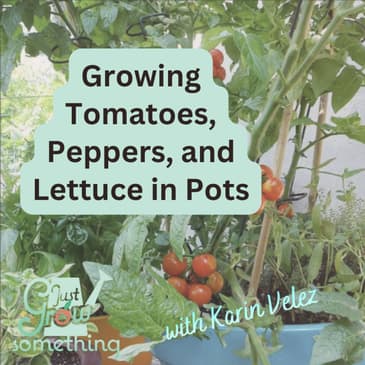
This week we’re digging into the three crops I get asked about the most often when it comes to growing in containers: tomatoes, peppers, and lettuce. And while, technically, you can grow most anything in the right sized pot, these three are the ones folks tend to try first, so we’re going to get specific on them. And yes, each one of them can be very productive in a container.
Welcome back to Just Grow Something, I’m Karin Velez, a horticulturist and market farmer who has grown in containers in some way, shape, or form for probably 18 of the 20-plus years I’ve been gardening. I have grown in 6-inch pots all the way up to 100-gallon grow bags – yes, I said 100-gallon and, in all fairness, that’s more like a raised planter bed than a pot – but I’ve been really successful in most instances with just a few failures along the way and I want to teach you how to avoid those mistakes with these popular crops. Let’s dig in.
University Extension References
Penn State Extension — Container Vegetable Gardening: Four Keys to Success: https://extension.psu.edu/container-vegetable-gardening-four-keys-to-success
Penn State Extension — Growing Vegetables and Flowers in Containers: https://extension.psu.edu/growing-vegetables-and-flowers-in-containers
Oregon State University Extension — Grow Your Own Peppers (EC 1227): https://extension.oregonstate.edu/catalog/ec-1227-grow-your-own-peppers
University of Missouri Extension — Container Gardens to Supply Your Salads: https://extension.missouri.edu/news/container-gardens-to-supply-your-salads
North Carolina A&T State University Cooperative Extension — Growing Fruiting Vegetables in Containers: Tomato, Pepper and Eggplant: https://www.ncat.edu/caes/cooperative-extension/covid-19/fruiting-vegetables.php
Resources:
Just Grow Something: https://justgrowsomething.com
Gardening Courses: https://justgrowsomething.com/courses
Just Grow Something Merch and Downloads: https://justgrowsomething.com/shop
Just Grow Something Gardening Friends Facebook Group: https://www.facebook.com/share/g/18YgHveF5P/
Check out how you can become a patron on Patreon: https://www.patreon.com/JustGrowSomething
Feed my coffee habit: https://buymeacoffee.com/justgrowsomething
Amazon storefront: https://www.amazon.com/shop/justgrowsomething
Get 10% off and FREE shipping on my favorite raised planters at Planter Box Direct using code JUSTGROW10: https://planterboxdirect.com/?ref=593
Hosted by Simplecast, an AdsWizz company. See pcm.adswizz.com for information about our collection and use of personal data for advertising.
[00:00:00] Last week on the show we talked about the basic considerations for growing in containers and that included how to evaluate whether a crop is a good candidate for growing in a pot. If you missed last week, go back and listen because there is a lot of essential information in that episode for what we're talking about today.
[00:00:16] This week we're digging into the three crops that I get asked about the most when it comes to growing in containers. Tomatoes, peppers, and lettuce. And while technically you can grow almost anything in the right sized pot, these three are the ones that folks tend to try first so we're going to get really specific on them this week.
[00:00:38] And yes, each one of them can be very productive in a container. Welcome back to Just Grow Something. I'm Karin Velez, a horticulturist and market farmer who has grown in containers in some way, shape, or form for probably 18 of the 20 plus years that I have been gardening. I've grown in six inch pots all the way up to 100 gallon grow bags. Yes, I said 100 gallon. And in all fairness, that's more like a raised planter bed than a pot.
[00:01:05] But I've been really successful in most instances with just a few failures along the way. And I want to teach you how to avoid those mistakes with these popular crops. Let's dig in.
[00:01:19] So I don't know what your spring weather is doing, but we had three tornado warnings over the span of 12 hours Sunday evening into Monday morning. We had almost five inches of rain in that time. So all the fields are flooded. We have rushing water where it shouldn't be. And it looks like we're getting more rain for Tuesday. I always say that I would much rather have too much rain than not enough and I'm sticking to that.
[00:01:48] But dang, Mother Nature needs to let us dry out for just a hot second before sending us more rain. My crops cannot take much more of this. You might even hear some rumbling in the background because I'm hearing thunder to the south of us as I record this. But I will say that with everything that I have seen, this is a really big testament to the good that can come when you are growing in containers.
[00:02:12] Not just smaller containers, but also raised planter boxes. You know, I walk out into the kitchen garden and into the area behind my greenhouse and over in the barn bed. And I've got all those planter box direct raised garden beds out there and they are all doing perfectly fine with all of this rain. They're draining the way they're supposed to. Everything that's in them is sheltered from the rushing water that we have seen coming through the yard areas.
[00:02:37] And so everything that's in those planters is doing really, really well at this point versus the things that are out in the garden beds, in the in-ground beds that are really, really struggling at this point. So just one more, you know, thumbs up for container gardening for sure. I hope your spring gardening has been a little bit less eventful than mine wherever you are.
[00:03:02] All right, crop deep dive number one, tomatoes. The most searched, the most loved, the most asked about container crop that there is. You can absolutely grow a great tomato in a container, but you have to get three things right. The variety, the pot size and consistent watering.
[00:03:25] So I'm going to point you straight to what Clemson extension, Michigan State extension, Cornell, Penn State, Oregon State, all the extensions they all agree on. For containers, determinate and compact varieties are easier to grow successfully than indeterminates. Now, it doesn't mean that you can't grow an indeterminate tomato in a very large pot.
[00:03:50] I would absolutely recommend you get the biggest one that you possibly can, and you are going to have to do some serious trellising and staking. I have experienced all of these myself, okay? So determinate tomatoes, these grow to a predetermined size, usually around three to four feet, and they produce most of their fruit in a very concentrated window of just a few weeks, and then they decline.
[00:04:16] That's kind of a downside, unless you are looking to want to can, and you can do some succession planting. They need minimal staking, and just a very simple cage will support them very, very well. So that's the easy part of those. But again, that downside is you're only going to get tomatoes for a certain amount of time, and then it's just going to be onesies and twosies from there on out.
[00:04:38] So if you want tomatoes all season long, and you want to choose a determinate variety, you might choose to start one and have it in a pot, and then about three to four weeks later, start a second one and have it in its own pot, and then do that again for a third round. And that way you do get some continuous harvest just by way of succession planting. The thing with the indeterminate tomatoes is that they vine continuously until that first frost takes them out,
[00:05:07] and they can get to be six or eight feet or even more. They do produce fruit continuously just in smaller batches, but they need serious, serious trellising and a much bigger pot. Again, you can absolutely do them this way. It's just going to take a little bit more in terms of management on your part and again, a bigger pot. The happy medium between these is an indeterminate short internode.
[00:05:37] You'll often see these described as compact, dwarf, patio, bush, container, whatever. These are my favorite version because you get the benefit of a continuous harvest like you get with an indeterminate, but you get the stature of a determinate plant. Okay? So container varieties that I have had really good luck with are bush early girl, bush goliath, better bush,
[00:06:01] and my absolute go-to for the past several years has been husky red in both the slicing and the cherry tomato versions. Plus there's also one called tidy treats, which is a very compact cherry tomato variety. And then we also have micro tomato varieties called micro tom, and those are for like really small containers or windowsills. But for most gardeners, you are looking at something that is a regular size slicer. So husky red is definitely my recommendation.
[00:06:30] And then tidy treats for those, for those cherry tomatoes. When we're talking about pot size, bigger is definitely better. So the minimum for a determinate or a container variety tomato should be five gallons. Can you get away with a two and a half to three gallon pot? Yes, but you are going to stunt the plant and you're also going to have a smaller harvest.
[00:06:55] So you can grow a compact determinate in a five gallon bucket and a lot of people do. It is going to dry out faster and you are going to need to be feeding it more frequently. So an ideal size would be 10 to 15 gallons. This is like an 18 inch diameter pot. Larger pots produce larger plants. Larger plants produce more fruit. It's just how it goes, okay? But if you are super, super limited on space, then yes, you can get away with growing something in a smaller pot.
[00:07:23] Just know you're going to have to feed it more frequently and you might not get as big of a yield. If you are planning on doing an indeterminate tomato, honestly, 15 gallons is probably the minimum and you would love to have 20 gallons if you can get it. They just really prefer to be able to spread those roots out as they continue to grow for the entire season.
[00:07:48] And also having that larger container gives you the ability to be able to put a larger stake or trellis in there. Now, if you have a smaller container like a 10 gallon one and you can put it up against like your balcony railing and then have a trellis that's attached to that, then you might be okay. I'm just saying for a large indeterminate tomato, they can have roots that extend like two feet or more in every direction.
[00:08:15] So, out in a regular garden bed or in a large raised planter, that's not much of a problem. But in a small pot, those roots run out of room and they start circling and then the plant dries out really fast and you have to water it multiple times a day. And the plant is going to suffer from a lack of nutrients because you've got that constant drenching going on, okay? So, a bigger and wider pot equals a better tomato.
[00:08:39] So, your practical setup for growing tomatoes in a container is one tomato per container and you want to plant them deep. Tomatoes are one of the few plants where you can bury all the way up to that top set of leaves. So, it does not matter the size of the plant that you are transplanting. You want to strip all of the lower leaves off until you get to that top set of leaves. And you want to plant it all the way down at that depth.
[00:09:08] They will grow additional roots all along the buried stem. So, this gives you a much stronger root system. And this isn't just for containers by the way. This is for your in-ground beds. This is for your raised planter boxes. Anytime you're planting a tomato, plant it as deep as you can get it. But this does matter even more in a container than it does in the ground. We really want that strong root system. And don't forget to install that cage or the stake at planting time.
[00:09:33] Make sure that you leave about an inch of space or so below the rim of the pot for some mulch. Yes, we are mulching the top of the soil. Straw, wood chips, shredded leaves, whatever you can use to reduce the evaporation. And then just like everything else in containers, we want to water deeply and consistently. Remember, less frequent, more thorough. This does not mean inconsistent, right? Because inconsistent watering is probably the number one cause of blossom end rot in tomatoes in general.
[00:10:03] And more specifically, in container tomatoes. So, just like everything else, make sure that you are soaking that plant. You're soaking the soil in that pot until the water runs out the bottom. And then you are checking, doing that finger test, putting your finger down into the soil. And if it's dry, down at the tip of your finger, then go ahead and water. But if it's not, then you can go ahead and wait. Feed the tomato plant about every two weeks.
[00:10:30] Preferably starting with a fish emulsion or something that's higher in that nitrogen. And then switch to something with a higher phosphorus and potassium once the flowering begins. Again, most tomato and vegetable fertilizers are formulated exactly like this. And then you want to make sure that you are putting your tomato plant someplace where it gets six to eight hours of direct sun. Again, it doesn't have to be all at once. If you get three hours of morning sun and then you move it and you can get like four or five hours in the afternoon with a break in the center.
[00:10:58] That's fine as long as you accumulate six to eight hours of direct sun. Just watch for this container to dry out faster as the plant gets bigger and then also as the weather heats up. So the bonus with this is if your container is sitting in a spot where eventually towards the middle of the summer, it's starting to get excruciatingly hot in the middle of the day, you can actually move it to a different spot. So where it gets the ideal level of light that you're looking for.
[00:11:25] So there are some, you know, advantages to being able to grow in containers. Okay, let's talk about growing peppers in containers. Both your sweet peppers and your hot peppers are probably one of my favorite crops for containers because they just fit really well. They have a couple of traits that make them genuinely very well suited to growing in containers. The first is that they have a very compact, mostly vertical growth habit.
[00:11:53] So unlike a sprawling tomato, a pepper plant stays reasonably tidy. They also love the heat. So the dark plastic pot sitting on that sunny patio that could stress out your tomatoes or your cucumbers. Peppers often respond to that extra warmth with just giving you more fruit. So that's a bonus. They also have a smaller root system than tomatoes. So they're perfectly happy in smaller pots.
[00:12:18] And because they're very cold sensitive, you can bring a container pepper indoors before, you know, your last or your first frost hits. So you can extend the season or in some cases you can overwinter the plant indoors to get a head start for the next year. Because the downside to most peppers in general, regardless of where you're growing them, is that they really need that heat and they need it for an extended period of time in order to be able to start producing.
[00:12:43] So if you're growing them in containers, you can get a little bit of an earlier start because you can bring them in and out to protect them from the cold weather. Versus trying to plant them out in a garden bed and get them an early start. And then all of a sudden, you know, the temperatures are dropping below 50 Fahrenheit at night for two weeks or so. And now your peppers are kind of stunted. So again, another advantage to being able to move those pots around.
[00:13:07] As far as most of your peppers are concerned, a five gallon container, so about 12 inches deep by 12 inches wide is ideal for one or two pepper plants. And the reason I say one or two or one to two is even though volume wise, one pepper would be happier by itself. Peppers are generally happier when they can hold hands.
[00:13:34] They ever so slightly touch their canopy together and that helps to shade the pepper fruits from sunscald. So if you have like two five gallon containers you can put side by side, each with one plant in it, then that works. Just leave the other sides of those containers away from obstruction so that you still get the airflow. This works well for bell peppers, for most chili peppers and for your standard sized sweet peppers.
[00:14:00] So the smaller peppers like your Thai chilies, bird's eye, shishitos, some of the cayennes, they can actually do well in the smaller three gallon containers because they stay so compact and they just produce a ton of very small fruits. But when you get into your larger longer season varieties, some of those super hot varieties or your really large, sweet peppers, your bell peppers that are grown for a very long growing season,
[00:14:26] they could benefit from a larger container if you have the space. And if you have somewhere that has or you grow somewhere that has extra long frost free season where these plants usually really truly thrive. So your minimum depth on those containers is probably needs to be about 12 inches. 14 to 16 inches for the larger varieties would actually be more ideal. In terms of varieties, just about any variety of pepper is going to work in a pot.
[00:14:55] I will say that hot peppers are a little bit more forgiving than bell peppers when you're learning to grow in containers. So if you're a beginner, these might be what you try first. But if you're not a huge fan of those hot peppers like me, I don't grow a ton of them for us. I mean, I do for sale at the market. But I mean, if we go through, you know, one or two jalapenos a month, then that's going to be a lot for us. We just, we don't do a lot with the spicy peppers.
[00:15:24] So I tend to grow a lot of the, again, small peppers, but the small snacker sized ones. So if you're not into the hot peppers, then maybe try one of those as your first pepper. In terms of container setup for your pepper plants, wait to transplant until the nighttime temperatures are consistently above 55 degrees Fahrenheit. Peppers absolutely sulk in cold soil. They may never fully recover if they get planted when it's too cool.
[00:15:50] So this is one where the crop, you know, one crop where your patience is going to pay off in the spring. However, like I said, if you need to get an early start because you have a short growing season or your growing season isn't very warm and you need that extra accumulation of those heat hours, then go ahead and start with them indoors. You know, let that soil be to the room temperature in your house when you transplant those peppers and slowly start to move them outside.
[00:16:18] If you can move them back and forth, making sure that they never are sitting outside when it drops below that 55, then you can get an early start. You do want to plant in a container, like I said, that's got at least 12 inches of depth. Fill it with a really good potting mix. Don't bury the stem on the pepper plants though. Unlike the tomatoes, peppers should be planted at about the same depth that they were in the nursery pot or whatever you started them in.
[00:16:42] For a lot of peppers, it is going to be beneficial for you to install a small cage or a stake at planting time. Even though they tend to be kind of bushy in their habit, pepper branches can get very brittle. And when they start to get really heavy with fruit, then oftentimes they can snap before the fruit is completely mature. So if you have a way to help support them, that's going to be helpful.
[00:17:08] But always make sure that you do that at the time that you plant the plant or you pot the plant, whatever. These again also want full sun. We always say six to eight hours as a minimum with peppers. I really lean more towards the eight or more side if you can get it. And just like your tomatoes, you know, watering consistently, maybe even more so with peppers. They like to stay pretty evenly moist but not soggy.
[00:17:35] So do not let them dry out totally in between waterings. Just like all of our other containers, we're likely going to want to feed these every two weeks with some sort of a liquid fertilizer. Again, because it's flowering fruiting, we want to switch it to higher phosphorus and potassium. Once the flowering begins, same principle as our tomatoes. Minimal pruning is needed with peppers. We're going to talk about this a little bit more next week if you've been considering topping your pepper plants.
[00:18:04] Hold off on that because we're going to do a whole episode on that next week. You can pinch off any flowers that form in the first two to three weeks after you transplant. And this is just to encourage the plant to put energy into roots and structure first. But after that, leave it alone. And we always want to harvest our peppers by cutting them off with scissors, not pulling on the plant. Because again, the stems are very fragile and you don't want to damage the plant.
[00:18:28] The bonus play on this is at the end of your season, before your first frost, bring that container pepper inside. Okay, put them in the sunniest window you have. Cut them back if you need to. And a lot of these peppers are going to go semi-dormant and then they will spring back to life the following season when it starts to warm up. You will have a major head start over starting from seed. So again, just one more reason why growing in containers can be very beneficial. And finally, let's talk about lettuce.
[00:18:57] Lettuce and a lot of other leafy greens are without question probably the easiest win in container gardening. If you are completely new, whether that's completely new to container gardening or gardening in general, and you want to grow one thing successfully this season to build your confidence, then let it be lettuce. Let it be lettuce. There's a joke in there somewhere. Lettuce is really fast growing. It's shallow rooted. It tolerates part shade.
[00:19:27] It tolerates a small container. And it's in the grocery store for like $6 for a clam shell. What a packet of lettuce seeds is like $3 and you can grow months and months and months of salad from that, right? So I'm sorry, lettuce is probably just a huge win for any gardener, but particularly for a beginning gardener. And it's perfect for in containers. So because it has a very shallow root system, you know, having a super deep pot is not required.
[00:19:53] You can get a one and a half to two gallon pot, something that's like four to six inches deep. That is perfectly fine for leaf lettuces. If you want head lettuces, like, you know, the round heads or the tall romaines, then you might want to do something like eight to ten inches deep if you can manage it. You can fit four lettuce plants or even spinach plants. I mean, that's just about as easy to grow as the lettuce is in a like 10 inch diameter container.
[00:20:21] And that is going to supply enough greens for two people to have like one decent sized salad per week. Okay. So plan the number of containers of greens that you want to grow around that. With lettuce and a lot of these other greens, width matters more than depth because it kind of wants to spread out a little bit. So a wider, shallower container.
[00:20:44] So even one of those rectangular window boxes or a shallow wooden planter, these actually often are going to work better for lettuce than some narrow but very deep pot. Again, benefits with containers, especially for something like lettuce, is that you can move it out of the sun. So lettuce is a cool season crop and it will bolt and turn very bitter when the temperatures consistently hit the 80s Fahrenheit.
[00:21:09] But in a container, you can literally just pick up the pot and move it into the afternoon shade when the summer heat arrives, which of course you obviously can't do with in ground lettuce. So that's going to extend your harvest to just a little bit. And the thing about the containers is you can grow your lettuce really close to the kitchen. You can have a shallow container of mixed lettuces right by the back door so you can go out and you can cut fresh greens right before you're serving dinner or for your lunch.
[00:21:35] And the flavor difference between garden lettuce and grocery store lettuce is that dramatic. Like it just containers make the level of convenience possible even when someone lives in an apartment and then you add in the flavor and the texture difference and it's just hands down one of my favorite things to do in a container.
[00:21:54] So in terms of varieties for containers, loose leaf and the kind of cut and come again varieties, these are the clear winners for containers because they allow you to harvest the outer leaves while the plant keeps producing from the center. So combinations like red leaf lettuce, butter crunch, throw in some arugula and some spinach into a single container and you have a mixed salad bowl that's right there. You harvest all of it at once and you've already got your salad mix.
[00:22:22] So some varieties that do really well in pots in terms of the lettuce are black seeded Simpson. This is kind of the classic. You've also got all the red and green oak leaf types. Butter crunch and the other butter head types tend to do well in containers. Salad bowl, there are red and green versions of this one that is also a really good one for containers. And basically anything that says it's cut and come again or that it's like a mesclin mix. These all do really well in containers.
[00:22:49] Lettuce, you want to use a shallow wide container around six inches deep and about as wide as you have space for. Direct sow those seeds about a quarter inch deep or you can go ahead and transplant small starts. We want to avoid transplanting plants that are too large because they tend to take a while to bounce back. And we want this kind of, you know, really quick turnover with lettuces.
[00:23:17] You can plant them pretty densely in these containers closer than you would in a garden bed because you're going to be harvesting those young leaves pretty often. So we're not too concerned about the airflow there. You want to position your pot to get the morning sun and then probably the afternoon shade, especially as the temperatures start to warm up. The great thing about lettuces is that you can do part shade. So four hours of sun is plenty.
[00:23:43] So if you are trying to garden on a patio that doesn't get a ton of full sun, lettuce is going to be a friend here up to six hours or so. More than six hours, then you might start to worry about the soil drying out too quickly. And that's important because you want to keep the soil consistently moist on lettuce. Lettuce is about 95% water and that dry soil can cause really bitter leaves.
[00:24:08] It also can cause those roots to heat up much more quickly, which causes the plant to bolt faster. So lettuce is one of those ones where we really do want to keep that soil consistently moist. We also want to harvest early and often. So cut those outer leaves off when they're about three to four inches long or so, and that plant is going to keep producing. The more you harvest it, the less likely it is to go to bolt. And then of course we like to do succession planting.
[00:24:34] So, you know, grab another container and sow another batch of lettuce about every two to three weeks or so from the early spring through the late spring. You might take a break during, you know, the hottest part of the summer and then start again in the late summer through the fall. If you really want to keep something going through the summertime and you can bring it into a sunny window in the house, then you can absolutely do that. Just know that the rate of growth is going to be a little bit slower unless you have a very, very bright window.
[00:25:04] When the plant eventually bolts, because it's going to, it's going to send up a flower stalk in the center or it's just going to turn really bitter. Just pull it out, compost that and start fresh. Okay, in the container you can even just drop new lettuce seeds right in where the old plant came out. Easy peasy. Lettuce is an absolute champion of spring and fall container gardening. If you've got a cool snap or even an early or late frost in the forecast,
[00:25:28] lettuce can easily be, you know, carried in or just kind of pushed up against a wall somewhere or covered with a sheet or whatever. Essentially zero effort to protect it from the cold. Okay, that's it. Easy peasy. Container grown tomatoes, peppers and lettuce. In the show notes, I am going to include links to university extension resources for container gardening of these specific crops and a few other ones.
[00:25:54] The great thing about containers is they can be moved to accommodate the weather. So whether your spring weather has been bringing constant tornado warnings like mine has, or if your summer weather means that your tomatoes need a good amount of shade in the afternoon, you can move your containers where it will be most beneficial for that plant, but also beneficial for the gardener. Until next time my gardening friends, keep on cultivating that dream garden and we'll talk again soon.