
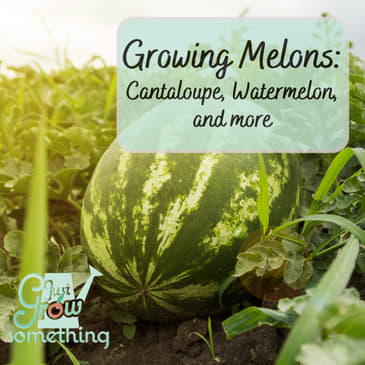
There are few things that taste like summer quite like cantaloupe or watermelon. These hydrating favorites can sometimes be a little mystifying for new gardeners to grow. And what's the difference between a crenshaw and a canary melon?
On today’s episode, we’re digging into all things melon. What does it take to grow them, can they cross-pollinate, and what’s the trick to picking a truly ripe watermelon? Let's Dig in!
Episode References and Citations:
Wasylikowa, Krystyna; van der Veen, Marijke (2004). "An archaeobotanical contribution to the history of watermelon, Citrullus lanatus (Thunb.) Matsum. & Nakai (syn. C. vulgaris Schrad.)". Vegetation History and Archaeobotany. 13 (4): 213–217. doi:10.1007/s00334-004-0039-6. ISSN 0939-6314. JSTOR 23419585. S2CID 129058509.
Paris, Harry S. (August 2015). "Origin and emergence of the sweet dessert watermelon, Citrullus lanatus". Annals of Botany. 116 (2): 133–148. doi:10.1093/aob/mcv077. PMC 4512189. PMID 26141130.
Strauss, Mark (21 August 2015). "The 5,000-Year Secret History of the Watermelon". National Geographic News.
"Cantaloupe". Oxford English Dictionary. 2016.
Marion Eugene Ensminger; Audrey H. Ensminger (1993). "Cantaloupe". Foods & Nutrition Encyclopedia (2nd Edition, Volume 1 ed.). CRC Press. pp. 329–331. ISBN 084938981X.
Watermelon | College of Agricultural Sciences (oregonstate.edu)
Explore Cornell - Home Gardening - Vegetable Growing Guides – Watermelon Growing Guide
Explore Cornell - Home Gardening - Vegetable Growing Guides – Melon Growing Guide
Episode Links:
Buy One Get One Free from Elm Dirt: Use Code WOLFCREEK
Check out how you can become a patron on Patreon
Positively Farming Media Podcast Playlist on Spotify
--- Send in a voice message: https://podcasters.spotify.com/pod/show/justgrowsomething/message
Karin Velez [00:00:39]:
There are Very few things that taste like summer are quite like a beautifully juicy cantaloupe or a perfectly ripe watermelon. I am cantaloupe obsessed. The instant they start ripening, I am eating half of 1 a day until the last one comes off the vine. I'm super picky, about my watermelons? And I will eat those nonstop when I've got a really good one. Canary melons are kind of a new obsession for me, and they are a close runner-up to my cantaloupe with Crenshaw melons not far behind? It is just something that I will eat all summer long. On today's episode of Just Grow Something, we're digging into all things melon. What does it take to grow them? Can they cross pollinate? And what's the trick to picking a truly ripe Watermelon? All that today and more, my gardening friends. Let's dig in.
Karin Velez [00:02:11]:
So the currently accepted protocol is to divide all melons into 2 categories, melons, Which includes cantaloupe and honeydew and crenshaw melons, etcetera, and watermelons. But since The growing of them is mostly the same in the home garden. I'm just gonna lump them both together today. Melons and watermelons all hail from the same plant family, the cucurbitaceae family or the gourd family. This family also includes pumpkin, squash, cucumbers, and zucchini. But within that family, There are different genus and species. So let's start by clarifying what I mean when I'm talking about a cantaloupe. Cucumis milo is the genus that all cantaloupe fall within. As a matter of fact, it's what all Melons fall within, but cucumbers milo variety, cantaloupeensis, is the true cantaloupe. And these are the things that are not commonly grown in the US? These are European cantaloupe.
Karin Velez [00:03:19]:
They have deeply grooved fruit with a hard Or like warty or scaly rind and orange or green flesh. Cucumus milo variety reticulatus Or what we call North American cantaloupe. These are those netted very aromatic melons that people will often refer to as muskmelons. That's what we call cantaloupe here in the US. Now calling them muskmelons is actually incorrect Because everything that is in cucumbersmilo is considered a muskmelon. That includes your cassabas and crenshaw's and honeydews, snake melon, those late maturing winter melons, Santa Claus melon, all those things, those are all cucumbers milo. They are all considered muskmelons. But For the purposes of this podcast, when I say cantaloupe, I'm referring to the North American cantaloupe, although all of these are actually grown In pretty much the same manner.
Karin Velez [00:04:17]:
Now in the same vein, watermelon is not cucumis mellow. Watermelon is citrulis linnatus. Again, also in the Curcobataceae family, but it also has, like, a 1,000 different varieties. The fruit of the watermelon is actually considered a berry. It's got that hard rind and has no internal divisions, so botanically, it's called a pepo. Now cordovan melons from Sudan are the Closest relatives to our modern cultivated watermelons. Wild watermelon seeds were found in a prehistoric site in Libya that dates to approximately 35100 BC, and then they were domesticated in northeast Africa and cultivated in Egypt by about 2000 BC, but those were not our sweet modern variety. Those did not develop until about Roman times when they started to spread across the Mediterranean.
Karin Velez [00:05:09]:
And there are actually 3 different cultivar groups of watermelon. So understand what we're talking about today, right now on the podcast are the sweet watermelons, which leads me right into the ethnobotany of melons in general. Ethnobotany is the study of a region's plants and their practical uses Through the traditional knowledge of a local culture and its people, watermelon and cantaloupe have been used by various cultures for their medicinal and culinary purposes. So watermelon were actually originally cultivated because of their high water content, and they were stored to be eaten during dry seasons, not just as a food source, but as a method of storing water? It's believed that watermelon has diuretic properties. So, some cultures, it's been used to support kidney health and help to alleviate urinary tract infections. It's been used as an anti inflammatory and antioxidant. It's claimed to have antidiabetic effects. It's just important to note here that the scientific evidence supporting these claims is Kind of limited, but it also hasn't been deeply studied either.
Karin Velez [00:06:16]:
And then as far as cantaloupe is concerned, some cultures have used cantaloupe as a topical treatment for skin conditions? It's believed to have moisturizing and rejuvenating properties so that they use it to promote healthy skin and reduce inflammation. It's also been used to alleviate symptoms of conditions like fever and cough and asthma because it's believed to have cooling and soothing effects on the respiratory system. Now 1 cup of diced watermelon provides 46 calories, 0.9 grams of protein, 11 and a half grams of carbs, and point Two grams of fat, where cantaloupe weighs in at 60 calories, 1 and a half grams of protein, 14.4 grams of carbs, and point 3 grams of fat. Both of them are very, very hydrating. Melons have a high water content, which makes them an excellent choice For maintaining hydration, I think it's perfect for staying hydrated in the summer while working in the garden. Melons are also rich in vitamin c and vitamin a? They have various antioxidants, lycopene and beta carotene specifically, Which, are supposed to help protect the body against cellular damage caused by free radicals. Lycopene in particular is more abundant in watermelon, and And that's why they associate oftentimes with heart health and cancer prevention. Melons are also a good source of several minerals including Acetium, magnesium, and copper.
Karin Velez [00:07:42]:
And melons provide a good amount of dietary fiber, so it helps in our digestion And it helps maintain healthy blood sugar levels. It is worth noting here that the nutrient content may vary slightly depending on the specific Type of melon we are growing as well. Speaking of growing them, how do we grow them? So watermelon and cantaloupe Both need full sun, and they say 6 to 8 hours, but I would definitely lean closer towards that 8 hours of direct sunlight every day. They also, just like most of our garden plants, prefer well draining soil that's rich in organic matter. So you wanna amend the soil with compost or some well rotted manure to improve fertility and its drainage, and just make sure that you have any weeds or grass pulled from the planting area because they are not gonna like that competition when they are first starting out. Eventually, as they grow, they will choke out anything that is underneath them. But in the beginning, they do not want the competition. And your soil pH Should be between 6.0 and 7.5 for optimal growth.
Karin Velez [00:08:49]:
Any lower than 5.8, and you will start to see some problems specifically in watermelon? So be sure that you're testing that soil pH. And when you're choosing varieties of melons, You're gonna wanna match the days to harvest with the length of your growing season. It is possible to grow melons in a shorter season, But keep in mind that you're gonna be planting these well after your last frost date, and you wanna make sure that you have time for that crop to ripen Well before the 1st frost in the fall. If you have a long enough season, you can get varieties with different maturity dates to spread out the harvest or you can stagger your plantings. But if you have a shorter season, you may be looking at those varieties that have the shorter days. Some of these are like your ice box mel icebox melons. These are the watermelons like, Sweet Beauties or Sugar Babies or even your more individual or personal sized cantaloupe like Sugar Cube or Minnesota Midget. Now if you're gonna start them indoors, this is optional.
Karin Velez [00:09:47]:
This is, a very good idea if you are in a region with a shorter growing season. You can start them indoors about 2 to 3 weeks before your anticipated planting date. Now notice I said planting date here and not your last frost date Because we definitely want that soil temperature to warm up, and we'll talk about that in a second. If you're starting them indoors, plant 1 or 2 seeds per container about an inch deep. Make sure that it's a container that is big enough to hold a pretty large plant. These seedlings grow very quickly, and you don't wanna have to pot them up Or cause them to be stunted because they outgrew their container. The less handling of that root system, the better. So plant it in a larger container than you think you need And just anticipate being able to plant directly from that container into the ground.
Karin Velez [00:10:31]:
Now in most areas that have longer growing seasons or warmer You can directly sow the seeds outdoors. That is what I do. Generally, wait until the soil temperature is consistently above 65 Fahrenheit or 18 Celsius, preferably 70 Fahrenheit for better plant health. I'm not usually in a rush to get them Unless I have a very large variety that needs loads of time to produce, usually like a a large 100 day watermelon, but we don't really grow those anymore. I generally get the 1st batch of melon seeds out around the time that the tomatoes are going in, and I may plant a 2nd fast maturing crop about a month or so later. You just wanna make sure that the soil is nice and warm. Plant your seeds about an inch deep. Space them about 2 to 3 feet apart in rows or in hills that are 5 to 6 feet apart? These are very, very viny plants, and they want to take up a lot of room.
Karin Velez [00:11:26]:
And the more room they have to sprawl, the better off they are. Now if you started your seeds indoors and you're gonna transplant those seedlings out after they have developed their 2nd set of true leaves, Make sure that you harden them off by gradually exposing them to those outdoor conditions over the course of a week or so before planting them in the garden, And then, again, put them out at that same spacing about 2 to 3 feet apart either in rows or in hills, and those rows and hills should be about 5 to 6 feet apart. Now I know I said these sprawl, but there are bush varieties that have more compact vines. Some of them are only about 3 feet long. So these are actually suitable for growing in containers? And if you have very little room where that you can't even afford to have those vines coming out over the containers, You can train them up a trellis. But for all but the smallest varieties, you're gonna wanna provide some support to the developing fruit? You can create fruit hammocks out of scrap material to support the weight So the fruit gets to full maturity without breaking from the vine prematurely. And this can actually be done in any garden, really, not just a container. Trellising is a great way to grow melons while saving space.
Karin Velez [00:12:36]:
If you're doing watermelon, again, I recommend icebox sized melons like Sweet Beauty or Sugar Baby that are easier to Port, then something like, say, a Crimson Sweet that can be 25 pounds or a Georgia rattlesnake that gets to be 2 foot long and weighs 30 pounds or more? Those are best grown on the ground. Now remember back to the beginning when I said watermelon and cantaloupe are in different genus even though they're in the same plant family? This is why it's perfectly fine to grow watermelon and cantaloupe together in the same area and still be able to save the seeds. 1 is cucumis, One is Satrelis. And you can grow other types of melons, cantaloupes, and honeydew, and cucumbers can all be grown close together without fear of Crossing? But remember, each of these items will cross within their own species. So if you wanted to save seeds from the fruit to plant next year? You need to separate the different varieties of watermelon or the different varieties of melons from each other. So when a cross does happen between 2 varieties within the same species, the resulting fruit that year is Completely normal looking and tasting. Only the resulting seed carries the cross gene. So if you save the seed And you planted it the following year, you might get something of a Franken melon.
Karin Velez [00:13:56]:
But the current year's fruit will be perfectly fine. And if you don't plan to save seeds, it might be a good idea to plant multiple varieties that all flower around the same time just for pollination's sake? Depending on the cultivar, cantaloupe and other muskmelon plants may bear separate male and female flowers on the same plant. This is called Menoceus or male and perfect flowers or complete flowers? Those are flowers that have both male and female organs in the same flower on the same plant? This is called being androminoecious. Watermelons bear separate male and female flowers on the same plant. They are also minotious. So young plants begin bearing male flowers first. Depending on the cultivar, either the perfect flowers or the female flowers Male flowers will begin appearing about 1 to 2 weeks after the start of the male flowers. Now melons are not pollinated by wind.
Karin Velez [00:14:59]:
And since melon Pollen is very heavy and very sticky. Even those varieties that have those perfect or complete flowers are going to need bees or other Pollinators for adequate pollination. The bees will transfer the pollen from the male flowers to the female flowers, or within those complete flowers, they will Transfer the pollen from the stamen within the perfect flower to get it down into the stigma, making fruit set possible. If you are in a particularly humid climate, this pollen gets even heavier and stickier and harder to move. So pollinators are necessary before melons, period? And this is where those different varieties come in. If you're not saving seeds, you just increase the production possibility by offering up more flowers for the bees to use to pollinate. Right after this, we'll talk about the different diseases and pests that can plague our cantaloupe and watermelon, how to know when to harvest the fruits, and how to store them properly.
Karin Velez [00:16:46]:
K. Let's talk about the pests that might want to Plague our cantaloupe or our watermelon. The most common pests are striped or spotted cucumber beetles, aphids, Squash vine borers, squash bugs, flea beetles, and sometimes spider mites. You want to regularly inspect your plants and take action as soon as you see Any of these going on. We've talked about the squash vine borer and the squash bugs before. These are a real problem here in west central Missouri in our zucchinis, and, yes, they can Actually, plague our watermelon and our cantaloupe plants as well. For cucumber beetles, you really do want to control them if possible because they can also lead into bacterial wilt, which is one of the diseases that we have to worry about? So some of the diseases that we get in cantaloupe and watermelon include powdery mildew and downy mildew, bacterial wilt. Again, this is spread by the cucumber beetles, fusarium wilt, fungal leaf spot, cucumber mosaic virus, and scab? A lot of these things can be prevented by making sure there is plenty of air circulation, so be sure that you are spacing your plants far enough apart, And you want to eliminate any weeds or that are around the plants in order to improve that air circulation. If you get bacterial wilt, you need to remove and Are any of the infested plants because they will continue to spread it to the other ones. This is the one that's in the soil, so you will need to plant in a different area the following year. If you do have Fusarium wilt in your soil? And you already know that there are tolerant varieties of certain of the, the melons. And then with the other ones, the fungal leaf spot and the The scab and that sort of thing, you want to avoid getting the foliage wet. And speaking of wet foliage, one more thing that's not really a disease, but it's a consideration And for growing, just like all of our garden plants, providing deep watering sessions to your melange is going to encourage that deep Root growth. So mulching around the plants is gonna conserve the moisture.
Karin Velez [00:18:50]:
It's gonna suppress the weed growth. But be aware with melons, Excess moisture can actually negatively affect the sweetness and the fruit quality of both the melons and the watermelons. This is particularly true late in the fruiting stage in when the melons can actually swell with water At a faster rate than they can produce sugar. So this is gonna result in a very bland, watery melon. So if you are in an area with particularly wet summers, growing up on those mounds or hills is gonna help with drainage to help prevent waterlogged soils and bland melons? So when it comes to harvesting, one very common problem, specifically in watermelons, Is harvesting too early? I see post after post every summer, and it is so sad to see gardeners Cut open what they thought was this beautifully, perfectly ripe melon that they've been babying on the vine for months only to have Have it be barely red in the center and nothing but white rind all the way around. Trust me. I did it myself for the 1st several years that I was trying to grow watermelon. Harvesting or knowing when to harvest watermelon takes practice.
Karin Velez [00:20:07]:
Okay? The harvest time is gonna vary depending on the variety. But generally speaking, You can expect to harvest a watermelon anywhere between 70 90 days after planting. Keep track of your seed packets so that you know when to start looking for the signs of ripeness? What are those signs? The rind of the watermelon should be dull. It should no longer be Shiny. Okay. So a dull rind color. The underside of the melon, if you're growing it on the ground, obviously, this isn't gonna work if you're growing it on a trellis. But if it's growing on the ground, there is going to be a dark yellow spot where it sat on the ground.
Karin Velez [00:20:45]:
You wanted a deep, dark, Almost orange yellow, not a pale yellow, not a white. Dark yellow. K? Then you're gonna look on the vine and find the tendril that is closest Chew your fruit. When it withers and dries, your watermelon should be pretty close to being ready. And then the final thing, I swear, it's true, tapping on the melon. It should sound hollow. And, honestly, when I Hold a ripe watermelon, and I hold 1 hand on the bottom, and I thump the top with my other hand. I should feel that vibration In the bottom hand all the way through.
Karin Velez [00:21:25]:
It should sound very deep and very hollow. I know this is kind of subjective, and you won't know until you actually do it What it is that you're supposed to be looking for? And it does take practice. I encourage people at the farmer's market when they're trying to figure Around, I'm like, here. Come here. Come listen to this. Come thump on this. Feel how this is. Look what this looks like.
Karin Velez [00:21:45]:
And and that helps gardeners figure out what their watermelon are supposed to look like in their from gardens when it's time to harvest them? Now cantaloupe are a little different. They are usually ready, you know, anywhere between 80 to a 100 days after planting, they should smell really sweet. You should be able to smell that cantaloupe? The rind color is going to change to, like, a beige or a yellow. The netting on, and we're talking about North American cantaloupe here. The netting is going to be very visible. It's gonna have a rough texture, and it will usually Slip very easily from the vine. You can just do a gentle twist, and it will come right off. The other thing too is the blossom end, right, of of the melon itself? Should be slightly soft.
Karin Velez [00:22:34]:
If you press your thumb in there, it should have a little bit of give. They should be firm, and that netting around them should be really well formed, but you should be able to give have just a little bit of give in that blossom end. This is called the full slip stage. This is the stage of ripeness at which the melon will come away easily from the stem attachment, And the skin begins to take on that slightly yellow appearance under the netting. There shouldn't be anything in in the green stage. Other melons, you know, you've got cassava, Crenshaw, honeydew, Santa Claus, canary. All of those, you Probably, you're gonna go ahead and have to refer to the packaging for what the melon should look like when it's ripe and then how to tell if it's ready. Most Seed packets will say so, or if you go on to, like, the seed manufacturer's website, they will talk about what they're supposed to look like.
Karin Velez [00:23:24]:
In general, Honeydew melons should be harvested when the stem end is slightly springy, and then that skin begins to take on sort of a creamy yellow appearance. The Crenshaw melons. Again, the blossom end should start to soften. The skin should be a golden yellow and greenish kind of tint. Cassava's, the skin is slightly golden. The flesh is gonna be white. Canary melons, they should be a bright deep canary yellow before they're harvested. So But just pay attention to what the variety is that you purchased and keep those seed packets that you have that information about what to look for when it's time to harvest.
Karin Velez [00:24:01]:
Now what about storage? This is the problem with melons. Watermelon specifically is not adapted to long storage? And it actually doesn't like really low temperatures. They don't like to be in the refrigerator if your refrigerator is below 45 degrees, which most of ours are. They can kind of get this chilling injury, and they, you know, don't don't eat quite as well. But then high temperatures are even worse. Leave it on the on the counter for too long, it's not gonna do very well either. It's gonna get mushy. So the general consensus is Between 50 60 Fahrenheit and a relative humidity of 90% is kind of a good compromise.
Karin Velez [00:24:45]:
And you can keep a Watermelon at that temperature range for about 2 weeks or so, maybe 3 weeks. You don't wanna be holding them at room temperature for very long because they're gonna affect The flavor. So, obviously, your refrigerator is colder than that 50 to 60 degrees. So if you're gonna hold it for longer than a few days, I would recommend trying to find a cooler spot in your house, whether it's a a a basement or a garage or someplace like that. Now we talk about cantaloupe. These, you definitely want to put into the refrigerator. Them sitting on the Counter much longer beyond when they have ripened is gonna cause them to become sort of mushy and overripe. They, again, don't love it super cold, but between 36 and 41 degrees Fahrenheit at 95% relative humidity is actually Just sort of the sweet spot.
Karin Velez [00:25:38]:
Anything lower than that and it's gonna be it's gonna start to cause a little bit of damage, but that's better than letting them sit out on the counter for too long? So we keep our refrigerator very, very cold. I just try to put it in sort of the warmest spot of a refrigerator, And they last just fine, but then again, I'm eating them so quickly that I wouldn't know, you know, for how long they they can hold. There there really should be okay for anywhere from 5 days to 2 weeks at that refrigerated temperature. Your honeydew, your Crenshaw, your Cassava melons, again, they don't like being held for too long below 40 degrees. Honeydew and Crenshaw are better at 45, cassava at 50. So if you meet really what the this all means Means is if you end up harvesting more melons than you can reasonably expect to eat over a couple of weeks, then you are likely going to need to cube them up and freeze them if you want to use them later, which I have done, and and with the exception of the watermelon, the majority of them all hold Pretty consistently well-being cubed and thrown into the freezer and then just being defrosted later to be used for whatever. Watermelon tends to lose a little bit of its texture, so that one I generally just don't freeze. But the other ones, all the other melons, I've had really good experience with Freezing when I have too much of it.
Karin Velez [00:27:04]:
K. So that's the basics So growing melon. Hopefully, this encourages you to be able to grow your own. I know they kinda seem like they are overwhelming because they will take over an Higher area. So look at maybe growing some of those compact varieties if you're concerned about the space that's needed, or look at possibly Trellising them up a trellis or over a cattle panel in some way. There really is nothing better tasting than a fresh Melon in the middle of the summer, especially when you are working in the heat. So I hope that you will all give it a try. Until next time, my gardening friends, keep on cultivating that dream garden, and we'll talk again soon.