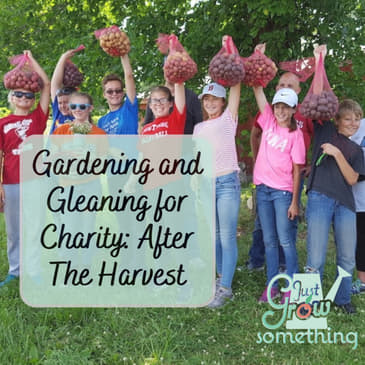
Last summer we talked a little bit about growing extra produce in our gardens specifically for donation. I will leave a link to that episode in this episode description. This week I have the pleasure of interviewing two folks from After The Harvest, an organization here in the Kansas City Metro area that rescues fruits and vegetables from going to waste and donates them to agencies that serve hungry people in the Greater Kansas City area. Their volunteers glean after the harvest, picking what’s left in farmers’ fields and picking up already harvested leftover produce. They bring together volunteers, growers, financial donors and food agencies all participating in fighting hunger, improving nutrition and reducing food waste.
Our farm has donated to After The Harvest for years at one of our local farmer’s markets and I was happy to reach out get them on this show to not only spread their mission here locally but to speak to you about how you can get involved in whatever organization facilitates the movement of fresh fruits in vegetables in your area to the people who need it the most.
So, take a listen to my conversation with Brooke and Clay from After The Harvest and maybe think about the ways you can be helping this movement in your own area with produce from your own garden. Let’s dig in.
RESOURCES:
After the Harvest | Healthy Food for Hungry People » After the Harvest (aftertheharvestkc.org)
Volunteer » After the Harvest Gleaning Calendar
Laws, Resources, & Organizations for Gleaning & Food Recovery - National Gleaning Project
Map of Gleaning & Food Recovery Organizations in the USA (nationalgleaningproject.org)
Get a Free Bloom Juice from Elm Dirt: Use Code JustGrow
Just Grow Something Gardening Friends Facebook Group
Check out how you can become a patron on Patreon
Merchandise | Just Grow Something Positively Farming MediaPodcast Playlist on Spotify
--- Send in a voice message: https://podcasters.spotify.com/pod/show/justgrowsomething/messageThis is positively farming media.
Karin Velez [00:00:04]:
Hello, my gardening friends, and welcome back to the Just Grow Something podcast. Last summer, we talked a little bit about growing extra produce in our gardens specifically for donation. I will leave a link to that episode in this episode's description. This week, I have the pleasure of interviewing two folks from After The Harvest, an organization here in the Kansas City metro area that rescues fruits and vegetables from going to waste and donates them to agencies that serve hungry people in the greater Kansas City area. Their volunteers glean After The Harvest, picking what's left in farmers fields and picking up already harvested leftover produce. They bring together volunteers, growers, financial donors, and food agencies, all participating in fighting hunger, improving nutrition, and reducing food waste. Now, our farm has donated to after the Harvest for years at one of our local farmers markets, and I was happy to reach out to get them on this show to not only spread their mission here locally, but to speak to you about how you can get involved in whatever organization facilitates the movement of fresh fruits and vegetables in your area to the people who need it the most. So take a listen to my conversation with Brooke and Clay from After The Harvest and maybe think about the ways you can be helping this movement in your own area with produce from your own garden. Let's dig in.
Karin Velez [00:01:29]:
Hey.
Karin Velez [00:01:30]:
I'm Karen, and I started gardening 18 years ago in a small corner of my suburban backyard. When we moved to a five acre homestead, I expanded that garden to half an acre, and I found such joy and purpose in feeding my family and friends. This newfound love for digging in the dirt and providing for others prompted my husband and I to grow our small homestead into a 40 acre market farm. When I went back to school to get my degree in horticulture, I discovered there is so much power in food, and I want to share everything I've learned with as many people as possible. On this podcast, we explore crop information, soil health, pests and diseases, plant nutrition, our own nutrition, and so much more in the world of food and gardening. So grab your garden journal and a cup of coffee and get ready to just grow something.
Karin Velez [00:02:14]:
Brooke and Clay with after the harvest. Thank you so much for being on this episode of the Just Grow Something podcast. Let's start with Brooke. Brooke, what is your role at After The Harvest, and how did you come to be involved with the organization?
Brooke [00:02:30]:
Yeah, thank you so much for having us. I know. Yeah, we were trying to schedule this for a while. The end of our season last year got really crazy, so I appreciate you having us, and we're excited to be here. So I am the volunteer and community engagement Coordinator with After The Harvest, so basically what that means is I am working with all of our volunteers and then our handful of community partners. So right now we work with two local elementary schools through their Caring for Kids program. And so basically we just work with their staff and are basically just there as a resource for them to help with anything that they need, like events or getting produce to their families and things like that. But most of the time I'm working with volunteers and trying to fill our shifts and stuff because we have a lot of volunteer opportunities may through November. And so I'm just working to try and get as many people as we can to help because we basically run on volunteer work.
Karin Velez [00:03:46]:
I can imagine that is a very busy position to be in, trying to manage all of those volunteers.
Brooke [00:03:52]:
Yeah, and I started with after the harvest. It was literally, I think, a year ago, is when I started interviewing Clay, and then I started in April of last year, so right before our really busy season started. But I have a background in environmental science and then have a master's in sustainable communities, and basically my research was looking at food insecurity and how we can make our food system more just and stuff like that. And so this is kind of after the Harvest is like, right up my alley and right in my interests, but I was actually working in a corporate job a year ago, how it happens. And I actually wasn't really actively looking, but my husband knew that I wasn't really fulfilled in my work and it kind of happened after I had my son. I was just like, oh, this corporate job is just not really very fun. And he just did like a really quick search on a whim one day and was like, hey, here's this job. Maybe you should just apply and see what happens. And really crazy that it ended up happening.
Karin Velez [00:05:09]:
Oh, my gosh, I love that.
Brooke [00:05:11]:
Yeah, so it's a pretty cool story and started in April and then we had a crazy busy season, had some new events that we did last summer that were really busy and really fun. And Clay and I are like each other's sidekicks for May through November. Basically.
Karin Velez [00:05:33]:
Work, spouses. I get it. Yeah, absolutely. Fun fact, Brooke. Actually, I was a dual major in sustainability when I was going for my Horticulture degree.
Brooke [00:05:41]:
That is so cool.
Karin Velez [00:05:42]:
Yeah. I ended up dropping it because I really wanted to graduate and they weren't going to let me do that until I finished all the sustainability stuff. So I was like, okay, maybe I'll go back to it, and I haven't gotten back to it, but my heart's not still there.
Brooke [00:05:55]:
Yeah, that's so cool.
Karin Velez [00:05:57]:
Clay, what about you? What is your role at after the Harvest and how did you get involved with the organization?
Clay [00:06:02]:
Yeah. So my name is Clay Jarrett. I am the Gleaning Network Manager of after the harvest, and that is basically the program manager. So I manage all of our programs. I work with Brooke, with the volunteers, as well as working with all of the farms and distributors that we work with. I have recently started taking over the truckloads program, and we can talk more about that where we bring in truckloads from across the country of B grade produce and then also our local Gleaning program, which is what Brooke and I really work together on. And throughout the season, we need thousands of volunteer hours and work with different farms to go and get excess produce from the farm or from the farmers market and also from some local distributors. So I got involved in after the harvest. Actually there was a previous organization doing a similar work in the Kansas City area. It was a nationwide organization, but our previous executive director, Lisa Ousley, was working there at the time. So I think back in about 2009, I was at the Eat Local and Organic Expo and someone like Brooke was at a table and saying, hey, we need volunteers. Do you have a truck? Would you like to pick up produce? Do you have weekends free? And like, yeah, I'll sign up for this. And got a phone call a few weeks later and said, hey, there's a farmer that's that's close to your house that has some eggplant and zucchini and would you mind picking that up and taking that to a local food pantry?
Brooke [00:07:34]:
Sure.
Clay [00:07:34]:
I'm not doing anything right now. So I went and did that and I was immediately hooked. So for several years, I was a regular volunteer and became part of the veg squad, which I'm sure we'll talk more about, and just really enjoyed it. And then back in 2020, my job situation changed. I'd been working in the corporate world and was not doing that anymore, not really feeling fulfilled, but really enjoyed the volunteer hours and saw that there was a positioning field coordinators. They're out in the field with the volunteers, and so I'll do that and started out doing some driving and some coordinating of different meanings. And now I look at 2023, I'm the full time program manager and really loving it.
Karin Velez [00:08:20]:
I love how many people have decided that the corporate world is just not for them and that they get to move into doing things that they were either previously like volunteering for or just something that they were really passionate or interested in and get to make it like their full time thing. I love that. I just love hearing stories like that. So we will dive into a little bit more about the volunteer opportunities and the Gleaning and all that kinds of stuff. Fun fact, as Lisa was starting to kind of move into this organization, I was starting as a market vendor, and I think our first year was 2008, and I think it was probably 2010 when we started to have volunteers coming out to pick up from us at the farmers market. And it's just kind of continued ever since. So that's pretty much how I learned about after the Harvest and some of the other organizations talk a little bit about and this is for either one of you, the reason behind why this organization and other organizations like it exist, the food insecurities that we're facing. And I mean, Brooke, you talked about working with a kids program, too. What is happening with the produce that you guys are getting and who is it going to and why?
Clay [00:09:38]:
I can take that. There's a huge food waste problem in this country. So there's a lot of food that never makes it to people's plate. We waste a lot on our plate. But even before that food is graded out in the farm field, the farmer looks at the produce and decides this is probably not sellable. And they just leave that on the vine. Sometimes it makes it to a packing house or some other sorting, and then it's again sorted there. If it gets to the grocery store shelf, it sits there too long. It's not the prettiest. It's going to get sorted out there. So all throughout the food chain, there's food waste. And we are trying to stop that food waste as soon as possible within the food chain. So just to try and prevent that food from going to waste and get it to people who need it. So we work with Harvesters, the local food bank, as well as over 100 individual agencies throughout Kansas City. And those may be shelters, could be abuse shelters, homeless shelters. They could be kitchens that are feeding people. It could be food pantries. And a lot of people think, oh, this is just going to homeless people, or something like that. And that's one of the places that it goes. But it goes to families who maybe just don't know where their next meal is coming from. The parents are working, but they still can't make ends meet. But we work with all different agencies. We don't actually distribute the food to the individuals, but we distribute to all different agencies all throughout Kansas City that distribute to people.
Karin Velez [00:11:15]:
And I mean, Brooke, what is the caring for kids program?
Brooke [00:11:18]:
So that is a program that is through the Kansas City Public School District. So most of their schools have this, and it's basically a way that most of the school counselors are the ones who run the programs for each individual school. And it's basically a way to get the community involved in the schools to help them in any way that the school is needing. So at the beginning of each school year, the school administrators and counselors get together and make a list of goals of what they want to see in their schools for the year. And that could be anything. And so then with that list of goals, they then go to their community partners like us. And then there's various different other organizations that also help with the Caring for Kids programs at different schools that help them meet those goals. For a lot of them, it's like, oh, we want to boost teacher morale. How can we do that? So next week one of our schools is having a teacher appreciation, so we're going to make little fruit baskets for the teachers and just different things like that. Or they want more parent involvement. And so we also did another school had organized like a breakfast for parents to come and sit with their students and just get together. And so we donated some produce for that breakfast. So just kind of sitting by and listening to the school see what they need and be like, oh, I think we can help with this, or I think we can do that. And one thing that we also do with our schools, one of our schools is do like a produce distribution day. So in the fall we did that at one of our schools and we distributed like £3000 to families directly.
Clay [00:13:20]:
Wow. Most of these that Brooks mentioned, they're in areas where the majority of the population is below the poverty level. So these are schools that they may be in a food desert or they're in an area where the families can't necessarily afford food, or all the students are mainly on like a reduced lunch or free lunch type program. So trying to supplement some of what they are able to take home with fresh fruits and vegetables or be able to just give them an option, a healthier option.
Karin Velez [00:13:54]:
Yeah. That's fantastic. I love that. I can imagine that the logistics of trying to get food because essentially what you guys do is you organize volunteer like Gleaning teams to go out to individual farms to take produce that has been left in the field that is still obviously usable and bringing it back. You also visit area farmers markets to collect anything that's been graded out or that's left over at the end of the day and take it to where it can be used. And then you also organize truckloads of stuff being brought in from other larger organizations to distribute here in the Kansas City area. The logistics alone behind trying to organize all of those different facets of all this produce being moved around has got to be just insane. Talk to me a little bit about how you coordinate all of these different components and then finally turn around and get it back out to the different organizations that need it as quickly as it takes because obviously we're talking about perishable foods here. So what is like a typical, I don't know, routine as far as, like, let's start with the Gleaning portion of it. When you get a volunteer group that goes out to Glean in a farmer's field, how does that process start and where does it end up.
Clay [00:15:17]:
Yeah, so a lot of it's really about relationships. And throughout the years we've had the fortune of making some really good relationships with a lot of people, with our farmers, with our volunteers, with the different agencies. And we post our volunteer calendar in the spring, early in the spring before the season really starts. And we can pretty confidently say that we will have gleanings available for volunteer groups to sign up on Tuesdays, Thursday, Thursdays and Saturdays all throughout the season from basically May until November. So we don't necessarily know exactly where we'll be gleaning at that time because we have some things that we know in the fall, we're most likely going to have the opportunity to be at an orchard. If you're signing up in September, we will probably be at an orchard and we can guess that or have a little more predictability. But all throughout the summer we have all different farms that we work with. And a lot of times this is on a moment's notice. Someone will call and say, hey, there's going to be a frost tomorrow, I really need to get everything out. And so we have to gather volunteers that's a little bit different type of situation, unless that happens to fall the night before a Tuesday, Thursday or Saturday. But on those Tuesday, Thursdays and Saturdays, we have a lot of different farms that we go to regularly. Some of them are planting specifically for us to come and harvest. They'll plant a few extra rows and we can go out and harvest that extra or they've already gone through. We know they're going to go to market on Wednesday, so then on Thursday we can come and clear out what was left after they've harvested on before the Wednesday market. So we have those different types of relationships. And then when volunteers sign up, we just let them know they'll be somewhere within basically an hour of the Kansas City area. And sometimes in the heat of the summer, we like to start pretty early in the morning just to make sure that produce lasts longer because it's being picked when it's not too hot. And also our volunteers are not out there overheating. So it's an early morning on the farm, but if a group reaches out and says, hey, I want to sign up, we can sign up on specific dates and schedule things, but really those Tuesdays, Thursdays and Saturdays and kind of sticking to a schedule. As long as our volunteers understand, hey, we may not know exactly where we're going to be. We will be working on a farm near the Kansas City area and be.
Karin Velez [00:17:53]:
Prepared to get dirty and sweaty. So you will take a group of volunteers out and they will either glean what is left or they will pick the rows that farmer has specifically planted and then how is that getting transported from the farm? Where does it go? And then where does it go from there.
Clay [00:18:13]:
We definitely rely on our volunteers to help with that as well. So once we know who the volunteers are and when they sign up, there's an option. Would you be willing to deliver produce after your shift is over? And so if they say yes, then we ask, what part of town are you headed to? And then we can try to make it as convenient as possible for them to say, okay, they're headed back towards the downtown area. Let's make some phone calls to some downtown agencies and see if they could use these tomatoes that we're picking today. And so we'll coordinate all of that and then basically they'll be handed a piece of paper with the directions and the receipt information and can pass that off to the agency where they're delivering the food.
Karin Velez [00:18:59]:
So it is quite literally going from the field directly to whomever it's going to go to. There is no holding. There is no storing or transferring. It's like, hey, get it out of the field and into the hands of the organization.
Clay [00:19:11]:
Yeah, it's farm fresh produce. We want to make sure it gets to you as quick as possible. Sometimes this is not the prettiest produce, sometimes it's fine, sometimes it's perfectly good produce, but sometimes it has a spot or it's a little wrinkly or something like that. You want to eat it within the next day or two. So we try to get it out as quick as possible because the longer it's going to be stored or set aside, the less shelf life that that has. So just want to make sure that people are getting the freshest, best produce available.
Karin Velez [00:19:40]:
Yeah, for sure. I knew as far as like the pickups at the farmers market, it wasn't until this year that I actually knew that it was being picked up from us and then going directly to the food bank or whoever it was they were working with. Our volunteer that shows up, I was talking to him about it. He goes, oh, yeah, I'm going over to the church and dropping it off. Or I'm going over here. And I was like, oh, you go right from here over. Because we're donating things like peaches and things that are definitely perishable, and you don't want that sitting around. And I didn't realize the same thing was happening as it was coming out of the field. That's fantastic.
Clay [00:20:14]:
Yeah. So we store very little food. Currently we have a refrigerated truck, but we don't have a regular refrigerated storage that we use. So we try to get everything out within the same day that it's picked up. And our volunteers really like that too. Not only are they seeing how it's grown in the field, but they're getting it to the person or to the place that is serving the people as well. So you're seeing the full cycle of that food all the way from the farm to the agency that's feeding people. So it's nice to be able to see it picked and then see the results of your work out in the field and like, oh, there are people that need this and that. It's really getting used right away.
Karin Velez [00:21:00]:
Yeah. That's fantastic. Now, I understand you also fundraise to bring semi truckloads of donated produce here. How is that being like, how are you coming across these truckloads of produce that end up showing up in the Kansas City area?
Clay [00:21:18]:
So we have some relationships with various distributors that work with different farmers. So we have a relationship that we've had for many years with a potato grower and all of their B grade potatoes, or potatoes that are too big or too lumpy or things are graded out for so many reasons. But we're able to bring in basically £40,000 at a time of potatoes. So we bring those in all throughout potato season, which we tend to bring in the most potatoes kind of through the winter months, especially when we're not out there gleaning. But we have some other relationships that are able to bring in tropical fruit and anything else that may be not grown around here. We also work with some local growers to secure semi truckload size loads of locally grown food as well. We work with some Amish and Mennonite farmers in the Rich Hill area. And so all throughout the local growing season here, those growers are selling that fresh local produce to grocery stores and different produce auctions here in the area. But zucchinis, for example, have to be a very specific size if they're in the grocery store, the shelf is made to fit a certain size zucchini. And I know as a grower, probably a lot of people listening know that zucchinis can get out of control very quickly.
Karin Velez [00:23:00]:
Baseball bat size. Yes.
Clay [00:23:05]:
So we're able to get some of those types of items donated for basically pennies on the pound and bring those in to be distributed as well.
Karin Velez [00:23:19]:
It's time to get moving on the gardening season, and the folks at Elm.
Karin Velez [00:23:22]:
Dirt have us covered.
Karin Velez [00:23:23]:
From potting mix to worm castings, their.
Karin Velez [00:23:25]:
Fantastic plant juice and Bloom Juice, even.
Karin Velez [00:23:28]:
Their new kelp mist foliar spray.
Karin Velez [00:23:30]:
They've got what we gardeners need for starting and growing plants of all kinds.
Karin Velez [00:23:34]:
They've even got gift bundles for the beginning gardener or the plant lover in your life. Listeners of this podcast get a free.
Karin Velez [00:23:39]:
Bottle of Bloom Juice with any purchase from Elm Dirt.
Karin Velez [00:23:42]:
So head to justgrowsomethingpodcast.com Dirt and use.
Karin Velez [00:23:47]:
Code justgrow at checkout for your free bottle.
Karin Velez [00:23:50]:
The link is in the show notes.
Karin Velez [00:23:55]:
Yeah, that's a lot of food moving through the system. Is there like a minimum amount that you guys require as far as either somebody going out to glean or is there a way that people can get smaller amounts to the organization for distribution?
Clay [00:24:16]:
Yeah, so if we're going to head out to a farm and pick up normally we would say at least £50 so that a volunteer is worth of the gas and time for a volunteer to travel and pick it up. But honestly, if someone called us and said, hey, I have these 20 extra tomatoes, I don't know where to take them. We have relationships with enough pantries that we could say, well, if you don't mind running over here to Shawnee, or we'll find a place where that's close to them, we can make some phone calls or refer them to a local pantry that might be able to take that.
Karin Velez [00:24:54]:
See, now I love this because I talk a lot to gardeners about being able to grow something extra. Not everybody is a farmer. They don't have huge areas where they can grow a bunch of extra rows that's going to produce that extra 50 to £100. But there are a lot of gardeners who want to get involved by just planting a couple of extra rows in their own garden that they would be able to then donate. Not everybody has a relationship with their food bank around the corner. Like for me, I know where to go right here in our own town. I know where to go one town over, and I can donate directly if I want to. But not everybody knows that. So how can home gardeners get involved with donating produce from their own home gardens to organizations like yours? Maybe not necessarily after the harvest. I mean, we've got listeners all over, but just like their own local organizations.
Clay [00:25:49]:
Definitely make a phone call or stop in at local organizations that are near you. If you're in the Kansas City area or nearby, definitely feel free to give us a call and we can help connect you with some of those agencies. We kind of have a schedule in our system to know that on Tuesdays this place serves, and on Saturdays this place serves. And so we can depending on the day of the week, one place might make more sense than another. Or depending on what you have, there are communities that appreciate that or need that more. Just thinking of some of the spicy peppers, some of the agencies will say, oh, our clients just don't use those. But other agencies, oh, my gosh, thank you so much. We love these. And so we have an idea through the database that we keep of some of those items that are more in demand or the hours of the different places, but definitely just reach out to those local pantries. There are churches, there are homeless shelters, there are battered women shelters, kitchens, feeding people so many different ways to get that out to people who need it.
Karin Velez [00:26:59]:
What other volunteer opportunities are there for folks to kind of jump in with after the harvest and see where they can help out? We talked about gleaning and then maybe possibly going and picking up and delivering from farmers markets. What else do we have here.
Brooke [00:27:15]:
Yeah, so those are the two main ones that we have basically multiple times a week, May through November. And then we also for people who maybe don't want to get their hands dirty or lift a bunch of produce, but I'm sure the people who listen to this are more up that alley. But we also have what's called our Yambassadors, and those are a group of people who basically are tabling at community events and getting the word out about what we do, recruiting volunteers and also helping with those community partners in any way that they can. So yeah, those are the three main things that those three main opportunities that we have pretty regularly. And then we also have a couple of special events every year that also require a day of kind of help. But gleaning and doing the produce rescue driving are the two things. And the produce rescue driving is at farmers markets. That's like the weekly regular thing that's scheduled. But we also have like last minute pickups at farms themselves throughout the season. It's like, oh, this farmer harvested a bunch of tomatoes and they're not going to be able to sell all of them. They want to donate some. So we have volunteers go last minute and go pick up and deliver from farms themselves as well. And then we also for those last minute gleanings, those ones that maybe don't fall on a Tuesday, Thursday or Saturday, but need are very time sensitive. We have what's called our veg squad, which those are the people who have signed up to be like our last minute response team to go out to fields and glean for us when we just really need people to go like right then.
Karin Velez [00:29:10]:
I was going to ask about that. I was wondering if there was any time when you had a situation where, hey, you got this phone call, we've got this field that needs to be gleaned and it needs to be done now. And you didn't end up with enough volunteers on the schedule. What do you do in that instance? So you have people that are kind of on standby then to be able to take care of that.
Clay [00:29:29]:
Yeah, that's a vegetable emergency. Our veg squad actually stands for Vegetable emergency Gleaners. And I'll let Brooke talk more about that. But the vegetable emergency is definitely I love this.
Karin Velez [00:29:46]:
Tell me more.
Brooke [00:29:47]:
Yeah, so those are the people who sign up and they're on our little we have like a WhatsApp group. And anytime there's any last minute gleaning or last minute farm pickup, usually we just send a message out like, hey, we need someone over here at this farm. And then yeah, we are usually able to find someone, but it's usually only like one or two people. And it's not always a lot of produce when it's last minute like that. Sometimes it is, but we're usually able to scramble and get it figured. Out. But yeah, the veg squad, those are the ones that really kind of carry us through the season, I would say. And even if they aren't only doing the last minute things, they are usually the ones that are leaning with us probably on a weekly basis, if not like every other week. And basically what we say that qualifies someone for a veg squad is if they've volunteered with us more than three times, which is pretty easy to do when we have three opportunities a week. So yeah, I think we have like around 40 or so of those volunteers that are really committed to helping us.
Clay [00:31:06]:
A large portion of those are retired people. So one who has a flexible schedule or just wants to volunteer more, it gives you those opportunities to just kind of get alerts when things are available and like, hey, I'm not doing anything today. I think I could go run over to this farm in Overland Park and pick up and drop off some produce so it's maybe an hour or two at a time or who wants to go pick corn today? So just really all kinds of various opportunities, but a lot of times those pop up at the last minute or we don't have enough volunteers signed up that day and we could just use an extra one or two people who wants to jump in.
Karin Velez [00:31:55]:
I've seen that firsthand with the farmers market because there's one guy who is very consistent about showing up when it's his turn to volunteer, but obviously he's not going to be there every single weekend. And I have noticed that if it's not him, it is very hit or miss as to whether or not somebody shows up to pick up from all the different vendors. At the end of the day, I know where to donate directly and so I will talk to the other farmers and say, hey, if they don't show up, you can drop it off at my booth and I will take it where I can if I have the time to be able to coordinate that with them. But we often don't know whether or not they're going to show up or not until the very end of the day. And so again, when you're trying to operate with strictly like a volunteer force, it's not like you can hold people's hands or feet to the fire and say, hey, no, you said you were going to be here, you need to be here. So just the challenges. I can only imagine the scrambling that you guys sometimes have to do with just the sheer volume of stuff that you are managing.
Clay [00:32:57]:
Yeah, we have a lot of really great volunteers, but there are always times when everybody else is already doing something or they're on vacation that week or whatever it is. Unfortunately, there are still vegetable emergencies and still vegetables that are falling through the crack. So the more volunteers that we have that are interested in this kind of thing. And the farmers market. We have a lot of volunteers that really enjoy doing that. But it takes a commitment to say, yeah, I'm going to once a month or every Saturday afternoon, I like to go to the farmers market. But then instead of just going to the farmers market and shopping for myself, I'm going to also go to the farmers market and pick up these donations and drop them off on my way home. So it adds an experience to your farmers market trip, but it takes some dedication to be willing to do that.
Karin Velez [00:33:48]:
And it's work, especially depending on the size of the market and the number of vendors that you have to stop with and how much they've got to donate that day and number of trips back and forth to your vehicle, depending on where you have to park. And some of this there's times when I've donated £40 at a time, and if you have ten vendors who are doing that, then that's a lot of stuff to be moving. So, yeah, it's not just like anybody can go and do this. There is some work involved and we greatly appreciate the fact that there are people out there who are willing to do that work.
Brooke [00:34:18]:
Yeah, absolutely. And yeah, the finding the consistent I think Clay was here during the pandemic and so he knows that there was like an influx of volunteers during that time. But then I think last year as things started to get back to normal, people were scheduling more vacations and stuff like that and we're just back to doing their regular summer things. And so, yeah, it was a challenge to fill Gleanings, and it was a challenge to fill those farmers market shifts last season. So, yeah, that list of veg quad were the ones that were really pulling through for us. Yeah, if you don't have someone who's coming on a regular schedule, it's hard to kind of find those people last minute that are like, oh, yeah, I'll take my Saturday afternoon to come. So, yeah, it's something that we're always working on and trying to fill those as early as we can.
Clay [00:35:22]:
Last year, that was 15 different markets per week. So that's a lot of people that are needed to cover 15 markets a week. And most of those are on Saturdays.
Karin Velez [00:35:34]:
A few on Sundays, yeah, that's a lot of coordination. So I know that one of your major events is your Sweet Corn Glenathon. Tell me a little bit about that.
Clay [00:35:44]:
Yeah, so we work with the Agricultural Hall of Fame in Kansas City and Water Springs and also with multiple local farmers. And the Sweet Corn Glenathon and Sweet Corn Festival. Are big events happening mainly in July? And we have corporate groups that sponsor this event and those corporate teams and also any families or church groups or anyone else that wants to come out. You can come out and compete and pick corn. And I don't know what our goal will be this year, but we wanted to get 50,000 ears of corn last year and we beat that goal. We have sponsors that sponsor to pay for the seed for that to be planted and then farmers that plant that seed intend to those fields and then we have those groups come out and who can pick the most corn today and other different challenges to be able to really just make it a fun kind of a team building or just a fun environment to go out and help feed people. That last year was our first year. Of having that event and we really enjoyed doing it, and we're going to bring that back as an annual event and then along with that at the AG Hall of Fame in Bonner Springs, which for those people who are interested in farming and growing, it's a great day trip to go see the Farm Museum and check it out as well. But they open up their grounds to us and we have a sweet corn festival with crafts and games and activities, music, corn, lots of food, lots of corn. It's a lot of fun. And that will be in late July at the AG Hall of Fame. That information is also on our website.
Brooke [00:37:28]:
And not just corporate groups can have a team with us. We had some church groups also do teams to go glean, too.
Karin Velez [00:37:39]:
Anything that you can make into a competition, I mean, come on. And I picked corn in July, so it's definitely a competition. It's not something that's easy. I think that's super fun and a great way to get people involved. So I'm good to hear. I'm glad to hear you guys are going to do that again this year.
Clay [00:37:55]:
Yeah, it was really fun. People strategizing, how are we going to do this? So they would send out people to go and pick and other people were running the bags or some of the teams were having somebody hold the bag while somebody else fills the bag. So everybody had their own strategies to see how we can do this faster and more efficiently and harvest the most corn. So it was really a lot of fun, competitive environment.
Karin Velez [00:38:21]:
That's great. Well, I will definitely when you guys have that event this year, again, continue to push your posts out there and let people know about it because that was a fun time last year. I love it.
Clay [00:38:32]:
Thank you.
Karin Velez [00:38:32]:
So if somebody is not able to donate produce and isn't able to really volunteer when it comes to gleaning or picking up or delivering, are there other ways that they can contribute to after the harvest to kind of help further your mission?
Brooke [00:38:47]:
Yeah. So that group of ambassadors who helps us at different community events, like we're going to be at the Eat Local.
Clay [00:38:57]:
Expo, that was actually how I started working with after the harvest and signed up as a volunteer there.
Brooke [00:39:03]:
Yeah, so we're going to be there and then we're doing like an Earth Day event. So we try and go to different things out in the community to spread the word and recruit volunteers and use existing volunteers to help do that. And then also the ambassadors can help us with our community partners, those elementary schools, just any way that they can.
Karin Velez [00:39:28]:
What about fundraising efforts?
Clay [00:39:30]:
Yeah, there's definitely fundraising always to donate. If you can't volunteer in person or donate produce, your donations help get that produce from the field and to people who need it. So all of these things that we do cost money. We do use volunteers for a lot of our efforts, but we still have a building and fuel and paying for truckloads of produce to come from across the country, so any financial support is also welcome. And all of these things, the volunteer opportunities and opportunities to donate are on our website@aftertharvestkc.org.
Karin Velez [00:40:14]:
That was what I was just about to ask you, is where everybody can find that information. So that was perfect timing. Brooke and Clay, I really appreciate you guys coming on today and talking a little bit about your organization. And hopefully this will kind of spur some of the gardeners that listen to this show to grow some extra or maybe even just volunteer, whether it's with you guys or depending on where they are, their local organization. So thank you again for being here. I really appreciate it.
Brooke [00:40:40]:
Yeah, thank you so much for having us.
Karin Velez [00:40:45]:
I can't stress enough how important it is for us to not only keep food waste out of the landfills, but to get that perfectly good produce into the hands of those that may be relying on boxed, processed foods to feed their families. So if you are here in the Casey Metro area and interested in either donating produce to after the Harvest or joining them as a volunteer, I have all the links you need in the show notes, including a link to the gleaning calendar and info about the amazing Sweet Corn Gleathon and festival happening in July. I have also left a link in the episode description to the National Gleaning Project, which showcases a map of the US highlighting gleaning and food recovery organizations nationwide. If you're not aware of one in your area and you live in the US, this is a great place to start. And if you're outside the US, I'm sure there is an organization within your local area that is serving people in need that would love to have a volunteer or someone donating fresh produce. Please do not hesitate to reach out to a local food bank or pantry and find out what they need. I've seen firsthand how excited folks get when they go in to receive assistance and have the options for fresh fruits and vegetables for their family instead of boxed or canned goods and we all know the nutritional value is much higher. Until next time, my gardening friends. Keep on cultivating that dream garden and maybe making some donations and we'll talk again soon.
Karin Velez [00:42:30]:
You just finished another episode of the Just Grow Something podcast. For more information about today's topic, go to Justgrowsomethingpodcast.com where you can find all the episodes, show notes, articles, courses, newsletter, sign up, and more. I'd also love for you to head to Facebook and join our gardening community in the Just Grow Something Gardening Friends Facebook group. Until next time, my gardening friends. Keep learning and keep growing.