
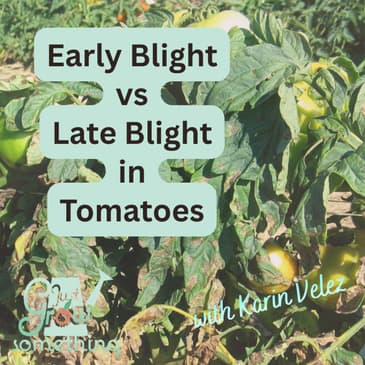
Every June, one of the most common questions that floods gardening groups, emails, and extension offices is some version of: “My tomato leaves are turning brown — do I have blight?” The confusion is completely understandable, because there are two diseases that get lumped under that word — and they are caused by completely different organisms, show up in different ways, and require completely different responses. Treating late blight like early blight — or vice versa — can mean the difference between saving your plants and losing your entire harvest.
In this episode, horticulturist and market farmer Karin Velez breaks both diseases down in plain language: what they look like, where they show up on the plant, what conditions favor them, how fast they move, what happens if you ignore them, and exactly what to do when you find either one. Whether you’re seeing spots on your lowest leaves or a whole section of your garden that looks like it got hit by frost overnight, this episode will help you figure out what you’re looking at — and what to do next.
Let’s dig in.
References and Resources
Captain Jack’s Copper Fungicide - https://amzn.to/43DKqAn
Penn State Extension — Tomato Diseases and Disorders in the Home Garden:
https://extension.psu.edu/tomato-diseases-and-disorders-in-the-home-garden
Penn State Extension — Scouting and Identifying Tomato Diseases:
https://extension.psu.edu/scouting-and-identifying-tomato-diseases
Penn State Extension — Tomato-Potato Late Blight in the Home Garden:
https://extension.psu.edu/tomato-potato-late-blight-in-the-home-garden
University of Georgia Extension — Common Tomato Diseases in Georgia (Bulletin B1285):
UGA Extension, Madison County — Tomato Troubles:
https://site.extension.uga.edu/madison/2021/08/tomato-troubles/
University of Minnesota Extension — Late Blight of Tomato and Potato:
https://extension.umn.edu/disease-management/late-blight
Michigan State University Extension — Organic Management of Early Blight on Tomato (Hausbeck Lab):
https://www.canr.msu.edu/hausbeck/Uploads/PDF/FS_Organic-Management-of-Early-Blight-on-Tomato.pdf
UC ANR / UC IPM — Late Blight of Tomato (Phytophthora infestans):
https://ipm.ucanr.edu/agriculture/tomato/late-blight/
Pacific Northwest Pest Management Handbooks — Tomato Late Blight:
https://pnwhandbooks.org/plantdisease/host-disease/tomato-solanum-lycopersicum-late-blight
Cornell University — Disease-Resistant Vegetable Varieties (late blight resistance):
Midwest Vegetable Production Guide — current fungicide recommendations for late blight (referenced by Penn State and UMN Extension): https://mwveguide.org/
USAblight.org — national real-time late blight tracking and outbreak alerts (when it’s working?): http://usablight.org/
Quick-Reference: Early Blight vs. Late Blight at a Glance
Pathogen type | Early Blight: true fungus (Alternaria solani) | Late Blight: water mold / oomycete (Phytophthora infestans)
Ideal temperature | Early Blight: 68–77°F (warm) | Late Blight: 60–78°F (cool to mild)
Where it starts | Early Blight: oldest/lowest leaves first | Late Blight: anywhere on the plant, no pattern
Lesion appearance | Early Blight: dark bullseye with concentric rings, yellow halo | Late Blight: large irregular dark oily blotch, gray-green edge, no rings
Underside of leaf | Early Blight: dark spores in lesion center | Late Blight: white downy/powdery growth at lesion margins in humidity
Speed | Early Blight: slow and progressive, weeks to months | Late Blight: explosive, can kill plant in ~14 days
Fruit symptoms | Early Blight: sunken dark spot at stem attachment | Late Blight: firm dark brown spot starting at fruit shoulders
Overwinters as | Early Blight: debris/soil/seeds in warm climates | Late Blight: infected potato tubers, volunteer plants
Fungicide type | Early Blight: copper, sulfur, standard fungicides | Late Blight: oomycete-specific only — NOT standard fungicides
Response urgency | Early Blight: act promptly, manageable with cultural controls | Late Blight: emergency response, remove immediately, notify extension and neighbors
Just Grow Something: https://justgrowsomething.com
Gardening Courses: https://justgrowsomething.com/courses
Just Grow Something Merch and Downloads: https://justgrowsomething.com/shop
Just Grow Something Gardening Friends Facebook Group: https://www.facebook.com/share/g/18YgHveF5P/
Check out how you can become a patron on Patreon: https://www.patreon.com/JustGrowSomething
Feed my coffee habit: https://buymeacoffee.com/justgrowsomething
Amazon storefront: https://www.amazon.com/shop/justgrowsomething
Hosted by Simplecast, an AdsWizz company. See pcm.adswizz.com for information about our collection and use of personal data for advertising.
[00:00:00] Have you ever walked out into your tomatoes and seen some yellowing of the leaves and some spots all over those leaves and then immediately run to do a Google search? What did you search for? If you're like most gardeners, you typed something like brown spots on tomato leaves or maybe just tomato blight because that's what someone told you it was. And then the internet sent you down a rabbit hole and you came out the other side even more confused than when you started. Maybe you read about early blight and then you clicked on something about late blight and then you clicked on something about late blight and then you clicked on something about late blight and then you clicked on something about late blight.
[00:00:30] And then you weren't sure which one you had or even what the difference really was. I get it. The naming is genuinely confusing. Early blight, late blight. And the internet is full of conflicting information, especially when we don't know exactly what it is that we're searching for. What we need to understand is that these are two completely different diseases caused by two completely different organisms and the way that you respond to one is not the same way you respond to the other.
[00:00:59] If you mix them up and you treat the wrong one, you could lose your whole harvest. And I don't want that for your tomatoes. I don't want that for you. Welcome back to Just Grow Something. I'm Karin Velez, horticulturist, market farmer, and someone who deals with diseases in her tomato plants every single year, pretty much without fail.
[00:01:18] And this week we are doing a deep, plain language dive into two very misunderstood diseases in the home vegetable garden. Early blight and late blight, specifically on tomatoes.
[00:01:30] By the time we're done, you're going to know exactly what each one looks like, what conditions make each one spread, what happens to your plant if you leave either of them unchecked, how to prevent both of them from showing up in the first place, and probably most importantly, how to respond correctly when you find one of them in your garden.
[00:01:50] We're going to spend some real time on identification because that is the whole ballgame here. If you can tell them apart confidently just by looking, you are so far ahead of the game. Let's begin. So before I start describing symptoms, I want to spend a couple of minutes on why it matters that we're having this conversation at all.
[00:02:15] Early blight and late blight are not just different names for the same disease at different points in the season, which is what I initially thought that was. They are caused by completely different organisms. Early blight is caused by a true fungus. This is Alternaria solani. And that word soleni is important because it lets you know that this is a fungus of solanaceae plants.
[00:02:42] So not only can it affect your tomatoes, but it can also jump to your potatoes and then your peppers and then your eggplant. Late blight is caused by something called Phytophthora infestans. And here is your real first piece of science for today. Phytophthora infestans is not a true fungus at all. It's what's called a water mold or in scientific terms, an umyscete, which where early blight is a deuteromycete.
[00:03:11] So Phytophthora infestans behaves kind of like a fungus, but it's biologically in a completely different group of organisms. And despite my science-y terms, that distinction matters because conventional antifungal treatments, the kind that you would use to fight early blight, do not work on late blight.
[00:03:34] So if you're out there spraying copper spray on a late blight infection thinking that you're going to stop it, you might slow it down a little, but you are not treating it correctly. Late blight requires umyscete-specific products. We'll get there, I promise. The other thing that matters here is speed. Early blight is a slow, progressive disease. It creeps up your plants over weeks or even months. You have time to manage it.
[00:04:03] Late blight, on the other hand, can kill a mature tomato plant in as little as two weeks. It can spread through entire fields and your neighbor's gardens in a matter of days. And this goes back to the type of organisms that we're dealing with. Deuteromycetes, like early blight, reproduce only one way, where umyscetes, like late blight, can reproduce in multiple ways. These are not equivalent situations.
[00:04:31] They do not get equivalent responses. Both of these disease are genuinely preventable. And, of course, prevention is always the best place to put your energy. So we're going to talk about what works before the disease arrives and then what to do if it does. Because 9 out of 10 seasons, we get early blight here. And it only took me one year of losing a large portion of my tomato crop to get it figured out how to battle it. Which is why we're going to start with early blight.
[00:05:01] Because it's the one that most of you have probably already encountered in your garden, whether you knew what to call it or not. Early blight is very widespread. We are talking, it's present essentially everywhere tomatoes are grown in the entire world. The fungus survives in infected plant debris in the soil, on seeds, and on volunteer tomato plants.
[00:05:28] Spores spread to healthy plants in the spring through wind and through splashing rain. The fungus needs a wet leaf surface to germinate and grow. Which is why those mornings when your tomatoes are dripping with dew are the exact conditions that it's looking for. The temperature sweet spot for early blight is around 68 to 77 degrees Fahrenheit. Combined with long periods of high relative humidity. So warm and wet.
[00:05:58] Basically our typical Missouri late springs. So I want you to be able to walk out to your garden and know what you are looking at. So let's start at the leaves. The very first thing to understand about early blight is where it starts. And that is the oldest leaves. The lowest leaves closest to the ground. The most mature foliage. That location alone is diagnostic.
[00:06:22] If your new growth looks fine and your problem is concentrated in the lower portion of your plant, that is early blight's calling card. So what do these spots look like? They start as small, dark brown spots. They're not huge or dramatic at first. You might just think it's just a little blemish on the leaves. But as they enlarge, they develop a very distinct pattern.
[00:06:46] You're looking for concentric rings inside the lesion like a bullseye or a topographical map or the rings inside a tree stump when you cut it open. That is the signature of early blight. And a lot of you right now are having this aha moment because you can picture what this looks like in your head if you have seen it on the leaves or even on the fruit. And these spots very often have a yellow halo surrounding them.
[00:07:14] It's a pale yellow ring around the outside of the dark lesion. And then as the spots expand, the tissue between them might also start to turn yellow. And eventually the whole leaflet just collapse and it drops from the plant. So as the disease progresses, it moves up the plant. It starts at the bottom. The lowest leaves turn brown and fall off. And then the infection just gradually works its way up toward the top. Now, fruit production can continue even while this is happening.
[00:07:44] But if the conditions stay favorable and you don't intervene, the disease eventually removes enough leaf mass that the plant can't support a good harvest. So by late summer, you might be looking at a plant with very bare stems and just a few little green leaves clinging to the very top. That is what early blight looks like if it's left unchecked. But it can also show up on the stems and the fruit, although the leaf infection is typically the most severe.
[00:08:12] But on stems, you're going to see lesions that start small and dark and kind of slightly sunken in. And then they're going to enlarge. And you are going to see them develop those same bullseye sort of rings. And on the fruit, you're looking for dark, leathery, sunken spots, usually at or near the point where the stem attaches to the fruit. And again, you can look for those rings. Infected fruit are likely just going to drop from the plant before they're fully ripe. Now, I want to make a quick detour here
[00:08:42] because early blight gets confused with another very common disease called septoria leaf spot. And I want to give you a fast way to tell them apart because they both show up on the lower leaves and both of them are common in like June and July. The key difference is size and pattern. So septoria leaf spot lesions are smaller. They're more circular. They have a distinct like grayish or even tan center with dark borders.
[00:09:12] And if you look closely with a magnifying glass, and I know not everybody is out there in their garden with a magnifying glass, but I am that kind of a plant nerd. You will see tiny little black dots in the center. Those are the fungal fruiting bodies. So early blight lesions are larger. They're more irregular in shape. They have that unmistakable bullseye ring pattern. Septoria also does not typically affect the fruit, but early blight can.
[00:09:41] And unfortunately, because they both favor warm, humid, wet conditions, especially when the leaves remain wet for like extended periods of time, we can see a problem in my area where early blight leads right into septoria. Now we're not going to do a deep dive on septoria today. That's like its own episode. But I wanted to make sure that you can rule it out when you're standing in your garden trying to figure out what you're looking at.
[00:10:15] So the good news is that early blight is not a let's panic and rip out your plant situation, but it also is not a let's look the other way situation either. The consequences of just letting it go unchecked are gradual, but they are going to lead to a significant reduction in your harvest. So as that fungus progresses up the plant and you lose that leaf mass,
[00:10:43] the plant loses its ability to photosynthesize. And that's what supports the fruit development. So your yield is going to drop. Your fruit quality is going to drop. I'm not going to bore you with the research literature. I will link to it in the show notes, of course. But home gardeners usually don't see total crop failure from early blight by itself. But you can absolutely go from a strong, productive harvest to a very genuinely disappointing one if you ignore this when you see it. Okay.
[00:11:13] So prevention is always easier than treatment every single time. Right. And crop rotation is your first move. The fungus overwinters in soil and plant debris. So growing tomatoes in the same spot year after year is a recipe for escalating that disease pressure. So where possible, we want to rotate away from tomatoes, potatoes, eggplant, and peppers
[00:11:38] for three or more years to reduce the pathogen populations in the soil. Now I know that is hard in a small garden, but even rotating every two years helps more than not rotating at all. And remember, I have said before that I am not a stickler in terms of rotating your plants unless you have seen a problem. So if you have seen any of what I have described, that is a problem. That is an indication that you need to rotate your garden. Okay.
[00:12:09] Your second prevention tool is mulch. Did you say mulch? If you said mulch, I'm so proud of you. Mulch, mulch, mulch. Okay. I'm going to make a t-shirt. I swear. One of the primary ways that early blight spores get onto your lower leaves is through soil splash. Rain or irrigation water hitting that bare ground and flinging those fungal spores upward onto the leaves.
[00:12:35] So a good two to three inches of mulch under your tomatoes creates a physical barrier that dramatically reduces that soil splash. This is one of the most impactful things you can do. And it also helps with moisture retention and weed suppression. So triple win. Okay. Water management is also huge in irrigated gardens. Okay. So we want to water at the base of the plant, not overhead. Drip irrigation is ideal if you can swing it.
[00:13:05] If you're using overhead irrigation or a sprinkler, then you want to water in the morning so that leaves have time to dry during the day, the fungus needs a wet leaf surface to germinate and get established. Dry leaves are inhospitable leaves. So keep your plants as dry as you can. And obviously if it's raining constantly and it's super muggy, there's not a whole lot you can do without it. Okay. I'm not going to expect that you're out there patting the leaves dry of your tomato plants,
[00:13:32] but anything that you are doing, we're trying to prevent getting those leaves wet. Another prevention is air circulation, especially if you live in a really humid area like I do. So you definitely want to stake or cage your plants to keep them up off the ground and then space them appropriately so that there is airflow in between the plants. Good air movement helps the leaves dry faster and that reduces the humid little micro environment that that early blight loves.
[00:14:02] So when I trellis my indeterminate tomatoes, I also prune the lower 12 inches of foliage off the plant once it is nicely established. And this is genuinely one of the most effective early blight prevention moves that I make every season on top of using mulch. Okay. It gets the foliage up off the ground and away from that soil splash entirely.
[00:14:26] So this is still effective even when I'm behind on getting my mulch in place. This is probably one of the biggest lessons that I learned the very first year that I ended up with early blight and didn't really know what it was. I, you know, make no bones about the fact that I don't heavily prune my tomato plants in most instances. But this is the pruning that I now do every single season. It's just those bottom 12 inches. Everything else, as far as I'm concerned, is, you know, voluntary.
[00:14:56] And then the final step is just to start clean. So use healthy transplants. And as much as this hurts, remove those volunteer tomato plants from last year's garden. They can carry the pathogen from one season to the next. I know this hurts because sometimes those little volunteers are so productive. But if you're battling fungal diseases, it really is better just to pull those guys out. Okay.
[00:15:25] So let's say that you're out there scouting and you see those bull's eye spots on your lower leaves. What do you do? The first thing is don't panic. Okay. Early blight is manageable. You have time. Remove the infected leaves. Okay. Prune those leaves off the bottom 12 inches, you know, above the ground at the very first sign of early blight. You can actually safely remove up to about a third of the plant's total leaf mass without
[00:15:54] doing significant harm to the plant. You just don't want to remove more than that all at once. Put those leaves that you prune off in a bag and dispose of them in the trash, not the compost. As much as I hate any green waste going to the landfill, the fungus will survive in your compost pile and you will just be reintroducing it to the garden the next season. You also want to disinfect your pruning tools between plants.
[00:16:23] And I know this sounds like a royal pain. Okay. Which is why the skip, you know, is kind of easy to skip, but it really does matter. So just have a little bucket in the garden with you with a solution of one part bleach to nine parts water. Okay. Swish your pruner around in the bucket before moving on to the next plant. It is really just that easy. We're just trying to get rid of any of the spores that might transfer from one plant to the next.
[00:16:50] And then copper-based fungicides and sulfur products can also be part of an integrated management approach. See, all these IPM strategies the past few episodes, they really do help. You know, the copper-based fungicides especially, but also sulfur, you know, these can kind of help with the management, but the results are going to be kind of mixed depending on the timing and the particular conditions in your garden.
[00:17:20] You just have to remember that these are protective. They are not curative. So meaning they help prevent the fungus from establishing on the healthy tissue, but they do not reverse the damage that has already occurred. So we need to apply these before the disease pressure is high or at the very first signs of infection and then reapply it according to the label directions, especially after rain.
[00:17:47] This is the problem that I have faced the last two, maybe three seasons here because we have had particularly rainy seasons. And so trying to prevent the disease from latching on is difficult because you're out there spraying your copper and then all of a sudden we're getting a heavy rain and it's just running it right off. So there is some timing and that's why I say, you know, the results can be mixed based on the timing and the conditions. Okay.
[00:18:16] If you're growing organically, copper and sulfur are your primary chemical tools. I have it on my calendar every year to spray my copper spray before the infections hit. As a matter of fact, it's on my calendar for next week and I will reapply it according to the label because why that's right boys and girls, because the label is the law until the threat of the infection has passed.
[00:18:43] And generally that's by like mid July because around here, mother nature cranks up the thermostat around that point and then turns off the faucet. So the conditions are no longer right for the fungus to thrive. I'll link to the one that I use in the show notes. And if you find yourself battling this problem year after year after year, and your yield continues to be reduced, even with trying all these other methods, then you might consider some resistant varieties.
[00:19:09] So, you know, defiant, Juliet, mountain magic, these have all shown resistance to early blight in university research trials. All right. Now we get to the one that in my opinion, every tomato gardener genuinely needs to understand because the stakes are higher. The speed at which it spreads is alarming and the response is completely different.
[00:19:39] Late blight. This is the disease that caused the Irish potato famine. This pathogen appeared in epidemic and catastrophic proportions throughout Europe and North America from 1844 to 1847. And it was directly responsible for the famine that killed more than a million people in Ireland and drove a million more to emigrate. I'm not telling you this to be dramatic.
[00:20:08] I want you to understand what this organism is capable of doing when conditions are right. And it's why we treat it with such urgency. So late blight is caused by Phytophthora infestans, right? As I mentioned earlier, this is not a true fungus. It is a water mold or an uumicet. The most common roots of introduction each season are infected potato seed tubers,
[00:20:36] infected tomato transplants that have been shipped in from other regions, and windblown spores from infected fields that travel and then they circulate locally, right? So in northern climates, it can overwinter in potato cull piles. So these are piles of diseased or discarded potatoes that are left on the properties. Volunteer potato plants growing from last year's tubers can be a source of late blight in a new season.
[00:21:04] So the conditions it thrives in are cool to mild temperatures. So 53 to 64 degrees Fahrenheit for one type of reproduction combined with sustained high humidity above 90%. So when those conditions persist together, infection can occur in as little as 10 hours.
[00:21:27] This is why late blight often shows up after stretches of cool, rainy, or foggy weather. This is also what makes it so different in character from early blight. So late blight is a cool weather disease, while early blight thrives in those warmer conditions. But late blight lesions can peak their growth rate at slightly warmer temperatures of like 68 to 75 Fahrenheit. So cool start, warm finish, basically.
[00:21:58] Another problem with late blight is that infected stems can harbor the pathogen even during dry weather. So when cool, wet conditions come back, those infected stems can start producing spores again, and the disease just picks right back up again. Late blight doesn't just stop and go away when the weather dries out like early blight does.
[00:22:23] So because late blight looks different from early blight in several very important ways, if you can hold these differences in your head, you will be able to distinguish them in your garden really confidently. The first is, where does it show up? Anywhere on the plant. This is one of the biggest distinguishing features. Early blight always starts at the bottom on those oldest leaves. Late blight doesn't care. It has no preference for starting at the bottom.
[00:22:50] It can appear on any part of the plant, including the top growth and all the new leaves. Okay, so if you are seeing significant browning on young upper growth, that is a serious red flag for late blight. The leaf symptoms of late blight first start as small, water-soaked areas that very quickly get bigger to form these large, dark brown blight. They look oily or greasy.
[00:23:19] Sometimes they're described as being purple-brown, if you can kind of picture that color. These lesions are not confined by the leaf veins. They spread across the leaf in these really large, irregular patches. There are no concentric rings. There is no bullseye, okay? Just large, spreading, oily-looking, dark areas that have irregular edges to them. Now, flip the leaf over. This step is critical.
[00:23:47] Always look at the underside of the leaf when you are scouting for late blight. In high humidity conditions, you're going to see a ring or a fringe of grayish-white, powdery, or downy growth around the margins of those dark blotches on the underside of the leaf. That white growth on the underside surrounding the dark lesions on top is one of the clearest diagnostic signs of late blight.
[00:24:15] Early blight does not produce that white downy growth. Now, as late blight progresses, the entire leaves die. The infections spread really rapidly into the petioles and into the young stems, and then large sections of the plant will just go brown. Late blight can develop on all plant parts and kill tomatoes in as quickly as 14 days.
[00:24:40] So, under cool, wet conditions, entire fields of tomatoes or potatoes can turn brown and wilted seemingly overnight like they were just hit by a frost. Now, for the stems and the fruit, the stem infections are going to look like firm, dark brown lesions with a rounded edge. They're firm to the touch. They are not mushy. So, if it's firm, this is a distinguishing quality.
[00:25:08] On the fruit, the late blight typically starts at the shoulders of the fruit because the spores fall from the infected leaves above, and they land on the top of the first fruit. So, the infected fruit will turn brown, but it's likely going to remain firm unless it gets invaded by secondary decay bacteria.
[00:25:32] So, you might see a large, firm, dark brown spot starting at or near the stem end of the fruit and growing to cover a significant portion of it. And then, as secondary bacteria move in, then it can become mushy. So, both green and ripe tomatoes can be infected by late blight. So, what happens if you leave late blight?
[00:26:01] With early blight, we talked about a slow decline and a reduced yield. With late blight, we are talking about a completely different category of outcome. If conditions are right and late blight gets established in your garden and you do not respond immediately, the realistic outcome is a total crop failure. So, I mean, we're not talking reduced yield. Early blight, absolutely. You can continue throughout your season and you can continue to get some fruit off of those plants.
[00:26:30] They might be onesies and twosies here and there. With late blight, we are talking a total loss in as little as two weeks. And what makes late blight genuinely different from almost every other garden disease is it's not just your problem. Late blight produces enormous quantities of airborne spores that can travel on the wind and infect neighboring gardens and farms.
[00:26:57] This is a community-level disease, which is why it's so serious. In fact, the University of Minnesota Extension specifically recommends that you contact your local Extension office if you even suspect that you have late blight because your neighboring crops are at risk. I cannot stress this enough. If you identify late blight in your garden, your neighbors with tomatoes and potatoes need to know. I know that conversation might feel awkward.
[00:27:27] Have it anyway, okay? And keep in mind, it's likely not your fault, and I'm using air bunnies here, that this happened. It had to come from somewhere. So keeping the information to yourself because you're embarrassed that it's in your yard is only going to make the situation worse for everyone. And your neighbors might not even know what to look for in their own garden. So do what I do. Teach them. So what about prevention of late blight, right?
[00:27:53] A lot of the same cultural practices that reduce the early blight risk also apply to late blight. But with late blight, there are some additional very specific considerations. So you definitely want to destroy any potato cull piles before the growing season, okay? If you have any piles of discarded potatoes on your property from last season or from storage, like say you had your potatoes stored,
[00:28:19] maybe they started to get soft and you tossed them out, those are potential overwintering sites for late blight. So bury them or incorporate them into the soil or put them in the trash. Do not leave them sitting above ground. You also want to control volunteer potatoes and tomatoes anywhere on your property, okay? These can harbor the pathogen from the previous season. The best control is to cut up infected potatoes, spread them on the surface so that they freeze over the winter,
[00:28:48] or if you're doing this in the spring, dispose of them in the trash. Volunteer potatoes and tomatoes should be removed as soon as they appear in spring, no matter how hard it hurts your heart, okay? You also want to inspect transplants before you plant them. When you are buying tomato transplants from a nursery, look closely at the stems and the leaves before those plants go into your garden.
[00:29:14] Tomato transplants that are shipped from like southern regions up to northern regions actually may already be infected with late blight, and that is how it enters a lot of the northern gardens every season. So if you see dark lesions on the stems or the leaves of transplants, leave them at the store. And if it's a reputable nursery, notify someone so they can take care of it. Now, I don't know if the clerk at Walmart is going to do anything, but the person who works at your local nursery likely will
[00:29:43] to at least remove those off the shelf so that they're not accidentally sold to somebody else. Water management is the same as with early blight. Watering at the base of the plant, morning watering whenever possible, drip irrigation when you can manage it, keep the foliage as dry as possible, stake, cage, prune for airflow, the whole deal, okay? Now, I would normally tell you to monitor for regional alerts because there used to be a website.
[00:30:12] USA blight.org used to be a real-time national late blight tracking resource run by the USDA in conjunction with NIFA. Yes, there was an entire website dedicated to tracking this disease. It is that serious. Unfortunately, when I looked today, when I was making the notes for this episode, it appears that that resource has simply recently disappeared.
[00:30:40] So, I'm hoping it comes back because when it's active, you can report disease occurrences, you can submit a sample online, you can see the disease occurrence maps, you can even sign up for text disease alerts. So, in the absence of this resource, if you are in a local gardening group and a late blight instance is reported in your region, your vigilance needs to go up immediately.
[00:31:09] Scout your plants more frequently and start protective fungicide applications proactively if you are in a high-risk weather window. The good news, sort of, is that the same copper fungicide used for early blight is also used on late blight, which is why I opt for copper rather than sulfur, feeding two birds with one scone, as it were. But copper alone isn't the answer for late blight. We'll talk about that in a minute.
[00:31:38] And finally, again, planting resistant varieties. So, Cornell University compiles lists of disease-resistant vegetable varieties, including late blight-resistant ratings. And so, I will link to that resource in the show notes. No variety is completely immune, but resistance can buy you some significant protection if you are getting a little bit of light pressure or even moderate pressure from this disease.
[00:32:06] So, Mountain Magic, Iron Lady, Defiant, are we sensing a theme in the names here? These are all varieties that have been, you know, shown to have pretty high levels of resistance in some of the university trials. So, what do you do when you find late blight in your garden? And this is where the response is fundamentally different from early blight, and I want to be very clear about it. If you suspect late blight, and I say suspect because I know confirmation is not always possible before you need to act.
[00:32:36] The single most important thing is speed. Remove the infected plant material immediately. Do not prune and leave the material in the garden. Bag it in a heavy garbage bag, tie it closed, put it in the trash. Again, not the compost, the trash. In fact, Penn State Extension is very clear on this point. Infected tomato refuse should be buried or bagged and disposed of. Any pathway that allows those spores to remain viable
[00:33:06] is a pathway to continuing to spread the disease. So, if you only have a few infected plants and you've caught it very early in a larger planting, then removal of those plants and immediate protective fungicide applications to the remaining healthy plants may protect the rest of them. But once late blight has spread beyond a plant or two, you are managing a much more difficult situation.
[00:33:33] Now, the problem with areas where late blight is very prevalent is that prevention requires oomicete-specific fungicides, not your standard garden fungicides and not just copper alone. The University of California actually shows that resistant strains of phytopthora infestans to one particular fungicide has already occurred.
[00:34:01] So, that product is not even a reliable resource there anymore. Penn State Extension basically emphasizes rotating between different fungicide groups to avoid developing that resistance. So, this disease truly is a problem. So, for a current and region-specific list of appropriate products, check with your State Extension service.
[00:34:28] I will link to the Midwest Vegetable Production Guide in the show notes. I have the physical guide behind me that I've had for years and years, but of course, the updated one is always online. It's going to give you the current fungicide recommendations. Unfortunately, I think 99% of them are not organic. So, contact your local Extension office. Seriously, late blight is one of those diseases
[00:34:56] that plant pathologists genuinely want to hear about because it helps track outbreaks regionally and it protects other gardeners, but also large growers. Most Extension offices have a way to submit a sample or a photo for identification. It takes five minutes and it matters. All right, I want to run through the key differences side by side so you can hold the whole picture kind of in your head.
[00:35:24] So, both of these diseases, where does it start on the plant? For early blight, it is the oldest leaves at the bottom of the plant. It is progressive from the bottom to the top. So, the location in this instance is diagnostic all by itself. Late blight, anywhere on the plant. It does not hit a preference. So, if you're seeing the upper parts of the plant go first, then late blight should probably be at the top of your suspect list. What do the spots look like?
[00:35:52] Early blight, dark brown, irregular lesions with those bullseye rings inside and a yellow halo surrounding them. They look like a target. They are pretty unmistakable once you know what you're looking for. For late blight, we're talking dark, large, oily looking, maybe purpley brown blotches. Irregular edges. No rings. No bullseye. It spreads across the leaf without being confined by the leaf veins. What is on the underside of the leaf?
[00:36:22] In early blight, you're just going to see dark, fuzzy spores maybe in the center of the lesion. Okay, there's not going to be any white powdery growth at the margins. With late blight, that white powdery or downy growth at the margins of that lesion on the underside of the leaf is one of the clearest visual identifiers that it is late blight. So, flip the leaf over and look for the white. What weather makes these worse? So, for early blight, it's the warm temperatures, right?
[00:36:50] 68 to 77 Fahrenheit combined with wet conditions. We're talking probably late spring into early summer. For late blight, it's those cool to mild temperatures. So, 53 to 64 degrees Fahrenheit to start, but like 60 on up to 75 for it to spread like wildfire. And this is also combined with sustained high humidity. So, rainy stretches, heavy fog, persistent dew. We're usually looking around late spring for this one,
[00:37:20] but also it can happen in the fall depending on where you are. How fast does it move? Early blight? Slow and progressive. Weeks to months. You have plenty of time to intervene. Late blight? Explosive. It can kill a plant in about two weeks and it can spread to neighboring gardens through the airborne spores. So, treat it like the emergency that it is. What do you treat it with? With both of these, of course, we want cultural controls first, okay? But, when you see it, then we're removing the infected leaves
[00:37:50] on early blight. We're using copper or sulfur as a preventative, you know, or early intervention tool. Conventional fungicides, if needed and appropriate, and if you are willing to go that direction. For late blight, we need to look for those uumicete-specific fungicides only. Those standard antifungals to include the copper by itself are not enough. And you want to remove and bag all of the infected material immediately, again, in the trash, not the compost.
[00:38:20] Who else needs to know that you found these in your garden? If it's early blight that you found, that's between you and your garden, okay? And maybe your friends in your garden group so that you have someone to complain to about all the pruning that you're having to do to save your plants. If it's late blight, you, your neighbors who grow tomatoes or potatoes, and your local extension office. This is a community-level disease and it deserves a community-level response. All right, my gardening friends,
[00:38:50] I want you to walk away from this episode with a few things locked on. First, these are not the same disease. They are caused by different organisms. They look different. They spread under different conditions and they require different responses. Second, identification is the whole game. Before you do anything, before you reach for a spray, before you start pulling leaves, look at your plant carefully. Where are the lesions? What do they look like? Is there white fuzz on the underside of the leaves? Is this happening in the lower leaves
[00:39:19] or everywhere? Is this coming on during warm, humid weather or after a cool, rainy stretch? Those observations are going to tell you what you are dealing with so you know how to deal with it. The third thing is prevention is almost always easier than treatment. Mulch, rotate, water smart, prune your lower leaves, scout for these things weekly, do the consistent things. The gardeners who don't fight these diseases every single season
[00:39:49] are usually the ones who have built these habits into their routine over time. It took me a while to get there. I had to practice putting these prevention measures on my calendar and doing the things, the pruning that needs to be done as soon as I get those plants established. But now, I generally always have it under control. And fourth, if you suspect late blight, act fast and reach out to your extension office, to your neighbors, to anyone in your area
[00:40:19] growing tomatoes or potatoes. It is that important to prevent the spread. All of the extension resources from today are linked in the show notes. If you have problems identifying what you're seeing in your garden, these sites often have pictures to help you so you can determine how you need to act. If you know a tomato gardener who's had problems with fungal diseases and wasn't really sure what to do, I would love it if you would share this episode with them. The more that we can help each other out in identifying
[00:40:49] what's going on, the better gardeners we can be. Until next time, my gardening friends, keep on cultivating that dream garden and we'll talk again soon.