
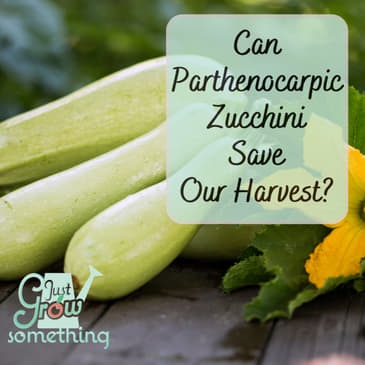
If you're in the U.S. Midwest, squash bugs and squash vine borers often keep you from getting your best zucchini harvest. But what if there were a variety of zucchini you could keep covered the whole time you were growing it so the pests couldn't get to it? And it would fruit without pollination? Today we explore the possibility of parthenocarpy in zucchini varieties, where to find them, and how they can thwart our biggest zucchini pests.
EPISODE RESOURCES:
Dunja - Organic (F1) Zucchini Squash Seed | Johnny's Selected Seeds (johnnyseeds.com)
Golden Glory - (F1) Zucchini Squash Seed | Johnny's Selected Seeds (johnnyseeds.com)
Noche - (F1) Zucchini Squash Seed | Johnny's Selected Seeds (johnnyseeds.com)
Give Parthenocarpic Squash a Try Next Year | Home & Garden Information Center (clemson.edu)
--- Send in a voice message: https://podcasters.spotify.com/pod/show/justgrowsomething/message
Karin Velez [00:00:00]:
Welcome back my gardening friends to another focal point Friday episode. Let's spend just a few minutes together reviewing a snippet of information from a previous episode highlighting a new topic or quickly focusing on a current event in the food and agriculture world. Let's get down and dirty. So I was running a half marathon last weekend, and I ran into my running friend, Kris. Kris is also a gardening friend, and inevitably, she yelled at me, hey. Hey. I have a gardening question, which is usually the way it works out when Kris and I are at the same running event. We start out talking gardening before we do anything running related.
Karin Velez [00:00:37]:
And what Kris was asking about was when would be a good time to go ahead and start her zucchini plant? See here in West Central Missouri, you've heard me talk about it before. Our major pests of squash are the squash vine borer and the squash bug and the cucumber beetle, mainly those first two. And I think I remember Kris saying that she had sworn off even bothering to grow any zucchini this year because she had such a problem with those 2 pests last season. But I guess she changed her mind and decided that she was gonna try to do a late planting to try to avoid some of these pests. And so she was asking me about when would be a good time to start. And I told her, you know, the squash vine borer, usually, it is rearing its head now right around the beginning of June when most of the zucchini flowers are starting to appear. And they generally are gone by about mid July. So if you put your seeds in the ground around mid July, and they start to sprout and you keep them covered, then hopefully, you will avoid the squash vine borer.
Karin Velez [00:01:39]:
Of course, then she asked me about the squash bugs, and I had to tell her the bad news that the squash bugs are always around. They have multiple life cycles throughout one season, so it really is all about Keeping them covered until the last possible minute, uncovering the plants once they need to be pollinated, and then being vigilant about removing the eggs. and the adults and any of the larvae that you see to just try to keep the plants clean. And you can also do a succession planting as well even if you're planting later on in the season. So when I got home, I went into my greenhouse, and I was caring for the cucumber plants that I have in the greenhouse this year. I have chosen to do a greenhouse variety in the very small center area of my greenhouse as a specialty cucumber. And the reason they're in the greenhouse is because these are gynoceous and parthenocarpic. So gynoceous meaning that they produce nothing but female flowers.
Karin Velez [00:02:32]:
And parthenocarpic, meaning that they will produce fruit without pollination. So this means that these cucumbers are going to be practically seedless. Now if they were to be cross pollinated with something out in the gardens, then they would end up with seeds, and it would likely change the texture. These are supposed to be very tender sort of long Asian type cucumbers, and there's something new that I wanted to try. So I'm growing them in the greenhouse, keep them separate from everything. And since they're parthenocarpic, I don't have to worry about the pollinators. Which got me to thinking, why am I not doing this with zucchini? If I was growing a parthenocarpic squash variety, I could put it out in the field, and I could cover it with the insect netting like I am right now, but I wouldn't have to remove that insect netting once those plants started to flour I could keep them covered, essentially protecting them the entire season other than the times that I have to open it to weed or to harvest. So believe me when I said, I went down a rabbit hole trying to find parthenocarpic squash varieties.
Karin Velez [00:03:43]:
I know I had remembered seeing them. And as I went to do my searches, I found a couple of articles that listed several varieties. But every single place that I went to try to find these varieties, including Johnny's, which is one of my go to seed companies, said that This particular variety, which is called Parthenon, had been or Partenon, I guess, had been discontinued. And then all of the other varieties that I could find were either only offered, like, in the UK, maybe out of Ukraine. So, hey, for my Ukraine listeners, you guys have available, I guess, to you some parthenocarpic zucchinis that we can't get, or they just didn't exist anymore. It was very, very bizarre to me. So I did find one of the varieties that was listed was a burpee variety called Sure Thing. And in the description on the Burby website, it does not say that specifically that it is parthenocarpet.
Karin Velez [00:04:42]:
It does say that it will bear fruit in cool cloudy conditions even when there are no bees or male flowers around. So to me, that reads as parthenocarpic. Right? If you're pollinating with no bees and no male flowers, then obviously, then you are self fruiting, and you are able to produce. So the price point on these kind of matches something like that, like a a high end hybrid. I mean, the seeds themselves on the burpee site were, like, 650 or something like that for 25 seeds. And then, of course, with the shipping, it end up being close to $10. And I ended up getting them off of Amazon because I was ordering something else. And so I threw it in with my with my order, but it was still close to $10 for this pack of 25 seeds.
Karin Velez [00:05:31]:
But did I order it? You betcha. I'm gonna I'm gonna try this out. I wanna see if we can do this. And if this is truly a parthenocarpic variety, then I should be able to produce these fruits with out having to worry about pollination, which means I can keep them covered completely. So I will link to where I found these in the show notes. But then as I was continuing to look through, I was looking through the Johnny's website, and I thought, okay. Well, what other zucchini squashes do they offer that is specific to greenhouse growing? Because to my way of thinking, well, they should all be pretty close a parthenocarpic if you're growing them in the greenhouse. Otherwise, you're relying on at least very, very low pollinator activity, if not hand pollination.
Karin Velez [00:06:18]:
But, again, none of the varieties said anything about being parthenocarpic. There were 2 other varieties that were listed in and around that partanon variety that has been discontinued. One of them was called desert, and the other was called Dunja. Well, I already have Dunja. I haven't planted that one yet. It actually is my next succession planting. And it is indicated for greenhouse growing or for tunnel production, and it says it sets fruit well with minimal pollinator activity. But to me, that says it still requires a pollinator.
Karin Velez [00:06:52]:
So I went ahead and ordered the little slightly more expensive burpees seeds to see what's gonna happen. And as I was continuing to do a little bit more research, I happened to cross an article from September of 2021 on the Clemson Cooperative Extension website, and it specifically says give Parthenocarpic squash a try next year. I thought, okay. Cool. They've got to have some more information. And lo and behold, as I am scrolling through this article, which I will also link to in the show notes, here, there are pictures of the vine borer larvae and its damage and what happens there. And pickleworm moths showing up And here, the author of the article is using the same type of insect netting that I am going to be using or that I already am using over top of their zucchinis. So this is something that this author has done.
Karin Velez [00:07:53]:
This is a horticultural extension agent out of York County. And as I scroll to the bottom, I see the 3 different varieties that this gentleman used were Golden Glory, which is a golden zucchini, which I happen to already have seeds of. Nocha, which is a dark green one, and lo and behold, Dunja. And so I'm hoping that if I also plant the Dunja, as a, I guess, self fertile variety and the Golden Glory as well that I may not have to worry about taking these covers off. So we are gonna have multiple experiments going on around here. I am gonna plant all three of these varieties, the one that I ordered from Burpees, which is the shore thing hybrid. I am also going to do the dunja and the golden glory. All three of those And I'm gonna do a couple of side by sides.
Karin Velez [00:08:48]:
I'm gonna grow some of them completely covered, and I'm gonna have them remain covered. at least for the time being, you'll very quickly be able to know whether or not a zucchini has been pollinated and whether or not it is viable or not. So when you're growing zucchinis, you you usually have plenty of male flowers that will start to open up burst, and then you'll have the female flower. And, usually, your male flowers will outperform your females. You'll have more of the male flowers. And this is kind of intentional on the part of the plant because it really wants to make sure that those female flowers get pollinated. Well, the female flowers already have a fruit at the base of the flower. It's just that that fruit won't be viable unless it gets pollinated.
Karin Velez [00:09:32]:
So you'll see the fruits on the base of the the female flowers and they will start to grow. But very quickly, if they haven't been pollinated, they are going to shrivel up and they're gonna fall off the plant. If they have been pollinated, they will continue to grow brutally. So in a parthenocarpic variety or one of these varieties that supposedly does not need much pollinator activity, I will very quickly be able to tell after these plants have started to to flower into fruit whether or not they are sort of self fertile. So and I'll also be able to see exactly what the difference is as far as the level of male flowers to female flowers. So I will do some side by sides and figure out whether or not this is actually a viable thing to do with all of these different varieties. Again, none of them are specifically listed. as parthenocarpic.
Karin Velez [00:10:21]:
But I am gonna roll the dice and see what happens. So I will report back to you and let you know if maybe possibly, we might have come up with a little bit of a protective measure, and it doesn't have to be in a necessarily squash vine bores or cucumber build whatever it is that you are dealing with. Again, pickle worm and those types of things. Whatever you're dealing within your squash, If we can find some varieties that are really good at producing fruit without pollinators, then we'll be able to keep them covered and keep them protected, and we might actually get a squash yield with a little bit less stress. So, Kris, if you're listening, click that link. order yourself some seeds. And if you're not listening, well, I guess I'll talk to you about it at the next race. Happy gardening.
Karin Velez [00:11:07]:
Thanks for joining me on this vocal point Friday. I'll be back again on Tuesday for another regular episode of the Just Grow Something podcast. So until next time, my gardening friends, keep on cultivating that dream garden and we'll talk again soon.