
Studies have shown that foods higher in protein and fiber are more satiating – they make us feel fuller longer regardless of the energy density of the food. In other words, higher calories don’t necessarily mean we feel full. This is often cited in terms of dieting. For example, celery was a popular food in 70s and 80s diet culture because it made you feel full while carrying very few calories. If you’re trying to cut calories in order to lose weight, that might be a good thing. Some fruits and vegetables have a very low energy density. Those foods are a challenge to overeat, especially if you’re not adding fattening dressings or dips to them.
 But, what about nutritional density? What if what we’re eating makes us feel fuller not just because of the level of fiber or protein, but because our body has gotten the nutrition it needs regardless of the calories? There is a difference between the terms, satiation and satiety.
Satiation occurs when we feel full immediately after eating and we don’t want to eat anything else at the moment. Satiety is a longer-term phenomenon that occurs when we obtain enough of the all the essential nutrients like the vitamins, minerals, amino acids, and fatty acids that our body’s need. When we experience satiety, we don’t get the chemical hunger cues for food for a longer period of time. Our body has what it needs. And the level of satiety goes up based a lot on the amino acids we consume, nutrients like potassium and phosphorous and calcium, and vitamins like folate and niacin.
This is why we can eat a sugary, yummy donut and feel satiated for a little while but start feeling hungry again much more quickly than if we had had a baked potato. A plain baked potato is about 160 calories. The calories come from carbs and some protein, but also lots of vitamin C, potassium, magnesium, iron, and calcium. You can add a little butter and sour cream to up the calories to about 260 and then you’ve got more calcium and more fat, some more carbs and protein and a little sugar. Compare that to a standard glazed donut that also has 260 calories, but is comprised of mainly fat and carbs and has very little nutrition – a little bit of fiber and protein, plenty of sugar, some sodium, and that is about it. So, same calorie count, but which one keeps us feeling fuller for longer? The baked potato. And that has to do with nutrient density.
Now, obviously, that’s not a fair comparison but it’s a great example of how the nutritional content of what we eat makes a difference in how full we feel.
So, if your goal is to either decrease the family food budget or increase the nutritional content of your foods, or both, then choosing the right vegetables to grow may be your starting point for deciding what to plant.
Because the problem doesn’t just stop at the foods we’re eating. How the nutrition of that fruit or vegetable holds up before it gets to the grocery store is one more piece to the puzzle.
There can be a significant amount of time between when a fruit or vegetable is harvested to when it reaches the grocery store shelves and, ultimately, your plate. During that time, that produce can experience some significant nutrient degradation. This depends on the item and the way it’s handled post-harvest and some definitely degrade much more quickly than others.
According to a report by U.C. Davis, here in the U.S. fruits and vegetables grown in North America may spend up to 5 days in transit following harvest before finally arriving at a distribution center. Transportation time for fruits and vegetables grown in the southern hemisphere for consumption in the U.S. ranges from as little as a few days if transported by air freight to several weeks if sent by refrigerated ship. Yes, several weeks. Once they get to the store, those fruits and vegetables may spend 1–3 days on display prior to being purchased by us, and then we may store them for up to a week prior to actually consuming them. That is a significant length of time from harvest to plate.
And a lot of that nutrient degradation is specific to those micronutrients we were talking about, things like vitamins C, B-6, A, and E, thiamine, riboflavin, niacin, etc. Let’s take that first one, vitamin C, as an example. Vitamin C losses in vegetables stored at 39F (4°C) for 7 days range from 15% loss in peas to 75% loss in spinach and 77% loss in green beans. The colder the produce is kept, the slower the losses, which is why most produce is shipped at temperatures around 32F (0C). But, that temperature ends as soon as it gets to the store shelves and then moves into most home refrigerators.
So, which fruits and vegetables lose their nutrients the fastest? Which ones should we try to grow ourselves if they’re in our diet in order to preserve those nutrients?
In order to create this list I dug through all kinds of sources, reviewed the initial nutrient density of the fruit or vegetable, the resulting loss of several different nutrients due to fresh storage, and the conditions under which those items were stored. This list is not at all comprehensive because certain fruits and veggies degrade differently, so I looked at the overall number of nutrients that were lost and did the best I could in terms of the information available. (References are listed below if you’d like to read the raw data yourself).
These are in no particular order with the exception of number one:
- Spinach. No matter which source I looked at spinach seemed to lose so many of it’s nutrients very quickly when not stored at exactly the freezing point and the losses seem to start almost immediately. I mean if we just look at vitamin C, within a day of being harvested and held just slightly above freezing spinach lost 64% of its vitamin C. That’s insane. It also shows significant losses in thiamine and riboflavin and all kinds of other micronutrients. So, I put spinach at the top of my list of veggies you want to grow yourself to get more intact nutritional content.
- Berries. Berries, in general, have a short shelf life as it is and they are often harvested just barely ripe – ripe enough to look good but not to really taste like much because they need to be shipped and still make it to the store shelves looking good. And that short shelf life also means short lifespan for the nutrients in the berries.
- Green Beans. Green beans lose a lot of nutrients if not kept very cold and consumed pretty quickly. We’re especially talking vitamin C along with the B vitamins.
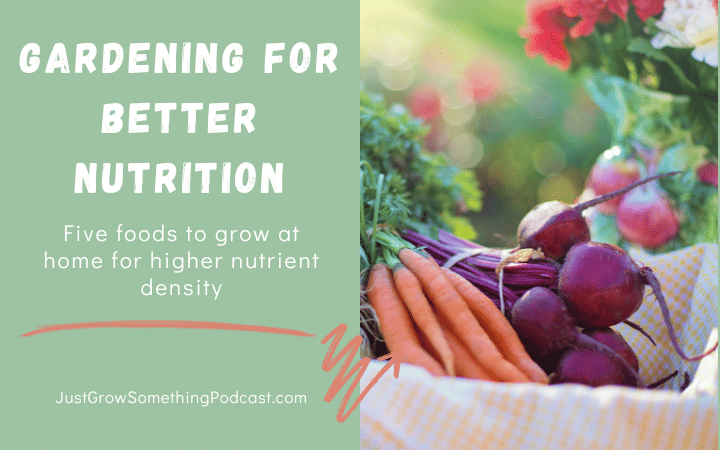
- Carrots. Carrots in the store tend to have been in storage for an extended time before getting to you because they’re what’s considered “good keepers” when it comes to commercial sales, meaning they can be stored for a long time and still look good and be crisp in texture. That also means they’ve been losing nutrients that whole, so I’d opt for homegrown if you can swing it.
- Summer squash. The thing about zucchini and yellow squash and other summer squashes is that they are transported and stored at higher temperatures, usually around 50F, because they have a high sensitivity to chilling injury. You’ll see pitting on the surface, sunken lesions, and some dehydrating on the ends if they’re exposed to lower temperatures for too long in transit and storage which makes the fruits less than attractive and unable to be sold. Which also means the nutrients are degrading more quickly than if they were able to be stored at a colder temperature.
There are lots of other fruits veggies out there that can start to degrade pretty quickly after harvest, like asparagus and cucumbers and sweet corn. And they all have their specific nutrients they are high in, but I didn’t include those in the list, because they don’t have as much of a well-rounded nutritional profile to begin with as the others. It doesn’t mean you shouldn’t grow them if you have the space because you’ll definitely get a better quality product and the nutrients they do have will be much more intact than if you get them from the store. But the ones I mentioned in the list have a higher level of nutrients across the board and were the most volatile in terms of nutrient loss, so that’s why they were my top five.
If you do grow these at home, what do you do to keep those nutrients intact until you get to eat them?
The big thing about growing these at home is you can harvest as you need them. If you can plan succession plantings where you don’t need to harvest everything all at once, you can harvest what you need when you need it and bring them into the kitchen just before you plan to eat. That is the most nutritionally dense food you can possibly eat.
Next, we know how each one should be cleaned and stored properly. Harvesting and storing at the right temperature will keep the nutrients from degrading before you get a chance to eat them.
Finally, know that in terms of preserving nutrients, frozen fruits and vegetables retain more of their nutrients than anything we can. Just the sheer act of canning any fruit or vegetable is going to degrade the nutrients more than freezing them at their peak.
What it boils down to is do the best you can. If you can’t manage to grow any of the things that were on this list, look at getting them directly from a farmer at the farmers market. In most cases, that item has been harvested within the previous 24 hours and sometimes within just a few hours of you buying them. Barring that, look at buying them frozen in the store if you and your family will eat them that way. The nutrients are going to be more preserved than if you buy the fresh version that has been shipped and stored, rather than flash frozen within hours of being harvested. It’s all about making the best choices we possibly can.
Your Friend in the Garden,

Resources:
Optimising foods for satiety - ScienceDirect
Maximizing the Nutritional Value of Fruits and Vegetables (ucdavis.edu)
Harvesting and storing home garden vegetables | UMN Extension